Montana Real Estate Broker · 2026 版
Montana Real Estate Broker Exam Study Guide (2026)
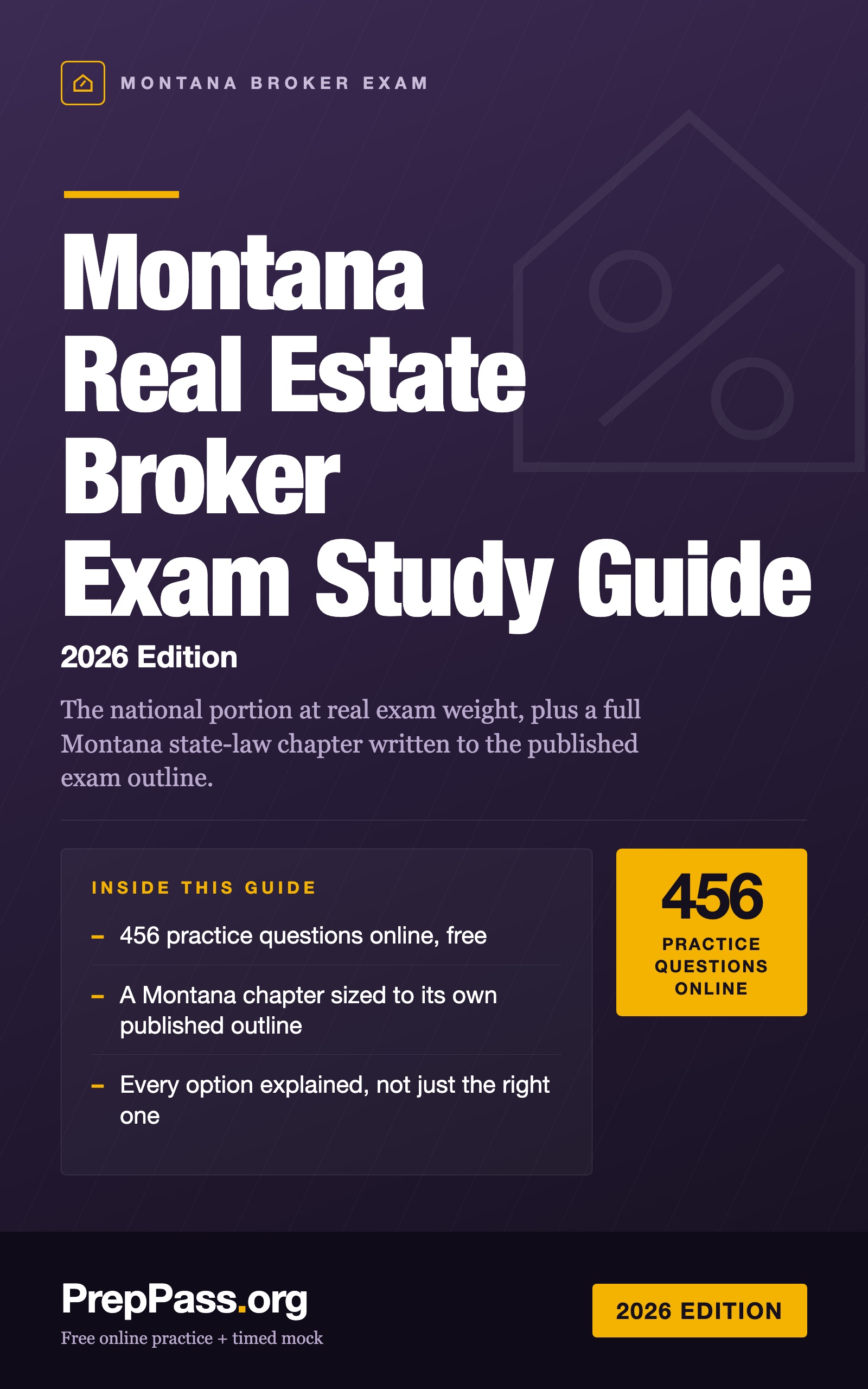
The national portion at real exam weight, plus a Montana chapter. The Montana chapter is sized to the published outline — 5 areas, 40 scored items — area by area, not flattened.
- 全国通用部分 8 章,外加一整章蒙大拿房地产法 —— PDF + EPUB 永久保存
- 一套 60 题的全国部分模拟考,答案键逐一解释四个选项,而不只是正确的那个
- 另有 20 道蒙大拿房地产法题目,并附完整解析答案键
先做 10 题,看看讲解 —— 免费
先答完这 10 题,交卷后每题都有解析 —— 还会指出本指南里讲这一点的那一节。约 5 分钟,无需注册。
开始 10 道免费题翻开这本书看看
三页真实内页,直接从你将下载的 PDF 渲染而来 —— 一页讲解、一道带解析的例题、一页速查。没有任何一页是为了好看而重画的。
- 速查页Part C — Encumbrances a broker must read off a title report · PDF 第 102 页
一页可以随时翻回来的内容:把数字、期限或术语集中在一处。
- 一道题的完整解析Answer Key and Explanations · PDF 第 174 页
一道练习题,连同答案和背后的推理 —— 不只是一个答案键。
- 怎么讲Answer key · PDF 第 304 页
讲解页:用文字把知识讲清楚,顺序与考试考查的顺序一致。
包含什么,不包含什么
包含
- A Montana chapter written to the published exam outline, area by area
- Where Montana law departs from the national rule — both stated, so neither is guessed
- Supervision, trust accounts, brokerage operation and broker math
- A Montana practice set with every option explained, not just the right one
- 456 practice questions online, free, from the same bank
- PDF (print & tab it) + EPUB (phone / e-reader)
不包含
- 不寄送纸质书 —— 这是一份你下载后可自行打印的文件
- 购书不含视频课程、讲师或一对一辅导 —— 站上的免费视频是另一回事
- 不含考试报名费与考点费用,这些仍需向官方机构缴纳
目录
查看 30 章及各章起始页
- Part C — Advertising and recordkeeping compliance第 14 页
- Part D — Consumer contact and transaction integrity第 16 页
- 2. Trust Funds, Escrow, and the Client’s Money第 30 页
- Part C — Records that survive an audit第 33 页
- Part D — Disputed money第 34 页
- 3. Agency at the Broker Level第 40 页
- Part C — Fiduciary duties, at the level a broker is examined on第 44 页
- Part D — Dual agency, designated agency, and the alternatives第 46 页
- 4. Contracts and Brokerage Agreements第 55 页
- Part C — Options, rights of first refusal, and installment contracts第 60 页
- Part D — Between contract and closing第 61 页
- 5. Fair Housing, Accessibility, and Antitrust: The Exposure You Carry Personally第 72 页
- Part C — The exemptions, and why they rarely save anyone第 78 页
- Part D — Disability: the distinction the exam always tests第 79 页
- 6. Ownership, Land Use Controls, and Transfer of Title第 95 页
- Part C — Encumbrances a broker must read off a title report第 101 页
- Part D — Legal descriptions第 103 页
- 7. Valuation, Financing, and the Federal Lending Laws第 113 页
- Part C — The instruments第 121 页
- Part D — Loan programs, structures, and qualifying第 123 页
- 8. Disclosures, Environmental Risk, and Property Management第 136 页
- Part C — The management agreement and the manager’s authority第 142 页
- Part D — Leases and tenancies第 144 页
- Practice Exam — 60 Questions第 153 页
- Answer Key and Explanations第 170 页
- Appendix A — Broker Math Cheat Sheet第 221 页
- Appendix B — Glossary第 243 页
- Appendix C — Exam-Day Strategy第 262 页
- Part II — Montana State Law & Practice第 267 页
- Answer key第 301 页
取自你将下载的那份 PDF,并标明各章起始页 —— 不是在此手工录入的。
免费读完整一章
完整的一章,与电子书正文一字不差。直接在此窗口滚动阅读;无需下载,无需邮箱。
在本页直接阅读第 9 章
我们没有拿轻松的绪论充数 —— 免费章节直接翻到书里最见功力的部分,让你在考试真正难的地方检验这本书讲得好不好。
What the Montana portion actually is
The Montana broker examination is delivered by Pearson VUE, and the state content outline is printed on page 10 of Pearson VUE publication #092701.
| Scored items | Pretest items | Time | |
|---|---|---|---|
| National/general (broker) | 80 | 5 | 150 minutes |
| Montana state | 40 | 5–10 | 90 minutes |
The vendor's own sentence reads: "The state-specific examination is made up of forty (40) scored items for salesperson and broker candidates. The examinations also contain five to ten (5–10) pretest items. The pretest items are not identified and will not affect a candidate's score in any way."
The date almost everybody gets wrong
The Montana state outline is effective January 1, 2025. Not April.
You will see April 1, 2025 quoted for Montana constantly, and 04/2025 too. Both figures are in the document; neither is the Montana date. Publication #092701 bundles three outlines. The two national/general outlines — one for salespersons, one for brokers — are each headed "Effective: April 1, 2025." The Montana page is headed "Effective: January 1, 2025." And 04/2025 is the publication stamp in the footer, printed as "#092701 | 04/2025" — a printing date, not a legal effective date.
It is worth thirty seconds to check for yourself, because it tells you something about the guide you are holding. Any Montana study material that dates the state outline to April copied a heading off the wrong page — which means it did not read the Montana page, the only page that concerns you.
Read the broker column, not the salesperson column
The Montana outline is unusual in that every area heading prints both tracks at once: "SALESPERSONS: 3 ITEMS, BROKERS: 2 ITEMS," and so on. A candidate skimming picks up whichever number the eye lands on first, and a guide writer skimming does the same. Here is how to know which column is yours. Only the broker figures sum to 40 alongside Area V, which is marked BROKERS ONLY:
| # | Area | Broker items | Share | Salesperson items |
|---|---|---|---|---|
| I | The Real Estate Licensing Agency's Powers | 2 | 5% | 3 |
| II | Licensing | 2 | 5% | 3 |
| III | Requirements Governing the Activities of Licensees | 26 | 65% | 28 |
| IV | Additional Topics | 4 | 10% | 6 |
| V | Additional Broker Topics (BROKERS ONLY) | 6 | 15% | — |
| Total | 40 | 100% | 40 |
2 + 2 + 26 + 4 + 6 = 40 with Area V. 3 + 3 + 28 + 6 = 40 without it. Both columns are internally consistent; they are two different exams sharing one page. Read down the second number in every heading and pick up Area V, which the salesperson never sees.
What Area III's 65 percent means for how you study
Area III is 26 of 40 items — more than the other four areas combined, doubled. Answer everything in Areas I, II, IV and V correctly and everything in Area III incorrectly and you score 35 percent.
This chapter is built to that shape: Area III gets roughly 65 percent of the teaching text and thirteen of the twenty printed practice questions, while Areas I and II get about three hundred words each because they are worth two items each. That will feel thin if you have read other state guides, which typically open with several thousand words on the composition of the licensing board. Montana's board composition is not on the Montana outline.
The vendor's reference list, and one typo in it
Montana is better than most states here: publication #092701 page 11 prints an actual reference list, headed "Montana State Exam Resources." It names ARM Title 24 chapters 101, 209 and 210; MCA Title 2 chapter 15 part 17; MCA Title 37 chapters 51, 1 and 56; MCA chapters 70-24, 70-25 and 70-26; and the board's regulations page. Every entry was checked against mca.legmt.gov (MCA 2025) during the rebuild of this chapter and every one is current. Two defects in the printed list are worth knowing so they do not confuse you:
- "Title 24, Chapter 209 - Property Management Licensure***" carries a triple-asterisk footnote marker. There is no footnote — the marker appears nowhere else in the eleven-page document. The chapter is real and new: property-manager rules moved into ARM chapter 24.209 in late 2023.
- The last statute line is printed truncated as "Chapter 70-26 - Residential and Commercial." The chapter's actual title is Landlord and Tenant — Residential and Commercial; the vendor's line is cut off mid-title in the PDF.
And Area IV subtopic F is printed as "Statue of frauds." That is a typo in the vendor's document for Statute of frauds. We print the correction because a candidate who searches the PDF for "Statute" will find nothing under Area IV and may conclude the topic is not tested. It is tested; the vendor misspelled it.
One thing the outline does not publish is a pass mark, and neither it nor our record of it carries one. We will not invent a number a candidate can be failed by: check the current Montana candidate handbook, or the board, for the passing score in force on your test date.
Finally, the vendor's list names chapters, not sections. Every specific MCA section and ARM rule number in this chapter is ours, read out of the current code and rules. Do not attribute them to Pearson VUE.
One structural fact that shapes the broker outline
Montana licenses property managers separately, under Title 37, chapter 56 MCA; the old home of property-manager licensure, Title 37, chapter 51, part 6, was repealed by Sec. 17, Ch. 482, L. 2023. But the separate credential does not fence brokers out. 37-56-104(2) says: "A broker or salesperson licensed under Title 37, chapter 51, may act as a property manager. A salesperson may not act as a property manager without a supervising broker."
That is why the broker outline assumes property-management authority rather than excluding it, and why property management surfaces inside the licensee-conduct rules rather than as its own area. 37-51-313(9) provides that while managing properties for owners a licensee "is only required to meet the requirements of 37-56-105 through 37-56-107, other than those requirements for the licensing of property managers," plus the department's property-manager rules. 37-51-314(8) requires a licensee managing properties to disclose the contractual relationship to all customers and clients, and 37-51-314(9) adds that a licensee acting only as a property manager owes no other relationship disclosure. Managing brokers disclose the contract, not the agency.
Area I — The Real Estate Licensing Agency's Powers (2 items, 5%)
Two items. Three lettered subtopics: investigations, hearings and appeals; sanctions, split into disciplinary actions and penalties; and examination of records. Most of the machinery sits in Title 37, chapter 1 MCA, which governs every licensing board in the state, not in the real estate chapter.
A. Investigations, hearings and appeals. Anyone may file a written complaint with the department (37-1-308(1)), which may investigate for reasonable cause with a screening panel member's concurrence (37-1-308(2)(a)). If reasonable cause is found, department legal staff serve a notice (37-1-309(1)), and the licensee has 21 days after receipt to request a hearing in writing; failing to do so is a default and the board may decide on the facts available (37-1-309(2)). Hearings run under Title 2, chapter 4, and a person disciplined or denied a license may appeal to district court (37-1-313(1)). A member who sat on the screening panel may not sit on the hearing (37-1-307(2)).
B. Sanctions and penalties. On a finding of unprofessional conduct the board may combine any of the sanctions in 37-1-312(1): revocation; suspension; probation not to exceed 3 years; restriction of practice; remedial education; a fine not to exceed $5,000 for each violation, deposited in the general fund; censure; refund of costs and fees collected from a consumer. Trust-account failures carry their own, much smaller, civil penalty: $50 for each cited violation under 37-51-324(3), with 5 business days from issuance to pay or dispute (37-51-324(5)).
The trap. Those two money figures get swapped. $5,000 per violation is the board's disciplinary ceiling; $50 per cited violation is the trust-account citation. They come from different sections, follow different procedures, and one is not a scaled version of the other.
C. Examination of records. Trust account records must be maintained "to facilitate auditing" (ARM 24.210.427(8)); records and transaction documents are kept eight years (ARM 24.210.414); and a supervising broker's written office policy must "be available for inspection, upon request, by any authorized representative of the board" (ARM 24.210.605(1)(a)(ii)). Stonewalling is itself an offense: failing to respond to a board request is unprofessional conduct under ARM 24.210.641(1)(hh).
Area II — Licensing (2 items, 5%)
Two items, three subtopics: activities requiring a license; license renewal; change in license status or information.
A. Activities requiring a license. It is unlawful to act as, or advertise as, a broker or salesperson without a license (37-51-301(1)), and a single act within the statutory definitions is enough to constitute engaging in the business (37-51-301(4)(b)). Montana licenses individuals only: 37-51-301(3) bars licensing corporations, partnerships and associations, though such an entity may act as a licensee if every officer or partner performing licensee functions is licensed. Supervising salespersons takes an active Montana broker's license plus a supervising broker endorsement (37-51-301(2)). Exemptions in 37-51-103 cover owners and lessors dealing in their own property, attorneys at law, court-appointed appraisers, receivers, trustees, executors, public officials, hydrocarbon and hard-mineral dealings, and property managers licensed under 37-56-105.
B. Renewal, lapse, expiration, termination. Montana draws a line most states do not. A lapsed license may be reactivated within 45 days after the renewal date, and 37-1-141(6)(a) says a licensee who practices with a lapsed license "is not considered to be practicing without a license." Past 45 days it is expired, and 37-1-141(6)(b) is blunt: "A licensee who practices after a license has expired is considered to be practicing without a license." An expired license may be reactivated within 2 years (37-1-141(4)); one not renewed within 2 years of the most recent renewal date automatically terminates (37-1-141(8)). The board keeps disciplinary jurisdiction for 2 years after the lapse (37-1-141(9)). Continuing education is 12 hours every licensing year between November 1 and October 31 (ARM 24.210.667(1)), plus four hours a year of supervising broker education to keep that endorsement (ARM 24.210.604(3)).
C. Change in status or information. A broker who moves notifies the department before removal or within 10 days after it (37-51-308(3)). A salesperson changing supervising brokers notifies the department promptly in writing, the successor broker notifies the department of acceptance, and the salesperson "may not directly or indirectly work for or with a supervising broker until the salesperson has been issued a license to work for or with that supervising broker" (37-51-309(2)). Leaving without a successor puts the license on inactive status automatically and at no fee (37-51-309(3)). Termination by the supervising broker "is not effective under this subsection until the supervising broker has notified both the salesperson and the board" (37-51-309(4)).
Area III — Requirements Governing the Activities of Licensees (26 items, 65%)
This is the exam. Twenty-six of forty items. Thirteen lettered subtopics: advertising and marketing; the broker/salesperson relationship; unprofessional conduct; compensation; disclosure, itself split into conflict of interest, property disclosure and agency disclosure; agency duties and responsibilities; handling of documents; handling of monies; listings and buyer brokerage agreements; and illegal inducements and ethics. The sources are 37-51-102, -103, -105, -306, -309, -313, -314, -321 and -401 MCA, together with ARM 24.210.428 and the board's long unprofessional-conduct rule, ARM 24.210.641.
A. Advertising and marketing
The listing must exist before the advertisement does. 37-51-321(2)(a): "It is unlawful for a broker or salesperson to openly advertise property belonging to others, whether by means of printed material, radio, television, or display or by other means, unless the broker or salesperson has a signed listing agreement from the owner of the property. The listing agreement must be valid as of the date of advertisement."
Two words do the work. Signed — an owner's verbal go-ahead is not a signed listing agreement, however sincere. And valid as of the date of advertisement — a listing that expired last Tuesday will not support an advertisement running this Tuesday, which makes expired-listing marketing an enforcement risk in Montana rather than a taste question.
What has to be in the advertisement, under ARM 24.210.428(1) — the advertising rule adopted effective 23 August 2025: a truthful, accurate and detailed description of the real property or service; the licensee's name; and a statement that the advertisement is made by the licensee or a brokerage company. In an internet advertisement, "a link to this information may be used."
The trap. Candidates reach for the license number or the board's telephone number, because several states require one or the other. Montana requires neither — a name and an admission that a licensee placed the ad. Nor does the rule require a street address: subsection (1)(a) asks for a description.
Franchise branding has its own clause. Under 37-51-321(1)(a), a broker operating under a franchise agreement "engages in misleading, untruthful, or inaccurate advertising if in using the franchise name, the broker does not incorporate the broker's own name or the trade name, if any, by which the office is known in the franchise name or logotype." The same subsection bars the board from adopting advertising standards more stringent than the ones in it — a limit on the regulator that is easy to miss.
Another firm's listings. Subsection (2)(b)(i) permits including cooperating brokers' listings in materials dispensed to prospective customers, and ARM 24.210.428(3) permits internet advertising of another firm's listings where both the listing agent and the owner have consented.
B. Broker/salesperson relationship
One supervising broker at a time. 37-51-309(1): "A salesperson may not be associated with, be under contract to, or perform services for more than one supervising broker, except on a temporary basis as provided in 37-51-302." And 37-51-309(5): "Only one license issued to a salesperson is in effect at one time."
The temporary exception is procedural, not a second job. Under ARM 24.210.607(2) — the salesperson-supervision rule effective 21 February 2026 — a supervising broker may temporarily transfer supervision by written notice naming the salesperson, the effective and termination dates, and the temporary broker's acceptance of responsibility. A copy goes to the board within three business days after the transfer begins, and a temporary transfer "may not exceed 60 days in any 12-month period unless extended by the board for good cause."
The trap. Two brokers agreeing in writing that a salesperson may work for both does not create a second association; nothing in 37-51-309 makes the brokers' consent the operative act. Geography is irrelevant too — a second brokerage in a different county is still a second brokerage.
The supervising broker validates the listing. ARM 24.210.607(3): "A listing agreement negotiated by a salesperson is not valid until it is reviewed, signed, and dated by the supervising broker." Notice what that makes the supervising broker's signature — not a formality but a condition of validity. When the board adopted the new rule, commenters asked it to extend the requirement to buyer broker agreements too; the board declined for now and carried subsection (3) forward verbatim.
And the salesperson's own deals sit outside the firm. 37-51-309(6) permits for-sale-by-owner personal transactions and relieves the supervising broker and firm of responsibility — but (6)(c) requires the salesperson, before entering one, to disclose in writing to the other party that it "does not involve the salesperson's supervising broker or real estate firm."
C. Unprofessional conduct
37-51-321(1) lists twenty-four practices, lettered (a) through (x), "in addition to the provisions of 37-1-316 and as provided in board rule." Three lists apply to a Montana licensee at once: the statute's twenty-four, the general list at 37-1-316, and the board's rule ARM 24.210.641, which runs past subsection (1)(pp).
The clauses that recur on examinations:
- (b) making false promises "of a character likely to influence, persuade, or induce";
- (d) use of the term "realtor" by a person not authorized, or use of another trade name or insignia of a real estate organization the licensee does not belong to;
- (e) failing to account for or to remit money belonging to others;
- (f) an undisclosed commission, rebate or profit on expenditures made for a principal;
- (g) acting as broker and undisclosed principal, "including failing to disclose in advertisements for real property the person's dual capacity as broker and principal";
- (h) guaranteeing future resale profits;
- (m) conducting lotteries to influence purchasers;
- (o) failing voluntarily to furnish a copy of a written instrument at the time of execution;
- (r) a salesperson failing to place deposit money in the supervising broker's custody;
- (u) and (v), on property management: failing to meet 37-56-105 through -107 while managing properties, and failing to disclose the contractual relationship to owners and tenants; and (w) failing to maintain continuous professional liability coverage.
The trap on "realtor." Candidates treat it as a trademark dispute outside the board's business. Montana's statute makes it a licensing offense, sanctionable under 37-1-312 in addition to any private remedy. Disclosure does not cure it either — the prohibition is on the use of the term by an unauthorized person, not on the impression it leaves.
Board rule adds the clauses candidates find hardest, because they name conduct that feels helpful:
- ARM 24.210.641(1)(h) — falsifying documents, placing a party's signature on one, or altering one on a party's behalf "without authority of a written power of attorney from the party";
- (1)(i) — advising that an offer or counteroffer has been accepted "without the licensee having in the licensee's possession a document signed by the party evidencing the party's acceptance";
- (1)(e) — recommending an attorney, title company, appraiser, escrow agent or maintenance service without disclosing any family or financial relationship or interest;
- (1)(l) — failing to document agreements in writing and obtain the parties' signatures, including any change to terms between execution of the buy-sell and closing;
- (1)(bb) — lotteries, raffles and contests to influence purchasers;
- (1)(ll) — acting as a dual agent in a transaction in which the licensee is a principal;
- (1)(pp) — submitting a competing offer as a principal against the licensee's own client;
- (1)(uu) — "failing as a supervising broker to adequately supervise his or her salespeople."
购买前
- 怎么拿到?
- 付款后下载入口立即出现在本页,链接同时发到你的邮箱。无需注册账号。
- 不合适怎么办?
- 14 天内发邮件即可全额退款,无需理由。
- 免费练习会取消吗?
- 不会。站上的每一道练习题、计时模考和免费章节都继续免费。这本书是「学」的那一半,不是把免费部分围起来的门。
- 能在手机上看吗?
- 可以 —— EPUB 适合手机和电子书阅读器,PDF 适合打印和贴标签,两种都给你。
详细信息
The national portion at real exam weight, plus a Montana chapter. The Montana chapter is sized to the published outline — 5 areas, 40 scored items — area by area, not flattened.
- Format: PDF + EPUB download · 308 pages
- 80 practice questions in the book, with a full answer key
- 456 free practice questions for this exam on PrepPass, included at no cost
- $14.99 one-time — no subscription
- 14-day money-back guarantee · refund policy
- Cross-referenced against: MCA 37-1-141 · MCA 37-1-307 to 37-1-316 · MCA 37-51-102 · MCA 37-51-103 · Pearson VUE #092701 (rev doc #092701 | 04/2025; Montana state outline effective January 1, 2025)
- Last updated: September 2026
- 官方来源核验(MCA 37-1-141 · MCA 37-1-307 to 37-1-316 · MCA 37-51-102 · MCA 37-51-103 · Pearson VUE #092701 (rev doc #092701 | 04/2025; Montana state outline effective January 1, 2025))
- 456 道免费练习题
- 即时下载,永久拥有
real estate broker pre-license course 要 $200–$1,000。这本书讲的是同一门考试 —— 同样的规则、核对到最新标准 —— 只需一次性 $14.99,永久归你。
练习免费,为什么还要买书?
我们的练习题和计时模考一直免费 —— 网站上的东西不会因为这本书而收起来。这本 $14.99 的书是「学」的那一半:知识本身,按顺序讲清楚,存成一份属于你的文件。
- 系统讲解 —— 每个考试部分按章节从头讲到尾,不只是题目
- 可打印可贴标签 —— 一份适合打印的 PDF,能划重点、做批注、带到书桌前
- 随处离线学 —— EPUB 放手机或电子书阅读器;不用 wifi,不用一堆浏览器标签
- 全在一处 —— 章节、每章速记卡、练习题都在同一份文件里
- 永久归你 —— 一次 $14.99,即时下载,无订阅
而且零风险:14 天退款保证 —— 不满意?发邮件即可全额退款,无需理由。 详见退款政策。
14 天退款保证 · 全额退款,无需理由。
一次购买,永久下载访问。此电子书是完整的 Montana Real Estate Broker 学习指南,含 PDF 与 EPUB。仅为教育性摘要,非专业或法律意见 —— 请始终以官方来源核实当前规定。最后更新:September 2026。