California Insurance Code & Ethics for P&C
This is the single largest topic on the California P&C broker-agent exam. The questions test your knowledge of the rules the California Department of Insurance (CDI) enforces against producers and insurers: how unfair practices are defined, how claims must be handled, how a producer's license is earned, kept, and lost, how premiums must be safeguarded as trust funds, how an insured's privacy is protected, and how fraud is prevented and punished. The twelve sections below walk through the statutes and regulations that supply most of the answers, with the precise time frames and section numbers most often tested. Master these and roughly one out of every five exam questions will already be in hand.
The Unfair Insurance Practices Act: §§790-790.10
Sections 790 through 790.10 of the California Insurance Code form the Unfair Insurance Practices Act, the master ethics statute for the industry. The Act declares that insurers, producers, and adjusters may not engage in any of the unfair methods of competition or unfair or deceptive practices listed in §790.03. The Commissioner has the power to investigate complaints, hold hearings, and issue cease-and-desist orders, and may impose civil penalties up to $5,000 per act, or up to $10,000 per act when the conduct is willful. The statute reaches the business of insurance broadly, so it applies to marketing, sales, underwriting, and claims handling alike.
Misrepresentation, Twisting, Defamation, Boycott, and Rebating
The exam frequently asks you to put a name on a fact pattern, so memorize the labels. Misrepresentation is any false statement about a policy's terms, benefits, dividends, or financial condition of an insurer. Twisting is a special form of misrepresentation used to induce an insured to drop one policy and replace it with another to the insured's disadvantage. Churning is the related practice of inducing replacement using the insured's own existing policy values. Defamation of an insurer is any false, maliciously critical, or derogatory statement about another carrier intended to injure it in the business. Boycott, coercion, and intimidation cover agreements or threats among insurers not to deal with someone. Rebating is offering any valuable consideration not specified in the policy, such as cash, gifts, or shared commission, to induce a sale.
Fair Claims Settlement Practices Regulations (10 CCR §2695.1+)
The Department of Insurance has issued detailed regulations at Title 10, California Code of Regulations, sections 2695.1 and following, that govern how every insurer must handle a claim. The regulations define specific duties that an insurer owes both to first-party insureds and third-party claimants. They are tested heavily because they convert the general unfair-practices statute into concrete, numeric deadlines. Three deadlines come up over and over: 15 days to acknowledge a claim, 40 days to accept or deny once proof of claim is received, and 30 days to tender payment once the amount is agreed. Failure to meet these deadlines, when done knowingly or as a general business practice, is itself an unfair claims settlement practice.
Producer and Broker Licensing: §§1631, 1633, 1668
Section 1631 is the foundation rule: no person may solicit, negotiate, or effect insurance contracts in California without a valid license issued by the Commissioner. Doing so is a misdemeanor and a basis for civil penalties. A license is granted only after the candidate passes the qualifying examination, files the application and bond, and pays the prescribed fees. Once issued, a license remains in force under §1633 for a fixed term, two years for most lines, and must be renewed before expiration. Section 1668 lists the grounds on which the Commissioner may deny, suspend, or revoke a license; these include felony or moral-turpitude convictions, fraud or misrepresentation in the application, conduct showing incompetence or untrustworthiness, and conviction of any of the unfair practices already discussed. The license is a privilege, not a right, and bad conduct outside the office can support discipline as readily as bad conduct inside it.
Continuing Education: §1749
California requires a producer to stay educated throughout the career, not just at the time of original licensure. Under §1749 and the regulations at 10 CCR §2188.1 and following, a fire-and-casualty broker-agent must complete 24 hours of approved continuing education during each two-year license term, including at least 3 hours of ethics. The CE must be taken from CDI-approved providers and tracked in the producer's CE record. Section 1749.3 conditions renewal on completion: the Commissioner may not renew a license if the CE requirement is unmet. Once a producer has held a P&C license for 30 continuous years and is age 70 or older, certain CE requirements are reduced, but the ethics component remains.
Fiduciary Duty and Premium Trust Funds: §§1733-1734
When a producer collects premium from a client, the money does not belong to the producer; it belongs to the insurer net of commission and, in some cases, must be returned to the insured. Section 1733 makes any premium handled by a licensee a fiduciary fund: it must be held in trust, kept separate from personal and business operating accounts, and accounted for accurately. Section 1734 reinforces this by treating misappropriation of premium as a separate offense subject to license discipline and possible criminal prosecution. The classic violation is depositing client premium into the broker's personal or general operating account, even briefly, to cover other expenses. A separate fiduciary or premium-trust bank account is the safe practice, and many agency contracts require it.
Cancellation, Non-Renewal, and Replacement for Property Policies
California restricts when and how an insurer may end a residential property policy. Once a personal-lines residential property policy has been in force for 60 days, the insurer may cancel during the term only for narrow, statutory reasons such as non-payment of premium, material misrepresentation in the application, or a substantial change in the risk insured. At the natural end of the policy term, if the insurer chooses not to renew, it must mail the named insured written notice of non-renewal at least 45 days before expiration, stating the reason. After a declared wildfire emergency, a one-year moratorium under §675.1/§677.2 bars the insurer from non-renewing or canceling a policy solely because the covered property is in the declared area. The replacement-cost and disclosure rules in 10 CCR §2695.180 and following protect insureds from being under-insured on rebuild.
Privacy: California Insurance Information & Privacy Protection Act (§791+)
California has its own privacy code for insurance, distinct from federal law. The California Insurance Information and Privacy Protection Act, found at §791 and following, governs when an insurer or producer may collect, use, and share personal information. Before collecting information from a source other than the applicant or insured, such as an investigative consumer report or a database, the insurer must deliver a Notice of Information Practices. The Act also gives the applicant or insured the right to access most recorded personal information, request correction of inaccurate items, and learn the reason for an adverse underwriting decision. Section 791.13 limits disclosure of personal information to non-affiliated third parties unless the individual has signed an authorization or one of the listed exceptions applies, such as fraud investigation or regulatory examination.
Insurance Fraud: §1871.4 and the SIU under §1875.20
California treats insurance fraud as a serious crime and gives insurers an active role in investigating it. Section 1871.4 makes it unlawful to knowingly present or cause to be presented any false or fraudulent statement in support of a workers' compensation claim; violations are wobblers carrying up to five years in state prison and substantial fines. Section 550 of the Penal Code reaches false claims in property and auto insurance with similar severity. Under §1875.20 and following, certain insurers writing auto, workers' compensation, and other lines must establish a Special Investigative Unit, or SIU, staffed and trained to detect suspected fraud and report it to the CDI Fraud Division. Section 1879.5 grants civil immunity to insurers that report suspected fraud in good faith, removing the disincentive to report.
Commissioner Powers and the CDI vs. DMHC
The Insurance Commissioner is an elected statewide officer charged by §12921 with executing and enforcing the Insurance Code, adopting reasonable regulations, examining the affairs of every insurer, and protecting consumers. The Commissioner may hold hearings, take testimony, issue subpoenas, and refer matters for criminal prosecution. It is essential to remember that the Commissioner does not regulate every health plan in California: full-service Health Maintenance Organizations operate under the Knox-Keene Health Care Service Plan Act and are regulated by the Department of Managed Health Care (DMHC), not the CDI. The CDI regulates indemnity health insurance, PPO products, and traditional life and P&C lines. When a fact pattern involves an HMO, the answer about state oversight points to DMHC.
Agent vs. Broker; Insurable Interest in Property
The exam distinguishes agents from brokers using the basic representation rule. Under §31, an insurance agent is authorized by, and acts on behalf of, an insurer. Under §33, a broker is engaged for compensation by the insured to transact insurance other than life with, but not on behalf of, an admitted insurer. So an agent's loyalty runs to the insurer that appointed her, while a broker's loyalty runs to the client who hired him. Only a broker may charge a broker fee and must disclose it in writing. Property insurance also requires insurable interest, the legally recognized financial stake in the preservation of the property. Section 250 says any interest, whether ownership, mortgage, or possessory, is insurable as long as it stands to suffer pecuniary loss. Critically, insurable interest in property must exist at the time of loss; if the insured sold the building before the fire, no payable claim exists.
Proposition 103 Rates, Earthquake Offer, and Free-Look Notes
California has special pricing and disclosure rules unique to P&C lines. Proposition 103, codified at §1861.05, requires prior approval of property and casualty rates: an insurer must file a rate with the Commissioner and obtain approval before using it. The good-driver discount of at least 20 percent, mandatory uninsured-motorist offer, and limits on certain underwriting factors all trace to Prop 103. The Mandatory Earthquake Insurance Offer Law (§10081 and following) requires every insurer that issues or renews a residential property policy to make a separate written offer of earthquake coverage, which the insured may accept or decline. The California Earthquake Authority (CEA) is the principal vehicle through which most carriers satisfy the offer. P&C policies do not use the 10-day free-look that applies to life and accident-and-health policies; instead, the protections come through the right to cancel within the statutory cancellation rules and through the regulations on disclosure of policy terms and limits at issuance.
Keep going: the full California Property & Casualty Broker-Agent guide covers every section of the exam. California Property & Casualty Broker-Agent Study Guide — 2026 Edition — PDF + EPUB, $24.99 · 14-day refund →
Want the 6-page colour cheat sheet to print for exam week? California Property & Casualty Insurance Producer cheat sheet PDF — $9.99 →
Last updated: October 2026
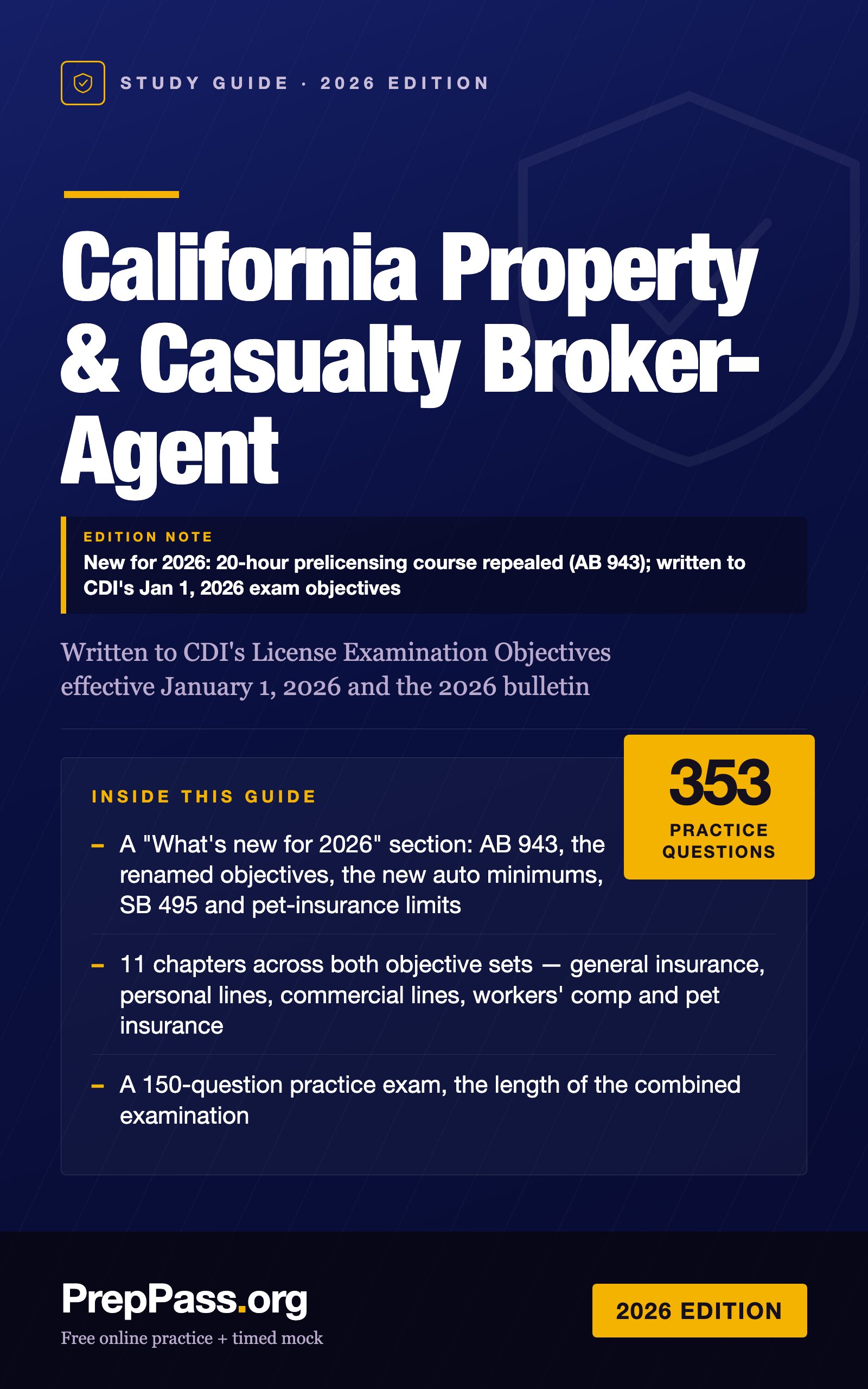
Practice stays free. The full California Property & Casualty Broker-Agent study guide is the material itself, taught start to finish — a downloadable PDF + EPUB you keep.