Food Safety Management and HACCP
Rules only work if someone builds a system to follow them. Active managerial control, the HACCP method, and cooperation with health inspectors turn scattered good habits into a reliable program. This chapter shows how a manager runs food safety like a system.
Active Managerial Control
Active managerial control means a manager takes deliberate, ongoing steps to prevent the most common causes of foodborne illness rather than reacting after something goes wrong. The CDC identifies five leading risk factors: purchasing food from unsafe sources, failing to cook food adequately, holding food at incorrect temperatures, using contaminated equipment, and poor personal hygiene. A manager builds controls for each — approved suppliers, cooking temperature checks, holding logs, cleaning schedules, and health and handwashing policies. The tools include training, standard operating procedures, monitoring with thermometers and checklists, and corrective action when something is off. Active managerial control is proactive: you design the system, verify it works, retrain when needed, and document it, so food safety does not depend on luck or on one careful employee.
The Seven HACCP Principles
HACCP (Hazard Analysis Critical Control Point) is a science-based system that builds food safety into each recipe and process. It follows seven principles in order. One, conduct a hazard analysis to find where hazards can enter. Two, determine the critical control points (CCPs), the steps where a hazard can be prevented or eliminated, such as cooking. Three, establish critical limits, the exact measurable standards like 165°F for poultry. Four, establish monitoring procedures to check the limits are met. Five, identify corrective actions to take when a limit is not met. Six, verify the system works through review and testing. Seven, establish record-keeping and documentation. A HACCP plan is specific to your menu and operation — you cannot copy someone else's — and it is especially important for complex processes like cook-chill or sous vide.
Variances and Special Processes
Some processes are risky enough that the regulatory authority requires special written approval called a variance before you may use them. You generally need a variance and an accompanying HACCP plan for methods like smoking food to preserve it (not just for flavor), curing food, using food additives or acids to preserve food such as making your own ferments or acidifying rice for sushi, reduced-oxygen packaging (ROP) including vacuum packing and sous vide, sprouting seeds or beans, offering live shellfish from a display tank, and custom-processing animals for personal use. To get a variance you submit information showing how you will control the added hazards. Operating one of these processes without required approval is a violation, so know which of your menu items trigger the requirement and get the paperwork before you start.
Inspections and Imminent Hazards
Health inspectors visit to verify your operation follows the law, and a manager should cooperate professionally. Ask for identification, accompany the inspector, take notes, answer questions honestly, and be ready to provide temperature logs and other records. Correct violations noted in the report within the time frame given, and use the report to improve your systems. Certain emergencies, called imminent health hazards, are serious enough to require stopping operations immediately: examples include a loss of electrical power, a sewage backup into the kitchen, a water supply interruption or contamination, a fire or flood, or a significant pest infestation. When an imminent hazard occurs, cease affected operations, notify the regulatory authority, and do not resume until the hazard is corrected and, when required, the authority approves reopening.
Last updated: October 2026
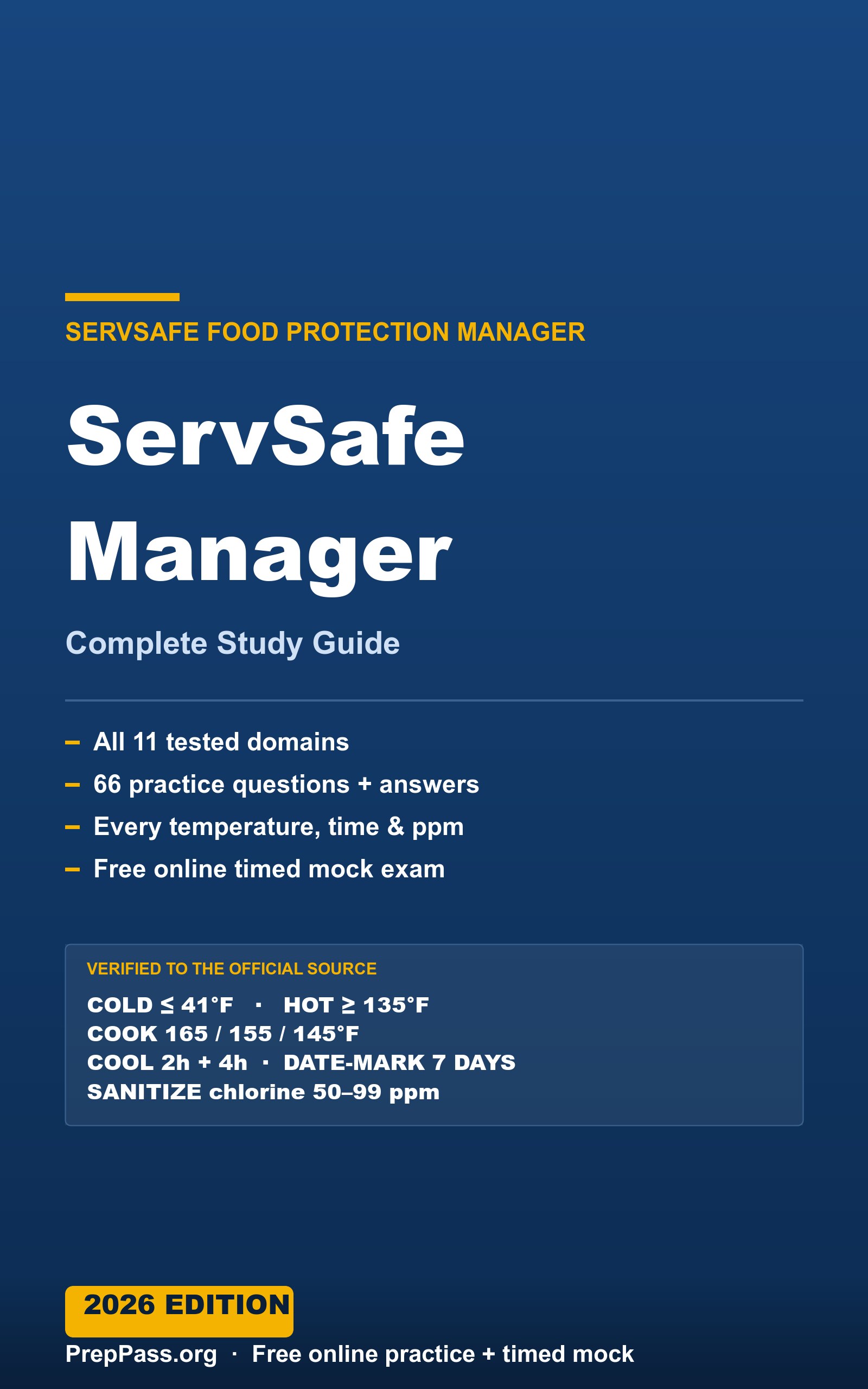
In the ServSafe Food Protection Manager guide: A quiz closing each of the 8 chapters, with an answer key that explains every one. Practice here stays free.