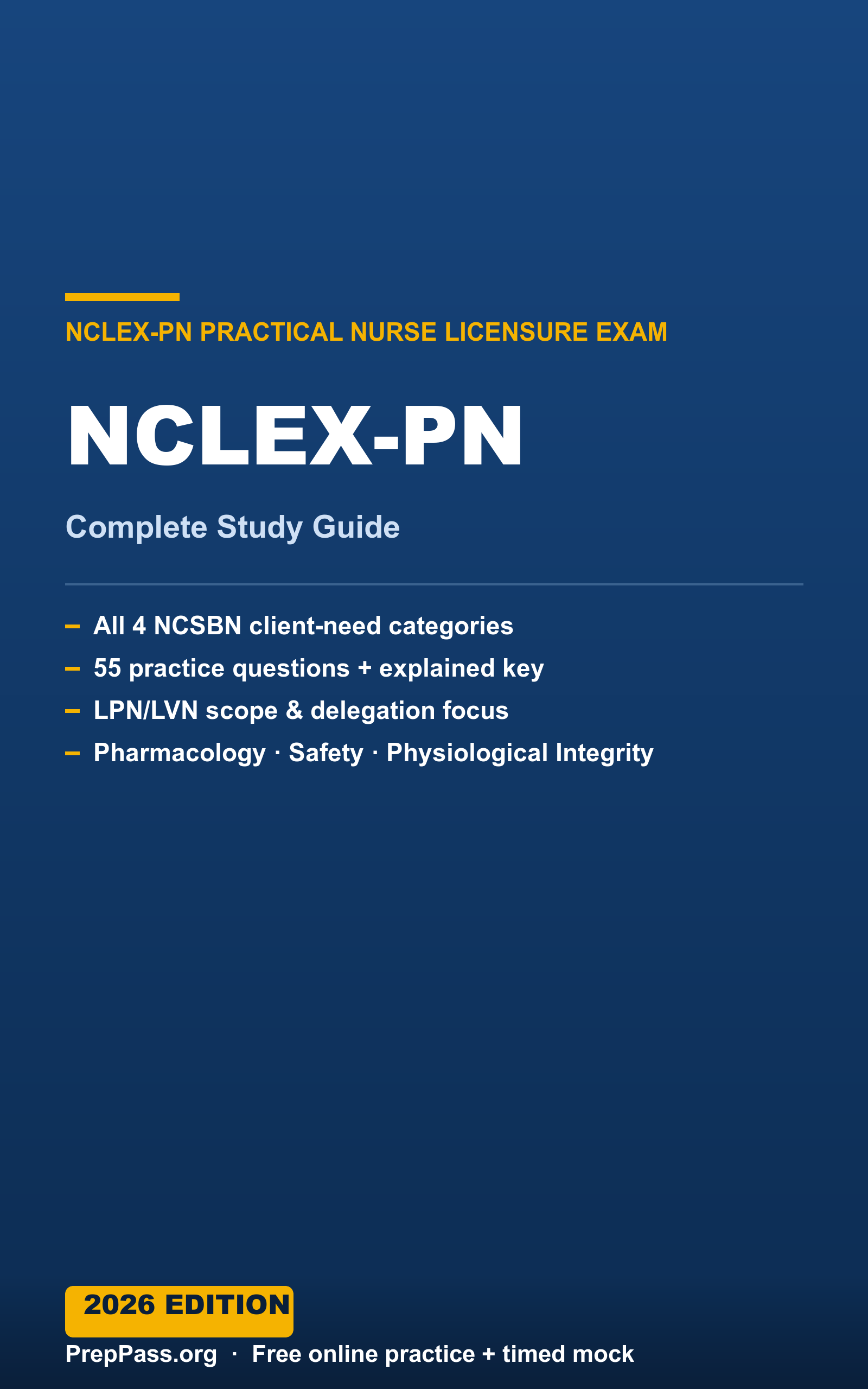
NCLEX-PN — Complete Study Guide (2026)
The practical/vocational nurse licensure exam across all four NCSBN client-need categories, with an LPN/LVN scope-and-delegation focus throughout.
Own the complete book — PDF + EPUB
The practice questions and timed mock stay free. The book is the studying half:
- Taught chapter by chapter — every exam section explained in order, not just questions
- Print it & tab it — a paper reference you can highlight and mark up
- Works offline — PDF for print, EPUB for your phone or e-reader
- Everything in one file — chapters, cram sheets, and practice questions together
14-day money-back guarantee — not satisfied? Email us for a full refund, no questions asked. Refund policy
Chapter 1 is free to read on this page — try before you buy. One payment unlocks the complete book (PDF + EPUB, practice questions with explanations, per-chapter cram sheets).
Instant PDF + EPUB download · one-time, yours forever · no subscription · 14-day money-back guarantee · not sure yet? read Chapter 1 free below.
The full opening chapter — the same text as the eBook. Scroll the window to read it right here; no download, no email.
Introduction
Coordinated Care is where the practical/vocational nurse's role is defined most sharply, and it is the largest slice of the NCLEX-PN. It tests something more abstract than any single disease: whether you understand how the LPN/LVN works within the health-care team — the scope of your practice, what you may delegate and to whom, your legal and ethical duties, how you protect confidentiality, how you set priorities among several clients, and how you communicate and document so nothing falls through the cracks.
The through-line of this chapter is the scope line that separates the two nursing roles: the LPN/LVN gathers data, reinforces teaching, administers many medications, and reports to the RN; the RN retains the initial assessment, the care plan, initial teaching, and evaluation. In shorthand — the RN plans and assesses; the PN reinforces and collects data. Almost every Coordinated Care question is, underneath, a test of whether you can hold that line while still acting decisively within it.
Scope of practice and delegation
The LPN/LVN practices under the direction of an RN or provider and carries out tasks that follow an established plan of care. The exam tests three layers of the team, and you must know what belongs to each.
What the LPN/LVN does. The practical nurse collects data (vital signs, intake and output, wound appearance, a client's report of symptoms), administers many medications by common routes, provides and reinforces basic care, and reinforces teaching that the RN has already begun. Notice the verbs: collect, administer, reinforce, report. What the LPN/LVN does not do is the initial assessment of a new or unstable client, the nursing diagnosis, the development of the care plan, the initial teaching about a new diagnosis, and the evaluation of whether the plan worked. Those require the broader clinical judgment reserved for the RN. So administering a routine oral antibiotic to a stable client is squarely PN work, while performing the admission assessment on an unstable client, developing the initial care plan, or giving the first teaching about a new diabetes diagnosis are RN work — even though the LPN/LVN will later reinforce that diabetes teaching.
What may be delegated to unlicensed assistive personnel (UAP). UAP may perform routine, standardized tasks on stable clients: hygiene, feeding a client who has no swallowing risk, ambulation, repositioning, and measuring and recording intake and output. What can never be delegated to UAP is the nursing process itself — assessment, planning, evaluation, and any task requiring clinical judgment. Measuring a urine output and writing the number down is delegable; interpreting that the output is dangerously low and deciding to notify the RN is not.
The five rights of delegation. When you delegate, confirm the right task, under the right circumstances, to the right person, with the right direction and communication, and the right supervision and follow-up. The last two rights carry the rule the exam loves: the task transfers, the responsibility does not. When you delegate, you remain accountable to supervise and follow up. Any answer that says "the UAP is fully responsible now" or "no follow-up is needed if the UAP is experienced" is wrong.
A reliable mental test for any delegation question is to ask, does this task require the person to interpret data or decide on a plan? If yes, it is nursing judgment and cannot travel down the chain. Measuring and recording a urine output can go to UAP; interpreting a low output, deciding whether to call the RN, and adjusting a fluid restriction cannot. Similarly, a UAP may take a stable client's vital signs, but the moment those numbers must be evaluated against the client's condition and trend, the responsibility is the licensed nurse's. The exam builds whole items on this single distinction between doing a task and exercising judgment — watch for verbs such as assess, interpret, evaluate, teach, plan, and titrate, which flag judgment that cannot be delegated.
The exam also tests matching acuity to competency. When you help assign a group of clients, give the stable, predictable clients to less-experienced staff and keep the complex or rapidly changing clients with the most experienced nurses. Loading one nurse with every unstable client, or handing them out at random, is unsafe and always a wrong answer. And remember that even a correct delegation is not "finished" when the task is handed off — the person who delegated checks that the task was done and done correctly. Follow-up is part of the job, not an optional courtesy.
Scope note — verify your state. The exact list of what an LPN/LVN may do — especially IV therapy, IV push medications, blood administration, and supervising other staff — is set by your state's Nurse Practice Act, and states differ. The NCLEX tests the common national pattern taught here; your license obeys your state board. When the two seem to conflict, follow your state board for practice and confirm the current NCSBN framing for the exam.
Legal and ethical responsibilities
The LPN/LVN is accountable for practicing within the law and following core ethical principles: autonomy (self-determination), beneficence (doing good), nonmaleficence (avoiding harm), justice (fairness), and veracity (truthfulness). Several duties flow directly from these.
Honor client autonomy. A competent adult may refuse any treatment, even one that is ordered and even one you believe is beneficial. The correct response to a refusal is never to give the treatment anyway or to threaten the client — it is to document the refusal and notify the RN or provider.
Support informed consent — and know your narrow role in it. Informed consent splits into two roles the exam tests constantly. The provider who performs the procedure explains the risks, benefits, and alternatives. The nurse's role is to confirm the consent is voluntary and to witness the signature — and to notify the provider if the client has questions or does not understand. The nurse does not explain the surgical risks. If a client about to sign clearly does not understand the procedure, you stop and notify the provider; you do not fill in the explanation yourself.
Report unsafe or dishonest practice. Falsified documentation, an impaired coworker, and unsafe conditions must be reported through the chain of command. Charting care that was never given is a violation of veracity and both an ethical breach and a legal risk.
Act as a mandatory reporter. Suspected abuse or neglect of children, elders, or vulnerable adults must be reported to the proper authorities. This duty does not wait for permission from the client or family.
Handle errors honestly — and know where the incident report goes. When an error or a near-miss occurs — even one that never reached the client — you complete an incident (occurrence) report so the facility can learn and improve. Two rules trip up test-takers. First, the incident report is a quality-improvement document that is kept out of the client's medical record — you do not file it in the chart, and you do not chart that one was written. Second, you still document the client's actual condition and any care given in the record, factually and without editorializing. Reporting a colleague directly to the state board of nursing is reserved for repeated or unresolved unsafe practice, not a single correctable slip; for a one-time error, you fix the immediate risk and follow the facility's process.
Question an unsafe order rather than carry it out. Nonmaleficence — the duty to avoid harm — means that if an order appears unsafe (a dose that looks ten times too high, a drug the client is allergic to), you hold it and clarify with the provider before administering. "The provider ordered it" is never a defense for carrying out an order you recognized as dangerous. This is one of the few places where the LPN/LVN's independent duty overrides the plan of care: your license obligates you not to knowingly harm a client.
Confidentiality and information sharing
Protected health information may be shared only with those involved in the client's care or as required by law. Four rules follow: share on a need-to-know basis; avoid casual disclosure (never discuss clients in elevators, hallways, or with people not on the care team); follow authorized exceptions (mandatory reporting and communication with the treating team are permitted); and protect records and screens by logging off computers and securing printed material. A classic wrong answer has the nurse giving a client's information to a caller or a visitor who "just wants to know how she's doing" — without the client's authorization, that is a breach.
Prioritization and care coordination
The LPN/LVN constantly helps decide who and what comes first among several clients. You rank with a framework, not with whoever asked most recently or most loudly.
- Use the ABCs first. Address airway, breathing, and circulation threats before anything else. A blocked airway kills in minutes; a headache does not. A client with new shortness of breath or a low oxygen saturation jumps ahead of a client wanting a snack.
- Then apply Maslow's hierarchy. When no one has an ABC threat, meet physiological needs first, then safety, then comfort, teaching, and self-esteem.
- Actual over potential; acute over chronic. A real, worsening problem outranks a potential risk, and a new, unstable problem outranks a stable, chronic, expected one.
- Communicate changes promptly. Because the PN works within the RN's plan, a new or worsening finding is reported to the RN so the plan can be adjusted. Recognizing when to report is itself a tested skill.
To see the frameworks working together, picture four call lights at once: a client whose oxygen saturation just dropped, a client asking for pain medicine, a client wanting help to the bathroom, and a client requesting a warm blanket. ABC puts the falling oxygen saturation first — it is a breathing threat. Once that client is stabilized and the RN notified, Maslow ranks the rest: help to the bathroom (a physiological/elimination and safety need, with fall risk) outranks pain medicine, which outranks the blanket (comfort). Notice that "who asked first" and "who is loudest" never entered the ranking. NCLEX-PN prioritization questions are almost always solvable by running this exact sequence — ABC, then Maslow, then acute-over-chronic — rather than by instinct.
One more refinement the exam rewards: a new, unexpected finding outranks an expected one, even if the expected one sounds worse on paper. A client with chronic, stable heart failure who is expected to have mild ankle edema is not your emergency; a previously stable client who suddenly becomes confused or short of breath is. Stability and trend matter more than the raw severity of a diagnosis.
Communication and documentation
Accurate, timely communication protects both the client and your license.
- Use SBAR for hand-off. Report the Situation, Background, Assessment/data, and Recommendation to organize what you pass along, and emphasize the least stable, highest-risk client — that is where a dropped detail does the most harm.
- Document objectively. Record specific, factual, measurable data with the time of the observation. "Client appears fine" is not documentation; "Respirations 18, unlabored, lungs clear at 0800" is.
- Read back verbal and telephone orders. Write the order down, read it back, and have it signed per policy. Verbal orders are error-prone and are accepted only under defined circumstances.
- Chart promptly and correct properly. Document care after it is provided, never before. Correct an error according to facility policy without obscuring the original entry (single line, initial, date) — never erase or black out.
Key numbers & facts — Coordinated Care
- Five rights of delegation — right task, circumstances, person, direction/communication, supervision/follow-up.
- Five rights of medication administration (also Chapters 2 and 6) — right client, drug, dose, route, time (many references add documentation, reason, response).
- Two identifiers — verify at least two client identifiers (e.g., name + date of birth) before any medication, procedure, or transfusion; never the room number alone.
- Cannot be delegated to UAP — assessment, planning, evaluation, teaching, and clinical judgment.
- Cannot be done by the LPN/LVN — initial assessment of an unstable client, nursing diagnosis, care-plan development, initial teaching, evaluation of outcomes.
- The task transfers; the responsibility does not — the delegator supervises and follows up.
- No laboratory or dosing values are introduced in this chapter; those live in Chapters 5 and 6.
What's in the eBook
Why buy the book when the practice is free?
Our practice questions and timed mock stay free — nothing on the site moves behind this book. The $9.99 book is the studying half: the material itself, taught in order, in a file you own.
- Systematic teaching — every exam section explained chapter by chapter, start to finish, not just questions
- Print it & tab it — a paper-ready PDF you can highlight, mark up, and bring to your study table
- Study anywhere, offline — EPUB on your phone or e-reader; no wifi, no browser tabs
- Everything in one place — chapters, per-chapter cram sheets, and practice questions in one file
- Yours for life — one-time $9.99, instant download, no subscription
And it's risk-free: 14-day money-back guarantee — not satisfied? Email us for a full refund, no questions asked. See the refund policy.
14-day money-back guarantee · full refund, no questions asked.
One-time purchase, lifetime access to the download. The eBook is the full NCLEX-PN study guide in PDF and EPUB. Educational summary, not professional or legal advice — always confirm the current rules with the official source. Last updated: August 2026.