Sách ôn thi · Ấn bản 2026
AWS Certified AI Practitioner (AIF-C01) — Complete Study Guide (2026)
All five official AIF-C01 domains — AI/ML fundamentals, generative AI, foundation models (Amazon Bedrock), responsible AI, and security & governance — with original practice questions. Not affiliated with AWS.
- Độ dài
- 67 trang
- Câu hỏi luyện tập trong sách
- 55
- Thông tin kỳ thi đối chiếu
- tháng 9 năm 2026
- Tệp cập nhật lần cuối
- tháng 10 năm 2026
- Giao hàng
- PDF + EPUB · tiếng Anh · tải ngay
Về cuốn sách này
Lệ phí thi: $100 mỗi lần thi, nộp cho AWS. Thi lại phải nộp lại. Cuốn sách này: $14.99, trả một lần.
Thông tin kỳ thi, ai nên dùng và thay đổi
Về chính kỳ thi này
| Cơ quan quản lý | Amazon Web Services (AWS Certification) — kỳ thi do Pearson VUE tổ chức Nguồn: AWS Certification — AWS Certified AI Practitioner (Exam overview) |
|---|---|
| Số câu hỏi | 65 câu hỏi (50 câu tính điểm, 15 câu thử nghiệm không tính điểm) Nguồn: AWS — AWS Certified AI Practitioner (AIF-C01) Exam Guide |
| Thời gian làm bài | 90 phút Nguồn: AWS Certification — AWS Certified AI Practitioner (Exam overview) |
| Điểm đậu | Điểm quy đổi 700 trên thang 100–1,000 Nguồn: AWS — AWS Certified AI Practitioner (AIF-C01) Exam Guide |
| Lệ phí |
Nguồn: AWS Certification — AWS Certified AI Practitioner (Exam overview) |
| Ngôn ngữ thi | Tiếng Ả Rập · Tiếng Anh · Tiếng Pháp (Pháp) · Tiếng Đức · Tiếng Ý · Tiếng Nhật · Tiếng Hàn · Tiếng Bồ Đào Nha (Brazil) · Tiếng Tây Ban Nha (Mỹ Latinh) · Tiếng Tây Ban Nha (Tây Ban Nha) · Tiếng Trung giản thể · Tiếng Trung phồn thể Nguồn: AWS Certification — AWS Certified AI Practitioner (Exam overview) |
Xem bên trong cuốn sách
Ba trang thật, kết xuất thẳng từ tệp PDF bạn sẽ tải — lần lượt là một trang tra cứu, một trang giảng giải, và một câu hỏi có lời giải. Không trang nào được vẽ lại cho đẹp.
- Trang tra cứu nhanhChapter 1 — Fundamentals of AI and ML · Trang 13 của PDF
Một trang để lật lại: các con số, mốc thời hạn hoặc thuật ngữ gom về một chỗ.
- Cách giảng dạyChapter 1 — Fundamentals of AI and ML · Trang 12 của PDF
Trang giảng giải: kiến thức được trình bày bằng văn xuôi, theo trình tự kỳ thi kiểm tra.
- Một câu hỏi có lời giảiPractice Exam — 55 Questions · Trang 49 của PDF
Một câu luyện tập kèm đáp án và lập luận đằng sau — không chỉ là đáp án.
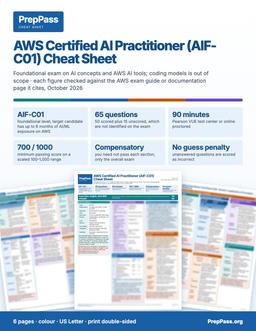
Thi trong vòng hai tuần?
Sách này là phần giảng dạy, đọc trong nhiều tuần. Nếu bạn thi trong vòng hai tuần, bảng tra cứu màu in được là sản phẩm còn lại: các con số then chốt, xếp theo từng phần.
6 trang · US Letter · PDF in được · giữ vĩnh viễn
Có gì — và không có gì
Bao gồm
- All 5 official AIF-C01 domains at their real exam weights
- Generative AI: foundation models, tokens, embeddings, prompting, RAG, fine-tuning
Không bao gồm
- Không gửi bản in — đây là tệp bạn tải về và có thể tự in
- Sách không kèm khoá video, giảng viên hay kèm riêng — video miễn phí trên trang là phần khác
Toàn bộ phần bao gồm và không bao gồm
Bao gồm
- Amazon Bedrock, SageMaker AI, Amazon Q, and the AWS AI service catalog
- Responsible AI + security/governance (Guardrails, Clarify, IAM, Macie)
- 55 original practice questions with answer explanations
- PDF (print & tab it) + EPUB (phone / e-reader)
Không bao gồm
- Không bao gồm lệ phí đăng ký thi hay phí trung tâm khảo thí — bạn vẫn nộp cho cơ quan chính thức
Mục lục
Xem 7 phần và trang bắt đầu của từng phần
- Chapter 1 — Fundamentals of AI and MLtr. 8
- Chapter 2 — Fundamentals of Generative AItr. 15
- Chapter 3 — Applications of Foundation Modelstr. 22
- Chapter 4 — Guidelines for Responsible AItr. 30
- Chapter 5 — Security, Compliance, and Governance for AI Solutionstr. 36
- Practice Exam — 55 Questionstr. 41
- Answer Key with Explanationstr. 60
Lấy từ chính tệp PDF bạn tải về, kèm trang bắt đầu của từng phần — không phải gõ tay ở đây.
Đọc miễn phí trọn một chương
Trọn vẹn một chương, đúng như trong eBook. Cuộn cửa sổ để đọc ngay tại đây; không cần tải, không cần email.
Đọc chương 1 ngay tại đây, không rời trang
This domain builds the vocabulary the rest of the exam depends on. Before you can reason about generative AI, foundation models, or responsible AI, you need to know what "AI," "machine learning," and "deep learning" actually mean, how they nest inside one another, how a model is trained and then used, and where the core AWS machine-learning services fit. None of it is hard, but the exam is precise, and a single loose definition is enough to turn an easy question into a wrong answer. Master this chapter and you will move faster through every chapter that follows, because the same terms reappear constantly.
1.1 AI, Machine Learning, and Deep Learning
Start with the three-ring nesting, because the exam tests it directly and uses it as a trap in later questions.
Artificial intelligence (AI) is the broadest idea: the goal of getting computers to perform tasks that normally require human intelligence — understanding language, recognizing images, making decisions, solving problems. AI is the outer ring. It is a field and an aspiration, not a single technique. A hand-written rule-based "expert system" that plays chess is AI even though it contains no learning at all.
Machine learning (ML) is a subset of AI. In machine learning, a system is not explicitly programmed with the rules for a task; instead it learns the patterns directly from data. You show it many examples, and it infers a model that maps inputs to outputs. This is the middle ring. The defining shift is from "a human writes the rules" to "the system derives the rules from examples."
Deep learning is a further subset of ML — the inner ring. Deep learning uses multi-layer neural networks, loosely inspired by the interconnected neurons of the brain, to model very complex patterns. "Deep" refers to the many layers stacked between input and output. Deep learning is what powers modern image recognition, speech, and the large language models behind generative AI. Every deep-learning system is machine learning, and every machine-learning system is AI — but not the reverse.
Memory hook: Deep learning ⊂ Machine learning ⊂ Artificial intelligence. Three nested rings, smallest inside largest. The classic wrong answer flips the order (claims deep learning is the umbrella that "contains" AI). If you can draw the three rings, you will get this family of questions right every time.
1.2 The Main Types of Machine Learning
Machine learning is usually divided into three paradigms, and the exam constantly asks you to match a described business scenario to the correct one. Learn the one-line trigger for each.
Supervised learning trains on labeled data: every training example is a pair of an input and its known, correct output (the label). The model learns the mapping so it can predict the label for new, unlabeled inputs. The trigger word is labeled. Supervised learning splits into two sub-types by the kind of output:
- Classification predicts a discrete category — spam vs. not spam, fraud vs. legitimate, which of ten animal species is in a photo. The output is a class.
- Regression predicts a continuous number — a house price, tomorrow's temperature, an expected sales figure. The output is a quantity on a scale.
Telling classification from regression is a favorite exam distinction: if the answer is a category, it is classification; if the answer is a number on a continuum, it is regression.
Unsupervised learning works on unlabeled data to find hidden structure that no one specified in advance. The signature task is clustering — grouping similar records together, such as segmenting customers into natural groups when you do not know the groups ahead of time. The trigger is no labels / discover groups. Because nobody told the model what the "right" groups are, unsupervised learning is used for discovery, segmentation, and anomaly detection rather than prediction of a known target.
Reinforcement learning (RL) trains an agent to take actions in an environment so as to maximize a reward signal over time. There are no labeled input-output pairs; instead the agent tries actions, receives rewards or penalties, and learns a policy that earns the most reward. The triggers are agent, action, reward. Think of a system learning to play a game, control a robot, or optimize a process through trial and feedback.
A fourth term worth recognizing is transfer learning — reusing a model trained on one task as the starting point for a related task, which is conceptually how foundation models get adapted. It is a legitimate concept but a common distractor when the real answer is plain supervised learning.
1.3 The ML Lifecycle: Training, Evaluation, and Inference
A machine-learning model has two big phases in its life, and the exam wants you to keep them straight.
Training is where the model is built. You feed it training data, and the model adjusts its internal parameters (called weights) to reduce the error between its predictions and the known answers. Training is compute-intensive and happens before deployment. Adjusting weights is the essence of training — remember that phrase, because "adjusting the model's internal weights" is the tell for training on the exam.
Evaluation measures how good the trained model is. The crucial practice is to hold out a separate test set — data the model did not see during training — and measure performance on it. Why? Because a model can look great on data it has already memorized while being useless on anything new. Evaluating on unseen data estimates real-world performance and exposes overfitting.
Two failure modes anchor a whole family of questions:
- Overfitting — the model learns the training data too well, memorizing its noise and quirks, and then performs poorly on new data. The classic symptom is a large gap: near-perfect on training data, much worse on the test set. The model is "too complex" or "over-trained" for the signal that is really there.
- Underfitting — the opposite. The model is too simple to capture the underlying pattern and performs poorly even on the training data. Neither training nor test accuracy is good.
Inference is the payoff phase: taking a finished, trained model and using it to generate predictions on brand-new inputs in production. No weights change during inference; the model is fixed and simply produces outputs. Every time a deployed spam filter classifies a new email, that is inference. Keep the pair straight: training adjusts weights; inference uses the fixed model to predict.
1.4 Features, Labels, and Why Data Quality Rules Everything
Two more terms complete the core vocabulary.
A feature is an input variable the model reads — a column of data such as a customer's age, a house's square footage, or the words in an email. Features are what the model looks at.
A label is the target value the model learns to predict — the "right answer" attached to each training example. In a spam model, the words are features and "spam / not spam" is the label. In a house-price model, square footage and location are features and the sale price is the label. In supervised learning, every training example pairs features with a known label; unsupervised learning has features but no labels.
The single most important practical truth in this chapter: the quality, quantity, and representativeness of the data largely determine how good a model can be. This is why data preparation — collecting, cleaning, labeling, and balancing data — typically consumes the majority of a real ML project's effort. And it sets up a theme that dominates Chapters 4 and 5: poor or biased data produces poor or biased models. "Garbage in, garbage out" is not a slogan on this exam; it is the correct answer to a surprising number of questions about why a model failed or behaved unfairly.
1.5 When to Use AI/ML — and Where AWS Fits
Not every problem needs machine learning, and the exam rewards the judgment to know the difference.
Use ML when the patterns are complex, changing, or hard to write down as explicit rules, and when you have enough representative data to learn from. Recognizing thousands of objects across millions of images, detecting subtle fraud patterns that shift over time, understanding natural language — these resist hand-written rules and are ideal for ML.
Prefer a traditional rule-based system when the logic is well understood, stable, and can be written as clear deterministic rules. A rule-based approach is simpler, cheaper, more transparent, and easier to audit. Calculating sales tax or enforcing a fixed business policy does not need a neural network. The exam likes to offer ML as the "sophisticated" answer to a problem that is really just a set of known rules — resist it.
Where AWS fits is the other half of this domain, and it maps cleanly onto the "build vs. buy" choice:
- Amazon SageMaker AI is the managed platform for the end-to-end ML lifecycle — preparing data, building, training, tuning, and deploying your own custom models at scale. Reach for SageMaker AI when you need to build a model, not just call one. (SageMaker AI is covered in depth in Chapters 3 and 4.)
- Pre-built AI services — Amazon Rekognition (images and video), Amazon Comprehend (text analysis), Amazon Textract (document extraction), and their siblings — provide ready-made AI capabilities through a simple API, so a team can add intelligence without training any model at all. Reach for these when a common capability already exists as a service. (These are covered in Chapter 3.)
That build-versus-buy axis — custom model on SageMaker AI versus a managed AI service you simply call — is one of the most heavily tested ideas on the entire exam, so fix it now: if the scenario needs a common, general capability with no training, pick the managed service; if it needs a bespoke model trained on your own data, pick SageMaker AI.
Key Facts — Chapter 1 (memorize cold)
- Nesting: Deep Learning ⊂ Machine Learning ⊂ Artificial Intelligence (smallest inside largest).
- Supervised = labeled data. Classification → discrete category; Regression → continuous number.
- Unsupervised = unlabeled data; clustering groups similar records (customer segmentation).
- Reinforcement learning = agent + actions + reward, maximized over time.
- Feature = input variable; label = target being predicted.
- Training adjusts the model's weights; inference uses the fixed, trained model to predict on new data.
- Overfitting = great on training, poor on new data (memorized noise). Underfitting = too simple, poor even on training data.
- Split into train/test; evaluate on the held-out test set to estimate real-world performance.
- Data quality, quantity, and representativeness cap how good a model can be. Bad data → bad/biased model.
- Rule-based beats ML when logic is known, stable, and writable as clear rules.
- Amazon SageMaker AI = build/train/deploy custom models. Pre-built AI services (Rekognition, Comprehend, Textract…) = ready capability via API, no training.
Worked Scenario — Choosing the Paradigm
A logistics company has three projects. (a) It has two years of delivery records labeled "late" or "on-time" and wants to predict whether a new shipment will be late. (b) It wants to group its 50,000 customers into natural segments for marketing, with no predefined groups. (c) It wants a system that learns, through trial and reward, the best sequence of warehouse-robot moves to minimize travel time. Which ML paradigm fits each?
Work it by the trigger words. Project (a) has labeled examples and predicts a category (late / on-time) — that is supervised classification. Project (b) has no labels and wants to discover groups — that is unsupervised learning, specifically clustering. Project (c) has an agent taking actions to maximize a reward over time — that is reinforcement learning. Notice that all three are "learning," but the data (labeled? unlabeled? reward-driven?) decides the paradigm. That is exactly how the exam frames these questions: read for whether labels exist and what the output is.
Exam Traps — Chapter 1
- Flipping the nesting. Any answer that says deep learning "contains" ML or AI is wrong. AI is the biggest ring.
- Classification vs. regression by output type. If the target is a number on a continuum → regression. If it is a category → classification. "Predict the price" is regression; "predict which class" is classification.
- Calling clustering "supervised." Clustering is unsupervised — there are no labels. If the scenario says "no predefined categories/groups," it is unsupervised.
- Training vs. inference. "Adjusting weights to reduce error" = training. "Using the trained model on new inputs" = inference. Do not swap them.
- Overfitting vs. underfitting. Great-on-training-but-bad-on-new = overfitting. Bad-on-everything (too simple) = underfitting. "Convergence" and "regularization" are distractors, not names for this gap.
- Reaching for ML when rules suffice. If experts can write the logic down and it is stable, the rule-based system is the better, cheaper, more transparent answer.
- Confusing SageMaker AI with a pre-built service. SageMaker AI is a platform to build your own model; Rekognition/Comprehend/Textract are finished capabilities you call. CloudWatch and Route 53 are not ML services at all — pure distractors.
Câu hỏi người mua thường hỏi
Nhận sách thế nào?
Thanh toán xong, mục tải xuống hiện ngay trên trang này. Liên kết cũng được gửi qua email. Không cần tài khoản.
Nếu sách không hợp thì sao?
Gửi email trong vòng 14 ngày để được hoàn tiền đầy đủ, không cần lý do.
Phần luyện tập miễn phí có bị bỏ không?
Không. Mọi câu hỏi luyện tập, bài thi thử tính giờ và các chương miễn phí trên trang vẫn miễn phí. Cuốn sách là nửa "học", không phải hàng rào quanh phần miễn phí.
Thêm câu hỏi (1)
Đọc trên điện thoại được không?
Được — EPUB cho điện thoại và máy đọc sách, PDF để in và dán tab. Bạn nhận cả hai.
Vì sao mua sách khi phần luyện tập miễn phí?
Câu hỏi luyện tập và bài thi thử tính giờ vẫn miễn phí — không có gì trên trang bị giấu sau cuốn sách này. Cuốn sách $14.99 là nửa "học": chính phần kiến thức, dạy theo trình tự, trong một tệp thuộc về bạn.
- Dạy có hệ thống — mọi phần thi giảng theo từng chương, từ đầu đến cuối, không chỉ là câu hỏi
- In ra & dán nhãn — PDF sẵn sàng để in, tô đậm, ghi chú và mang tới bàn học
- Học mọi nơi, ngoại tuyến — EPUB trên điện thoại hay máy đọc sách; không cần wifi, không cần tab trình duyệt
- Tất cả một chỗ — các chương và câu hỏi luyện tập trong một tệp
- Của bạn trọn đời — trả một lần $14.99, tải ngay, không thuê bao
Chi tiết
- Đối chiếu từ nguồn chính thức(official AWS AIF-C01 exam guide / current AWS documentation)
- 150 câu hỏi luyện tập miễn phí
Một AWS certification course có giá $100–$800. Cuốn sách này dạy cùng một kỳ thi — cùng quy định, đối chiếu theo chuẩn hiện hành — chỉ với $14.99 trả một lần, thuộc về bạn trọn đời.
Mua một lần, truy cập tải về trọn đời. eBook là trọn bộ hướng dẫn ôn AWS Certified AI Practitioner (AIF-C01) ở dạng PDF và EPUB. Bản tóm tắt mang tính giáo dục, không phải tư vấn chuyên môn hay pháp lý — luôn xác nhận quy định hiện hành với nguồn chính thức. Cập nhật lần cuối: October 2026.