Certified Nursing Assistant (CNA) · Ấn bản 2026
CNA — Complete Study Guide (2026)
Resident rights, infection control, basic nursing and restorative skills, and legal/ethical duties — national standard, with the skills-exam walkthroughs and state-variation checklist.
- Cả 8 chương trong một bản PDF + EPUB bạn giữ
- 120 câu luyện tập trong hai đề thi thử đầy đủ ở cuối sách, cùng một bài kiểm tra kèm đáp án giải thích khép lại cả 8 chương
- Số liệu quan trọng, các bẫy đề được gọi tên và nguồn dẫn cho chúng, khép lại cả 8 chương
$19.99trả một lần · tải trọn đời · không thuê bao
PDF + EPUB · tiếng Anh · 155 trang · $19.99 trả một lần
Sách này được viết bằng tiếng Anh — tệp PDF và EPUB bạn tải về đều bằng tiếng Anh.
Tải ngay sau khi thanh toán — không cần tài khoản, không thuê bao.
Đảm bảo hoàn tiền 14 ngày: không hài lòng vì bất kỳ lý do gì? Email support@preppass.org trong vòng 14 ngày kể từ khi mua để được hoàn tiền đầy đủ. Đây là bản tải xuống nên không phải gửi trả gì cả. Chính sách hoàn tiền
Thông tin kỳ thi được đối chiếu với nguồn chính thức lần gần nhất: tháng 9 năm 2026.
Thử 10 câu trước — miễn phí
Trả lời hết 10 câu, nộp bài xong sẽ thấy lời giải từng câu — kèm phần trong sách này dạy nội dung đó. Khoảng 5 phút, không cần đăng ký.
Bắt đầu 10 câu miễn phíXem bên trong cuốn sách
Ba trang thật, kết xuất thẳng từ tệp PDF bạn sẽ tải — lần lượt là một trang tra cứu, một trang giảng giải, và một câu hỏi có lời giải. Không trang nào được vẽ lại cho đẹp.
- Trang tra cứu nhanhAppendix C — Glossary of essential CNA terms · Trang 142 của PDF
Một trang để lật lại: các con số, mốc thời hạn hoặc thuật ngữ gom về một chỗ.
- Cách giảng dạyChapter 1 — Resident Rights & Dignity · Trang 19 của PDF
Trang giảng giải: kiến thức được trình bày bằng văn xuôi, theo trình tự kỳ thi kiểm tra.
- Một câu hỏi có lời giảiChapter 6 — Mental Health & Social-Service Needs · Trang 84 của PDF
Một câu luyện tập kèm đáp án và lập luận đằng sau — không chỉ là đáp án.
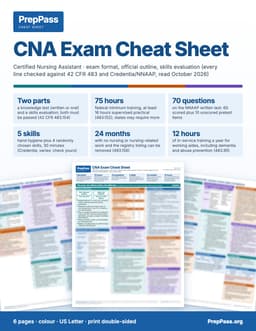
Thi trong vòng hai tuần?
Sách này là phần giảng dạy, đọc trong nhiều tuần. Nếu bạn thi trong vòng hai tuần, bảng tra cứu màu in được là sản phẩm còn lại: các con số then chốt, xếp theo từng phần.
6 trang · US Letter · PDF in được · giữ vĩnh viễn
Về chính kỳ thi này
| Cơ quan quản lý | California Department of Public Health (CDPH), Healthcare Workforce Branch — kỳ thi do three CDPH-approved testing vendors: D&SDT-Headmaster LLP, Credentia Nurse Aide LLC, and the Regional Testing Center tổ chức Nguồn: CDPH — CNA Testing Vendors |
|---|---|
| Số câu hỏi | CDPH không công bố Những trang chúng tôi đã đọc và không tìm thấy: CDPH — CNA Testing Vendors |
| Thời gian làm bài | CDPH không công bố Những trang chúng tôi đã đọc và không tìm thấy: CDPH — CNA Testing Vendors |
| Điểm đậu | CDPH không công bố Những trang chúng tôi đã đọc và không tìm thấy: CDPH — CNA Testing Vendors |
| Lệ phí | CDPH không công bố Những trang chúng tôi đã đọc và không tìm thấy: CDPH — CNA Testing Vendors |
| Ngôn ngữ thi | CDPH không công bố Những trang chúng tôi đã đọc và không tìm thấy: CDPH — CNA Testing Vendors |
Câu hỏi luyện tập và chương học miễn phí Certified Nursing Assistant (CNA) →
Có gì — và không có gì
Bao gồm
- Key numbers & facts and the exam traps called out in every chapter, with the sources cited
- Written to be re-read the night before, not read once cover to cover
- Resident rights & dignity, communication, and mandated reporting
- Infection control, standard/transmission-based precautions, and safety
- Basic nursing + restorative skills with skills-exam walkthroughs
- Vital-sign ranges, positioning, and the CNA scope-of-practice line
- 120 original practice questions + a state-variation checklist
- PDF (print & tab it) + EPUB (phone / e-reader)
Không bao gồm
- Không gửi bản in — đây là tệp bạn tải về và có thể tự in
- Sách không kèm khoá video, giảng viên hay kèm riêng — video miễn phí trên trang là phần khác
- Không bao gồm lệ phí đăng ký thi hay phí trung tâm khảo thí — bạn vẫn nộp cho cơ quan chính thức
Mục lục
Xem 16 phần và trang bắt đầu của từng phần
- Chapter 1 — Resident Rights & Dignitytr. 14
- Chapter 2 — Communication & Cultural Sensitivitytr. 26
- Chapter 3 — Safety & Infection Controltr. 38
- Chapter 4 — Basic Nursing Skillstr. 52
- Chapter 5 — Restorative Care & Rehabilitationtr. 65
- Chapter 6 — Mental Health & Social-Service Needstr. 76
- Chapter 7 — Emotional & Spiritual Supporttr. 88
- Chapter 8 — Legal, Ethical Duties & Mandated Reportingtr. 99
- Practice Exam A — 60 Questionstr. 113
- Practice Exam B — 60 Questionstr. 125
- Appendix A — Vital signs & reporting thresholds (quick reference)tr. 138
- Appendix B — The skills evaluation: the national patterntr. 140
- Appendix C — Glossary of essential CNA termstr. 142
- Appendix D — Common medical abbreviations for the CNAtr. 145
- Appendix E — How to prepare for and pass the CNA examtr. 146
- Appendix G — What varies by state: a confirmation checklisttr. 153
Lấy từ chính tệp PDF bạn tải về, kèm trang bắt đầu của từng phần — không phải gõ tay ở đây.
Đọc miễn phí trọn một chương
Trọn vẹn một chương, đúng như trong eBook. Cuộn cửa sổ để đọc ngay tại đây; không cần tải, không cần email.
Đọc chương 4 ngay tại đây, không rời trang
The free chapter is Basic Nursing Skills — the heart of the CNA exam — so you can judge the teaching where it matters most.
This is the hands-on heart of CNA work and the largest slice of the written test, and most of the skills you demonstrate on the manual exam come from this chapter: measuring vital signs, height, and weight; assisting with activities of daily living; positioning, transferring, and ambulating residents; feeding; and preventing pressure injuries. The numbers here — normal vital-sign ranges, reporting thresholds, positioning schedules, water temperatures — are the most heavily tested facts in the whole exam. Two ideas run through everything: learn the exact sequence of each skill (the skills evaluation grades order and safety steps, not just the result), and remember the CNA's lane — you measure, observe, and report; the licensed nurse assesses and decides.
Vital signs: the numbers that protect the resident
A CNA measures and records vital signs and reports abnormal values to the licensed nurse; the nurse interprets them and decides on action (nursing assessment is the nurse's job under 42 CFR §483.35, not the aide's). The four classic vital signs are temperature, pulse, respirations, and blood pressure; oxygen saturation (SpO2) is now commonly measured as a fifth. Vital signs are called "vital" because they are the body's early-warning system — a rising temperature or falling oxygen level often shows a problem hours before the resident can describe it. Standard adult normal ranges taught in nurse-aide training:
- Temperature: average 98.6 °F orally; a normal oral range is roughly 97.6–99.6 °F. The axillary (armpit) route reads about a degree lower; the rectal route about a degree higher and is the most accurate; tympanic (ear) and temporal (forehead) are quick and close to oral. Match the route to the resident (never oral for a confused resident or one who is unconscious, on oxygen, or unable to hold the thermometer), and record which route you used.
- Pulse: 60–100 beats per minute, regular and strong, in an adult at rest. Note the rate, rhythm (regular or irregular), and force (strong, weak, thready). The radial pulse (wrist) is usual; the apical pulse (over the heart with a stethoscope) is used for irregular or hard-to-feel pulses and is counted for a full minute.
- Respirations: 12–20 breaths per minute. Count respirations without telling the resident — people change their breathing when they know they are being watched — so count them right after the pulse while you still appear to be holding the wrist. One rise and fall of the chest is one breath.
- Blood pressure: a normal adult reading is roughly 90–120 systolic over 60–80 diastolic, and current guidelines call under 120/80 "normal." The systolic (top) number is the pressure when the heart beats; the diastolic (bottom) is between beats. Use the correct cuff size — a cuff too small reads falsely high, a cuff too large reads falsely low — and never take a BP on an arm with a dialysis shunt, a fresh mastectomy side, or an IV.
- SpO2 (oxygen saturation): 95–100% on room air is normal; the sensor clips on a clean, warm finger (remove dark nail polish).
Report immediately — before finishing your round — any of these: temperature over 100.4 °F, pulse under 60 or over 100, respirations under 12 or over 20, systolic over 180 or under 90, or SpO2 under 90%. Count for a full 60 seconds whenever a pulse or breathing is irregular. Never chart a rounded guess ("about 80"); write the exact reading and the route or site. (Blood-pressure category labels are periodically revised by national guidelines; teach the normal range above and report per your facility's thresholds and the nurse's orders.)
Measuring height and weight
Weight is one of the most important numbers in long-term care because a change flags fluid retention (heart or kidney trouble) or malnutrition. Weigh the resident at the same time of day, on the same scale, in similar clothing, after voiding so the comparison is fair, and report a sudden change (a common alert is a gain or loss of several pounds in a short period) to the nurse. Balance a standing scale at zero before use, guard the resident for safety, or use a chair or bed scale for a resident who cannot stand. Height is usually measured standing against the scale's rod, or by a measured supine length for a resident who cannot stand. Record in the units your facility uses and note how the measurement was taken.
Body positions — and why each is used
The exam expects you to name the common positions and know when they are used, and correct positioning prevents pressure injuries, aids breathing and digestion, and keeps the airway safe:
- Supine — flat on the back; a resting/neutral position.
- Fowler's — semi-sitting with the head of the bed raised about 45–60°, used for eating, breathing comfort, and many procedures. Semi-Fowler's is lower (~30°); high-Fowler's is ~60–90° (upright, best for a resident short of breath).
- Lateral — lying on the side, used for rest and to relieve pressure off the back; support the top arm and leg with pillows.
- Prone — lying on the stomach, used less often in the elderly.
- Sims' — a left side-lying position with the top knee drawn up, used for enemas and rectal care.
For every position, use pillows and wedges to keep the body in good alignment, keep joints slightly flexed and supported, and change the position on a schedule to protect the skin.
Activities of daily living: bathing, dressing, grooming, toileting
ADL care is governed by 42 CFR §483.24, which requires that a resident's ability to perform ADLs not decline unless it is clinically unavoidable. Translation: if your resident loses the ability to feed or dress themselves on your watch with no medical reason, the facility owes surveyors an explanation. Core principles that apply to every ADL:
- Privacy and dignity first — door and curtain closed, body kept covered except the part you are working on, supplies gathered before you start so you never leave a resident exposed or unattended.
- Water temperature for bathing about 105 °F, no hotter — elderly skin burns easily and feels heat poorly; check the water before the resident gets in, and wash from cleanest to dirtiest, changing water when it cools or becomes soiled.
- Perineal care goes clean-to-dirty — front to back for women (to keep bowel bacteria away from the urethra and prevent UTIs); for an uncircumcised man, retract the foreskin, clean the tip first, then return the foreskin to prevent constriction.
- Encourage the resident to do what they can — hand them the washcloth, let them choose the clothes — to preserve function and dignity (this ties directly to restorative care, Chapter 5).
- Inspect the skin during every bath and report any reddened, broken, bruised, or new area.
- Oral care at least twice a day, including for residents who are NPO (nothing by mouth) and those with dentures — dry mouth and inhaled mouth bacteria are leading causes of nursing-home pneumonia. For an unconscious resident, do mouth care with the head turned to the side to prevent aspiration.
- Dress the weak (affected) side first and undress it last, and support the joint you are moving — this avoids forcing a stiff or paralyzed limb.
Denture care, step by step: put on gloves; line the sink with a towel or fill it with water so a dropped denture does not break; remove the dentures (rock the upper gently to break the seal); brush them over the cushioned sink with denture cleaner and cool water (hot water warps them); rinse; store in a labeled cup of cool water or denture solution when out of the mouth; provide mouth care to the gums and tongue before reinserting.
Toileting, elimination, and specimen basics
Assist residents to the bathroom or commode on a schedule, answer the call light promptly, provide privacy, and observe and record what you see — amount, color, and any blood, pain, or unusual odor — then report anything abnormal.
For a resident who cannot get up, know the equipment and its exam-tested details. A standard bedpan goes wide end (the seat) under the buttocks, with the head of the bed raised afterward so the resident sits in as natural a position as possible. A fracture pan is the flatter, thinner pan with a low wedge end — used for residents with a hip fracture, recent hip surgery, casts, or very limited movement, because it slides under with far less lifting; the thin, flat end goes under the buttocks. Warm a cold metal pan with water first, place a protective pad, give the resident privacy and the call light, and return promptly — a resident left sitting on a bedpan is both a dignity problem and a pressure-injury risk. A male resident who can use a urinal should be positioned comfortably (standing if safe, or in bed), given privacy, and never left with the urinal in place between uses. After any use: gloves on, perineal care as needed, measure and observe the contents before discarding, empty into the toilet, rinse per policy, and wash your hands and the resident's. The CNA records intake and output (I&O) in milliliters and may collect certain specimens within scope: a routine or clean-catch (midstream) urine specimen (clean the perineal area, have the resident start the stream, then catch the middle portion in a sterile container) and a stool specimen (catch it without urine or toilet-paper contamination). Label every specimen at the bedside, use Standard Precautions, and deliver it promptly. Inserting or removing catheters and any sterile collection are outside CNA scope.
Transfers, ambulation, and range of motion
Transfers are the most common moment of injury for both resident and CNA, so follow the care plan's transfer level exactly: independent, supervision, one-person assist with a gait belt, two-person assist, or mechanical lift (sit-to-stand or full sling/Hoyer-type). Before any transfer: lock the bed and wheelchair brakes, raise the bed to a safe working height and then to where the resident's feet reach the floor, position the chair on the resident's strong side, apply the gait belt around the waist (never over a colostomy, feeding tube, or fresh surgical site), have the resident wear non-skid shoes, and count out loud ("on three") so the resident moves with you. Let the resident dangle (sit on the edge of the bed with feet down) for a moment first to prevent dizziness from a blood-pressure drop.
For ambulation, walk slightly behind and to the weak side, holding the gait belt from underneath — never grip the resident's arm, which tears fragile skin and gives you no control. If a resident starts to fall, do not try to catch the full weight. Ease them down along your body/leg to the floor, protecting the head, and call for help; trying to hold up a falling adult is how aides injure their backs and residents break hips.
Range-of-motion (ROM) exercises keep joints mobile and prevent contractures (permanent tightening). Active ROM = the resident moves the joint; active-assisted = you help; passive = you move the joint for a resident who cannot. Move each joint gently, only to the point of resistance — never past pain, supporting the limb above and below the joint, and do each motion the ordered number of times.
Anti-embolism stockings and circulation aids
Anti-embolism (TED) stockings are elastic stockings that promote blood return and help prevent clots. Apply them in the morning before the resident gets up, while the legs are elevated and not yet swollen; turn the stocking partly inside out, ease it over the toes and heel, and smooth it up with no wrinkles, twists, or rolled-down tops (a rolled top acts like a tourniquet). Remove them periodically per orders to check the skin and circulation, and report any coolness, color change, numbness, or new pain in the leg.
Warm and cold applications
Applied heat and cold are ordered treatments; the CNA applies them only per policy and with care, because frail skin and reduced sensation make burns and frostbite injuries easy. Never apply a heat or cold pack directly to bare skin, always place a cloth barrier, follow the ordered time limit (usually short), and check the skin often. Stop and report immediately any redness, blistering, paleness, blue color, numbness, or a complaint of pain — a resident who cannot feel the application cannot warn you.
Trước khi mua
- Nhận sách thế nào?
- Thanh toán xong, mục tải xuống hiện ngay trên trang này. Liên kết cũng được gửi qua email. Không cần tài khoản.
- Nếu sách không hợp thì sao?
- Gửi email trong vòng 14 ngày để được hoàn tiền đầy đủ, không cần lý do.
- Phần luyện tập miễn phí có bị bỏ không?
- Không. Mọi câu hỏi luyện tập, bài thi thử tính giờ và các chương miễn phí trên trang vẫn miễn phí. Cuốn sách là nửa "học", không phải hàng rào quanh phần miễn phí.
- Đọc trên điện thoại được không?
- Được — EPUB cho điện thoại và máy đọc sách, PDF để in và dán tab. Bạn nhận cả hai.
Chi tiết
Resident rights, infection control, basic nursing and restorative skills, and legal/ethical duties — national standard, with the skills-exam walkthroughs and state-variation checklist.
- Format: PDF + EPUB download · 155 pages
- 200 practice questions in the book, with a full answer key
- 200 free practice questions for this exam on PrepPass, included at no cost
- $19.99 one-time — no subscription
- 14-day money-back guarantee · refund policy
- Cross-referenced against: OBRA '87 / 42 CFR Part 483 / CDC
- Last updated: September 2026
- Đối chiếu từ nguồn chính thức(OBRA '87 / 42 CFR Part 483 / CDC)
- 200 câu hỏi luyện tập miễn phí
- Tải ngay, thuộc về bạn trọn đời
Một CNA training program có giá $895–$1,050. Cuốn sách này dạy cùng một kỳ thi — cùng quy định, đối chiếu theo chuẩn hiện hành — chỉ với $19.99 trả một lần, thuộc về bạn trọn đời.
Vì sao mua sách khi phần luyện tập miễn phí?
Câu hỏi luyện tập và bài thi thử tính giờ vẫn miễn phí — không có gì trên trang bị giấu sau cuốn sách này. Cuốn sách $19.99 là nửa "học": chính phần kiến thức, dạy theo trình tự, trong một tệp thuộc về bạn.
- Dạy có hệ thống — mọi phần thi giảng theo từng chương, từ đầu đến cuối, không chỉ là câu hỏi
- In ra & dán nhãn — PDF sẵn sàng để in, tô đậm, ghi chú và mang tới bàn học
- Học mọi nơi, ngoại tuyến — EPUB trên điện thoại hay máy đọc sách; không cần wifi, không cần tab trình duyệt
- Tất cả một chỗ — các chương và câu hỏi luyện tập trong một tệp
- Của bạn trọn đời — trả một lần $19.99, tải ngay, không thuê bao
Và không rủi ro: Đảm bảo hoàn tiền 14 ngày — không hài lòng? Email cho chúng tôi để hoàn tiền đầy đủ, không cần lý do. Xem chính sách hoàn tiền.
Đảm bảo hoàn tiền 14 ngày · hoàn tiền đầy đủ, không cần lý do.
Mua một lần, truy cập tải về trọn đời. eBook là trọn bộ hướng dẫn ôn Certified Nursing Assistant (CNA) ở dạng PDF và EPUB. Bản tóm tắt mang tính giáo dục, không phải tư vấn chuyên môn hay pháp lý — luôn xác nhận quy định hiện hành với nguồn chính thức. Cập nhật lần cuối: September 2026.