Personal Lines Insurance Producer · Ấn bản 2026
Personal Lines Insurance Producer — Complete Study Guide (2026)
The personal subset of P&C — homeowners, dwelling, personal auto, renters/condo, and umbrella — with HO forms, PAP parts, and coinsurance worked examples.
- Cả 8 chương phần thi toàn quốc Personal Lines — nhà ở, dwelling, ô tô cá nhân, người thuê nhà và chung cư, ô dù và lũ lụt NFIP — PDF + EPUB bạn giữ
- Một đề luyện 55 câu, đáp án giải thích từng câu — lập luận chứ không chỉ chữ cái
- Mọi con số do chính bang bạn quy định — 51 chỗ — đều được đánh dấu [state-set] trong sách, để bạn biết chính xác cần xác nhận gì với DOI của bang
$19.99trả một lần · tải trọn đời · không thuê bao
PDF + EPUB · tiếng Anh · 70 trang · $19.99 trả một lần
Sách này được viết bằng tiếng Anh — tệp PDF và EPUB bạn tải về đều bằng tiếng Anh.
Tải ngay sau khi thanh toán — không cần tài khoản, không thuê bao.
Đảm bảo hoàn tiền 14 ngày: không hài lòng vì bất kỳ lý do gì? Email support@preppass.org trong vòng 14 ngày kể từ khi mua để được hoàn tiền đầy đủ. Đây là bản tải xuống nên không phải gửi trả gì cả. Chính sách hoàn tiền
Thử 10 câu trước — miễn phí
Trả lời hết 10 câu, nộp bài xong sẽ thấy lời giải từng câu — kèm phần trong sách này dạy nội dung đó. Khoảng 5 phút, không cần đăng ký.
Bắt đầu 10 câu miễn phíXem bên trong cuốn sách
Ba trang thật, kết xuất thẳng từ tệp PDF bạn sẽ tải — lần lượt là một trang tra cứu, một trang giảng giải, và một câu hỏi có lời giải. Không trang nào được vẽ lại cho đẹp.
- Trang tra cứu nhanhChapter 2 — Insurance Regulation, Licensing & Producer Ethics · Trang 19 của PDF
Một trang để lật lại: các con số, mốc thời hạn hoặc thuật ngữ gom về một chỗ.
- Cách giảng dạyPractice Exam — 55 Questions · Trang 63 của PDF
Trang giảng giải: kiến thức được trình bày bằng văn xuôi, theo trình tự kỳ thi kiểm tra.
- Một câu hỏi có lời giảiChapter 1 — General Insurance Principles · Trang 13 của PDF
Một câu luyện tập kèm đáp án và lập luận đằng sau — không chỉ là đáp án.
Ôn cả hai môn? Có giá combo
- Personal Lines Insurance Producer — Complete Study Guide (2026)$19.99
- California Personal Lines Insurance Producer — Cheat Sheet (2026)$9.99
Mua cả hai: $22.99 — tiết kiệm $6.99 so với mua riêng
Mua riêng $29.98 · giảm 23% · Một lần thanh toán, cả hai phần.
Đã mua California Personal Lines Insurance Producer rồi? Đừng mua combo — combo có sẵn cuốn đó và bạn sẽ trả tiền hai lần. Mua riêng Personal Lines Insurance Producer với giá $19.99. Personal Lines Insurance Producer · Combo gồm gì →
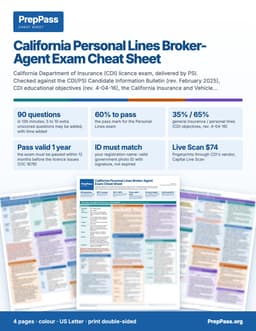
Thi trong vòng hai tuần?
Sách này là phần giảng dạy, đọc trong nhiều tuần. Nếu bạn thi trong vòng hai tuần, bảng tra cứu màu in được là sản phẩm còn lại: các con số then chốt, xếp theo từng phần.
4 trang · US Letter · PDF in được · giữ vĩnh viễn
Về chính kỳ thi này
| Cơ quan quản lý | Không có một cơ quan duy nhất: sở bảo hiểm của từng tiểu bang cấp phép bảo hiểm cá nhân và tự đặt kỳ thi, thường do một đơn vị khảo thí tổ chức. California do PSI Services LLC tổ chức; Texas do Pearson VUE. Hãy xem trang dữ kiện của tiểu bang bạn nếu PrepPass đã có. Những trang chúng tôi đã đọc và không tìm thấy: PSI / California Department of Insurance — Candidate Information Bulletin for California Insurance License Examinees (revised March 2026) |
|---|---|
| Số câu hỏi | Do từng tiểu bang quy định. Kỳ thi của California có 90 câu. Hãy xem trang dữ kiện của tiểu bang bạn nếu PrepPass đã có. Những trang chúng tôi đã đọc và không tìm thấy: PSI / California Department of Insurance — Candidate Information Bulletin for California Insurance License Examinees (revised March 2026) |
| Thời gian làm bài | Do từng tiểu bang quy định. California cho 135 phút; kỳ thi Personal Lines Property & Casualty của Texas cho 120 phút. Hãy xem trang dữ kiện của tiểu bang bạn nếu PrepPass đã có. Những trang chúng tôi đã đọc và không tìm thấy: PSI / California Department of Insurance — Candidate Information Bulletin for California Insurance License Examinees (revised March 2026) |
| Điểm đậu | Do từng tiểu bang quy định. California công bố 60%; sổ tay Texas của Pearson VUE công bố điểm quy đổi 70 trên thang 0–100 và nói rằng đó không phải phần trăm số câu đúng. Hãy xem trang dữ kiện của tiểu bang bạn nếu PrepPass đã có. Những trang chúng tôi đã đọc và không tìm thấy: CDI — Examination Times and Number of Questions (CDI website table; stale on languages and, for time limits, disagrees with the CIB) |
| Lệ phí | Do từng tiểu bang quy định. Sổ tay Texas của Pearson VUE ghi $39 mỗi lần thi cho kỳ thi Personal Lines Property & Casualty. Hãy xem trang dữ kiện của tiểu bang bạn nếu PrepPass đã có. Những trang chúng tôi đã đọc và không tìm thấy: Pearson VUE — Texas Insurance Licensing Candidate Handbook, October 2024 (#124400) |
| Ngôn ngữ thi | Do từng tiểu bang quy định; sổ tay Texas của Pearson VUE có bản tiếng Anh và tiếng Tây Ban Nha. Hãy xem trang dữ kiện của tiểu bang bạn nếu PrepPass đã có. Những trang chúng tôi đã đọc và không tìm thấy: Pearson VUE — Texas Insurance Licensing Candidate Handbook, October 2024 (#124400) |
Câu hỏi luyện tập và chương học miễn phí Personal Lines Insurance Producer →
Có gì — và không có gì
Bao gồm
- Homeowners: HO-2/3/4/5/6/8, Coverage A–F, and special limits
- Dwelling (DP-1/2/3) and the 'no liability in the base DP' trap
- Personal auto (PAP) Parts A–F, UM/UIM, and newly-acquired-auto rules
- Property fundamentals: coinsurance, ACV vs RC, NFIP flood
- 55 original practice questions with answer explanations
- PDF (print & tab it) + EPUB (phone / e-reader)
Không bao gồm
- Không gửi bản in — đây là tệp bạn tải về và có thể tự in
- Sách không kèm khoá video, giảng viên hay kèm riêng — video miễn phí trên trang là phần khác
- Không bao gồm lệ phí đăng ký thi hay phí trung tâm khảo thí — bạn vẫn nộp cho cơ quan chính thức
Mục lục
Xem 12 phần và trang bắt đầu của từng phần
- Chapter 1 — General Insurance Principlestr. 7
- Chapter 2 — Insurance Regulation, Licensing & Producer Ethicstr. 14
- Chapter 3 — Property Insurance Fundamentalstr. 20
- Chapter 4 — The Dwelling Policy (DP)tr. 27
- Chapter 5 — Homeowners Insurance (HO Forms)tr. 33
- Section I — The Property Coveragestr. 34
- Section II — Liability and Medical Paymentstr. 35
- Section I Exclusions (Homeowners)tr. 36
- Chapter 6 — Personal Auto Insurance (PAP)tr. 39
- Chapter 7 — State Overlays, Residual Markets & Catastrophe Perilstr. 46
- Chapter 8 — Endorsements, Personal Liability & Umbrellatr. 52
- Practice Exam — 55 Questionstr. 58
Lấy từ chính tệp PDF bạn tải về, kèm trang bắt đầu của từng phần — không phải gõ tay ở đây.
Đọc miễn phí trọn một chương
Trọn vẹn một chương, đúng như trong eBook. Cuộn cửa sổ để đọc ngay tại đây; không cần tải, không cần email.
Đọc chương 1 ngay tại đây, không rời trang
Before you ever quote a homeowners or personal auto policy, you need a vocabulary. This chapter covers the bedrock ideas every personal lines producer must master: which risks are insurable, how hazards differ from perils, the legal nature of an insurance contract, the duty of utmost good faith, and the doctrines — insurable interest, indemnity, subrogation, contribution — that keep insurance from turning into a wager. These concepts are truly national: they come from insurance law and industry practice, not from any one state's code, so nothing in this chapter is state-set. Expect roughly seven percent of the exam here, and expect it to test definitions and applications, not memorized statute language.
Risk, and What Makes a Risk Insurable
Risk is simply uncertainty about a future outcome. Insurance addresses only pure risk — a situation that can end in a loss or in no loss, but never in a gain. A house burning, a car being rear-ended, jewelry being stolen: each is a pure risk. Speculative risk carries three possibilities — loss, no change, or gain — like buying a stock or betting on a game. Speculative risk is not insurable, because insuring a chance to profit would create a wagering contract, which the law will not enforce.
To be insurable, a pure risk should also meet several practical conditions. A common memory aid is that an insurable loss should be definite (measurable in time, place, and amount), accidental (fortuitous, outside the insured's control — not intentional), part of a large group of similar exposure units (so the insurer can predict aggregate losses by the law of large numbers), not catastrophic to the insurer (one event should not bankrupt the pool the way an uninsured war or a single mega-hurricane could), calculable (frequency and severity can be estimated well enough to price), and economically feasible (the premium is small relative to the potential loss). This is why insurers reinsure or exclude flood, quake, and war — those perils threaten too many insureds at once.
Peril vs. Hazard
A peril is the actual cause of a loss — fire, theft, windstorm, a falling tree. A hazard is a condition that increases the chance a peril will occur or makes a resulting loss worse. The exam tests three kinds of hazard, and confusing them is a classic wrong answer.
- A physical hazard is a tangible condition: worn knob-and-tube wiring, an unfenced pool, a roof at the end of its life.
- A moral hazard is a dishonest tendency in the insured — a history of suspicious claims, or a desire to over-insure in order to profit from a loss. Moral hazards involve intent to cause or exaggerate loss.
- A morale hazard (sometimes "attitudinal hazard") is carelessness or indifference that arises because the person has insurance — leaving the front door unlocked because "the policy will pay." No dishonesty, just apathy.
Underwriters price physical hazards, decline or surcharge moral hazards, and try to educate against morale hazards.
The Insurance Contract and Its Special Nature
An insurance policy is a contract, so it needs the four elements of any contract: agreement (offer and acceptance), consideration (the premium in exchange for the insurer's promise to pay), legal capacity of both parties, and a legal purpose. Beyond those basics, insurance contracts carry four special characteristics that appear on nearly every exam:
- Aleatory — the dollars exchanged are unequal and depend on chance. An insured might pay one premium and collect a $400,000 loss, or pay for thirty years and never file a claim.
- Conditional — the insurer pays only if conditions are met: premium paid, prompt notice of loss, cooperation, proof of loss.
- Unilateral — only one party (the insurer) makes a legally enforceable promise. The insured can simply stop paying without being sued for breach; the insurer, once premium is paid, is bound.
- Adhesion — the insurer drafts the contract and offers it on a take-it-or-leave-it basis. Because the insured cannot negotiate the wording, courts construe any genuine ambiguity against the insurer (the drafter). This rule of construction is heavily tested.
A related idea: insurance contracts are contracts of utmost good faith (see below), and they rely on representations and warranties. A representation is a statement believed true when made; a warranty is a promise guaranteed to be true. In modern personal lines, most applicant statements are treated as representations.
The Anatomy of a Policy — and the Binder
Every personal-lines policy is assembled from the same four building blocks, remembered by the acronym DICE:
- Declarations — the who/what/where/how much page: named insured, address, policy period, limits, deductibles, premium.
- Insuring agreement — the insurer's core promise: what perils or claims it will pay for.
- Conditions — the rules both parties must follow for the promise to operate: duties after loss, appraisal, subrogation, cancellation.
- Exclusions — what the policy will not pay for, no matter how the loss occurred.
Endorsements are attached forms that modify the base contract — adding, removing, or reshaping coverage — and an endorsement controls over the base form wherever they conflict.
Before the policy itself is issued, an agent with binding authority may issue a binder: temporary evidence that coverage is in force, effective immediately, oral or written. A binder is not the policy and does not guarantee one will be issued; it simply holds coverage in place until the insurer issues the policy or declines the risk, at which point the binder ends. Exam questions like to test that a binder is temporary and that it is real coverage while it lasts.
Utmost Good Faith, Representations, and Concealment
An insurance contract is one of utmost good faith (Latin: uberrimae fidei). Both sides must deal honestly, and the applicant in particular must disclose information the insurer cannot easily verify. Three terms recur:
- A representation is a statement of fact made by the applicant before the policy takes effect. A misrepresentation is a false one. If it is material, the insurer may rescind (void) the policy.
- Concealment is silence — the failure to disclose a fact the applicant knows and ought to communicate. A material concealment also gives the insurer grounds to rescind.
- Materiality is the test that governs both: a fact is material if it would influence a prudent insurer's decision to accept the risk or set the premium. For property-casualty policies, materiality generally does not require proof of intent — even an innocent material misstatement can support rescission (whereas fraud requires intent).
Two doctrines cut the other way — they stop the insurer from going back on its own conduct. Waiver is the intentional relinquishment of a known right: an insurer that issues a policy knowing of a breach may be held to have waived the right to rely on it. Estoppel bars the insurer from asserting a defense after its words or conduct led the insured to reasonably rely to their detriment — an adjuster who tells the insured "you're covered, go ahead and repair" may estop the company from later denying on a technicality. Good faith runs in both directions.
(The specific statutory citations and the exact standard for rescission are [state-set]; the concepts are national.)
Insurable Interest — When It Must Exist
Insurable interest is the legal or financial stake an insured must have in the covered property or life. Without it, the contract is a wager and unenforceable. The rule that matters most in property insurance:
In property insurance, insurable interest must exist at the time of loss (it need not exist when the policy is bought). In life insurance, insurable interest must exist at policy inception (it need not exist at the time of the insured's death).
Sources of insurable interest in personal lines include direct ownership of a home or car, a mortgagee's lien on a dwelling, a lessee's interest in property, and a bailee's interest in property held for another. Classic trap: a homeowner sells the house, and the buyer's payment clears before a fire; the seller has no insurable interest at the moment of loss and cannot collect — even though premium was paid through the policy period.
Indemnity, Subrogation, and Contribution
Indemnity is the principle that insurance should restore the insured to the same financial position as before the loss — no better, no worse. It is what keeps property insurance from becoming a profit center. Most personal lines property policies are contracts of indemnity, paying actual cash value or replacement cost up to the limit and never more than the actual loss. (Valued policies and some replacement-cost settlements are limited exceptions.)
Subrogation is indemnity's enforcement arm. Once the insurer pays the insured for a covered loss, it steps into the insured's shoes and may pursue any responsible third party to recover what it paid. If a neighbor's contractor negligently starts a fire that damages the insured's home, the insurer pays the homeowner, then sues the contractor. Two rules follow: the insured may not collect twice (once from the insurer, once from the wrongdoer) because that would violate indemnity, and the insured may not sign away the insurer's subrogation rights after a loss.
Contribution (and the Other Insurance clause) governs when more than one policy covers the same loss. The most common personal-lines method is pro rata: each insurer pays the share of the loss that its limit bears to the total of all applicable limits. If two policies cover the same dwelling for $400,000 and $200,000 and the loss is $300,000, the first pays two-thirds ($200,000) and the second one-third ($100,000). Contribution prevents the insured from profiting by stacking overlapping policies.
How Insurers Are Classified
Insurers are grouped by ownership and by regulatory status:
- A stock insurer is owned by shareholders; profits go to shareholders as dividends, and policyholders are simply customers.
- A mutual insurer is owned by its policyholders; surplus may be returned to insureds as policyholder dividends, which are not guaranteed.
- A reciprocal exchange is an unincorporated group whose subscribers insure each other through an attorney-in-fact.
- An admitted (authorized) insurer holds a certificate of authority from the state, is regulated for rates and forms, and participates in the state guaranty association that pays covered claims if the insurer becomes insolvent.
- A non-admitted (surplus lines) insurer is not licensed in the state; its policies are placed through a surplus lines broker only for risks the admitted market will not write, and its insureds generally get no guaranty-association protection.
(Guaranty-association names, coverage caps, and surplus-lines rules are [state-set]; the categories are national.)
Key Numbers & Facts — Chapter 1 - Insurance covers pure risk only (loss or no loss), never speculative risk (loss/no change/gain). - Peril = cause of loss; hazard = something that raises the chance/severity. Physical / moral (dishonesty) / morale (carelessness). - Four special contract traits: aleatory, conditional, unilateral, adhesion. Ambiguity is read against the insurer. - Policy anatomy = DICE: Declarations, Insuring agreement, Conditions, Exclusions (+ endorsements modify). A binder = temporary, immediate evidence of coverage until the policy issues or is declined. - Utmost good faith; a material misrepresentation or concealment can let the insurer rescind. Property-casualty materiality generally needs no proof of intent. - Waiver = insurer intentionally gives up a known right; estoppel = insurer barred from a defense after the insured relied on its conduct. - Insurable interest: property = at time of loss; life = at inception. - Indemnity = made whole, no more. Subrogation = insurer pursues the at-fault third party. Contribution/pro rata = insurers share by limits. - Stock (shareholders) vs. mutual (policyholders); admitted (guaranty-fund protected) vs. non-admitted/surplus (not).
Worked Example. A homeowner tells her agent she has "never had a claim," when in fact she had two water-damage claims two years ago that she genuinely forgot. A pipe bursts; the insurer's investigation surfaces the prior claims. Can the insurer rescind? Likely yes: prior claims are material (they influence acceptance and pricing), and for a property policy the misrepresentation need not be intentional to be grounds for rescission. Her honest forgetfulness does not save the policy. The lesson for a producer: help clients answer application questions completely, because an innocent material error can void coverage after a loss.
Exam Traps.
- Moral vs. morale. Moral = dishonesty (padding a claim). Morale = carelessness born of having insurance (leaving keys in the car). Test-writers swap these constantly.
- Peril vs. hazard. Fire is a peril; the frayed wiring that started it is a hazard.
- Insurable-interest timing. Property = time of loss; life = inception. A choice that says "property insurance requires insurable interest when the policy is issued" is wrong.
- Unilateral. Only the insurer makes an enforceable promise. Do not pick "bilateral."
- Ambiguity is construed against the drafter (insurer) — a consequence of adhesion, not of good faith.
- A binder is coverage, but temporary. "No coverage exists until the policy is delivered" is wrong when a binder was issued; "a binder guarantees the policy will be issued" is wrong too.
Trước khi mua
- Nhận sách thế nào?
- Thanh toán xong, mục tải xuống hiện ngay trên trang này. Liên kết cũng được gửi qua email. Không cần tài khoản.
- Nếu sách không hợp thì sao?
- Gửi email trong vòng 14 ngày để được hoàn tiền đầy đủ, không cần lý do.
- Phần luyện tập miễn phí có bị bỏ không?
- Không. Mọi câu hỏi luyện tập, bài thi thử tính giờ và các chương miễn phí trên trang vẫn miễn phí. Cuốn sách là nửa "học", không phải hàng rào quanh phần miễn phí.
- Đọc trên điện thoại được không?
- Được — EPUB cho điện thoại và máy đọc sách, PDF để in và dán tab. Bạn nhận cả hai.
Chi tiết
The personal subset of P&C — homeowners, dwelling, personal auto, renters/condo, and umbrella — with HO forms, PAP parts, and coinsurance worked examples.
- Format: PDF + EPUB download · 70 pages
- 55 practice questions in the book, with a full answer key
- 324 free practice questions for this exam on PrepPass, included at no cost
- $19.99 one-time — no subscription
- 14-day money-back guarantee · refund policy
- Cross-referenced against: ISO personal-lines forms / NFIP / NAIC model acts
- Last updated: September 2026
- Đối chiếu từ nguồn chính thức(ISO personal-lines forms / NFIP / NAIC model acts)
- 324 câu hỏi luyện tập miễn phí
- Tải ngay, thuộc về bạn trọn đời
Một insurance pre-license course có giá $100–$500. Cuốn sách này dạy cùng một kỳ thi — cùng quy định, đối chiếu theo chuẩn hiện hành — chỉ với $19.99 trả một lần, thuộc về bạn trọn đời.
Vì sao mua sách khi phần luyện tập miễn phí?
Câu hỏi luyện tập và bài thi thử tính giờ vẫn miễn phí — không có gì trên trang bị giấu sau cuốn sách này. Cuốn sách $19.99 là nửa "học": chính phần kiến thức, dạy theo trình tự, trong một tệp thuộc về bạn.
- Dạy có hệ thống — mọi phần thi giảng theo từng chương, từ đầu đến cuối, không chỉ là câu hỏi
- In ra & dán nhãn — PDF sẵn sàng để in, tô đậm, ghi chú và mang tới bàn học
- Học mọi nơi, ngoại tuyến — EPUB trên điện thoại hay máy đọc sách; không cần wifi, không cần tab trình duyệt
- Tất cả một chỗ — các chương và câu hỏi luyện tập trong một tệp
- Của bạn trọn đời — trả một lần $19.99, tải ngay, không thuê bao
Và không rủi ro: Đảm bảo hoàn tiền 14 ngày — không hài lòng? Email cho chúng tôi để hoàn tiền đầy đủ, không cần lý do. Xem chính sách hoàn tiền.
Đảm bảo hoàn tiền 14 ngày · hoàn tiền đầy đủ, không cần lý do.
Mua một lần, truy cập tải về trọn đời. eBook là trọn bộ hướng dẫn ôn Personal Lines Insurance Producer ở dạng PDF và EPUB. Bản tóm tắt mang tính giáo dục, không phải tư vấn chuyên môn hay pháp lý — luôn xác nhận quy định hiện hành với nguồn chính thức. Cập nhật lần cuối: September 2026.