California Guard Card (BSIS Security Guard) · Ấn bản 2026
California Guard Card — Complete Study Guide (2026)
Powers to arrest, appropriate use of force, liability, observation & report writing, and terrorism awareness — California statute, cited to BSIS + Penal Code.
- 50 câu hỏi luyện tập trong sách, kèm đáp án đầy đủ
- 89 trang giảng giải theo từng chương — không phải một đống câu hỏi
- Đối chiếu với CA BSIS / B&P §7580+ / Penal Code / 16 CCR
$9.99trả một lần · tải trọn đời · không thuê bao
PDF + EPUB · tiếng Anh · 89 trang · $9.99 trả một lần
Sách này được viết bằng tiếng Anh — tệp PDF và EPUB bạn tải về đều bằng tiếng Anh.
Tải ngay sau khi thanh toán — không cần tài khoản, không thuê bao.
Đảm bảo hoàn tiền 14 ngày: không hài lòng vì bất kỳ lý do gì? Email support@preppass.org trong vòng 14 ngày kể từ khi mua để được hoàn tiền đầy đủ. Đây là bản tải xuống nên không phải gửi trả gì cả. Chính sách hoàn tiền
Thông tin kỳ thi được đối chiếu với nguồn chính thức lần gần nhất: tháng 9 năm 2026.
Thử 10 câu trước — miễn phí
Trả lời hết 10 câu, nộp bài xong sẽ thấy lời giải từng câu — kèm phần trong sách này dạy nội dung đó. Khoảng 5 phút, không cần đăng ký.
Bắt đầu 10 câu miễn phíXem bên trong cuốn sách
Ba trang thật, kết xuất thẳng từ tệp PDF bạn sẽ tải — lần lượt là một trang tra cứu, một trang giảng giải, và một câu hỏi có lời giải. Không trang nào được vẽ lại cho đẹp.
- Trang tra cứu nhanhChapter 2 — Appropriate Use of Force · Trang 28 của PDF
Một trang để lật lại: các con số, mốc thời hạn hoặc thuật ngữ gom về một chỗ.
- Cách giảng dạyChapter 1 — Powers to Arrest · Trang 12 của PDF
Trang giảng giải: kiến thức được trình bày bằng văn xuôi, theo trình tự kỳ thi kiểm tra.
- Một câu hỏi có lời giảiPart II — Practice Exam · Trang 66 của PDF
Một câu luyện tập kèm đáp án và lập luận đằng sau — không chỉ là đáp án.
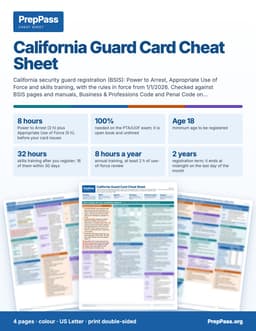
Thi trong vòng hai tuần?
Sách này là phần giảng dạy, đọc trong nhiều tuần. Nếu bạn thi trong vòng hai tuần, bảng tra cứu màu in được là sản phẩm còn lại: các con số then chốt, xếp theo từng phần.
4 trang · US Letter · PDF in được · giữ vĩnh viễn
Về chính kỳ thi này
| Cơ quan quản lý | Bureau of Security and Investigative Services (BSIS), California Department of Consumer Affairs — kỳ thi do a BSIS-approved training school, or the employer where it has a Bureau-qualified instructor tổ chức Nguồn: 16 CCR § 628(b) — BSIS Regulations (BSIS-published compilation, PDF) |
|---|---|
| Số câu hỏi | BSIS không công bố Những trang chúng tôi đã đọc và không tìm thấy: BSIS — Power to Arrest Answer Key (released to instructors on request) |
| Thời gian làm bài | Bài thi không tính giờ: BSIS yêu cầu người tổ chức cho phép làm bài không giới hạn thời gian. Cái BSIS quy định là thời lượng khóa học — Power to Arrest 3 giờ, Appropriate Use of Force 5 giờ — chứ không phải thời lượng bài thi. Những trang chúng tôi đã đọc và không tìm thấy: BSIS — Power to Arrest and Appropriate Use of Force Training Manual (revised July 2023, PDF) |
| Điểm đậu | 100% Nguồn: 16 CCR § 628(b) — BSIS Regulations (BSIS-published compilation, PDF) |
| Lệ phí |
Nguồn: BSIS — Licensing Fees (fee schedule dated September 2025, PDF) |
| Ngôn ngữ thi | BSIS không công bố Những trang chúng tôi đã đọc và không tìm thấy: BSIS — Resources and Training Materials |
Câu hỏi luyện tập và chương học miễn phí California Guard Card (BSIS Security Guard) →
Có gì — và không có gì
Bao gồm
- Every chapter ends the same way: key numbers & deadlines, the exam traps named one by one, and the takeaways — so the night before is a re-read, not a re-study
- A worked California example in each chapter: the rule applied to a real guard scenario
- Powers to arrest vs peace-officer arrest; citizen's arrest (PC §837)
- Appropriate use of force (PC §835a) and the observe-and-report rule
- Liability, detention limits, and merchant's privilege (PC §490.5(f))
- Observation, documentation, and courtroom-ready report writing
- 50 original practice questions with answer explanations
- PDF (print & tab it) + EPUB (phone / e-reader)
Không bao gồm
- Không gửi bản in — đây là tệp bạn tải về và có thể tự in
- Sách không kèm khoá video, giảng viên hay kèm riêng — video miễn phí trên trang là phần khác
- Không bao gồm lệ phí đăng ký thi hay phí trung tâm khảo thí — bạn vẫn nộp cho cơ quan chính thức
Mục lục
Xem 11 phần và trang bắt đầu của từng phần
- Part I — The Study Guidetr. 8
- Chapter 1 — Powers to Arresttr. 9
- Chapter 2 — Appropriate Use of Forcetr. 22
- Chapter 3 — Liability & Legal Aspectstr. 31
- Chapter 4 — Observation, Documentation & Report Writingtr. 39
- Chapter 5 — Communication, Public Relations & Ethicstr. 46
- Chapter 6 — Emergency Procedures & Officer Safetytr. 53
- Chapter 7 — Terrorism Awareness & Weapons of Mass Destructiontr. 59
- Part II — Practice Examtr. 66
- Part III — Answer Key & Explanationstr. 79
- Appendix — Quick statute & standard referencetr. 88
Lấy từ chính tệp PDF bạn tải về, kèm trang bắt đầu của từng phần — không phải gõ tay ở đây.
Đọc miễn phí trọn một chương
Trọn vẹn một chương, đúng như trong eBook. Cuộn cửa sổ để đọc ngay tại đây; không cần tải, không cần email.
Đọc chương 4 ngay tại đây, không rời trang
Chúng tôi không đưa phần mở đầu dễ dãi — chương miễn phí mở thẳng vào một trong những phần đậm đặc nhất của cuốn sách, để bạn đánh giá cách dạy ở đúng chỗ kỳ thi trở nên khó.
Introduction
A security guard's real product is information — accurate observation, clearly documented, delivered to the people who need it. The camera does not testify; you do. A theft, an assault, a slip-and-fall, a use of force: months later, the only reliable record of what happened is the report you wrote and the notes behind it. A vague, editorial, or contradictory report loses cases; a specific, factual, chronological one wins them. This chapter teaches you to see deliberately, note contemporaneously, and write in a way that would satisfy a judge reading it five years from now.
It covers patrol technique and situational awareness, the discipline of note-taking and the 5W + H report structure, systematic suspect and vehicle descriptions, and the legal limits on photography and audio recording in a two-party-consent state.
Learning objectives
After working through this chapter you should be able to:
- Patrol with varied patterns and situational awareness (Cooper's color codes; the OODA loop), using all your senses.
- Take contemporaneous notes and write a report answering Who, What, When, Where, Why, How with facts, not conclusions.
- Give a systematic head-to-toe suspect description and a CYMBALS vehicle description.
- Apply the two-party consent rule for audio (Penal Code §632) and the privacy limits on recording (Penal Code §647(j)), and treat images as evidence.
- Explain how contemporaneous notes refresh recollection for later testimony (Evidence Code §771).
Part A — Patrol patterns and situational awareness
Good patrols are neither random wandering nor predictable loops. A predictable patrol teaches a hostile actor exactly when you will be at the back dock; a varied patrol — changing direction, timing, and route, with deliberate pauses to listen — denies them that. Practical habits: walk against vehicle traffic so you can see drivers; use your nose (smoke, fuel, marijuana often register before anything is visible) and your ears (breaking glass, raised voices, alarms) as much as your eyes.
Two mental models anchor awareness:
- Cooper's color codes. White = oblivious (never acceptable on duty); Yellow = relaxed alert (your normal on-duty baseline); Orange = a specific possible threat identified, plan forming; Red = acting on the threat. Live in Yellow.
- The OODA loop. Observe, Orient, Decide, Act — cycle continuously so you keep updating on fresh information instead of locking onto your first guess.
Your post orders define the patrol path; your awareness determines whether the patrol accomplishes anything.
Part B — Notes and reports: the 5W + H, written contemporaneously
Every incident report answers six questions:
- Who — everyone involved, with full names where available, detailed descriptions where not, witness contact information, and your own name and post.
- What — what happened, in plain chronological order, with concrete facts ("the man swung his right fist at the cashier"), not conclusions ("he became aggressive").
- When — specific times from your watch or radio log, for each step.
- Where — the exact location on the property, detailed enough that a stranger could find it.
- Why — the hardest box: stick to facts and reported statements; do not guess at motive unless the subject told you.
- How — how the events unfolded and how they were resolved.
Take notes during the incident if it is safe, or immediately after while it is fresh. The bridge from raw notes to clean report to courtroom testimony months later is California Evidence Code §771, which allows a witness to refresh recollection from a writing made when the events were fresh. Two rules make a report defensible: write facts over conclusions ("the subject said he had three beers," not "the subject was drunk"), and apply the stranger test — could someone who was not there reconstruct what happened from your report alone? If not, rewrite it.
Part C — Suspect and vehicle descriptions that hold up
Build a suspect description head to toe so a responding officer can broadcast it without gaps: gender and approximate age; race/ethnicity if discernible; height and build; hair (color, length, style); eyes; facial hair, glasses, scars, tattoos; hat; shirt and outerwear with colors; pants; shoes; anything in the hands; and direction of travel. Practice the sequence out loud on slow shifts — the time to learn the script is not while someone is running away.
For vehicles, a common California mnemonic is CYMBALS: Color, Year, Make, Body style, All other (damage, decals, distinguishing marks), License, State. The license plate beats every other identifier — get it first if you can; if you cannot, get a partial plate and the state. For weapons, describe what you actually saw ("a black semi-automatic pistol with a stainless slide"), rather than guessing make and model. Use compass directions for travel, not "that way."
Part D — Photography, recording, and privacy
Phones make documentation easy and legally complicated at once.
- Video without sound, in a public space or your employer's premises where there is no reasonable expectation of privacy, is generally allowed.
- Audio is the harder line. California is a two-party (all-party) consent state under Penal Code §632: it is a crime to record a confidential communication without the consent of all parties. Body cameras that capture audio in private areas implicate §632 — know whether your company policy or a posted written notice supplies the needed consent.
- Privacy crimes. Penal Code §647(j) makes it a crime to photograph or record a person in a place where they have a reasonable expectation of privacy — restrooms, dressing rooms, hotel rooms — even with no audio.
- Treat images as evidence. Do not edit them, do not post them to social media, and turn them over to your supervisor with a clear chain of custody.
Write and photograph as if a judge will read and view it tomorrow — because one might.
California worked example
At 9:42 p.m. a guard hears glass break near the loading dock, moves to Yellow-to-Orange, and sees a man throw a laptop bag over a fence and run west toward Elm Street in a gray hooded sweatshirt.
The report writes itself if the observation was disciplined. When: 9:42 p.m. (from the radio log). Where: northeast loading dock, exterior. Who/What (facts): "I heard glass breaking; I observed a male adult, approximately 20–30, ~5'10", medium build, gray hooded sweatshirt, dark pants, throw a dark laptop bag over the north fence and run west on Elm Street." Suspect description head-to-toe, finishing with direction of travel (west). Vehicle, if one was used, in CYMBALS order with the plate captured first. The guard does not write "the burglar" (a conclusion) but "a male adult who threw a bag and fled." If the guard used a phone to photograph the broken window, those images are evidence — unedited, handed to the supervisor, not posted anywhere. Notes taken now let the guard refresh recollection (Evidence Code §771) if called to testify next year.
Key numbers & deadlines
Awareness models: Cooper's color codes (White / Yellow / Orange / Red — operate in Yellow); OODA loop (Observe, Orient, Decide, Act). Vary patrol patterns; use all senses. Report structure: 5W + H (Who, What, When, Where, Why, How); chronological, specific times/names/locations, facts over conclusions. Descriptions: suspect head-to-toe, ending with direction of travel; vehicle CYMBALS (Color, Year, Make, Body, All-other, License, State). Plate beats all other IDs. Recording law: audio = two-party consent, Penal Code §632 (crime to record a confidential communication without all-party consent). Penal Code §647(j) — criminal invasion of privacy (restrooms, dressing rooms, etc.). Treat images as evidence (no edits, chain of custody). Testimony: contemporaneous notes refresh recollection — Evidence Code §771.
Named exam traps
- "A good patrol follows the same reliable route every time." No — predictable patrols are exploitable. Vary route and timing.
- "Write your conclusion so it's clear ('he was drunk / he was the thief')." No — write facts ("said he had three beers"; "threw a bag and fled"). Conclusions belong to others.
- "Guess the make and model of the gun so the report looks complete." No — describe what you saw. Guessing invents evidence.
- "You can record any conversation on duty." No — audio needs all-party consent (§632); recording a confidential conversation without it is a crime.
- "A photo is just a photo — edit or share it freely." No — images are evidence; no edits, no social media, keep a chain of custody. Recording in restrooms/dressing rooms violates §647(j).
- "Notes don't matter once you file the report." No — contemporaneous notes are what let you refresh recollection (Evidence Code §771) in court months later.
Key takeaways
- Patrol with varied patterns and stay in Cooper's Yellow; run the OODA loop and use every sense.
- Write 5W + H, chronological, specific, and factual — pass the stranger test.
- Describe suspects head-to-toe (end with direction of travel) and vehicles by CYMBALS, capturing the plate first.
- Audio recording needs all-party consent (§632); respect privacy (§647(j)); treat images as evidence.
- Contemporaneous notes refresh recollection at trial (Evidence Code §771).
Sources
Cited to leginfo.legislature.ca.gov (Penal Code, Evidence Code). Awareness models (Cooper's color codes, OODA, CYMBALS) are standard security-training frameworks, not statutes.
- Cal. Penal Code §632 — recording of confidential communications (two-party consent).
- Cal. Penal Code §647(j) — invasion of privacy by recording/photography.
- Cal. Evidence Code §771 — refreshing recollection from a writing.
- Security-training frameworks: Cooper's color codes; the OODA loop (J. Boyd); CYMBALS vehicle- description mnemonic; the 5W + H report standard.
Trước khi mua
- Nhận sách thế nào?
- Thanh toán xong, mục tải xuống hiện ngay trên trang này. Liên kết cũng được gửi qua email. Không cần tài khoản.
- Nếu sách không hợp thì sao?
- Gửi email trong vòng 14 ngày để được hoàn tiền đầy đủ, không cần lý do.
- Phần luyện tập miễn phí có bị bỏ không?
- Không. Mọi câu hỏi luyện tập, bài thi thử tính giờ và các chương miễn phí trên trang vẫn miễn phí. Cuốn sách là nửa "học", không phải hàng rào quanh phần miễn phí.
- Đọc trên điện thoại được không?
- Được — EPUB cho điện thoại và máy đọc sách, PDF để in và dán tab. Bạn nhận cả hai.
Chi tiết
Powers to arrest, appropriate use of force, liability, observation & report writing, and terrorism awareness — California statute, cited to BSIS + Penal Code.
- Format: PDF + EPUB download · 89 pages
- 50 practice questions in the book, with a full answer key
- 200 free practice questions for this exam on PrepPass, included at no cost
- $9.99 one-time — no subscription
- 14-day money-back guarantee · refund policy
- Cross-referenced against: CA BSIS / B&P §7580+ / Penal Code / 16 CCR
- Last updated: September 2026
- Đối chiếu từ nguồn chính thức(CA BSIS / B&P §7580+ / Penal Code / 16 CCR)
- 200 câu hỏi luyện tập miễn phí
- Tải ngay, thuộc về bạn trọn đời
Một BSIS guard card training course có giá $50–$150. Cuốn sách này dạy cùng một kỳ thi — cùng quy định, đối chiếu theo chuẩn hiện hành — chỉ với $9.99 trả một lần, thuộc về bạn trọn đời.
Vì sao mua sách khi phần luyện tập miễn phí?
Câu hỏi luyện tập và bài thi thử tính giờ vẫn miễn phí — không có gì trên trang bị giấu sau cuốn sách này. Cuốn sách $9.99 là nửa "học": chính phần kiến thức, dạy theo trình tự, trong một tệp thuộc về bạn.
- Dạy có hệ thống — mọi phần thi giảng theo từng chương, từ đầu đến cuối, không chỉ là câu hỏi
- In ra & dán nhãn — PDF sẵn sàng để in, tô đậm, ghi chú và mang tới bàn học
- Học mọi nơi, ngoại tuyến — EPUB trên điện thoại hay máy đọc sách; không cần wifi, không cần tab trình duyệt
- Tất cả một chỗ — các chương và câu hỏi luyện tập trong một tệp
- Của bạn trọn đời — trả một lần $9.99, tải ngay, không thuê bao
Và không rủi ro: Đảm bảo hoàn tiền 14 ngày — không hài lòng? Email cho chúng tôi để hoàn tiền đầy đủ, không cần lý do. Xem chính sách hoàn tiền.
Đảm bảo hoàn tiền 14 ngày · hoàn tiền đầy đủ, không cần lý do.
Mua một lần, truy cập tải về trọn đời. eBook là trọn bộ hướng dẫn ôn California Guard Card (BSIS Security Guard) ở dạng PDF và EPUB. Bản tóm tắt mang tính giáo dục, không phải tư vấn chuyên môn hay pháp lý — luôn xác nhận quy định hiện hành với nguồn chính thức. Cập nhật lần cuối: September 2026.