Cosmetology State Board · Ấn bản 2026
Cosmetology State Board Exam — Complete Study Guide (2026)
The NIC-based written theory exam — infection control plus hair, skin, and nail science.
- 64 câu hỏi luyện tập trong sách, kèm đáp án đầy đủ
- 88 trang giảng giải theo từng chương — không phải một đống câu hỏi
- Đối chiếu với NIC content outline / EPA / OSHA
$14.99trả một lần · tải trọn đời · không thuê bao
PDF + EPUB · tiếng Anh · 88 trang · $14.99 trả một lần
Sách này được viết bằng tiếng Anh — tệp PDF và EPUB bạn tải về đều bằng tiếng Anh.
Tải ngay sau khi thanh toán — không cần tài khoản, không thuê bao.
Đảm bảo hoàn tiền 14 ngày: không hài lòng vì bất kỳ lý do gì? Email support@preppass.org trong vòng 14 ngày kể từ khi mua để được hoàn tiền đầy đủ. Đây là bản tải xuống nên không phải gửi trả gì cả. Chính sách hoàn tiền
Vui lòng đọc trước khi mua: Not written for California's exam: this book follows the NIC national content outline and does not teach California's own laws and rules.
Đọc phần còn lại của thông báo
California's written exam has been PSI's national exam since July 2022; if you test there, read PSI's California content outline alongside this book.
Thử 10 câu trước — miễn phí
Trả lời hết 10 câu, nộp bài xong sẽ thấy lời giải từng câu — kèm phần trong sách này dạy nội dung đó. Khoảng 5 phút, không cần đăng ký.
Bắt đầu 10 câu miễn phíXem bên trong cuốn sách
Ba trang thật, kết xuất thẳng từ tệp PDF bạn sẽ tải — lần lượt là một trang tra cứu, một trang giảng giải, và một câu hỏi có lời giải. Không trang nào được vẽ lại cho đẹp.
- Trang tra cứu nhanh7. Nail Care — Manicuring & Pedicuring · Trang 67 của PDF
Một trang để lật lại: các con số, mốc thời hạn hoặc thuật ngữ gom về một chỗ.
- Cách giảng dạy7. Nail Care — Manicuring & Pedicuring · Trang 60 của PDF
Trang giảng giải: kiến thức được trình bày bằng văn xuôi, theo trình tự kỳ thi kiểm tra.
- Một câu hỏi có lời giảiChapter 1 — Infection Control, Safety & Sanitation · Trang 69 của PDF
Một câu luyện tập kèm đáp án và lập luận đằng sau — không chỉ là đáp án.
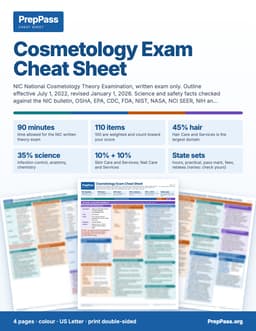
Thi trong vòng hai tuần?
Sách này là phần giảng dạy, đọc trong nhiều tuần. Nếu bạn thi trong vòng hai tuần, bảng tra cứu màu in được là sản phẩm còn lại: các con số then chốt, xếp theo từng phần.
4 trang · US Letter · PDF in được · giữ vĩnh viễn
How this book compares
Since 1 July 2022 California's Board of Barbering and Cosmetology has given the national written exam developed by PSI, and the Board links PSI's candidate bulletin with each exam's content outline. This book is written from the NIC national content outline, not from PSI's California outline, and does not teach California's own laws and rules.
| Resource | Price | What you get | Choose it if |
|---|---|---|---|
| This bookCosmetology State Board Exam — Complete Study Guide (2026)PrepPass | $14.99 | Downloadable review of the science on cosmetology written (theory) exams
| Choose this book for infection control and hair, skin and nail science taught in writing. Read your own state's exam outline and rules alongside it; California's law is not in this book. |
| From the exam bodyPSI Candidate Information Bulletin and content outlines (opens the publisher's page in a new tab)PSI, for the California Board of Barbering and Cosmetology | Free, linked from the Board's exam page | The outline and reference list California's written exam is built from | Read it in any case if you test in California: it is the outline your exam is written to. |
| AlternativeCosmetology Exam Secrets (opens the publisher's page in a new tab)Mometrix Test Preparation | $39.99 ebook; $44.99 printed book | Study guide with practice questions | Choose Mometrix if you want a printed copy. |
This book
Cosmetology State Board Exam — Complete Study Guide (2026)
PrepPass
- Price
- $14.99
- What you get
Downloadable review of the science on cosmetology written (theory) exams
- 64 practice questions with explanations
- 88 pages, PDF + EPUB
- Choose it if
- Choose this book for infection control and hair, skin and nail science taught in writing. Read your own state's exam outline and rules alongside it; California's law is not in this book.
From the exam body
PSI Candidate Information Bulletin and content outlines (opens the publisher's page in a new tab)
PSI, for the California Board of Barbering and Cosmetology
- Price
- Free, linked from the Board's exam page
- What you get
The outline and reference list California's written exam is built from
- Choose it if
- Read it in any case if you test in California: it is the outline your exam is written to.
Alternative
Cosmetology Exam Secrets (opens the publisher's page in a new tab)
Mometrix Test Preparation
- Price
- $39.99 ebook; $44.99 printed book
- What you get
Study guide with practice questions
- Choose it if
- Choose Mometrix if you want a printed copy.
Other resources' prices and contents are as listed on each publisher's or seller's own page, checked September 24, 2026. Prices change; confirm on the linked page before you buy. This book's price and contents come from our own catalog.
Sources (2)
- https://www.barbercosmo.ca.gov/applicants/national.shtml — read September 24, 2026
- https://www.mometrix.com/studyguides/cosmetology/ — read September 24, 2026
Có gì — và không có gì
Bao gồm
- A “key facts” cram box in every chapter — the numbers, times and disinfectant rules on one page each
- A worked scenario and the exam traps, chapter by chapter, so you practice the wording the board actually uses
- All 4 NIC theory domains, weighted like the NIC written exam
- Infection control: EPA-registered disinfectants, wet disinfection, OSHA bloodborne
- Verified science: pH, the acid mantle, peroxide volumes, oxidation-color chemistry
- Hair, skin, and nail structure, disorders, and services
- 64 original practice questions with answer explanations
- State-set rules taught and flagged — confirm the numbers with your board
Không bao gồm
- Không gửi bản in — đây là tệp bạn tải về và có thể tự in
- Sách không kèm khoá video, giảng viên hay kèm riêng — video miễn phí trên trang là phần khác
- Không bao gồm lệ phí đăng ký thi hay phí trung tâm khảo thí — bạn vẫn nộp cho cơ quan chính thức
Mục lục
Xem 11 phần và trang bắt đầu của từng phần
- 7. Nail Care — Manicuring & Pedicuringtr. 58
- Practice Questionstr. 69
- Chapter 1 — Infection Control, Safety & Sanitationtr. 69
- Chapter 2 — Anatomy & Physiologytr. 71
- Chapter 3 — Bacteriology, Chemistry, Electricity & Lighttr. 72
- Chapter 4 — Hair Care Servicestr. 74
- Chapter 5 — Chemical Texture & Haircoloringtr. 76
- Chapter 6 — Skin Care & Facialstr. 77
- Chapter 7 — Nail Caretr. 79
- Chapter 8 — Salon Business & Ethicstr. 81
- Answer Key & Explanationstr. 83
Lấy từ chính tệp PDF bạn tải về, kèm trang bắt đầu của từng phần — không phải gõ tay ở đây.
Đọc miễn phí trọn một chương
Trọn vẹn một chương, đúng như trong eBook. Cuộn cửa sổ để đọc ngay tại đây; không cần tải, không cần email.
Đọc chương 1 ngay tại đây, không rời trang
Introduction
If the exam had a single most important chapter, this is it — and not only because a large block of questions comes from it. Infection control is the part of cosmetology where a mistake can actually hurt a client, which is exactly why every state board writes it into law and why the NIC blueprint lists it first. The good news is that this material is highly learnable: it is definitions, a short hierarchy of "how clean is clean," a handful of disease-causing organisms, and a set of rules from two federal agencies — the EPA and OSHA — that the outline names directly.
The traps here are careful distinctions the exam builds wrong answers out of. Cleaning is not disinfection, and neither is sterilization. A single-use (disposable) item is not the same as a multi-use (reusable) item, and the two are handled in opposite ways. An EPA-registered hospital-grade disinfectant is a specific legal category, not just "a strong cleaner." And the number of minutes an implement must sit in that disinfectant is not a national fact — it is set by your state board. Learn the concept, and flag the number.
This chapter covers the three levels of decontamination; the categories of infection-causing organisms (bacteriology in brief — we return to it in Chapter 3); how disease is transmitted and how cross-contamination is prevented; EPA-registered disinfectants and correct "wet disinfection"; single-use versus multi-use tools; and the OSHA rules — the Bloodborne Pathogens Standard and Safety Data Sheets — that govern a blood-exposure incident and every chemical on your shelf.
Learning objectives
After this chapter you should be able to:
- Rank the three levels of decontamination — sterilization > disinfection > cleaning (sanitation) — and state what each does and does not destroy.
- Explain why a salon disinfects (it does not sterilize) most tools, and what an EPA-registered, hospital-grade disinfectant must be labeled to kill.
- Perform correct immersion ("wet") disinfection: fully submerge a cleaned implement for the manufacturer's stated contact time in a covered container, made fresh per the label.
- Distinguish single-use (disposable) items — used once, then thrown away — from multi-use (reusable) items that can be cleaned and disinfected.
- Identify the roles of the EPA (registers disinfectants) and OSHA (worker safety — Bloodborne Pathogens Standard and Hazard Communication / Safety Data Sheets).
- Apply a correct blood-exposure (exposure-incident) procedure, and recognize that the rule on discarding vs. disinfecting a blood-contaminated implement is state-set.
- Recognize the main routes of disease transmission and how cross-contamination is prevented in a salon.
Part A — The three levels of decontamination
"Decontamination" is the removal of pathogens and dirt from tools and surfaces. There are three levels, and the exam tests the order and the boundary between them constantly.
- Cleaning (sanitizing) — the lowest level. Mechanically removing visible dirt, debris, oils, and most microbes with soap or detergent and water. Cleaning reduces the number of organisms; it does not kill enough of them to make a tool safe on its own. Cleaning is always the required first step before disinfection — a disinfectant cannot work through a layer of hair, oil, or product. In salons, "sanitizing" (for example, a hand sanitizer, or wiping a station) is this lowest level.
- Disinfection — the middle level, and the salon's workhorse. Using a chemical agent (an EPA-registered disinfectant) to destroy most microorganisms on hard, non-porous surfaces and implements. Disinfection is strong enough to control disease on tools like metal shears, combs, and nippers, but it does not kill bacterial spores. This is the level state boards require for multi-use implements between clients.
- Sterilization — the highest level. Destroying all microbial life, including bacterial spores. True sterilization requires an autoclave (steam under pressure). Salons rarely sterilize; it is mostly relevant where instruments break the skin. Because most cosmetology tools do not need it, the correct salon standard for reusable tools is disinfection, not sterilization — a favorite exam distinction.
Memory hook: C-D-S climbs uphill — Clean, then Disinfect, and only medical/ spore situations need Sterilize. You always clean before you disinfect.
Source: NIC Content Outline I-A-2 (differentiate sanitation, disinfection, sterilization). Sterilization defined as destruction of all microbial life including spores; disinfection does not kill spores — standard EPA/CDC framework.
Part B — The organisms you are controlling (bacteriology in brief)
You are disinfecting against something. The exam expects you to know the broad categories. (Chapter 3 revisits bacterial shapes in detail.)
- Bacteria — one-celled microorganisms. Pathogenic (disease-causing, "harmful") bacteria are the minority; most bacteria are non-pathogenic (harmless or helpful). Bacteria are classified by shape into cocci (round), bacilli (rod-shaped), and spirilla (spiral). Some bacteria form spores — a resistant coating that survives heat and disinfectants, which is exactly why disinfection (which does not kill spores) is a step below sterilization.
- Viruses — much smaller than bacteria; they replicate only inside a host's living cells. Bloodborne viruses (hepatitis B and C, HIV) are the reason for the OSHA blood rules below.
- Fungi — molds, mildews, and yeasts. In the salon these show up as tinea infections (ringworm; tinea pedis is athlete's foot) and nail infections.
- Parasites — organisms that live on another organism. Pediculosis capitis (an infestation of head lice) and scabies (an itch mite) are the two the exam names; both are contagious and are contraindications to service.
An infection occurs when pathogens enter the body and multiply. A local infection is confined to one area (a pimple, an infected nail fold shows pus, a sign of infection). A general (systemic) infection has spread through the bloodstream to the whole body. A contagious (communicable) disease spreads from one person to another — the salon's whole job is to break that chain.
Source: NIC I-A-1 (cause/transmission of disease). Standard microbiology as taught in cosmetology fundamentals.
Part C — How disease spreads, and how cross-contamination is prevented
Pathogens move by direct transmission (touching, coughing, sharing an infected implement) and indirect transmission (touching a contaminated surface, tool, or towel). Cross-contamination is the spread of pathogens from one person, tool, or surface to another — for example, using a comb on a client with a scalp infection and then on the next client without disinfecting it.
The prevention rules the exam rewards:
- Clean and disinfect every multi-use tool between every client — no exceptions.
- Use single-use items once, then discard them. Never "double-dip": do not return a used wax applicator to the wax pot, and do not put a used implement back into a clean supply.
- Never contaminate a product container. Dispense creams and waxes with a clean spatula, not fingers; pour disinfectant or lotion out rather than dipping used tools into the bottle.
- Store clean and dirty separately. Disinfected implements go in a clean, covered, labeled container; used tools go in a separate labeled container until they are cleaned.
- Wash hands before and after each client, and after any contact with the face, scalp, or broken skin.
Part D — EPA-registered disinfectants and correct wet disinfection
State boards do not let salons use just any cleaner. They require an EPA-registered disinfectant — a product the U.S. Environmental Protection Agency has reviewed and assigned an EPA registration number (the EPA registers disinfectants because they are legally classified as pesticides). For salon implements, boards typically require one labeled as hospital-grade and effective as a bactericide, virucide, and fungicide (able to kill bacteria, viruses, and fungi). Some boards additionally require it to be tuberculocidal or pseudomonacidal — an example of a state-set requirement to confirm locally.
Correct immersion ("wet") disinfection — the tested procedure:
- Clean first. Wash the implement with soap and water to remove all hair, debris, and product. Disinfectant cannot penetrate soil.
- Fully immerse the cleaned implement in the disinfectant so all surfaces, including handles and hinges, are submerged.
- Leave it for the full contact time on the manufacturer's label. Many states require at least 10 minutes, but the exact required time is state-set and product-specific — the precise number of minutes is set by your state board and the product label, so confirm it in your state's rules and follow the label.
- Use a covered container (a "wet sanitizer" jar with a lid).
- Mix fresh and change it per the label — commonly daily, and immediately if it becomes cloudy or contaminated.
- Remove, rinse if the label says to, and store the implement in a clean, covered container.
Surfaces vs. immersion: hard non-porous surfaces (stations, chairs, shampoo bowls) are disinfected by spraying or wiping with the same EPA-registered disinfectant and letting it stay wet for the label's contact time. Porous items that absorb (emery boards, wooden pushers, foam buffers, paper) generally cannot be disinfected and must be treated as single-use.
Source: NIC I-A-5 (identify requirements of EPA); state salon rules (e.g., Connecticut, Florida, Texas board regulations) uniformly require EPA-registered, hospital-grade bactericidal/virucidal/fungicidal disinfectants with immersion for the label's contact time. Exact minutes and any tuberculocidal/pseudomonacidal add-on are state-set.
Part E — Single-use vs. multi-use
| Single-use (disposable) | Multi-use (reusable) | |
|---|---|---|
| Definition | Used once, on one client, then discarded | Can be cleaned and disinfected for reuse |
| Examples | Emery boards, wooden/orangewood pushers, cotton, gauze, wax strips, neck strips, gloves, buffers/foam | Metal shears, combs, brushes, metal nippers/pushers, clips, non-porous bowls |
| Why | Porous — they absorb and cannot be disinfected | Hard, non-porous — disinfectant reaches all surfaces |
| Rule | Throw away after one use | Clean → disinfect between every client |
The exam's trap: it will describe a porous item (an emery board, a buffer) and ask how to "disinfect" it. The correct answer is that you do not disinfect it — you discard it. Only hard, non-porous tools can be disinfected.
Part F — OSHA, Safety Data Sheets, and the blood-exposure procedure
Where the EPA governs the disinfectant, OSHA (the federal Occupational Safety and Health Administration) governs worker and client safety. Two OSHA rules are on the outline:
- Hazard Communication Standard → Safety Data Sheets (SDS). Every hazardous product in the salon (developers, relaxers, acetone, disinfectants) must have a Safety Data Sheet from the manufacturer, kept accessible to staff. The SDS lists the ingredients, hazards, safe handling and storage, first-aid, and what to do in a spill or fire. Knowing the SDS is where you go for chemical-safety information is a common test point. (The SDS was formerly called the "MSDS.")
- Bloodborne Pathogens Standard. Because services can nick skin, OSHA requires precautions against bloodborne pathogens — chiefly hepatitis B (HBV), hepatitis C (HCV), and HIV. The core idea is Universal (Standard) Precautions: treat all human blood and body fluids as if they are infectious, every time.
Exposure-incident procedure (if a client is cut and bleeds):
- Stop and protect. Put on gloves.
- Care for the client — stop the service, clean the wound, and apply an antiseptic and a dressing.
- Handle the blood. Discard blood-contaminated single-use items (cotton, wipes) in a proper container. Whether a multi-use implement that contacted blood must be discarded or may be cleaned and disinfected (or sterilized) is set by your state board — some states require discarding it, others allow disinfection, so confirm the rule in your state's regulations.
- Clean and disinfect the station and any contaminated surfaces.
- Remove gloves, wash hands, and (per employer/OSHA policy) document the incident.
Key facts — cram box
| Item | Fact |
|---|---|
| Three levels (low→high) | Cleaning/sanitizing → Disinfection → Sterilization |
| Cleaning | Removes debris & most microbes; always first, before disinfection |
| Disinfection | Kills most microbes on hard non-porous tools; does NOT kill spores; salon standard for reusables |
| Sterilization | Kills all life including spores; needs an autoclave |
| Salon disinfectant | EPA-registered, hospital-grade, labeled bactericidal + virucidal + fungicidal |
| EPA vs. OSHA | EPA registers disinfectants; OSHA = worker safety (Bloodborne Pathogens, SDS) |
| Wet disinfection | Clean first → fully immerse → full contact time (label) → covered container → fresh solution |
| Contact time (minutes) | State-set (often ≥10 min) — confirm in your state's rules and follow the label |
| Single-use (porous) | Emery boards, wax strips, buffers, cotton, gloves → discard after one use |
| Multi-use (non-porous) | Shears, combs, metal nippers → clean + disinfect between clients |
| Bloodborne pathogens | HBV, HCV, HIV; use Universal Precautions — treat all blood as infectious |
| After blood contact | Discard-vs-disinfect an implement is state-set — confirm in your state's rules |
| SDS | Where you find a product's hazards, handling, first-aid (formerly MSDS) |
Trước khi mua
- Nhận sách thế nào?
- Thanh toán xong, mục tải xuống hiện ngay trên trang này. Liên kết cũng được gửi qua email. Không cần tài khoản.
- Nếu sách không hợp thì sao?
- Gửi email trong vòng 14 ngày để được hoàn tiền đầy đủ, không cần lý do.
- Phần luyện tập miễn phí có bị bỏ không?
- Không. Mọi câu hỏi luyện tập, bài thi thử tính giờ và các chương miễn phí trên trang vẫn miễn phí. Cuốn sách là nửa "học", không phải hàng rào quanh phần miễn phí.
- Đọc trên điện thoại được không?
- Được — EPUB cho điện thoại và máy đọc sách, PDF để in và dán tab. Bạn nhận cả hai.
Chi tiết
The NIC-based written theory exam — infection control plus hair, skin, and nail science.
- Format: PDF + EPUB download · 88 pages
- 64 practice questions in the book, with a full answer key
- 320 free practice questions for this exam on PrepPass, included at no cost
- $14.99 one-time — no subscription
- 14-day money-back guarantee · refund policy
- Cross-referenced against: NIC content outline / EPA / OSHA
- Last updated: August 2026
- Đối chiếu từ nguồn chính thức(NIC content outline / EPA / OSHA)
- 320 câu hỏi luyện tập miễn phí
- Tải ngay, thuộc về bạn trọn đời
“I liked that I could study the explanation instead of only seeing right or wrong.”
Kết quả cá nhân, được chia sẻ với sự cho phép. Không phải tỷ lệ đỗ.
Vì sao mua sách khi phần luyện tập miễn phí?
Câu hỏi luyện tập và bài thi thử tính giờ vẫn miễn phí — không có gì trên trang bị giấu sau cuốn sách này. Cuốn sách $14.99 là nửa "học": chính phần kiến thức, dạy theo trình tự, trong một tệp thuộc về bạn.
- Dạy có hệ thống — mọi phần thi giảng theo từng chương, từ đầu đến cuối, không chỉ là câu hỏi
- In ra & dán nhãn — PDF sẵn sàng để in, tô đậm, ghi chú và mang tới bàn học
- Học mọi nơi, ngoại tuyến — EPUB trên điện thoại hay máy đọc sách; không cần wifi, không cần tab trình duyệt
- Tất cả một chỗ — các chương và câu hỏi luyện tập trong một tệp
- Của bạn trọn đời — trả một lần $14.99, tải ngay, không thuê bao
Và không rủi ro: Đảm bảo hoàn tiền 14 ngày — không hài lòng? Email cho chúng tôi để hoàn tiền đầy đủ, không cần lý do. Xem chính sách hoàn tiền.
Đảm bảo hoàn tiền 14 ngày · hoàn tiền đầy đủ, không cần lý do.
Mua một lần, truy cập tải về trọn đời. eBook là trọn bộ hướng dẫn ôn Cosmetology State Board ở dạng PDF và EPUB. Bản tóm tắt mang tính giáo dục, không phải tư vấn chuyên môn hay pháp lý — luôn xác nhận quy định hiện hành với nguồn chính thức. Cập nhật lần cuối: August 2026.