NYC Food Protection Certificate · Ấn bản 2026
NYC Food Protection Certificate — Complete Study Guide (2026)
The NYC DOHMH Food Protection Course exam every NYC food-service supervisor must pass — taught to the NYC Health Code (Article 81), including the NYC-specific temperatures the FDA Food Code doesn't use.
- 55 câu hỏi luyện tập trong sách, kèm đáp án đầy đủ
- 47 trang giảng giải theo từng chương — không phải một đống câu hỏi
- Đối chiếu với NYC Health Code Article 81 / NYC DOHMH Food Protection Course
Bài thi cuối sau khóa học trực tuyến miễn phí: $24 mỗi lần thi, nộp cho NYC DOHMH / Health Academy. Thi lại phải nộp lại. Cuốn sách này: $14.99, trả một lần.
$14.99trả một lần · tải trọn đời · không thuê bao
PDF + EPUB · tiếng Anh · 47 trang · $14.99 trả một lần
Sách này được viết bằng tiếng Anh — tệp PDF và EPUB bạn tải về đều bằng tiếng Anh.
Tải ngay sau khi thanh toán — không cần tài khoản, không thuê bao.
Đảm bảo hoàn tiền 14 ngày: không hài lòng vì bất kỳ lý do gì? Email support@preppass.org trong vòng 14 ngày kể từ khi mua để được hoàn tiền đầy đủ. Đây là bản tải xuống nên không phải gửi trả gì cả. Chính sách hoàn tiền
Thông tin kỳ thi được đối chiếu với nguồn chính thức lần gần nhất: tháng 9 năm 2026.
Thử 10 câu trước — miễn phí
Trả lời hết 10 câu, nộp bài xong sẽ thấy lời giải từng câu — kèm phần trong sách này dạy nội dung đó. Khoảng 5 phút, không cần đăng ký.
Bắt đầu 10 câu miễn phíXem bên trong cuốn sách
Ba trang thật, kết xuất thẳng từ tệp PDF bạn sẽ tải — lần lượt là một trang tra cứu, một trang giảng giải, và một câu hỏi có lời giải. Không trang nào được vẽ lại cho đẹp.
- Trang tra cứu nhanhTrang 10 của PDF
Một trang để lật lại: các con số, mốc thời hạn hoặc thuật ngữ gom về một chỗ.
- Cách giảng dạyTrang 43 của PDF
Trang giảng giải: kiến thức được trình bày bằng văn xuôi, theo trình tự kỳ thi kiểm tra.
- Một câu hỏi có lời giảiTrang 39 của PDF
Một câu luyện tập kèm đáp án và lập luận đằng sau — không chỉ là đáp án.
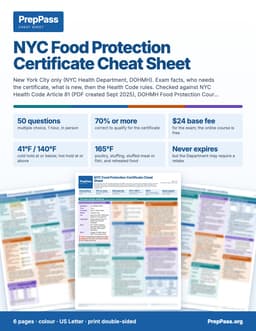
Thi trong vòng hai tuần?
Sách này là phần giảng dạy, đọc trong nhiều tuần. Nếu bạn thi trong vòng hai tuần, bảng tra cứu màu in được là sản phẩm còn lại: các con số then chốt, xếp theo từng phần.
6 trang · US Letter · PDF in được · giữ vĩnh viễn
Về chính kỳ thi này
| Cơ quan quản lý | New York City Department of Health and Mental Hygiene (DOHMH), Health Academy |
|---|---|
| Số câu hỏi | NYC DOHMH không công bố Những trang chúng tôi đã đọc và không tìm thấy: NYC Health — Food Protection: Free Online Training |
| Thời gian làm bài | NYC DOHMH không công bố Những trang chúng tôi đã đọc và không tìm thấy: NYC Health — Food Protection: Classroom Course |
| Điểm đậu | NYC DOHMH không công bố Những trang chúng tôi đã đọc và không tìm thấy: NYC Health — Food Protection Course Online Frequently Asked Questions (PDF) |
| Lệ phí |
|
| Ngôn ngữ thi | Tiếng Anh + 36 ngôn ngữ khác, cơ quan quản lý không liệt kê từng ngôn ngữ |
Câu hỏi luyện tập và chương học miễn phí NYC Food Protection Certificate →
Có gì — và không có gì
Bao gồm
- NYC Health Code Article 81 — incl. the NYC-specific temps vs the FDA Food Code
- Time & temperature control, 2-stage cooling, cooking/reheat temps
- Contamination, personal hygiene, and pest control
- HACCP, active managerial control, letter grades & inspections
- 55 original practice questions with answer explanations
- PDF (print & tab it) + EPUB (phone / e-reader)
Không bao gồm
- Không gửi bản in — đây là tệp bạn tải về và có thể tự in
- Sách không kèm khoá video, giảng viên hay kèm riêng — video miễn phí trên trang là phần khác
- Không bao gồm lệ phí đăng ký thi hay phí trung tâm khảo thí — bạn vẫn nộp cho cơ quan chính thức
Đọc miễn phí trọn một chương
Trọn vẹn một chương, đúng như trong eBook. Cuộn cửa sổ để đọc ngay tại đây; không cần tải, không cần email.
Đọc chương 2 ngay tại đây, không rời trang
Chúng tôi không đưa phần mở đầu dễ dãi — chương miễn phí mở thẳng vào một trong những phần đậm đặc nhất của cuốn sách, để bạn đánh giá cách dạy ở đúng chỗ kỳ thi trở nên khó.
Introduction
Controlling time and temperature is the heart of food protection in New York City, and this is the largest topic on the exam. Because bacteria grow fastest in the danger zone, the certified supervisor must know the exact temperatures for cooking, cooling, reheating, and holding food — and must check them with an accurate thermometer, not by eye. This chapter also carries the two most important NYC-vs-FDA divergences in the whole book, so read the flags carefully.
The temperature danger zone
The temperature danger zone in New York City is 41°F to 140°F — the range in which bacteria multiply most rapidly. Every hazardous food should spend as little time as possible in this zone.
- Cold hazardous food must be held at 41°F or below.
- Hot hazardous food must be held at 140°F or above.
NYC-vs-FDA flag: NYC uses 140°F as the top of the danger zone and the hot-holding minimum. The federal FDA Food Code uses 135°F. On the NYC exam, answer 140°F.
When food does pass through the zone during cooking or cooling, it should move through quickly. As a general limit, hazardous food left in the danger zone for more than four cumulative hours must be discarded, because bacteria may have multiplied to dangerous levels or formed heat-stable toxins. Treat temperature as your primary defense and use time only as a backup control, with written procedures.
Cooking temperatures
Cooking to the correct internal temperature destroys the bacteria that cause illness. Measure at the thickest part of the food with a clean, calibrated thermometer, and take at least two readings in different spots. The NYC minimums:
- Poultry, stuffed foods, and stuffing — 165°F. This is the highest required cooking temperature.
- Ground / chopped meat (hamburger, chopped meat, ground pork) — 158°F. Grinding spreads surface bacteria throughout the meat, so ground meat needs a higher temperature than a whole cut.
- Pork that is not ground and not a whole roast (e.g., pork chops) — 150°F.
- Whole cuts and roasts of beef and lamb, fish, and shell eggs cooked for immediate service — generally 140°F to 145°F (145°F for whole roasts and shell eggs; 140°F is the general minimum).
NYC-vs-FDA flag: NYC teaches 158°F for ground/chopped meat. The federal FDA Food Code uses 155°F. This is a well-known NYC divergence — on the NYC exam, answer 158°F.
Never judge doneness by color alone; a burger can look brown and still be unsafe, or look pink and be fully cooked. The thermometer is the only reliable test.
Cooling — the two-stage rule
Cooling is one of the most dangerous steps in the flow of food, because the food sits inside the danger zone as it cools. NYC uses a two-stage cooling rule:
- 140°F down to 70°F within 2 hours (the first stage is the riskiest, so it has the tightest limit).
- 70°F down to 41°F within 4 more hours.
- Total cooling time: no more than 6 hours from 140°F to 41°F.
If the food does not reach 70°F within the first two hours, you must reheat it and start cooling again, or discard it. Speed cooling by:
- Dividing food into shallow pans
- Using an ice-water bath
- Adding ice as an ingredient
- Stirring with an ice paddle
Cooling is about surface area and speed, not just putting a deep pot in the cold.
Reheating, holding, and thawing
Reheating. When reheating hazardous food for hot holding, bring it to 165°F within 2 hours, and reheat only once. Never use holding equipment (like a steam table) to reheat — it warms food too slowly and lets bacteria grow.
Holding. Once cooked, food must be held out of the danger zone until served: hot at 140°F or above, cold at 41°F or below. Check holding temperatures at least every two hours so problems are caught early.
Thawing. Thaw frozen food safely by one of four methods:
- In the refrigerator at 41°F or below
- Under cold running water at 70°F or below
- In a microwave, if the food is cooked immediately after
- As part of the cooking process
Thawing on the counter at room temperature is not allowed — it leaves the outer layer in the danger zone for hours.
Using a thermometer
A thermometer is only useful if it is accurate. Calibrate a bimetallic stem thermometer in ice water, where it should read 32°F; adjust the nut until it does. Clean and sanitize the stem before and between uses so it does not move bacteria from raw chicken to the next food you check. Measure at the thickest part, wait for the reading to steady, and take more than one reading.
Key numbers & facts — memorize these cold
| Item | NYC value / rule | FDA Food Code (for contrast) |
|---|---|---|
| Danger zone | 41°F – 140°F | 41°F – 135°F |
| Cold holding | 41°F or below | 41°F or below |
| Hot holding | 140°F or above | 135°F or above |
| Poultry / stuffed foods | 165°F | 165°F |
| Ground / chopped meat (incl. ground pork) | 158°F | 155°F |
| Pork (chops / non-roast, non-ground) | 150°F | 145°F |
| Whole cuts/roasts, fish, eggs to order | ~140°F – 145°F | 145°F (whole cuts) |
| Cooling — stage 1 | 140°F → 70°F in 2 hours | 135°F → 70°F in 2 hours |
| Cooling — stage 2 | 70°F → 41°F in 4 more hours (6 total) | same total |
| Reheating for hot holding | 165°F within 2 hours, once | 165°F within 2 hours |
| Time-only control | discard after 4 cumulative hours in the zone | 4 hours |
| Check holding temps | at least every 2 hours | — |
| Thermometer calibration | reads 32°F in ice water | 32°F |
| Safe thawing | fridge · cold running water (≤70°F) · microwave (cook now) · during cooking | same |
Source: NYC Health Code Article 81 and the DOHMH Food Protection Course for the NYC values; FDA Food Code shown only to flag where NYC differs. Teach and answer with the NYC column on this exam.
Worked scenario
The situation. At 3:00 p.m. a cook makes a large pot of chicken soup, cooks it to 165°F, and then puts the whole deep, covered pot straight into the walk-in to save for tomorrow. At 9:00 p.m. — six hours later — a manager checks the center of the pot: it is still 95°F.
What went wrong? A deep pot cools very slowly; the outside chills while the thick center stays warm for hours, sitting in the danger zone. To pass NYC's rule the soup needed to reach 70°F within 2 hours and 41°F within 6 hours total. At six hours it is still 95°F — it failed the cooling rule, and bacteria have had all evening to grow.
The right move. The soup must be thrown out — you cannot rescue it now. Next time, cool it correctly: divide it into shallow pans, set them in an ice-water bath, stir with an ice paddle, and check with a thermometer so it drops from 140°F to 70°F within 2 hours and to 41°F within 4 more.
Common exam traps
- Answering 135°F for hot holding or the danger-zone top. That is the FDA number. NYC = 140°F. This is the single most common NYC trap.
- Answering 155°F for ground meat. Again the FDA number. NYC = 158°F.
- Reheating on a steam table. A steam table holds hot food; it cannot reheat cold food fast enough. Reheat to 165°F on a stove, oven, or microwave first.
- Counter thawing. Never an approved method. Know the four safe ways.
- Judging doneness by color. Only the internal temperature, read on a calibrated thermometer, proves food is safe.
- Forgetting the two-hour checkpoint in cooling. If food is not at 70°F by 2 hours, it is already out of compliance.
Trước khi mua
- Nhận sách thế nào?
- Thanh toán xong, mục tải xuống hiện ngay trên trang này. Liên kết cũng được gửi qua email. Không cần tài khoản.
- Nếu sách không hợp thì sao?
- Gửi email trong vòng 14 ngày để được hoàn tiền đầy đủ, không cần lý do.
- Phần luyện tập miễn phí có bị bỏ không?
- Không. Mọi câu hỏi luyện tập, bài thi thử tính giờ và các chương miễn phí trên trang vẫn miễn phí. Cuốn sách là nửa "học", không phải hàng rào quanh phần miễn phí.
- Đọc trên điện thoại được không?
- Được — EPUB cho điện thoại và máy đọc sách, PDF để in và dán tab. Bạn nhận cả hai.
Chi tiết
The NYC DOHMH Food Protection Course exam every NYC food-service supervisor must pass — taught to the NYC Health Code (Article 81), including the NYC-specific temperatures the FDA Food Code doesn't use.
- Format: PDF + EPUB download · 47 pages
- 55 practice questions in the book, with a full answer key
- 240 free practice questions for this exam on PrepPass, included at no cost
- $14.99 one-time — no subscription
- 14-day money-back guarantee · refund policy
- Cross-referenced against: NYC Health Code Article 81 / NYC DOHMH Food Protection Course
- Last updated: September 2026
- Đối chiếu từ nguồn chính thức(NYC Health Code Article 81 / NYC DOHMH Food Protection Course)
- 240 câu hỏi luyện tập miễn phí
- Tải ngay, thuộc về bạn trọn đời
Vì sao mua sách khi phần luyện tập miễn phí?
Câu hỏi luyện tập và bài thi thử tính giờ vẫn miễn phí — không có gì trên trang bị giấu sau cuốn sách này. Cuốn sách $14.99 là nửa "học": chính phần kiến thức, dạy theo trình tự, trong một tệp thuộc về bạn.
- Dạy có hệ thống — mọi phần thi giảng theo từng chương, từ đầu đến cuối, không chỉ là câu hỏi
- In ra & dán nhãn — PDF sẵn sàng để in, tô đậm, ghi chú và mang tới bàn học
- Học mọi nơi, ngoại tuyến — EPUB trên điện thoại hay máy đọc sách; không cần wifi, không cần tab trình duyệt
- Tất cả một chỗ — các chương và câu hỏi luyện tập trong một tệp
- Của bạn trọn đời — trả một lần $14.99, tải ngay, không thuê bao
Và không rủi ro: Đảm bảo hoàn tiền 14 ngày — không hài lòng? Email cho chúng tôi để hoàn tiền đầy đủ, không cần lý do. Xem chính sách hoàn tiền.
Đảm bảo hoàn tiền 14 ngày · hoàn tiền đầy đủ, không cần lý do.
Mua một lần, truy cập tải về trọn đời. eBook là trọn bộ hướng dẫn ôn NYC Food Protection Certificate ở dạng PDF và EPUB. Bản tóm tắt mang tính giáo dục, không phải tư vấn chuyên môn hay pháp lý — luôn xác nhận quy định hiện hành với nguồn chính thức. Cập nhật lần cuối: September 2026.