Property & Casualty Insurance Producer · Ấn bản 2026
Property & Casualty Insurance Producer — Complete Study Guide (2026)
The general portion every state's P&C exam tests — property, homeowners, auto, commercial, liability and workers' comp — with a 100-question full-length practice exam. Pair it with your state's law.
- Cả 10 chương — tài sản, nhà ở, chủ nhà, ô tô, thương mại, casualty và bồi thường lao động — trong một bản PDF + EPUB bạn giữ
- Một ví dụ giải mẫu và một trang số liệu quan trọng khép lại cả 10 chương
- 100 câu luyện tập, mỗi đáp án đều được lập luận chứ không chỉ đánh dấu — không câu nào nằm trong ngân hàng đề miễn phí của trang này
$19.99trả một lần · tải trọn đời · không thuê bao
PDF + EPUB · tiếng Anh · 121 trang · $19.99 trả một lần
Sách này được viết bằng tiếng Anh — tệp PDF và EPUB bạn tải về đều bằng tiếng Anh.
Tải ngay sau khi thanh toán — không cần tài khoản, không thuê bao.
Đảm bảo hoàn tiền 14 ngày: không hài lòng vì bất kỳ lý do gì? Email support@preppass.org trong vòng 14 ngày kể từ khi mua để được hoàn tiền đầy đủ. Đây là bản tải xuống nên không phải gửi trả gì cả. Chính sách hoàn tiền
Xem bên trong cuốn sách
Ba trang thật, kết xuất thẳng từ tệp PDF bạn sẽ tải — lần lượt là một trang tra cứu, một trang giảng giải, và một câu hỏi có lời giải. Không trang nào được vẽ lại cho đẹp.
- Trang tra cứu nhanhAppendix C — Glossary of Key P&C Terms · Trang 117 của PDF
Một trang để lật lại: các con số, mốc thời hạn hoặc thuật ngữ gom về một chỗ.
- Cách giảng dạySection II — insureds, insured location, exclusions · Trang 42 của PDF
Trang giảng giải: kiến thức được trình bày bằng văn xuôi, theo trình tự kỳ thi kiểm tra.
- Một câu hỏi có lời giảiChapter 4 — The Dwelling Policy (DP) · Trang 39 của PDF
Một câu luyện tập kèm đáp án và lập luận đằng sau — không chỉ là đáp án.
Ôn cả hai môn? Có giá combo
- Life & Health Insurance Producer — Complete Study Guide (2026)$19.99
- Property & Casualty Insurance Producer — Complete Study Guide (2026)$19.99
Mua cả hai: $29.99 — tiết kiệm $9.99 so với mua riêng
Mua riêng $39.98 · giảm 24% · Một lần thanh toán, cả hai phần.
Đã mua Life & Health Insurance Producer rồi? Đừng mua combo — combo có sẵn cuốn đó và bạn sẽ trả tiền hai lần. Mua riêng Property & Casualty Insurance Producer với giá $19.99. Property & Casualty Insurance Producer · Combo gồm gì →
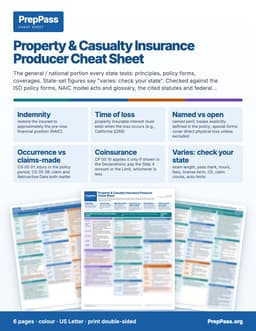
Thi trong vòng hai tuần?
Sách này là phần giảng dạy, đọc trong nhiều tuần. Nếu bạn thi trong vòng hai tuần, bảng tra cứu màu in được là sản phẩm còn lại: các con số then chốt, xếp theo từng phần.
6 trang · US Letter · PDF in được · giữ vĩnh viễn
Về chính kỳ thi này
| Cơ quan quản lý | Không có một cơ quan duy nhất: sở bảo hiểm của từng tiểu bang cấp phép bảo hiểm tài sản và tai nạn và tự đặt kỳ thi, thường do một đơn vị khảo thí tổ chức. California do PSI Services LLC tổ chức; Texas do Pearson VUE. Hãy xem trang dữ kiện của tiểu bang bạn nếu PrepPass đã có. Những trang chúng tôi đã đọc và không tìm thấy: PSI / California Department of Insurance — Candidate Information Bulletin for California Insurance License Examinees (revised March 2026) |
|---|---|
| Số câu hỏi | Do từng tiểu bang quy định. Kỳ thi của California có 150 câu. Hãy xem trang dữ kiện của tiểu bang bạn nếu PrepPass đã có. Những trang chúng tôi đã đọc và không tìm thấy: PSI / California Department of Insurance — Candidate Information Bulletin for California Insurance License Examinees (revised March 2026) |
| Thời gian làm bài | Do từng tiểu bang quy định. California cho 195 phút; kỳ thi General Lines - Property & Casualty của Texas cho 150 phút. Hãy xem trang dữ kiện của tiểu bang bạn nếu PrepPass đã có. Những trang chúng tôi đã đọc và không tìm thấy: PSI / California Department of Insurance — Candidate Information Bulletin for California Insurance License Examinees (revised March 2026) |
| Điểm đậu | Do từng tiểu bang quy định. California công bố 60%; sổ tay Texas của Pearson VUE công bố điểm quy đổi 70 trên thang 0–100 và nói rằng đó không phải phần trăm số câu đúng. Hãy xem trang dữ kiện của tiểu bang bạn nếu PrepPass đã có. Những trang chúng tôi đã đọc và không tìm thấy: CDI — Examination Times and Number of Questions (CDI website table; stale on languages and, for time limits, disagrees with the CIB) |
| Lệ phí | Do từng tiểu bang quy định. Sổ tay Texas của Pearson VUE ghi $49 mỗi lần thi cho kỳ thi General Lines - Property & Casualty. Hãy xem trang dữ kiện của tiểu bang bạn nếu PrepPass đã có. Những trang chúng tôi đã đọc và không tìm thấy: Pearson VUE — Texas Insurance Licensing Candidate Handbook, October 2024 (#124400) |
| Ngôn ngữ thi | Do từng tiểu bang quy định; sổ tay Texas của Pearson VUE có bản tiếng Anh và tiếng Tây Ban Nha. Hãy xem trang dữ kiện của tiểu bang bạn nếu PrepPass đã có. Những trang chúng tôi đã đọc và không tìm thấy: Pearson VUE — Texas Insurance Licensing Candidate Handbook, October 2024 (#124400) |
Câu hỏi luyện tập và chương học miễn phí Property & Casualty Insurance Producer →
Có gì — và không có gì
Bao gồm
- Property fundamentals, dwelling (DP) & homeowners (HO-2/3/4/5/6/8)
- Personal & commercial auto, CGL (occurrence vs claims-made)
- Workers' comp (exclusive remedy), casualty & liability doctrine
- Coinsurance, ISO forms, and the numbers the exam tests
- A 100-question full-length practice exam (general portion) with worked explanations
- PDF (print & tab it) + EPUB (phone / e-reader)
Không bao gồm
- Không gửi bản in — đây là tệp bạn tải về và có thể tự in
- Sách không kèm khoá video, giảng viên hay kèm riêng — video miễn phí trên trang là phần khác
- Không bao gồm lệ phí đăng ký thi hay phí trung tâm khảo thí — bạn vẫn nộp cho cơ quan chính thức
Mục lục
Xem 20 phần và trang bắt đầu của từng phần
- Chapter 1 — General Insurance Principlestr. 8
- Chapter 2 — Insurance Regulation, the Producer’s Legal Duties & Federal Lawtr. 18
- Chapter 3 — Property Insurance Fundamentalstr. 28
- Chapter 4 — The Dwelling Policy (DP)tr. 35
- Chapter 5 — Homeowners Insurance (HO Forms)tr. 40
- Section I — Coverages A and Btr. 41
- Section I — Coverages C and Dtr. 41
- Section I — special internal limits and scheduling valuablestr. 41
- Section II — Coverages E and Ftr. 42
- Section II — insureds, insured location, exclusionstr. 42
- Chapter 6 — Commercial Property Insurancetr. 47
- Chapter 7 — Auto Insurance — Personal and Commercialtr. 53
- Chapter 8 — Casualty & Liability Insurancetr. 60
- Chapter 9 — Workers’ Compensation Insurancetr. 67
- Chapter 10 — How to Study Your State’s Rules (the State Portion)tr. 73
- Practice Exam — 100 Questions (Full-Length General Portion)tr. 77
- Answer Key with Explanationstr. 99
- Appendix A — Exam-Day Strategy: How to Attack a P&C Questiontr. 111
- Appendix B — Rapid-Review Cram Sheet (50 High-Yield Facts)tr. 113
- Appendix C — Glossary of Key P&C Termstr. 117
Lấy từ chính tệp PDF bạn tải về, kèm trang bắt đầu của từng phần — không phải gõ tay ở đây.
Đọc miễn phí trọn một chương
Trọn vẹn một chương, đúng như trong eBook. Cuộn cửa sổ để đọc ngay tại đây; không cần tải, không cần email.
Đọc chương 5 ngay tại đây, không rời trang
Chúng tôi không đưa phần mở đầu dễ dãi — chương miễn phí mở thẳng vào một trong những phần đậm đặc nhất của cuốn sách, để bạn đánh giá cách dạy ở đúng chỗ kỳ thi trở nên khó.
The Homeowners (HO) policy is the most widely sold personal-lines property contract in the country and typically the largest single block on the general portion — about 15%. The package combines real-property, personal-property, loss-of-use, personal-liability, and medical-payments coverage in one contract with shared declarations, exclusions, and conditions. This chapter covers the standard HO forms, the four Section I property coverages, the two Section II liability coverages, exclusions, loss settlement, special internal limits, and the key conditions. These are ISO-standard, national forms; the state overlays (mandatory earthquake offers, wildfire moratoria, residual-market "FAIR" plans) belong to the state portion and are summarized in Chapter 10.
The standard HO forms at a glance
Carriers use the ISO Homeowners program or close proprietary equivalents:
- HO-2, Broad Form — dwelling and personal property on a named-peril basis (a list of roughly 16 perils).
- HO-3, Special Form — the workhorse owner-occupied contract. Open-peril on the dwelling and other structures; named-peril on personal property.
- HO-4, Contents Broad Form — the renter's/tenant's form. No dwelling coverage; protects the tenant's personal property, loss of use, liability, and medical payments.
- HO-5, Comprehensive Form — the broadest standard contract: open-peril on BOTH the dwelling AND personal property.
- HO-6, Unit-Owners Form — for condominium owners: interior building items, personal property, loss of use, liability, medical payments, and built-in loss-assessment coverage.
- HO-8, Modified Coverage Form — for older/historic homes whose replacement cost far exceeds market value; settles dwelling losses on an ACV or functional repair-cost basis.
Section I — Coverages A and B
- Coverage A — Dwelling: the dwelling on the residence premises, including attached structures and on-site building materials. Coverage A is the keystone because most other coverages are expressed as a percentage of it. The agent's first task is to determine the replacement cost of the dwelling with a cost estimator.
- Coverage B — Other Structures: detached structures separated by clear space (detached garage, shed, fence, gazebo). Provides an additional amount equal to 10% of Coverage A (a separate additional amount, not a sublimit). Structures rented to others or used for business are restricted/excluded.
Section I — Coverages C and D
- Coverage C — Personal Property: covers personal property owned or used by an insured anywhere in the world, automatically written at 50% of Coverage A on an owner-occupied HO-3 (different percentages apply on HO-4/HO-6, where Coverage C is the keystone). Off-premises personal property is covered, commonly up to 10% of Coverage C (or a stated minimum such as $1,000, whichever is greater).
- Coverage D — Loss of Use: pays the necessary increase in living costs above the normal baseline when a Section I peril makes the residence uninhabitable — additional living expense (ALE) for temporary lodging/meals, and fair rental value if the insured rented part of the home. Usually about 30% of Coverage A on an HO-3, payable for the shortest time to repair/replace or permanently relocate.
Section I — special internal limits and scheduling valuables
Within Coverage C, the form imposes special internal limits (sublimits) on classes of property that are easily stolen, hard to value, or invite moral hazard. Typical figures (edition-dependent) include roughly $200 on money/bullion; $1,500 on securities and on watercraft/trailers; $1,500 on theft of jewelry, watches, and furs; $2,500 on theft of firearms; $2,500 on theft of silverware; $2,500 on business property on premises. These caps apply per loss within the Coverage C limit — they are sublimits, not additional amounts, so they do not increase Coverage C. (Contrast Coverage B, which genuinely is a separate additional amount equal to 10% of Coverage A.) To insure valuables fully and on broader perils, add a Scheduled Personal Property endorsement (or a Personal Articles Floater): each item is listed at an appraised value, the deductible is generally waived, coverage is open-peril including mysterious disappearance, and the special-limit cap does not apply.
Section II — Coverages E and F
- Coverage E — Personal Liability: pays sums the insured is legally obligated to pay as damages for bodily injury or property damage caused by a covered occurrence, and includes a duty to defend with defense costs paid in addition to the limit. A common baseline limit is $100,000 per occurrence, though insureds routinely buy $300,000–$500,000 and pair the policy with a personal umbrella for $1 million or more.
- Coverage F — Medical Payments to Others: a small no-fault coverage paying reasonable medical expenses (typically within three years) for someone other than an insured injured on the insured location with permission, or off-premises by an insured, a residence employee, or an owned animal. Typical limits $1,000–$5,000 per person. It heads off small claims before they become lawsuits.
Section II — insureds, insured location, exclusions
An insured under Section II includes the named insured, resident spouse/partner, resident relatives, and others under age 21 in their care. An insured location includes the residence premises, other premises the insured uses in connection with it, vacant land, cemetery plots, and premises used temporarily (a hotel room, a vacation rental). Important Section II exclusions: business activities (a home daycare or for-profit venture needs a separate policy/endorsement), professional services, ownership/operation of most motor vehicles, watercraft over stated size/horsepower, and aircraft; intentional injury; communicable disease; molestation; controlled-substance offenses; injury to an insured; and obligations under workers' compensation (employee injuries belong on a WC policy).
Standard exclusions and companion coverages
Every HO form lists Section I exclusions that reveal the gaps needing separate coverage: earth movement (earthquake — needs an earthquake program/DIC), flood (needs NFIP or private flood), war/nuclear/government action, intentional loss, ordinance or law (add-back endorsement available), and wear and tear/settling/mold/vermin/faulty workmanship (inevitable, non-fortuitous). Some forms still cover an ensuing named peril (e.g., a fire that follows an excluded cause).
Loss settlement on the dwelling: 80% coinsurance and RC
The standard HO-3 dwelling loss-settlement clause uses an 80% coinsurance trigger. Carry Coverage A ≥ 80% of the dwelling's full replacement cost at the time of loss, and partial losses are paid at full replacement cost up to the limit with no depreciation deduction. Carry less than 80%, and the insurer pays the greater of (a) the ACV of the damaged part, or (b) the proportion the limit bears to 80% of full RC, up to the limit. To stay above the line as costs rise, insureds add Inflation Guard (auto-increases Coverage A), Extended Replacement Cost (pays a stated 25%/50% above the limit if needed), or Guaranteed Replacement Cost (removes the cap, subject to underwriting).
Personal-property settlement: ACV vs. RC
Unless endorsed, Coverage C settles on ACV (replacement cost minus depreciation). Most insureds add the Personal Property Replacement Cost endorsement, paying full RC for items actually replaced within a stated time (commonly 180 days). The endorsement still respects the special internal limits — adding it does not lift the jewelry-theft cap.
Mortgage clause, liberalization, and other conditions
The standard (union) mortgage clause protects the lender even when the insured's own claim would be denied; the insurer typically gives the mortgagee at least 10 days' notice for non-payment cancellation and more (often 30 days) for other cancellations, and the mortgagee may pay premium to keep the policy in force. The liberalization clause extends any broader form the insurer adopts during the term (without extra premium) automatically. Other conditions include appraisal (either party may demand it to resolve amount disputes), a suit-against-insurer time limit, an assignment condition (no transfer without consent), and subrogation/salvage rules.
### Key numbers & facts — Chapter 5 National ISO Homeowners concepts. Percentages are standard HO-3 defaults (edition-dependent). - HO-3 = open dwelling/other structures, named-peril contents (workhorse). HO-5 = open on both. HO-4 = renter's, no dwelling. HO-6 = condo + loss assessment. HO-8 = older homes, ACV. - Coverage B ≈ 10% of A (additional). Coverage C ≈ 50% of A (owner-occupied HO-3). Coverage D ≈ 30% of A. - Coverage E commonly $100,000 per occurrence; defense is in addition to the limit. - Coverage F (Med Pay) no-fault, ~$1,000–$5,000 per person, expenses within 3 years. - Special internal limits (typical): ~$200 money, $1,500 jewelry theft, $2,500 firearms theft, $2,500 silverware theft. - Dwelling loss settlement: 80% coinsurance trigger for full RC; below 80% → greater of ACV or the pro-rata amount. - Personal Property RC endorsement — replace within ~180 days; special limits still apply. - Excluded → companion coverage: earthquake (separate program), flood (NFIP), ordinance/law (endorsement). - State overlays (mandatory earthquake offer, wildfire moratorium, FAIR-type plans) are (state-set) — see Ch. 10.
Worked example
A homeowner's dwelling has a $400,000 replacement cost but she insured Coverage A for only $280,000 (70% of RC). A kitchen fire causes $60,000 of damage. Because she carries less than 80% of RC ($320,000 required), the RC settlement does not apply in full. The insurer pays the greater of the ACV of the damaged portion or the pro-rata amount: (280,000 ÷ 320,000) × 60,000 = $52,500 (before any deductible), versus the depreciated ACV of the damaged kitchen. She loses the depreciation/coinsurance shortfall for being under-insured — the reason Inflation Guard and periodic RC re-estimates matter.
Named exam traps
- HO-4 and HO-6 have no Coverage A percentage engine. On a renter's/condo form, Coverage C is the keystone, not 50% of a dwelling limit.
- Defense costs. On Coverage E, defense is outside (in addition to) the limit — a common wrong answer says it erodes the limit.
- Med Pay is no-fault and only for others. It does not pay the insured's own household members' medical bills.
- Scheduling doesn't lift Coverage C's RC vs. sublimit automatically. The Personal Property RC endorsement still respects special limits; only a Scheduled endorsement removes the sublimit for listed items.
- Earthquake/flood "must be in the HO." They are excluded — separate coverage required. Any answer covering flood under the HO is wrong.
Sources: ISO Homeowners program forms (HO-2/3/4/5/6/8) and standard endorsements; NFIP for the flood exclusion. State-specific homeowners overlays are treated in Chapter 10.
Trước khi mua
- Nhận sách thế nào?
- Thanh toán xong, mục tải xuống hiện ngay trên trang này. Liên kết cũng được gửi qua email. Không cần tài khoản.
- Nếu sách không hợp thì sao?
- Gửi email trong vòng 14 ngày để được hoàn tiền đầy đủ, không cần lý do.
- Phần luyện tập miễn phí có bị bỏ không?
- Không. Mọi câu hỏi luyện tập, bài thi thử tính giờ và các chương miễn phí trên trang vẫn miễn phí. Cuốn sách là nửa "học", không phải hàng rào quanh phần miễn phí.
- Đọc trên điện thoại được không?
- Được — EPUB cho điện thoại và máy đọc sách, PDF để in và dán tab. Bạn nhận cả hai.
Chi tiết
The general portion every state's P&C exam tests — property, homeowners, auto, commercial, liability and workers' comp — with a 100-question full-length practice exam. Pair it with your state's law.
- Format: PDF + EPUB download · 121 pages
- 100 practice questions in the book, with a full answer key
- 324 free practice questions for this exam on PrepPass, included at no cost
- $19.99 one-time — no subscription
- 14-day money-back guarantee · refund policy
- Cross-referenced against: ISO forms / NAIC model acts / NFIP / TRIA
- Last updated: September 2026
- Đối chiếu từ nguồn chính thức(ISO forms / NAIC model acts / NFIP / TRIA)
- 324 câu hỏi luyện tập miễn phí
- Tải ngay, thuộc về bạn trọn đời
Một insurance pre-license course có giá $100–$500. Cuốn sách này dạy cùng một kỳ thi — cùng quy định, đối chiếu theo chuẩn hiện hành — chỉ với $19.99 trả một lần, thuộc về bạn trọn đời.
Vì sao mua sách khi phần luyện tập miễn phí?
Câu hỏi luyện tập và bài thi thử tính giờ vẫn miễn phí — không có gì trên trang bị giấu sau cuốn sách này. Cuốn sách $19.99 là nửa "học": chính phần kiến thức, dạy theo trình tự, trong một tệp thuộc về bạn.
- Dạy có hệ thống — mọi phần thi giảng theo từng chương, từ đầu đến cuối, không chỉ là câu hỏi
- In ra & dán nhãn — PDF sẵn sàng để in, tô đậm, ghi chú và mang tới bàn học
- Học mọi nơi, ngoại tuyến — EPUB trên điện thoại hay máy đọc sách; không cần wifi, không cần tab trình duyệt
- Tất cả một chỗ — các chương và câu hỏi luyện tập trong một tệp
- Của bạn trọn đời — trả một lần $19.99, tải ngay, không thuê bao
Và không rủi ro: Đảm bảo hoàn tiền 14 ngày — không hài lòng? Email cho chúng tôi để hoàn tiền đầy đủ, không cần lý do. Xem chính sách hoàn tiền.
Đảm bảo hoàn tiền 14 ngày · hoàn tiền đầy đủ, không cần lý do.
Mua một lần, truy cập tải về trọn đời. eBook là trọn bộ hướng dẫn ôn Property & Casualty Insurance Producer ở dạng PDF và EPUB. Bản tóm tắt mang tính giáo dục, không phải tư vấn chuyên môn hay pháp lý — luôn xác nhận quy định hiện hành với nguồn chính thức. Cập nhật lần cuối: September 2026.