Sách ôn thi · Ấn bản 2026
ServSafe Manager Exam — Complete Study Guide (2026)
Nine content areas, and every tested temperature, time, and ppm checked against the FDA Food Code (2022 and its 2024 Supplement).
- Độ dài
- 416 trang
- Câu hỏi luyện tập trong sách
- 618
- Thi thử trực tuyến PrepPass
- 90 câu · 120 phút
- Đối chiếu thông tin và cập nhật tệp
- tháng 10 năm 2026
- Giao hàng
- PDF + EPUB · tiếng Anh · tải ngay
Về cuốn sách này
Thông tin kỳ thi, ai nên dùng và thay đổi
Về chính kỳ thi này
| Cơ quan quản lý | National Restaurant Association Educational Foundation (NRAEF) — kỳ thi do a registered ServSafe Instructor/Proctor, or ProctorU for online-proctored delivery tổ chức Nguồn: ServSafe — Food Protection Manager Certification Examinee Handbook (PDF, © 2020 NRAEF) |
|---|---|
| Số câu hỏi | 90 câu hỏi (80 câu tính điểm, 10 câu thử nghiệm không tính điểm) |
| Thời gian làm bài | 120 phút Nguồn: ServSafe — Manager Exam (Access Code), catalog product SSONLINEX |
| Điểm đậu | 70% (ít nhất 56 trong 80 câu tính điểm) Nguồn: ServSafe — FAQ: “What is the passing score for the ServSafe Food Protection Manager Examination?” |
| Lệ phí |
Nguồn: ServSafe — Manager Exam (Access Code), catalog product SSONLINEX |
| Ngôn ngữ thi | Tiếng Anh · Tiếng Tây Ban Nha · Tiếng Trung · Tiếng Hàn · Tiếng Pháp · Tiếng Nhật Nguồn: ServSafe — FAQ: “What languages is the ServSafe exam available in?” |
Xem bên trong cuốn sách
Ba trang thật, kết xuất thẳng từ tệp PDF bạn sẽ tải — lần lượt là một trang tra cứu, một trang giảng giải, và một câu hỏi có lời giải. Không trang nào được vẽ lại cho đẹp.
- Trang tra cứu nhanhChapter 1 — Foodborne Illness Basics · Trang 15 của PDF
Một trang để lật lại: các con số, mốc thời hạn hoặc thuật ngữ gom về một chỗ.
- Cách giảng dạyChapter 2 — Contamination, Cross-Contact, and Allergens · Trang 48 của PDF
Trang giảng giải: kiến thức được trình bày bằng văn xuôi, theo trình tự kỳ thi kiểm tra.
- Một câu hỏi có lời giảiChapter 1 — Foodborne Illness Basics · Trang 20 của PDF
Một câu luyện tập kèm đáp án và lập luận đằng sau — không chỉ là đáp án.
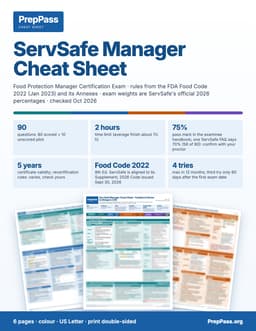
Thi trong vòng hai tuần?
Sách này là phần giảng dạy, đọc trong nhiều tuần. Nếu bạn thi trong vòng hai tuần, bảng tra cứu màu in được là sản phẩm còn lại: các con số then chốt, xếp theo từng phần.
6 trang · US Letter · PDF in được · giữ vĩnh viễn
How this book compares
ServSafe sells the Manager exam itself, which only a registered ServSafe instructor or proctor may administer, and tells candidates to ask their instructor or proctor which materials to buy. This book is an independent review to read before that exam; it does not include an exam access code.
| Resource | Price | What you get | Choose it if |
|---|---|---|---|
| This bookServSafe Manager Exam — Complete Study Guide (2026)PrepPass | $14.99 | Independent downloadable review for the ServSafe Manager exam
| Choose this book if you want every tested time, temperature and concentration in one file to review before your proctored exam. It does not replace the exam, or a course your employer or local health department requires. |
| From the exam bodyServSafe Manager Exam (Access Code) (opens the publisher's page in a new tab)ServSafe (National Restaurant Association) | $38.99; requires an exam proctor, and additional fees apply | The certification exam itself
| You need the exam in any case. Ask your instructor or proctor which materials they supply before you buy a course or book. |
| AlternativeServSafe Exam Secrets (opens the publisher's page in a new tab)Mometrix Test Preparation | $24.99 ebook; $29.99 printed book | Study guide with practice questions | Choose Mometrix if you want a printed copy. |
This book
ServSafe Manager Exam — Complete Study Guide (2026)
PrepPass
- Price
- $14.99
- What you get
Independent downloadable review for the ServSafe Manager exam
- 618 practice questions with explanations
- 416 pages, PDF + EPUB
- Choose it if
- Choose this book if you want every tested time, temperature and concentration in one file to review before your proctored exam. It does not replace the exam, or a course your employer or local health department requires.
From the exam body
ServSafe Manager Exam (Access Code) (opens the publisher's page in a new tab)
ServSafe (National Restaurant Association)
- Price
- $38.99; requires an exam proctor, and additional fees apply
- What you get
The certification exam itself
- A one-time exam access code; only registered ServSafe instructors or proctors may administer the exam
- Choose it if
- You need the exam in any case. Ask your instructor or proctor which materials they supply before you buy a course or book.
Alternative
ServSafe Exam Secrets (opens the publisher's page in a new tab)
Mometrix Test Preparation
- Price
- $24.99 ebook; $29.99 printed book
- What you get
Study guide with practice questions
- Choose it if
- Choose Mometrix if you want a printed copy.
Other resources' prices and contents are as listed on each publisher's or seller's own page, checked September 24, 2026. Prices change; confirm on the linked page before you buy. This book's price and contents come from our own catalog.
Sources (3)
- https://www.servsafe.com/access/ss/catalog/productdetail/ssonlinex — read September 24, 2026
- https://www.servsafe.com/ServSafe-Manager/Get-Certified — read September 24, 2026
- https://www.mometrix.com/studyguides/servsafe/ — read September 24, 2026
Có gì — và không có gì
Bao gồm
- Exam review, not an introduction: written for people who already work in or around a kitchen; it teaches the Food Code figures and drills them
- All 9 content areas of the ServSafe Manager exam, in the provider's published weights (Preparing Foods 20%, Managing Establishment Facilities 15%), including a Responding to Crises chapter
Không bao gồm
- Không gửi bản in — đây là tệp bạn tải về và có thể tự in
- Sách không kèm khoá video, giảng viên hay kèm riêng — video miễn phí trên trang là phần khác
Toàn bộ phần bao gồm và không bao gồm
Bao gồm
- Every cook / hold / cool / reheat temperature, sanitizer concentration and contact time checked against the FDA Food Code 2022 and its November 2024 Supplement (your state's code may differ)
- 618 practice questions with answer explanations: two 90-question full-length exams, nine domain sets sized to the area weights, chapter quizzes and a cumulative review
- “Exam traps to avoid” and a key-numbers box in every chapter
- PDF (print & tab it) + EPUB (phone / e-reader)
Không bao gồm
- Không bao gồm lệ phí đăng ký thi hay phí trung tâm khảo thí — bạn vẫn nộp cho cơ quan chính thức
Mục lục
Xem 16 phần và trang bắt đầu của từng phần
- Chapter 1 — Foodborne Illness Basicstr. 10
- Chapter 2 — Contamination, Cross-Contact, and Allergenstr. 26
- Chapter 3 — Personal Hygiene and Managing Personneltr. 51
- Chapter 4 — Purchasing, Receiving, and Storagetr. 81
- Chapter 5 — Preparation and Cookingtr. 108
- Answer key & explanationstr. 126
- Chapter 6 — Holding and Servicetr. 131
- Chapter 7 — Food Safety Management and HACCPtr. 156
- Chapter 8 — Facilities, Cleaning, Sanitizing, and Pest Controltr. 187
- Chapter 9 — Responding to Crisestr. 213
- Domain Practice Setstr. 233
- Full-Length Practice Exam 1tr. 305
- Full-Length Practice Exam 2tr. 339
- Cumulative Review Examtr. 373
- Appendix A — Master temperature & time referencetr. 411
- Appendix B — Sanitizer quick referencetr. 415
Lấy từ chính tệp PDF bạn tải về, kèm trang bắt đầu của từng phần — không phải gõ tay ở đây.
Đọc miễn phí trọn một chương
Trọn vẹn một chương, đúng như trong eBook. Cuộn cửa sổ để đọc ngay tại đây; không cần tải, không cần email.
Đọc chương 1 ngay tại đây, không rời trang
The free chapter is Chapter 1, Foodborne Illness Basics: the foundation chapter that defines the vocabulary every other chapter uses. It is the gentlest chapter in the book; later chapters assume it.
Foundation chapter: the vocabulary and the hazards behind every content area on the exam.
Every rule in the rest of this book exists to answer one question: how do we keep pathogens from reaching a guest in a dose that makes them sick? Foodborne illness is the outcome we are all working to prevent, so this chapter defines the enemy — the pathogens, the foods they love, the conditions they need, and the guests who suffer most. Master the vocabulary here (Big Six, TCS, FAT TOM, the temperature danger zone) and the operational chapters that follow will feel like common sense rather than a list to memorize.
A foodborne illness is a sickness carried to people by the food they eat, and when two or more people get the same illness from the same meal it becomes a foodborne-illness outbreak. As a manager your job is to understand what makes food unsafe so you can stop problems before a guest ever gets sick.
The Big Six Pathogens
Most foodborne illness comes from biological contaminants, and the Food Code singles out six pathogens as so contagious and severe that a food employee diagnosed with one must be reported and excluded or restricted from your operation. These “Big Six” are Norovirus, Hepatitis A, Shigella, Shiga toxin-producing E. coli (STEC), Salmonella Typhi, and nontyphoidal Salmonella. Several of them are spread through the fecal-oral route, which is exactly why handwashing after using the restroom is non-negotiable. Norovirus and Hepatitis A come mainly from ready-to-eat food touched by infected workers; nontyphoidal Salmonella from poultry, eggs, and produce; Shigella from unwashed hands; and E. coli from ground beef and contaminated produce. Knowing the source helps you target the right control, whether that is cooking, handwashing, or supplier selection.
TCS Foods
Time/Temperature Control for Safety (TCS) foods are the items that support rapid pathogen growth and therefore need strict time and temperature limits. Classic examples include milk and dairy, shell eggs, meat, poultry, fish, shellfish and crustaceans, baked potatoes, heat-treated plant foods like cooked rice, beans, and vegetables, tofu and other soy protein, sprouts and cut leafy greens, cut tomatoes, and cut melons. These foods share traits that microbes love: they are moist, protein-rich or high in carbohydrate, and have a neutral pH. Non-TCS foods such as dry pasta, whole uncut produce, and unopened commercially sterile canned goods are far more stable. When you can identify a TCS food on sight, you know instantly that it needs to stay out of the temperature danger zone.
FAT TOM: Conditions for Growth
Pathogens need the right conditions to multiply, summed up by the acronym FAT TOM: Food, Acidity, Temperature, Time, Oxygen, and Moisture. Microbes need nutrient-rich Food, a near-neutral Acidity (the Food Code's TCS tables treat a pH of 4.6 or less as a key line), and warm Temperatures in the danger zone of 41°F to 135°F. Given enough Time, a single bacterium can multiply into millions; the Food Code lets TCS food go without temperature control only for limited periods (up to 4 hours when time is used as the public health control). Some bacteria need Oxygen while others thrive without it, and nearly all need Moisture, measured as water activity (aw); the Food Code uses a food's aw and pH together to decide whether it needs time/temperature control. As a manager you cannot easily change food, oxygen, or acidity in most menu items, so your practical levers are temperature and time. Controlling those two factors is the foundation of nearly every food-safety rule you will enforce.
Toxins and Chemical Hazards
Not every hazard is a living microbe. Some fish carry natural toxins that cannot be cooked, frozen, or canned away. Scombroid poisoning comes from tuna, mahi-mahi, bluefish, and other susceptible species that were time-temperature abused, letting histamine build up. Ciguatera poisoning comes from large predatory reef fish like barracuda and grouper that ate smaller toxic fish. Certain wild mushrooms and shellfish from contaminated waters also carry toxins. Because these toxins are already formed and heat-stable, your only defense is buying from approved, reputable suppliers and keeping fish cold from the moment it arrives. Chemical hazards — cleaners, sanitizers, and pesticides — round out the picture and are prevented by proper labeling and storing chemicals away from food.
High-Risk Populations
Some guests get much sicker from foodborne illness than others, and a good manager keeps them in mind. The groups at highest risk are the very young (preschool-age children), older adults, pregnant women (a general public-health concern), and people with weakened immune systems, including those with cancer, HIV, or organ transplants. The Food Code's own term, highly susceptible population, covers immunocompromised people, preschool-age children, and older adults who obtain food at a facility that provides custodial care, health care, or assisted living. These populations have immune systems that are still developing, declining, or compromised, so even a small dose of a pathogen can cause severe illness. Facilities that serve these groups — hospitals, nursing homes, day cares — serve a highly susceptible population and face stricter rules, such as bans on serving raw or undercooked animal foods and raw sprouts. Knowing your audience helps you decide how conservative your menu and handling need to be.
Rules & Food Code citations for this chapter
| Rule | What it means | Citation |
|---|---|---|
| Six pathogens are highly infectious and reportable | A food employee diagnosed with any Big Six pathogen must be excluded or restricted as §2-201.12 directs (excluded when symptomatic), and the person in charge must notify the regulatory authority. | FDA Food Code §2-201.11 |
| Norovirus and Hepatitis A spread from infected food handlers | Both are common in ready-to-eat food contaminated by an ill worker’s hands, so barehand contact controls matter most here. | FDA Food Code §3-301.11 |
| Salmonella Typhi requires exclusion until cleared | A worker with Salmonella Typhi cannot return until the regulatory authority approves and the worker provides written medical documentation from a health practitioner that they are free from typhoid fever. | FDA Food Code §2-201.13(C) |
| TCS foods need time and temperature control | Because they support pathogen growth, TCS foods must be kept at 41°F or below or 135°F or above whenever possible. | FDA Food Code §3-501.16 |
| Cut melons, cut tomatoes, and cut leafy greens are TCS | Once these produce items are cut or processed, they lose their natural protection and must be temperature controlled. | — |
| Ready-to-eat TCS food has extra risk | Food that will not be cooked again, like deli salads or sliced fruit, must be protected from contamination at every step. | — |
| FAT TOM = Food, Acidity, Temperature, Time, Oxygen, Moisture | These six conditions govern pathogen growth, so controlling any one of them slows it. | — |
| The temperature danger zone is 41°F to 135°F | Pathogens grow fastest between 70°F and 125°F, so food should pass through this range as quickly as possible. | FDA Food Code Annex 3, §3-501.14 |
| Temperature and time are your best controls | You usually cannot alter a food’s pH, moisture, or oxygen, so managers focus on holding the right temperature for the right amount of time. | — |
| Fish toxins cannot be destroyed by cooking | Scombroid and ciguatera toxins are heat-stable, so prevention depends entirely on buying safe fish and keeping it cold. | FDA Food Code §3-201.11 |
| Buy from approved, reputable suppliers | Approved suppliers are inspected and meet applicable laws, which is your first line of defense against toxins. | FDA Food Code §3-201.11 |
| Store chemicals away from food and label them | Keep cleaners and pesticides in a separate area and in properly labeled containers to prevent chemical contamination. | — |
| The young, elderly, pregnant, and immunocompromised are highest risk | These groups can suffer severe illness from a small dose of a pathogen, so extra caution is warranted. | — |
| Highly susceptible populations get stricter rules | Facilities like nursing homes and hospitals may not serve raw or undercooked animal foods or raw seed sprouts. | FDA Food Code §3-801.11 |
| Match your controls to your guests | The more vulnerable your guests, the more conservative your sourcing, cooking, and handling should be. | — |
### Key numbers & deadlines | Item | Value | Source | |----|----|----| | Temperature danger zone | 41°F to 135°F | FDA Food Code §3-501.16 | | Fastest pathogen growth | 70°F to 125°F | Annex 3, §3-501.14 | | pH line in the Food Code TCS tables | 4.6 or less (heat-treated, packaged food is non-TCS) | §1-201.10, Table A | | Water activity | read together with pH in Tables A and B (no single cutoff) | §1-201.10 | | Time without temperature control (public health control) | up to 4 hours (up to 6 under stricter conditions) | §3-501.19(B),(C) | | Big Six → employee action | exclude or restrict per §2-201.12; person in charge notifies regulatory authority | §2-201.11, §2-201.12 | Each value above was checked against the FDA Food Code (2022) and its Supplement. Confirm it against your local adopted food code before relying on it.
Worked example — is it TCS, and is it in the zone?
A cook pulls a pan of cooked rice from the walk-in and leaves it on the line at room temperature while the lunch rush builds. Ask two questions. (1) Is it TCS? Cooked rice is a heat-treated plant food — moist, starchy, neutral pH — so yes, it is a Time/Temperature Control for Safety food. (2) Is it in the danger zone? Room temperature sits inside 41°F–135°F, and squarely inside the 70°F–125°F fast-growth band. Both FAT TOM’s Temperature and Time are now working for the bacteria. Under §3-501.16 that rice belongs at 41°F or below or 135°F or above — sitting out, it is on the clock toward discard, not safe holding.
Exam traps to avoid
- The danger zone is 41°F–135°F, not 40°F–140°F. Some other food-safety materials still use 40/140; the Food Code numbers are 41°F and 135°F.
- Fish toxins (scombroid, ciguatera) are heat-stable — cooking, freezing, and canning do not destroy them. The only control is an approved supplier plus keeping fish cold (§3-201.11).
- A cut melon, cut tomato, or cut leafy green is TCS; the same items whole and uncut are not. Processing is what makes them TCS.
- Highly susceptible populations (hospitals, nursing homes, day cares) may not be served raw or undercooked animal foods or raw seed sprouts (§3-801.11).
Chapter 1 quiz — 20 questions
Answer each question, then check the key that follows.
1. Six pathogens are treated as so infectious that a food employee diagnosed with one must be excluded or restricted and the case reported to the regulatory authority. Which organism belongs on that short list?
- A. Campylobacter, a common cause of diarrhea
- B. Listeria, a bacterium that grows in cold storage
- C. Shigella, spread on unwashed hands
- D. Vibrio, a bacterium linked to raw shellfish beds
2. A cook has been diagnosed with Salmonella Typhi and sent home. What does this chapter set as the condition for that cook returning to food work?
- A. Regulatory approval plus a health practitioner's written statement that the cook is free of typhoid
- B. Seven calendar days counted from the date of diagnosis
- C. Two consecutive shifts with no fever and no diarrhea
- D. A signed note from the cook saying he feels well
3. This chapter ties Norovirus and Hepatitis A to barehand-contact controls more tightly than to cooking temperatures. What explains that emphasis?
- A. Both survive any cooking temperature a commercial range reaches
- B. Both are destroyed by the sanitizer used on prep surfaces
- C. Both arrive in the kitchen on raw poultry and on shell eggs
- D. Both reach guests on ready-to-eat food an ill worker handled
4. Several of the six highly infectious pathogens travel by the fecal-oral route. Which control does that shared route point a manager toward first?
- A. Cooking all animal proteins to a higher internal temperature
- B. Sanitizing every food-contact surface at least every four hours
- C. Buying produce only from suppliers holding a third-party audit
- D. Thorough handwashing lasting at least 20 seconds, after every restroom visit
5. Dry rice sitting in a bin is not a TCS food, but the same rice cooked and panned is. What changed?
- A. It left its original package, so the supplier's controls end
- B. It has been handled by staff, so pathogens are now present
- C. It is now moist and near-neutral, so microbes grow
- D. It now carries far more protein than it did in the bin
6. A new prep cook insists that cases of unopened, commercially canned beans must be kept in the walk-in because cooked beans are a TCS food. How should the manager answer?
- A. He is wrong; beans are TCS only when they are raw
- B. He is right, but only for cans stored longer than a week
- C. He is wrong; unopened commercially sterile cans are not TCS
- D. He is right; any bean product is a TCS food
7. A whole cantaloupe sits in a dry-storage crate all morning. At 2:00 p.m. a cook cubes it for the salad bar. When did this melon become a TCS food?
- A. Never, since whole produce is never a TCS food
- B. At 2:00 p.m., when the cook cubed it for the bar
- C. On delivery, because all melon counts as a TCS food
- D. Once its surface temperature climbed past 41°F
8. A cook adds raw alfalfa sprouts to a sandwich and says that because sprouts are a plant food, they need no temperature control. What is the Food Code position?
- A. He is right; only heat-treated plant foods are TCS
- B. He is wrong; raw sprouts are a TCS food
- C. He is right; plant foods are never TCS foods
- D. He is wrong, but only once the sprouts are cut
9. FAT TOM lists six conditions, but on a normal menu a manager can realistically move only two of them. Which two?
- A. Food and Moisture
- B. Moisture and Acidity
- C. Acidity and Oxygen
- D. Temperature and Time
10. A cook seals a pan of potato salad in an airtight container and says that removing oxygen has taken care of the O in FAT TOM, so growth has stopped. What is wrong with that reasoning?
- A. Some pathogens grow perfectly well without any oxygen at all
- B. Oxygen is the one FAT TOM condition that cannot be removed
- C. Airtight lids actually trap oxygen against the food surface
- D. Removing oxygen raises water activity, which then feeds growth
11. A steam-table pan of gravy reads 60°F. The cook argues it is fine because bacteria grow fastest between 70°F and 125°F and the gravy never entered that band. Is he right?
- A. No, 60°F is inside the danger zone
- B. Yes, growth is negligible outside the fast-growth band
- C. No, the fast-growth band actually begins at 41°F, not 70°F
- D. Yes, 60°F is below the lower limit of the danger zone
12. A kitchen uses time alone, instead of temperature, as the public health control for a pan of TCS food, using the four-hour option. What must happen to the food by the four-hour mark?
- A. It is returned to the cooler and held until the next shift
- B. It is cooked and served, served as is if ready-to-eat, or discarded
- C. It is reheated to 135°F and returned to the line
- D. It is held until closing, then discarded with the day's waste
13. A cook proposes searing a questionable tuna loin hard on both sides to make it safe for service. Why does that not work?
- A. The histamine is already formed and survives heat
- B. Histamine only forms after the fish has been cooked
- C. Searing drives the histamine deeper into the flesh
- D. Heat converts the histamine into a second toxin
14. A cook infuses garlic in oil and leaves the jar on a dry-storage shelf. What does the Food Code say about it?
- A. It is fine for 30 days, as long as the jar stays closed
- B. It is a TCS food only if the garlic has been chopped first
- C. It is a TCS food unless it is modified so it cannot support growth
- D. It is fine, because oil does not support pathogen growth
15. Keeping fish cold from the moment it arrives protects against scombroid but does nothing against ciguatera. What accounts for that difference?
- A. Scombroid affects only tuna, which is always shipped frozen
- B. Scombroid toxin is heat-stable, while ciguatera toxin is not
- C. Ciguatera builds up during cold storage; scombroid arrives already formed
- D. Histamine builds during temperature abuse; ciguatera arrives formed
16. A manager is reviewing which guests need the most conservative handling. Which of these guests falls into a high-risk group as this chapter defines it?
- A. A marathon runner recovering from a bad head cold
- B. A guest partway through chemotherapy treatment
- C. A teenager with a diagnosed peanut allergy
- D. A line cook who just finished a course of antibiotics
17. Why does a nursing home face stricter menu rules than the diner across the street?
- A. Its residents report illness to inspectors more often
- B. Its batch cooking means large volumes that cool far too slowly
- C. Its guests can be severely harmed by a very small dose of a pathogen
- D. Its kitchen holds food far longer before it reaches the table
18. A day care with a preschool classroom sends its spring lunch menu up for review. Which item has to come off?
- A. Raw alfalfa sprouts on the garden salad
- B. Hamburger patties cooked well past rare
- C. Cubed melon held in the cold well at 41°F
- D. Scrambled pasteurized eggs at breakfast
19. A laminated poster in the break room says food is unsafe between 40°F and 140°F. What should the manager tell staff about that poster?
- A. It is outdated; the numbers now taught are 45°F and 130°F
- B. It is outdated; the numbers now taught are 41°F and 135°F
- C. It is correct, and the current numbers are simply rounded
- D. It is correct for cold holding but wrong for hot holding
Câu hỏi người mua thường hỏi
Nhận sách thế nào?
Thanh toán xong, mục tải xuống hiện ngay trên trang này. Liên kết cũng được gửi qua email. Không cần tài khoản.
Nếu sách không hợp thì sao?
Gửi email trong vòng 14 ngày để được hoàn tiền đầy đủ, không cần lý do.
Phần luyện tập miễn phí có bị bỏ không?
Không. Mọi câu hỏi luyện tập, bài thi thử tính giờ và các chương miễn phí trên trang vẫn miễn phí. Cuốn sách là nửa "học", không phải hàng rào quanh phần miễn phí.
Thêm câu hỏi (1)
Đọc trên điện thoại được không?
Được — EPUB cho điện thoại và máy đọc sách, PDF để in và dán tab. Bạn nhận cả hai.
Vì sao mua sách khi phần luyện tập miễn phí?
Câu hỏi luyện tập và bài thi thử tính giờ vẫn miễn phí — không có gì trên trang bị giấu sau cuốn sách này. Cuốn sách $14.99 là nửa "học": chính phần kiến thức, dạy theo trình tự, trong một tệp thuộc về bạn.
- Dạy có hệ thống — mọi phần thi giảng theo từng chương, từ đầu đến cuối, không chỉ là câu hỏi
- In ra & dán nhãn — PDF sẵn sàng để in, tô đậm, ghi chú và mang tới bàn học
- Học mọi nơi, ngoại tuyến — EPUB trên điện thoại hay máy đọc sách; không cần wifi, không cần tab trình duyệt
- Tất cả một chỗ — các chương và câu hỏi luyện tập trong một tệp
- Của bạn trọn đời — trả một lần $14.99, tải ngay, không thuê bao
Chi tiết
- Đối chiếu từ nguồn chính thức(FDA Food Code 2022 and Supplement (Nov 2024) / ServSafe Exam Development FAQs (Jan 2026))
- 500 câu hỏi luyện tập miễn phí
“I kept doing them until I was getting around 85-90% and the actual exam felt easier after that.”
Kết quả cá nhân, được chia sẻ với sự cho phép. Không phải tỷ lệ đỗ.
Một ServSafe Manager course + exam có giá $125–$350. Cuốn sách này dạy cùng một kỳ thi — cùng quy định, đối chiếu theo chuẩn hiện hành — chỉ với $14.99 trả một lần, thuộc về bạn trọn đời.
Mua một lần, truy cập tải về trọn đời. eBook là trọn bộ hướng dẫn ôn ServSafe Food Protection Manager ở dạng PDF và EPUB. Bản tóm tắt mang tính giáo dục, không phải tư vấn chuyên môn hay pháp lý — luôn xác nhận quy định hiện hành với nguồn chính thức. Cập nhật lần cuối: October 2026.