Sách ôn thi · Ấn bản 2026
U.S. Citizenship Civics Test — Complete Study Guide (2026)
The USCIS naturalization civics test — American government, history, and civics.
- Độ dài
- 46 trang
- Câu hỏi luyện tập trong sách
- 55
- Thi thử trực tuyến PrepPass
- 20 câu · 15 phút
- Thông tin kỳ thi đối chiếu
- tháng 9 năm 2026
- Tệp cập nhật lần cuối
- tháng 10 năm 2026
- Giao hàng
- PDF + EPUB · tiếng Anh · tải ngay
Về cuốn sách này
The USCIS naturalization civics test — American government, history, and civics — covering both the 2008 (100-question) and 2025 (128-question) versions and which one applies to you.
Thông tin kỳ thi, ai nên dùng và thay đổi
Về chính kỳ thi này
| Cơ quan quản lý | U.S. Citizenship and Immigration Services (USCIS) Nguồn: USCIS — Study for the Test (naturalization English and civics test) |
|---|---|
| Số câu hỏi | Tối đa 20 câu hỏi Nguồn: USCIS — Study for the Test (naturalization English and civics test) |
| Thời gian làm bài | Không giới hạn thời gian: bài thi miệng trong buổi phỏng vấn nhập tịch. Những trang chúng tôi đã đọc và không tìm thấy: USCIS — Study for the Test (naturalization English and civics test) |
| Điểm đậu | đúng 12 trên 20 câu Nguồn: USCIS — Study for the Test (naturalization English and civics test) |
| Lệ phí | Chưa kiểm tra |
| Ngôn ngữ thi | USCIS không công bố Những trang chúng tôi đã đọc và không tìm thấy: USCIS — Study for the Test (naturalization English and civics test) |
Xem bên trong cuốn sách
Ba trang thật, kết xuất thẳng từ tệp PDF bạn sẽ tải — lần lượt là một trang tra cứu, một trang giảng giải, và một câu hỏi có lời giải. Không trang nào được vẽ lại cho đẹp.
- Trang tra cứu nhanhChapter 1 — American Government · Trang 22 của PDF
Một trang để lật lại: các con số, mốc thời hạn hoặc thuật ngữ gom về một chỗ.
- Cách giảng dạyChapter 1 — American Government · Trang 12 của PDF
Trang giảng giải: kiến thức được trình bày bằng văn xuôi, theo trình tự kỳ thi kiểm tra.
- Một câu hỏi có lời giảiChapter 1 — American Government · Trang 16 của PDF
Một câu luyện tập kèm đáp án và lập luận đằng sau — không chỉ là đáp án.
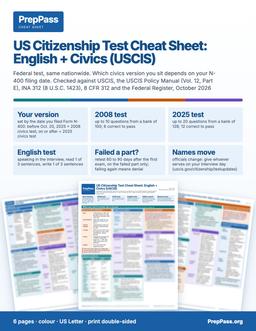
Thi trong vòng hai tuần?
Sách này là phần giảng dạy, đọc trong nhiều tuần. Nếu bạn thi trong vòng hai tuần, bảng tra cứu màu in được là sản phẩm còn lại: các con số then chốt, xếp theo từng phần.
6 trang · US Letter · PDF in được · giữ vĩnh viễn
Có gì — và không có gì
Bao gồm
- Both test versions (2008 100-Q and 2025 128-Q) and which applies to you
- American Government: Constitution, branches, Congress, rights & duties
Không bao gồm
- Không gửi bản in — đây là tệp bạn tải về và có thể tự in
- Sách không kèm khoá video, giảng viên hay kèm riêng — video miễn phí trên trang là phần khác
Toàn bộ phần bao gồm và không bao gồm
Bao gồm
- American History: independence, the 1800s, the Civil War, recent history
- Integrated Civics: geography, symbols, and holidays
- Moving answers (officials) taught as 'look up current at uscis.gov'
- 55 practice questions with answer explanations · PDF + EPUB
Không bao gồm
- Không bao gồm lệ phí đăng ký thi hay phí trung tâm khảo thí — bạn vẫn nộp cho cơ quan chính thức
Mục lục
Xem 4 phần và trang bắt đầu của từng phần
- Chapter 1 — American Governmenttr. 9
- Chapter 3 — Symbols and Holidays About 8% of the 128 civics questions (Q119–128) — the smallesttr. 25
- Practice Exam — 55 Questionstr. 29
- Answer Key with Explanationstr. 40
Lấy từ chính tệp PDF bạn tải về, kèm trang bắt đầu của từng phần — không phải gõ tay ở đây.
Đọc miễn phí trọn một chương
Trọn vẹn một chương, đúng như trong eBook. Cuộn cửa sổ để đọc ngay tại đây; không cần tải, không cần email.
Đọc chương 2 ngay tại đây, không rời trang
Chúng tôi không đưa phần mở đầu dễ dãi — chương miễn phí mở thẳng vào một trong những phần đậm đặc nhất của cuốn sách, để bạn đánh giá cách dạy ở đúng chỗ kỳ thi trở nên khó.
About 36% of the 128 civics questions (Q73–118) — the second-largest component, in three sub-sections: Colonial Period and Independence, The 1800s, and Recent American History.
The history questions run in a rough timeline: the colonial era and independence, the 1800s and the Civil War, and the 1900s to recent history. Almost every history answer is a fixed fact — a name, a document, a date, a war — that does not change with elections. The 2025 test goes deeper than the old 100-question test here: it adds "name one important event" questions (of the Revolution and of the Civil War), individual "famous for" questions about several founders, and several new "why did the U.S. enter this war" questions. Anchor everything to a few dates: 1776 (Declaration), 1787 (Constitution written), 1803 (Louisiana Purchase), 1861–1865 (Civil War), 1929 (Great Crash), 1941 (Pearl Harbor).
2.1 Colonial Period and Independence
Before the Europeans arrived, American Indians (Native Americans) already lived in America. Colonists later came for many reasons — freedom, political liberty, religious freedom, economic opportunity, and to escape persecution. Africans (people from Africa) were taken and sold as slaves.
The war the Americans fought to win independence from Britain was the American Revolution (the Revolutionary War / War for Independence). Reasons the Americans declared independence include high taxes, taxation without representation, British soldiers staying in Americans' houses (quartering), a lack of self-government, and specific sparks such as the Boston Massacre, the Boston Tea Party, the Stamp Act, the Sugar Act, the Townshend Acts, and the Intolerable (Coercive) Acts.
Thomas Jefferson wrote the Declaration of Independence, which was adopted on July 4, 1776. The American Revolution had many important events — you can name any one: the Battle of Bunker Hill, the Declaration of Independence, Washington crossing the Delaware (Battle of Trenton), the Battle of Saratoga, the Valley Forge encampment, or the Battle of Yorktown (the British surrender that effectively ended the war).
There were 13 original states along the Atlantic coast, and the 2025 test asks you to name five: New Hampshire, Massachusetts, Rhode Island, Connecticut, New York, New Jersey, Pennsylvania, Delaware, Maryland, Virginia, North Carolina, South Carolina, and Georgia.
The founders. The founding document written in 1787 was the Constitution. The Federalist Papers — written by James Madison, Alexander Hamilton, and John Jay (under the pen name Publius) — were important because they helped people understand the Constitution and supported passing it. The 2025 test adds individual "famous for" questions about several founders:
- Benjamin Franklin — founded the first free public libraries, was the first Postmaster General, helped write the Declaration of Independence, was an inventor, and a U.S. diplomat.
- George Washington — the "Father of Our Country," the first President, General of the Continental Army, and President of the Constitutional Convention.
- Thomas Jefferson — writer of the Declaration of Independence, the third President, the man who doubled the size of the country (the Louisiana Purchase), the first Secretary of State, and founder of the University of Virginia.
- James Madison — the "Father of the Constitution," the fourth President, President during the War of 1812, and one of the writers of the Federalist Papers.
- Alexander Hamilton — the first Secretary of the Treasury, one of the writers of the Federalist Papers, a helper in establishing the First Bank of the United States, an aide to General Washington, and a member of the Continental Congress.
2.2 The 1800s
The 1800s brought expansion and then a great crisis. In 1803, the United States bought the Louisiana Territory from France (the Louisiana Purchase), nearly doubling the country's size. Wars fought in the 1800s include the War of 1812, the Mexican-American War, the Civil War, and the Spanish-American War.
The U.S. war between the North and the South was the Civil War. The Civil War had many important events — name any one: the Battle of Fort Sumter, the Emancipation Proclamation, the Battle of Vicksburg, the Battle of Gettysburg, Sherman's March, the surrender at Appomattox, the Battle of Antietam (Sharpsburg), or Lincoln's assassination.
Abraham Lincoln is famous for many things: he freed the slaves (the Emancipation Proclamation), saved (preserved) the Union, led the United States during the Civil War, was the 16th President, and delivered the Gettysburg Address. The Emancipation Proclamation freed the slaves — specifically the enslaved people in the Confederate (Southern) states. The U.S. war that ended slavery was the Civil War.
The 14th Amendment says that all persons born or naturalized in the United States, and subject to its jurisdiction, are U.S. citizens. All men got the right to vote after the Civil War, during Reconstruction — with the 15th Amendment, in 1870. Leaders of the women's rights movement in the 1800s include Susan B. Anthony, Elizabeth Cady Stanton, Sojourner Truth, Harriet Tubman, Lucretia Mott, and Lucy Stone.
2.3 Recent American History and Other Important Information
Wars of the 1900s include World War I, World War II, the Korean War, the Vietnam War, and the (Persian) Gulf War. The United States entered World War I because Germany attacked U.S. (civilian) ships — and to support the Allied Powers against the Central Powers. All women got the right to vote in 1920 — after World War I, with the 19th Amendment.
The Great Depression was the longest economic recession in modern history; it started with the Great Crash — the stock market crash of 1929. Franklin Roosevelt was President during the Great Depression and World War II. The United States entered World War II because of the Japanese attack on Pearl Harbor — and to support the Allied Powers against the Axis Powers (Germany, Italy, and Japan). Dwight Eisenhower was a general during World War II, was President during the Korean War, was the 34th President, and signed the Federal-Aid Highway Act of 1956 that created the Interstate System.
During the Cold War, the United States' main rival was the Soviet Union (the USSR). One main concern was the spread of communism (and the threat of nuclear war). The U.S. entered both the Korean War and the Vietnam War for the same reason: to stop the spread of communism. It entered the Persian Gulf War to force the Iraqi military out of Kuwait.
The civil rights movement fought to end racial discrimination. Martin Luther King, Jr. fought for civil rights and worked for equality for all Americans. On September 11, 2001, terrorists attacked the United States — hijacking planes that struck the World Trade Center and the Pentagon, with a fourth crashing in Pennsylvania. U.S. military conflicts after 9/11 include the (Global) War on Terror, the War in Afghanistan, and the War in Iraq.
You may be asked to name one American Indian tribe — acceptable examples include the Cherokee, Navajo, Sioux, Apache, Cheyenne, Chippewa, Choctaw, Creek, Hopi, Lakota, Mohawk, Oneida, Pueblo, Seminole, Seneca, Shawnee, and many more (for the full list, USCIS points to bia.gov). Finally, the 2025 test adds a question on American innovation — examples include the light bulb, the automobile, skyscrapers, the airplane, the assembly line, landing on the moon, and the integrated circuit.
### Key Facts — Chapter 2 (all fixed facts — memorize) - Lived here first: American Indians (Native Americans). Taken and sold as slaves: Africans. Colonists came for freedom / religious freedom / economic opportunity / to escape persecution. - War for independence = the American Revolution. Reasons to declare independence = taxation without representation / high taxes / quartering soldiers / no self-government. - Declaration of Independence: written by Thomas Jefferson, adopted July 4, 1776. Name one Revolution event: Bunker Hill, Trenton, Saratoga, Valley Forge, Yorktown. - 13 original states — be ready to name five (e.g., Virginia, Massachusetts, New York, Pennsylvania, Georgia). - Constitution written 1787; Federalist Papers (Madison, Hamilton, Jay / "Publius") helped people understand and support the Constitution. - Founders "famous for": Washington (Father of Our Country, 1st President, General), Jefferson (wrote the Declaration, 3rd President, Louisiana Purchase), Madison ("Father of the Constitution," 4th President), Hamilton (1st Treasury Secretary), Franklin (first Postmaster General, U.S. diplomat, inventor). - Louisiana Purchase (1803) — bought from France. Name one 1800s war: War of 1812, Mexican-American, Civil War, Spanish-American. - Civil War = North vs. South; name one Civil War event: Fort Sumter, Gettysburg, Vicksburg, Appomattox, Emancipation Proclamation. Lincoln freed the slaves & saved the Union; the Civil War ended slavery. - Emancipation Proclamation freed slaves in the Confederate states. 14th Amendment = citizenship to all born/naturalized in the U.S. All men got the vote with the 15th (1870); all women with the 19th (1920). - WWI: U.S. entered because Germany attacked U.S. ships. Great Depression = longest modern recession, began with the 1929 crash; President Franklin Roosevelt. - WWII: U.S. entered after Japan attacked Pearl Harbor. Eisenhower = WWII general, 34th President, built the Interstate System. - Cold War rival = Soviet Union (USSR); concern = communism / nuclear war. Korea & Vietnam = to stop the spread of communism; Persian Gulf War = to force Iraq out of Kuwait. - Civil rights movement fought to end racial discrimination; leader = Martin Luther King, Jr. September 11, 2001 — terrorists attacked the U.S.; post-9/11 conflicts = War on Terror, Afghanistan, Iraq. - Name one American Indian tribe (Cherokee, Navajo, Sioux, Apache…) and one American innovation (light bulb, airplane, moon landing…).
Worked Example
Officer asks: "Why did the United States enter World War II?"
Reach for your date anchors. World War II = 1941, Pearl Harbor. The one-line answer the officer wants is "Because Japan attacked Pearl Harbor" (you could also say "to support the Allied Powers" or "to oppose the Axis Powers"). Now feel the trap: World War I has a different cause — Germany attacked U.S. (civilian) ships. The test deliberately offers "Germany attacked U.S. ships" as a choice on a World War II question to catch a memorized-but-mismatched answer. Tie each cause to its war: WWI → German attacks on U.S. ships; WWII → Japan attacks Pearl Harbor. And keep the two Cold War wars straight — the U.S. entered both Korea and Vietnam to stop the spread of communism.
Exam Traps
- WWI vs. WWII causes. WWI: Germany attacked U.S. ships. WWII: Japan attacked Pearl Harbor. Don't cross them.
- Which document did which job. The Declaration of Independence (1776) announced independence; the Constitution (1787) set up the government; the Emancipation Proclamation freed enslaved people in the Confederacy. Match the document to its action.
- Who "freed the slaves" vs. "first President." Lincoln freed enslaved people and saved the Union; Washington was the first President and "Father of Our Country." The test offers both names on both questions — and the new "famous for" questions about Jefferson, Madison, and Hamilton invite the same mix-ups (Jefferson wrote the Declaration; Madison is "Father of the Constitution"; Hamilton was first Treasury Secretary).
- All men (15th, 1870) vs. all women (19th, 1920). Two different amendments, two different dates — the 2025 test asks each separately.
- "Name one" (or "name five") means give exactly what's asked. For "name one event / one tribe / one war," a single correct example is a full answer — but the 13-original-states question asks you to name five, so have five ready. Make sure each example is correct (Texas and California were not original states; the Aztec and Maya were not U.S. tribes).
Câu hỏi người mua thường hỏi
Nhận sách thế nào?
Thanh toán xong, mục tải xuống hiện ngay trên trang này. Liên kết cũng được gửi qua email. Không cần tài khoản.
Nếu sách không hợp thì sao?
Gửi email trong vòng 14 ngày để được hoàn tiền đầy đủ, không cần lý do.
Phần luyện tập miễn phí có bị bỏ không?
Không. Mọi câu hỏi luyện tập, bài thi thử tính giờ và các chương miễn phí trên trang vẫn miễn phí. Cuốn sách là nửa "học", không phải hàng rào quanh phần miễn phí.
Thêm câu hỏi (1)
Đọc trên điện thoại được không?
Được — EPUB cho điện thoại và máy đọc sách, PDF để in và dán tab. Bạn nhận cả hai.
Vì sao mua sách khi phần luyện tập miễn phí?
Câu hỏi luyện tập và bài thi thử tính giờ vẫn miễn phí — không có gì trên trang bị giấu sau cuốn sách này. Cuốn sách $9.99 là nửa "học": chính phần kiến thức, dạy theo trình tự, trong một tệp thuộc về bạn.
- Dạy có hệ thống — mọi phần thi giảng theo từng chương, từ đầu đến cuối, không chỉ là câu hỏi
- In ra & dán nhãn — PDF sẵn sàng để in, tô đậm, ghi chú và mang tới bàn học
- Học mọi nơi, ngoại tuyến — EPUB trên điện thoại hay máy đọc sách; không cần wifi, không cần tab trình duyệt
- Tất cả một chỗ — các chương và câu hỏi luyện tập trong một tệp
- Của bạn trọn đời — trả một lần $9.99, tải ngay, không thuê bao
Chi tiết
- Đối chiếu từ nguồn chính thức(official USCIS civics questions / uscis.gov (2008 + 2025 civics tests))
- 128 câu hỏi luyện tập miễn phí
Mua một lần, truy cập tải về trọn đời. eBook là trọn bộ hướng dẫn ôn U.S. Citizenship Civics Test ở dạng PDF và EPUB. Bản tóm tắt mang tính giáo dục, không phải tư vấn chuyên môn hay pháp lý — luôn xác nhận quy định hiện hành với nguồn chính thức. Cập nhật lần cuối: October 2026.