CPA REG (Taxation and Regulation) · Ấn bản 2026
CPA REG Study Guide — 2026 Edition
Ghi chú phiên bảnNew for 2026: written to the Jan 2026 REG blueprint and the H.R. 1 tax law tested from July 1, 2026
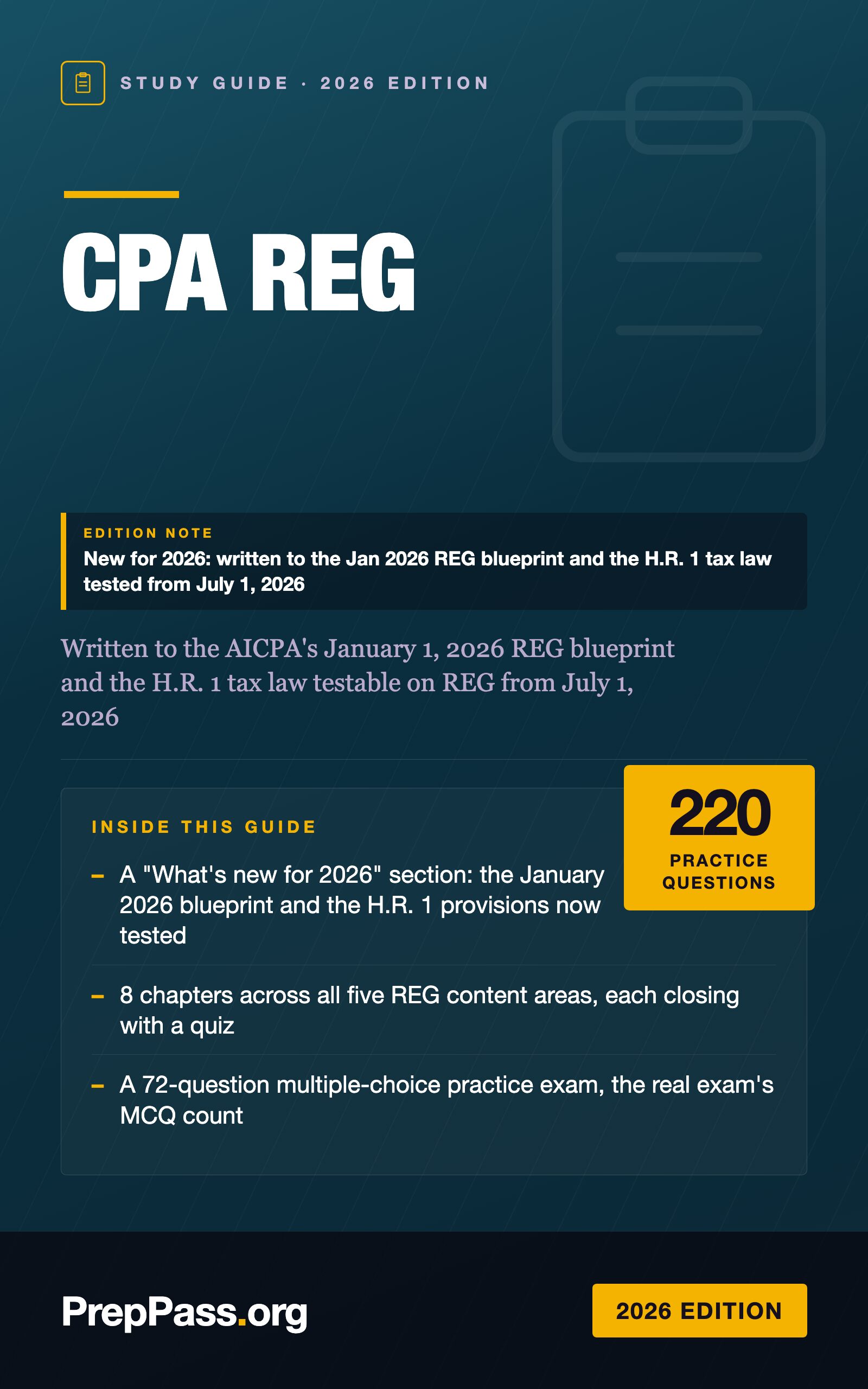
Written to the AICPA's January 1, 2026 REG blueprint and the H.R. 1 tax law testable on REG from July 1, 2026: 220 original questions, a 72-question practice exam and 5 worked simulation cases.
- 220 câu hỏi luyện tập CPA REG gốc, mỗi câu kèm lời giải, trong một bản PDF + EPUB bạn giữ
PDF + EPUB · tiếng Anh · 241 trang · $19.99 trả một lần
Sách này được viết bằng tiếng Anh — tệp PDF và EPUB bạn tải về đều bằng tiếng Anh.
Tải ngay sau khi thanh toán — không cần tài khoản, không thuê bao.
Đảm bảo hoàn tiền 14 ngày: không hài lòng vì bất kỳ lý do gì? Email support@preppass.org trong vòng 14 ngày kể từ khi mua để được hoàn tiền đầy đủ. Chính sách hoàn tiền
Thử 10 câu trước — miễn phí
Trả lời hết 10 câu, nộp bài xong sẽ thấy lời giải từng câu — kèm phần trong sách này dạy nội dung đó. Khoảng 5 phút, không cần đăng ký.
Bắt đầu 10 câu miễn phíXem bên trong cuốn sách
Ba trang thật, kết xuất thẳng từ tệp PDF bạn sẽ tải — lần lượt là một trang tra cứu, một trang giảng giải, và một câu hỏi có lời giải. Không trang nào được vẽ lại cho đẹp.
- Trang tra cứu nhanhChapter 1 — Ethics, Professional Responsibilities and Federal Tax Procedures (Area I) · Trang 22 của PDF
Một trang để lật lại: các con số, mốc thời hạn hoặc thuật ngữ gom về một chỗ.
- Cách giảng dạyChapter 2 — Business Law I: Agency and Contracts (Area II.A–II.B) · Trang 50 của PDF
Trang giảng giải: kiến thức được trình bày bằng văn xuôi, theo trình tự kỳ thi kiểm tra.
- Một câu hỏi có lời giảiAnswer key — Area II · Trang 188 của PDF
Một câu luyện tập kèm đáp án và lập luận đằng sau — không chỉ là đáp án.
Về chính kỳ thi này
| Cơ quan quản lý | American Institute of Certified Public Accountants (AICPA) — kỳ thi do Prometric tổ chức |
|---|---|
| Số câu hỏi | 72 câu hỏi Nguồn: AICPA — Uniform CPA Examination Blueprints (effective January 2026, PDF) |
| Thời gian làm bài | 240 phút Nguồn: AICPA — Uniform CPA Examination Blueprints (effective January 2026, PDF) |
| Điểm đậu | Điểm quy đổi 75 trên thang 0–99 Nguồn: AICPA & CIMA — Learn more about CPA Exam scoring and pass rates |
| Lệ phí | Boards of Accountancy / NASBA không công bố Những trang chúng tôi đã đọc và không tìm thấy: NASBA — CPA Exam Candidate Guide (07162026, PDF) |
| Ngôn ngữ thi | Tiếng Anh |
Câu hỏi luyện tập và chương học miễn phí CPA REG (Taxation and Regulation) →
Có gì — và không có gì
Bao gồm
- A "What's new for 2026" section: the January 2026 blueprint and the H.R. 1 provisions now tested
- 8 chapters across all five REG content areas, each closing with a quiz
- A 72-question multiple-choice practice exam, the real exam's MCQ count
- 5 worked task-based simulation cases: return review, depreciation, S corporation basis, Schedule M-1, research
- 220 original questions, each with a worked explanation citing its source
- PDF + EPUB you keep
Không bao gồm
- Không gửi bản in — đây là tệp bạn tải về và có thể tự in
- Sách không kèm khoá video, giảng viên hay kèm riêng — video miễn phí trên trang là phần khác
- Không bao gồm lệ phí đăng ký thi hay phí trung tâm khảo thí — bạn vẫn nộp cho cơ quan chính thức
Mục lục
Xem 13 phần và trang bắt đầu của từng phần
- Chapter 1 — Ethics, Professional Responsibilities and Federal Tax Procedures (Area I)tr. 10
- Chapter 2 — Business Law I: Agency and Contracts (Area II.A–II.B)tr. 33
- Chapter 3 — Business Law II: Debtor-Creditor Relationships, Federal Regulation and Business Structure (Area II.C–II.E)tr. 52
- Chapter 4 — Federal Taxation of Property Transactions: Basis and Cost Recovery (Area III)tr. 75
- Chapter 5 — Federal Taxation of Individuals I: Gross Income, Pass-Through Items, Adjustments and Deductions (Area IV.A–IV.C)tr. 91
- Chapter 6 — Federal Taxation of Individuals II: Loss Limitations, Filing Status, Tax and Credits (Area IV.D–IV.F)tr. 112
- Chapter 7 — Federal Taxation of Entities I: Book-Tax Differences, C Corporations and State and Local Taxes (Area V.A–V.B)tr. 132
- Chapter 8 — Federal Taxation of Entities II: S Corporations, Partnerships, LLCs and Tax-Exempt Organizations (Area V.C–V.F)tr. 152
- Answer key & explanationstr. 169
- Answer key — Area IItr. 180
- Appendix A — The exam at a glancetr. 211
- Appendix B — Terms to use preciselytr. 214
- Appendix C — Quick-reference sheet Procedure and penaltiestr. 217
Lấy từ chính tệp PDF bạn tải về, kèm trang bắt đầu của từng phần — không phải gõ tay ở đây.
Đọc miễn phí trọn một chương
Trọn vẹn một chương, đúng như trong eBook. Cuộn cửa sổ để đọc ngay tại đây; không cần tải, không cần email.
Đọc chương 8 ngay tại đây, không rời trang
Chúng tôi không đưa phần mở đầu dễ dãi — chương miễn phí mở thẳng vào một trong những phần đậm đặc nhất của cuốn sách, để bạn đánh giá cách dạy ở đúng chỗ kỳ thi trở nên khó.
Pass-through entities are tested in two ways. First, classification: can this corporation be an S corporation, and what is this LLC for tax purposes? Second, flow-through arithmetic: split the entity's items into ordinary business income and separately stated items, then roll each owner's basis forward. The basis roll-forward is where most candidates lose marks, so this chapter spends the most time on it.
V.C S corporations
V.C.1 Eligibility and election
A corporation can elect S status only if it is a small business corporation: a domestic corporation, not an ineligible corporation, that does not[1]
- have more than 100 shareholders (a husband and wife, and all members of a family, are treated as one shareholder[1]);
- have a shareholder that is not an individual, other than an estate, certain trusts and certain exempt organizations — so no corporations or partnerships as shareholders;
- have a nonresident alien shareholder; or
- have more than one class of stock. Differences in voting rights among common shares do not create a second class[1]; differences in rights to distributions or liquidation proceeds do.
Making the election. The corporation files Form 2553 with the consents of its shareholders — for an election filed before its effective date, every shareholder who owns stock on the day the election is made must consent[2]. An election is effective for a tax year if made during the preceding year or on or before the 15th day of the third month of the tax year[3]; a later election generally takes effect the following year. Relief for late elections is available.
Termination.
- Revocation — by shareholders holding more than one-half of the shares on the day of revocation[3].
- Ceasing to qualify — for example, a 101st shareholder, a corporate shareholder or a second class of stock; the termination is effective on the date of the terminating event.
- Excess passive investment income — the election terminates if the corporation has accumulated earnings and profits (from C corporation years) at the close of each of three consecutive years and passive investment income is more than 25% of gross receipts in each of those years[3].
After a termination, the corporation generally cannot re-elect until its fifth tax year after the year the termination took effect[3].
V.C.2 Ordinary business income and separately stated items
An S corporation generally pays no income tax. Each shareholder takes into account a pro rata share of the corporation's items of income (including tax-exempt income), loss, deduction and credit whose separate treatment could affect any shareholder's tax, and of its nonseparately computed income or loss[4].
| Ordinary business income (Form 1120-S page 1) | Separately stated (Schedule K / K-1) |
|---|---|
| Sales less cost of goods sold | Interest, dividends and royalties (portfolio income) |
| Salaries and wages, including reasonable compensation to shareholder-employees | Net rental real estate income or loss |
| Rent, taxes, repairs, depreciation (MACRS) | Capital gains and losses; §1231 gains and losses |
| Advertising, employee benefits | Charitable contributions |
| §179 deduction | |
| Tax-exempt interest (affects basis) | |
| Not deductible anywhere: fines, 50% of meals, federal income tax, entertainment | Nondeductible expenses (reduce basis) |
Pro rata share. Each item is assigned equally to each day of the year and then divided among the shares outstanding on that day[5] — so a shareholder who owned 40% for half the year is allocated 20% of the year's items.
The accumulated adjustments account (AAA)
The AAA tracks S corporation earnings that have been taxed to shareholders but not yet distributed. It is adjusted like stock basis, with two differences: no adjustment for tax-exempt income and its related expenses, and the AAA can go negative (the "but not below zero" limit in the basis rules is disregarded)[6]. Distributions reduce the AAA but cannot make it negative.
Distributions.
- S corporation with no accumulated E&P: a distribution is tax-free to the extent of the shareholder's stock basis; any excess is gain from the sale or exchange of property[6].
- S corporation with accumulated E&P from C years: distributions come first from the AAA (tax-free to the extent of basis), then as a dividend to the extent of accumulated E&P, then as a return of remaining basis and gain[6].
V.C.3 Shareholder's stock and debt basis
A shareholder's stock basis starts with the amount paid (or basis of property contributed). Each year it is[7]:
- increased by the shareholder's share of all income items — separately stated income, including tax-exempt income, and nonseparately computed income;
- decreased (not below zero) by non-taxable distributions, by losses and deductions, and by nondeductible, noncapital expenses[7].
Under the regulations the order is: increases, then distributions, then nondeductible expenses, then losses and deductions. Because distributions come before losses, a distribution is tested against basis before that year's losses reduce it.
Debt basis. A shareholder who lends money directly to the S corporation has basis in that debt. Losses that exceed stock basis reduce debt basis (not below zero)[7]. In later years, net increases restore debt basis first, before any increase to stock basis[7]. If the corporation repays a loan whose basis has been reduced, part of each repayment is income to the shareholder. Losses above combined stock and debt basis carry forward indefinitely[4].
A shareholder's guarantee of a bank loan to the corporation does not create debt basis; only a loan the shareholder actually made to the corporation does.
V.D Partnerships
V.D.1 Ordinary business income, separately stated items and guaranteed payments
A partnership files Form 1065 but pays no income tax. Its items flow to the partners on Schedule K-1 in the same two groups as an S corporation's: ordinary business income (loss) and separately stated items. The difference is guaranteed payments.
Guaranteed payments — payments to a partner for services or for the use of capital, determined without regard to the partnership's income — are treated as made to a non-partner for purposes of gross income and the deduction for business expenses[8]. So the partnership deducts them in computing ordinary business income, and the partner reports them as ordinary income in addition to his or her distributive share[9]. Guaranteed payments are not QBI (Chapter 5).
Contributions
No gain or loss is recognized by the partnership or the partner when property is contributed in exchange for a partnership interest[10]. The partner's initial basis in the interest (outside basis) is the money plus the adjusted basis of the property contributed[11]; the partnership's basis in the property (inside basis) is the partner's adjusted basis carried over[12].
V.D.2 Basis of a partner's interest
A partner's basis is[13]:
- increased by the distributive share of partnership taxable income, tax-exempt income and additional contributions;
- decreased (not below zero) by distributions, the distributive share of losses, and nondeductible expenditures not chargeable to capital[13].
Liabilities. An increase in a partner's share of partnership liabilities is treated as a contribution of money by the partner, increasing basis; a decrease is treated as a distribution of money, decreasing basis[14]. This is the key difference from an S corporation, where a shareholder gets no basis for the corporation's bank debt.
Distributions (non-liquidating).
- A partner recognizes gain only to the extent money distributed exceeds his or her basis immediately before the distribution; loss is not recognized in a current distribution[15].
- Property distributed takes the partnership's basis, but not more than the partner's outside basis reduced by any money distributed in the same transaction[16].
A partner's loss deduction is limited to outside basis at year-end (Chapter 6)[17].
Reviewing Form 1065 and Form 1120-S
The blueprint's review tasks ask you to classify items from a trial balance as ordinary, separately stated or nondeductible. Common errors: portfolio interest or dividends netted into ordinary income; charitable contributions deducted on page 1; §179 deducted on page 1 instead of passing through; guaranteed payments omitted from the deduction list (partnership) or treated as distributions; a shareholder's health insurance or a shareholder's salary misclassified; fines and the nondeductible part of meals deducted.
V.E Limited liability companies — classification
Under the "check-the-box" regulations, a domestic eligible entity that does not elect otherwise is a partnership if it has two or more members, or is disregarded as separate from its owner if it has a single owner[18]. Either kind of LLC may elect to be taxed as a corporation on Form 8832[19], and an LLC taxed as a corporation may then elect S status if it meets the S requirements. A disregarded single-member LLC is still treated as a separate entity for employment and certain excise taxes[19].
V.F Tax-exempt organizations
Section 501(c) lists the types of exempt organization. The ones REG expects you to recall:
| Section | Type |
|---|---|
| 501(c)(3) | Organized and operated exclusively for religious, charitable, scientific, literary or educational purposes (and certain others); no private inurement; no substantial lobbying; no political campaign activity[20] |
| 501(c)(4) | Civic leagues and social welfare organizations |
| 501(c)(5) | Labor, agricultural and horticultural organizations |
| 501(c)(6) | Business leagues (trade associations, chambers of commerce) |
| 501(c)(7) | Social and recreation clubs |
Source for (c)(4)–(c)(7):[21].
Only contributions to 501(c)(3)-type organizations (and certain others, such as government units) are generally deductible charitable contributions. A 501(c)(3) organization is either a public charity or a private foundation; private foundations face additional excise taxes.
Unrelated business income tax. An exempt organization pays tax at corporate rates on its unrelated business taxable income[22] — gross income from an unrelated trade or business regularly carried on, less directly connected deductions[23]. A trade or business is unrelated if its conduct is not substantially related (apart from the need for income) to the organization's exempt purpose[24]. A museum's gift shop selling reproductions of its collection is related; the same museum running a commercial car wash every weekend is not.
Worked example: a partner's year from K-1 to basis
Cedar Partners has three equal general partners. At January 1, Mia's outside basis is $50,000, which includes her one-third share ($20,000) of the partnership's $60,000 of recourse bank debt. During the year:
| Item | Partnership total | Mia's one-third |
|---|---|---|
| Ordinary business income (after a $36,000 guaranteed payment to Mia) | $90,000 | $30,000 |
| Guaranteed payment to Mia for services | $36,000 | $36,000 (hers alone) |
| Interest income | $6,000 | $2,000 |
| Tax-exempt interest | $3,000 | $1,000 |
| Charitable contributions | $9,000 | $3,000 |
| Nondeductible penalties | $1,500 | $500 |
| Bank debt at December 31 | $30,000 | $10,000 |
| Cash distribution to Mia | $25,000 |
Mia's return. Ordinary income $30,000 plus the $36,000 guaranteed payment, both reported as ordinary income[9]; interest $2,000; a $3,000 charitable contribution that she claims on her own return under the individual charitable rules (Chapter 5).
Mia's outside basis at December 31.
| Step | Amount |
|---|---|
| Beginning basis | $50,000 |
| + Distributive share of taxable income: ordinary $30,000 + interest $2,000 | $32,000 |
| + Tax-exempt interest | $1,000 |
| − Decrease in share of liabilities ($20,000 → $10,000), treated as a distribution of money | ($10,000) |
| − Cash distribution | ($25,000) |
| − Charitable contribution (a separately stated deduction item) | ($3,000) |
| − Nondeductible penalties | ($500) |
| Ending basis | $44,500 |
Sources: basis increases for taxable and tax-exempt income and decreases for distributions, losses and nondeductible expenditures[13]; a decrease in a partner's share of liabilities is a deemed distribution of money[14]. The guaranteed payment does not change basis: it is paid to Mia as if she were not a partner, and the partnership deducted it before computing the ordinary income she was allocated[8]. Because the total money distributed ($35,000 including the deemed distribution) never exceeds her basis, she recognizes no gain[15].
Choosing among entities — the tax comparison
| Feature | C corporation | S corporation | Partnership / multi-member LLC |
|---|---|---|---|
| Entity-level income tax | Yes, 21% | Generally no | No |
| Owners taxed on | Dividends when paid | Pro rata share of income, whether or not distributed | Distributive share, whether or not distributed |
| Allocation of items | Not applicable | Strictly per share, per day | By the partnership agreement |
| Owners' basis includes entity debt | No | No — only loans the shareholder makes | Yes — share of partnership liabilities |
| Ownership limits | None | ≤ 100 shareholders; eligible shareholders; one class of stock | None |
| Payments to owner-workers | Deductible salary | Reasonable salary, subject to payroll tax | Guaranteed payments |
| Losses | Stay in the corporation (NOL) | Pass through, limited by stock and debt basis | Pass through, limited by outside basis |
Worked example: an S corporation with C-corporation earnings and profits
Birch Inc. was a C corporation until 2023 and has $30,000 of accumulated E&P from those years. At the end of 2026, before distributions, its AAA is $50,000. Its sole shareholder, whose stock basis is $90,000, receives a $100,000 cash distribution.
- From AAA: $50,000 — tax-free to the extent of basis, reducing basis to $40,000[6].
- Then from accumulated E&P: $30,000 — a dividend[6].
- Remainder: $20,000 — applied against remaining basis ($40,000 → $20,000), tax-free[6].
Result: $30,000 dividend income; stock basis $20,000; AAA zero. Had Birch never been a C corporation, the whole $100,000 would have been measured only against basis: $90,000 tax-free and $10,000 capital gain.
Sources cited in this excerpt
- 26 U.S. Code § 1361 - S corporation defined. Legal Information Institute, Cornell Law School (U.S. Code), current text as retrieved. https://www.law.cornell.edu/uscode/text/26/1361
- Instructions for Form 2553, Election by a Small Business Corporation (Rev. December 2020). Internal Revenue Service, 2020-12. https://www.irs.gov/pub/irs-pdf/i2553.pdf
- 26 U.S. Code § 1362 - Election; revocation; termination. Legal Information Institute, Cornell Law School (U.S. Code), current text as retrieved. https://www.law.cornell.edu/uscode/text/26/1362
- 26 U.S. Code § 1366 - Pass-thru of items to shareholders. Legal Information Institute, Cornell Law School (U.S. Code), current text as retrieved. https://www.law.cornell.edu/uscode/text/26/1366
- 26 U.S. Code § 1377 - Definitions and special rule. Legal Information Institute, Cornell Law School (U.S. Code), current text as retrieved. https://www.law.cornell.edu/uscode/text/26/1377
- 26 U.S. Code § 1368 - Distributions. Legal Information Institute, Cornell Law School (U.S. Code), current text as retrieved. https://www.law.cornell.edu/uscode/text/26/1368
- 26 U.S. Code § 1367 - Adjustments to basis of stock of shareholders, etc. Legal Information Institute, Cornell Law School (U.S. Code), current text as retrieved. https://www.law.cornell.edu/uscode/text/26/1367
- 26 U.S. Code § 707 - Transactions between partner and partnership. Legal Information Institute, Cornell Law School (U.S. Code), current text as retrieved. https://www.law.cornell.edu/uscode/text/26/707
- Publication 541, Partnerships (Rev. December 2025). Internal Revenue Service, 2025-12. https://www.irs.gov/pub/irs-pdf/p541.pdf
- 26 U.S. Code § 721 - Nonrecognition of gain or loss on contribution. Legal Information Institute, Cornell Law School (U.S. Code), current text as retrieved. https://www.law.cornell.edu/uscode/text/26/721
- 26 U.S. Code § 722 - Basis of contributing partner’s interest. Legal Information Institute, Cornell Law School (U.S. Code), current text as retrieved. https://www.law.cornell.edu/uscode/text/26/722
- 26 U.S. Code § 723 - Basis of property contributed to partnership. Legal Information Institute, Cornell Law School (U.S. Code), current text as retrieved. https://www.law.cornell.edu/uscode/text/26/723
- 26 U.S. Code § 705 - Determination of basis of partner’s interest. Legal Information Institute, Cornell Law School (U.S. Code), current text as retrieved. https://www.law.cornell.edu/uscode/text/26/705
- 26 U.S. Code § 752 - Treatment of certain liabilities. Legal Information Institute, Cornell Law School (U.S. Code), current text as retrieved. https://www.law.cornell.edu/uscode/text/26/752
- 26 U.S. Code § 731 - Extent of recognition of gain or loss on distribution. Legal Information Institute, Cornell Law School (U.S. Code), current text as retrieved. https://www.law.cornell.edu/uscode/text/26/731
- 26 U.S. Code § 732 - Basis of distributed property other than money. Legal Information Institute, Cornell Law School (U.S. Code), current text as retrieved. https://www.law.cornell.edu/uscode/text/26/732
- 26 U.S. Code § 704 - Partner’s distributive share. Legal Information Institute, Cornell Law School (U.S. Code), current text as retrieved. https://www.law.cornell.edu/uscode/text/26/704
- 26 CFR § 301.7701-3 - Classification of certain business entities. Legal Information Institute, Cornell Law School (e-CFR), current text as retrieved. https://www.law.cornell.edu/cfr/text/26/301.7701-3
- Limited liability company (LLC). Internal Revenue Service, page as retrieved. https://www.irs.gov/businesses/small-businesses-self-employed/limited-liability-company-llc
- 26 U.S. Code § 501 - Exemption from tax on corporations, certain trusts, etc. Legal Information Institute, Cornell Law School (U.S. Code), current text as retrieved. https://www.law.cornell.edu/uscode/text/26/501
- Other tax-exempt organizations. Internal Revenue Service, page as retrieved. https://www.irs.gov/charities-non-profits/other-tax-exempt-organizations
- 26 U.S. Code § 511 - Imposition of tax on unrelated business income of charitable, etc., organizations. Legal Information Institute, Cornell Law School (U.S. Code), current text as retrieved. https://www.law.cornell.edu/uscode/text/26/511
- 26 U.S. Code § 512 - Unrelated business taxable income. Legal Information Institute, Cornell Law School (U.S. Code), current text as retrieved. https://www.law.cornell.edu/uscode/text/26/512
- 26 U.S. Code § 513 - Unrelated trade or business. Legal Information Institute, Cornell Law School (U.S. Code), current text as retrieved. https://www.law.cornell.edu/uscode/text/26/513
Trước khi mua
- Nhận sách thế nào?
- Thanh toán xong, mục tải xuống hiện ngay trên trang này. Liên kết cũng được gửi qua email. Không cần tài khoản.
- Nếu sách không hợp thì sao?
- Gửi email trong vòng 14 ngày để được hoàn tiền đầy đủ, không cần lý do.
- Phần luyện tập miễn phí có bị bỏ không?
- Không. Mọi câu hỏi luyện tập, bài thi thử tính giờ và các chương miễn phí trên trang vẫn miễn phí. Cuốn sách là nửa "học", không phải hàng rào quanh phần miễn phí.
- Đọc trên điện thoại được không?
- Được — EPUB cho điện thoại và máy đọc sách, PDF để in và dán tab. Bạn nhận cả hai.
Chi tiết
Written to the AICPA's January 1, 2026 REG blueprint and the H.R. 1 tax law testable on REG from July 1, 2026: 220 original questions, a 72-question practice exam and 5 worked simulation cases.
- Format: PDF + EPUB download · 241 pages
- 220 practice questions in the book, with a full answer key
- 112 free practice questions for this exam on PrepPass, included at no cost
- $19.99 one-time — no subscription
- 14-day money-back guarantee · refund policy
- Cross-referenced against: AICPA Uniform CPA Examination Blueprints (effective January 1, 2026), the AICPA's H.R. 1 testing statement, the Internal Revenue Code and Rev. Proc. 2025-32, read September 2026
- Đối chiếu từ nguồn chính thức(AICPA Uniform CPA Examination Blueprints (effective January 1, 2026), the AICPA's H.R. 1 testing statement, the Internal Revenue Code and Rev. Proc. 2025-32, read September 2026)
- 112 câu hỏi luyện tập miễn phí
- Tải ngay, thuộc về bạn trọn đời
Vì sao mua sách khi phần luyện tập miễn phí?
Câu hỏi luyện tập và bài thi thử tính giờ vẫn miễn phí — không có gì trên trang bị giấu sau cuốn sách này. Cuốn sách $19.99 là nửa "học": chính phần kiến thức, dạy theo trình tự, trong một tệp thuộc về bạn.
- Dạy có hệ thống — mọi phần thi giảng theo từng chương, từ đầu đến cuối, không chỉ là câu hỏi
- In ra & dán nhãn — PDF sẵn sàng để in, tô đậm, ghi chú và mang tới bàn học
- Học mọi nơi, ngoại tuyến — EPUB trên điện thoại hay máy đọc sách; không cần wifi, không cần tab trình duyệt
- Tất cả một chỗ — các chương và câu hỏi luyện tập trong một tệp
- Của bạn trọn đời — trả một lần $19.99, tải ngay, không thuê bao
Và không rủi ro: Đảm bảo hoàn tiền 14 ngày — không hài lòng? Email cho chúng tôi để hoàn tiền đầy đủ, không cần lý do. Xem chính sách hoàn tiền.
Đảm bảo hoàn tiền 14 ngày · hoàn tiền đầy đủ, không cần lý do.
Mua một lần, truy cập tải về trọn đời. eBook là trọn bộ hướng dẫn ôn CPA REG (Taxation and Regulation) ở dạng PDF và EPUB. Bản tóm tắt mang tính giáo dục, không phải tư vấn chuyên môn hay pháp lý — luôn xác nhận quy định hiện hành với nguồn chính thức.