CRC — Certified Rehabilitation Counselor Examination · Ấn bản 2026
CRC Study Guide — 2026 Edition
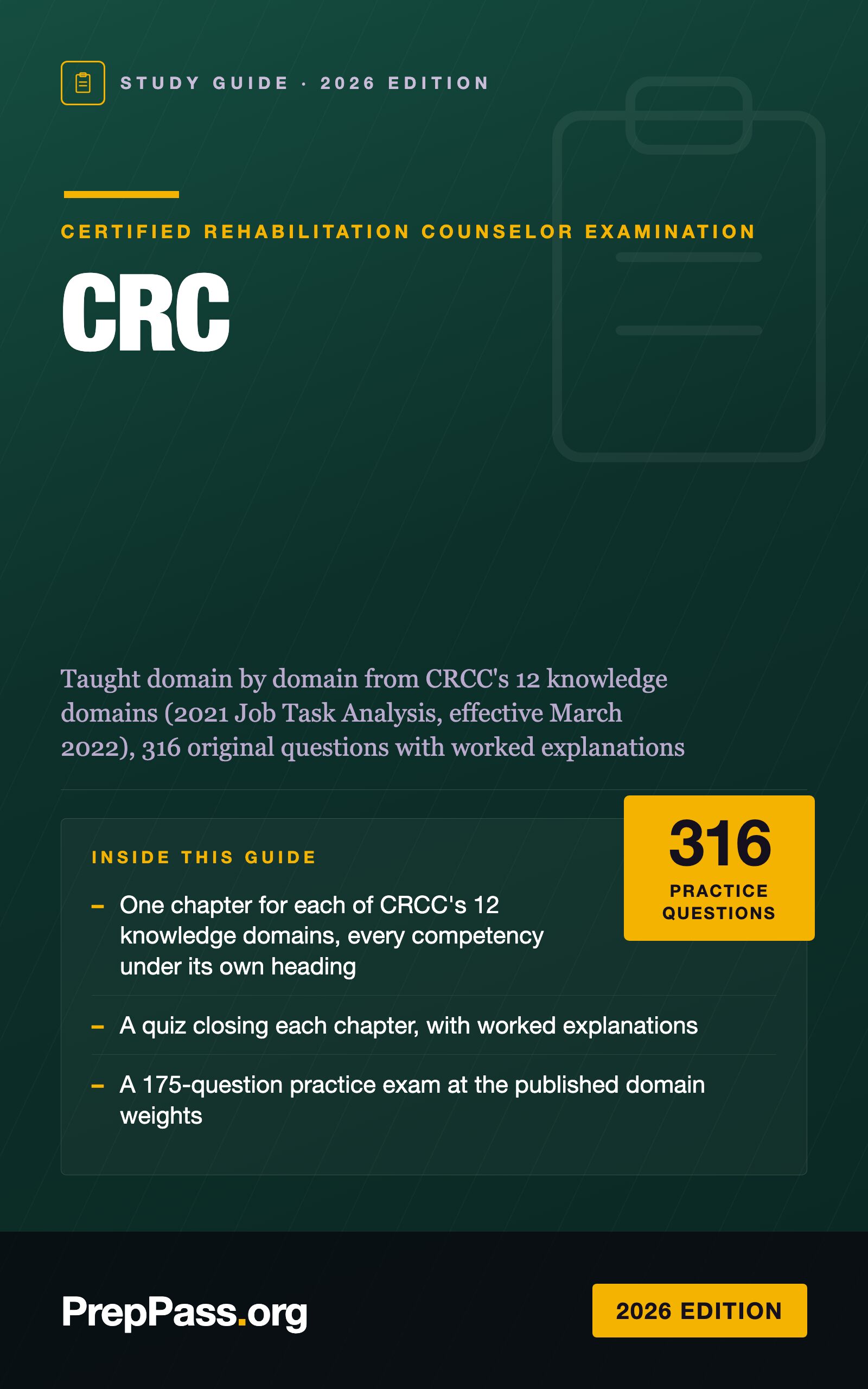
Taught domain by domain from CRCC's 12 knowledge domains (2021 Job Task Analysis, effective March 2022), 316 original questions with worked explanations, and a 175-question full-length practice exam.
- 316 câu hỏi luyện tập CRC gốc, mỗi câu kèm lời giải, trong một bản PDF + EPUB bạn giữ
PDF + EPUB · tiếng Anh · 192 trang · $24.99 trả một lần
Sách này được viết bằng tiếng Anh — tệp PDF và EPUB bạn tải về đều bằng tiếng Anh.
Tải ngay sau khi thanh toán — không cần tài khoản, không thuê bao.
Đảm bảo hoàn tiền 14 ngày: không hài lòng vì bất kỳ lý do gì? Email support@preppass.org trong vòng 14 ngày kể từ khi mua để được hoàn tiền đầy đủ. Chính sách hoàn tiền
Thử 10 câu trước — miễn phí
Trả lời hết 10 câu, nộp bài xong sẽ thấy lời giải từng câu — kèm phần trong sách này dạy nội dung đó. Khoảng 5 phút, không cần đăng ký.
Bắt đầu 10 câu miễn phíXem bên trong cuốn sách
Ba trang thật, kết xuất thẳng từ tệp PDF bạn sẽ tải — lần lượt là một trang tra cứu, một trang giảng giải, và một câu hỏi có lời giải. Không trang nào được vẽ lại cho đẹp.
- Trang tra cứu nhanhChapter 2 — Counseling Theories, Techniques, and Evidence-Based Practices · Trang 29 của PDF
Một trang để lật lại: các con số, mốc thời hạn hoặc thuật ngữ gom về một chỗ.
- Cách giảng dạyChapter 12 — Research, Methodology, and Performance Management · Trang 130 của PDF
Trang giảng giải: kiến thức được trình bày bằng văn xuôi, theo trình tự kỳ thi kiểm tra.
- Một câu hỏi có lời giảiChapter 7 — Career Development and Job Placement · Trang 78 của PDF
Một câu luyện tập kèm đáp án và lập luận đằng sau — không chỉ là đáp án.
Về chính kỳ thi này
| Cơ quan quản lý | Commission on Rehabilitation Counselor Certification (CRCC) — kỳ thi do Pearson VUE tổ chức Nguồn: CRCC — CRC Exam Overview |
|---|---|
| Số câu hỏi | 175 câu hỏi (150 câu tính điểm, 25 câu thử nghiệm không tính điểm) Nguồn: CRCC — CRC Exam Overview |
| Thời gian làm bài | 210 phút Nguồn: CRCC — CRC Exam Overview |
| Điểm đậu | CRCC không công bố Những trang chúng tôi đã đọc và không tìm thấy: CRCC — CRC Exam Overview |
| Lệ phí |
Nguồn: CRCC — Get Certified (CRC eligibility, fees and exam dates) |
| Ngôn ngữ thi | CRCC không công bố Những trang chúng tôi đã đọc và không tìm thấy: CRCC — CRC Exam Overview |
Câu hỏi luyện tập và chương học miễn phí CRC — Certified Rehabilitation Counselor Examination →
Có gì — và không có gì
Bao gồm
- One chapter for each of CRCC's 12 knowledge domains, every competency under its own heading
- A quiz closing each chapter, with worked explanations
- A 175-question practice exam at the published domain weights
- 316 original questions, each explained and cited to its source
- VR regulations (34 CFR 361), ADA Title I and 2026 SSA work-incentive figures
- PDF + EPUB you keep
Không bao gồm
- Không gửi bản in — đây là tệp bạn tải về và có thể tự in
- Sách không kèm khoá video, giảng viên hay kèm riêng — video miễn phí trên trang là phần khác
- Không bao gồm lệ phí đăng ký thi hay phí trung tâm khảo thí — bạn vẫn nộp cho cơ quan chính thức
Mục lục
Xem 14 phần và trang bắt đầu của từng phần
- Chapter 1 — Professional Orientation and Ethical Practicetr. 9
- Chapter 2 — Counseling Theories, Techniques, and Evidence-Based Practicestr. 22
- Chapter 3 — Group and Family Counselingtr. 35
- Chapter 4 — Crisis and Trauma Counselingtr. 43
- Chapter 5 — Medical and Psychosocial Aspects of Chronic Illness and Disabilitiestr. 50
- Answer key & explanationstr. 57
- Chapter 6 — Assessment/Evaluation, Occupational Analysis, and Service Implementationtr. 59
- Chapter 7 — Career Development and Job Placementtr. 71
- Chapter 8 — Business Engagementtr. 81
- Chapter 9 — Community Resources and Partnershipstr. 89
- Chapter 10 — Case Managementtr. 99
- Chapter 11 — Health Care and Disability Managementtr. 108
- Chapter 12 — Research, Methodology, and Performance Managementtr. 116
- Appendix B — Decision tablestr. 187
Lấy từ chính tệp PDF bạn tải về, kèm trang bắt đầu của từng phần — không phải gõ tay ở đây.
Đọc miễn phí trọn một chương
Trọn vẹn một chương, đúng như trong eBook. Cuộn cửa sổ để đọc ngay tại đây; không cần tải, không cần email.
Đọc chương 10 ngay tại đây, không rời trang
Chúng tôi không đưa phần mở đầu dễ dãi — chương miễn phí mở thẳng vào một trong những phần đậm đặc nhất của cuốn sách, để bạn đánh giá cách dạy ở đúng chỗ kỳ thi trở nên khó.
Case management is the operating system of rehabilitation counseling: the process that turns assessment into outcomes, the documentation that proves it, and the coordination that holds it together. The exam tests this domain through process questions — what comes next, what was skipped, what the record must show.
A. Understand and apply the case management process
The process follows a disciplined sequence: referral and intake, assessment, planning, implementation and coordination, monitoring, and closure or follow-up. Each step feeds the next; skipping steps creates the exam's favorite failure scenarios. A plan written before assessment is complete will miss needs; implementation without monitoring will miss problems. Interdisciplinary teamwork is part of the process: counselors on teams must keep the focus on how to serve clients best[1], and clients must be afforded full participation in decisions about their services[1]. The outcome standard for VR case management is competitive integrated employment or supported employment and economic self-sufficiency[2].
B. Complete case recording and documentation
The record must show what was done, why, and with whose consent: assessments administered, the client's choices, services authorized, provider contacts, and the rationale for significant decisions. Documentation standards the exam tests: timeliness (record promptly), accuracy (record what happened, not what should have happened), completeness (the next counselor can pick up the case), and confidentiality (access limited to those with a need to know). When disclosure of confidential information is required, clarify what is requested and share only what is required[1]. The trap is the thorough-but-late record or the prompt-but-vague one — the standard requires both.
C. Understand and apply negotiation, mediation, and conflict resolution strategies
Counselors negotiate with employers, mediate between clients and providers, and resolve conflicts among team members or stakeholders. The exam tests principled negotiation: separate the people from the problem, focus on interests rather than positions, and generate options before deciding. In team conflicts, the Code's procedure applies — attempt resolution within the team first; if that fails, recuse rather than implement a decision that breaches the Code. The trap is the counselor who avoids the conflict (hoping it resolves itself) or who escalates prematurely.
D. Understand and apply the principles of caseload management
Caseload management is triage under scarcity: prioritizing by urgency and need, allocating time across cases, and managing the order of selection when a VR agency cannot serve everyone (priority goes to individuals with the most significant disabilities[2]). The exam tests the counselor who systematizes — tickler systems, scheduled reviews, proactive outreach to stalled cases — versus the counselor who works whoever shouts loudest. Time management is an ethical issue: neglected cases are underserved clients.
E. Understand and address institutional and social barriers that impede access, equity, and success
Barriers live in systems, not just in clients: inaccessible facilities, discriminatory policies, transportation gaps, employer bias, and fragmented services. The counselor's job is to identify these barriers and address them — through advocacy, accommodation, referral, or systems change — rather than treating them as the client's personal deficit. The exam tests barrier analysis: when a capable client repeatedly fails, look at the system before blaming the client.
F. Apply techniques for working with individuals with limited English proficiency or varied communication methods
Effective service requires effective communication: qualified interpreters (never minor children, never the client's employer), translated materials, and alternative formats for sensory disabilities. The exam tests the details: the interpreter translates, not advises; the counselor speaks to the client, not the interpreter; confidentiality extends to the interpreted session. The trap is the convenient-but-inappropriate interpreter — a family member with a stake in the outcome, or a bilingual staff member pulled from unrelated duties without qualification.
G. Understand and apply principles, models, and documentation formats for biopsychosocial case conceptualization
The biopsychosocial model organizes the case: biological factors (medical conditions, medications, functional capacities), psychological factors (cognition, emotion, motivation, adjustment), and social factors (family, culture, community, systems). Treatment planning translates the conceptualization into goals, interventions, responsibilities, and timelines — with the client's informed choice at the center. The exam tests integration: the plan that addresses only the medical dimension while ignoring the psychological and social ones is incomplete by definition.
Going deeper — VR timelines and documentation
The VR regulations set the clock for case management. An eligibility determination is due within 60 days of application unless exceptional circumstances apply or the parties agree to extend it[3]. Applicants who are eligible for SSDI or SSI are presumed eligible and treated as individuals with significant disabilities[4]. The individualized plan for employment is due as soon as possible and no later than 90 days after eligibility, unless the agency and the individual agree to a specific later date[5]. Before providing most services, the agency checks for comparable services and benefits[6], but if they are not available when needed, VR provides the service until they are[6]. A case closes with an employment outcome only after the job has lasted at least 90 days[7], and a closure for other reasons must be justified in the record[8]. Throughout, clients receive the information and support to exercise informed choice[9].
Key numbers & deadlines
| Figure | Value | Source |
|---|---|---|
| Team member duty | Keep the focus on how to serve clients best | Code of Professional Ethics (2023)[1] |
| Client participation | Full participation in decisions about their services | Code of Professional Ethics (2023)[1] |
| VR outcome standard | Competitive integrated/supported employment; economic self-sufficiency | RSA[2] |
| Order of selection | Priority to individuals with the most significant disabilities | RSA[2] |
| Disclosure standard | Clarify what is requested; disclose only what is required | Code of Professional Ethics (2023)[1] |
Key takeaways
- Follow the process in order: intake, assessment, planning, implementation, monitoring, closure — each step feeds the next.
- Document promptly, accurately, completely, and confidentially; the record must show the client's choices and your rationale.
- On teams, keep the client's best interests central and protect full client participation in decisions.
- Manage the caseload systematically; when resources are scarce, priority goes to the most significant disabilities.
- Analyze barriers in the system before attributing failure to the client.
- Biopsychosocial planning integrates medical, psychological, and social dimensions with the client's informed choice.
Chapter 10 quiz — 13 questions
Answer each question, then check the key that follows.
1. A counselor opens a case management relationship. What must informed consent include?
- A. Only fees and office hours
- B. Only the counselor's credentials
- C. Purposes, methods, risks, benefits
- D. A signature on the intake form alone
2. A client applied for VR services on March 1. Absent exceptional circumstances or an agreed extension, by when must the eligibility decision be made?
- A. Within 60 days
- B. Within 30 days
- C. Within 90 days
- D. Within 120 days
3. A counselor serves on an interdisciplinary team for a client. What does the Code require of the counselor's team role?
- A. Serve the client best, with full participation
- B. Defer to team consensus without representing the client
- C. Share all client information with every team member
- D. Let the team's scheduling override the client's goals
4. A counselor writes a VR case plan. What outcome should it target?
- A. Integrated employment by choice
- B. Keeping the case open indefinitely
- C. Sheltered placement by default
- D. Whatever service costs least
5. A case requires expertise the counselor does not have. What does the Code require?
- A. Keep the case and learn as you go
- B. Close the case without a referral
- C. Ask the client to find another provider
- D. Refer the client, putting the client's welfare first
6. A counselor discontinues case management services. What procedure does the Code require?
- A. Close the file without a referral
- B. Orderly transfer with notice and referrals
- C. Close the case without notifying the client
- D. Transfer only the most recent notes
7. A counselor coordinates care within a treatment team. How much information should be shared?
- A. Only the information the team's work requires
- B. The entire file, to be thorough
- C. Nothing without a court order
- D. Whatever each member requests
8. A counselor coordinates services across agencies. What client right must be preserved?
- A. The team may decide without the client
- B. The right to refuse services
- C. Consent given once covers all agencies
- D. Only the lead agency needs consent
9. A counselor evaluates case management outcomes for a state VR client. What outcome defines success?
- A. Rapid case closure
- B. Integrated employment and self-sufficiency
- C. Continuous enrollment
- D. Appointment counts
10. A client was found eligible for VR on May 1. Unless both parties agree to an extension, when must the individualized plan for employment be developed?
- A. Within 30 days of eligibility
- B. Within 60 days of application
- C. Only after all assessments finish
- D. Within 90 days of eligibility
11. A VR client started a competitive integrated job 45 days ago and is doing well. May the counselor close the case as successfully employed now?
- A. No; it takes a year
- B. Yes, after 30 days on the job
- C. No; it must last 90 days
- D. Yes, once hired
12. A client's hearing aids could be paid for by her health insurance, but the insurer will not approve them for four months and her job starts next week. What should the VR agency do?
- A. Deny the hearing aids permanently
- B. Require the client to pay and seek reimbursement
- C. Wait for the insurer, since it is the comparable benefit
- D. Provide it now; the benefit is late
13. A client who receives SSDI applies for VR services. How is her eligibility treated?
- A. She is presumed eligible for VR services
- B. She is eligible only for supported employment
- C. She must prove eligibility like any applicant
- D. She is ineligible because she receives benefits
Answer key & explanations
1. C. The Code requires counselors to obtain informed consent that includes the purposes, goals, techniques, procedures, limitations, potential risks, and benefits of services. A case management plan starts from that consent.[1]
2. A. Under 34 CFR 361.41, once an individual applies, the eligibility determination must be made within 60 days unless exceptional and unforeseen circumstances intervene or the parties agree to an extension. Ninety days is the separate deadline for the IPE after eligibility.[3, 5]
3. A. The Code requires counselors who join interdisciplinary teams to keep the focus on how to serve clients best and to make reasonable efforts to ensure clients participate fully in decisions about their services. The counselor therefore advocates the client's interests inside the team and protects the client's participatory role. The most tempting distractor is deferring to team consensus, because the Code does expect counselors to implement team decisions they did not personally favor — but not decisions that breach the Code, and ethical concerns are raised within the team first. Unlimited sharing violates confidentiality, and letting convenience override goals abandons the client's interests.[1, 10]
4. A. State VR services are provided consistent with the client's strengths, priorities, and informed choice toward competitive integrated or supported employment. The case plan serves that goal.[2]
5. D. The Code requires referral when the counselor lacks competence, with the primary obligation being the client's welfare. A referral outside competence is the ethical move.[1]
6. B. The Code requires transferring or closing files in an orderly, professional manner, sensitive to the client's needs, when discontinuing services, with prior notification and appropriate referrals. That procedure governs case closure.[1]
7. A. The Code's minimal-disclosure rule applies: when circumstances require disclosing confidential information, the counselor clarifies what is being requested and ensures only required information is disclosed, and clients are told during professional disclosure that team members will share their information. Sending the whole file is the tempting "thorough" answer, but it discloses more than the work requires; refusing all sharing without a court order blocks legitimate coordination.[1]
8. B. The Code recognizes clients' freedom to choose whether to remain in a professional relationship and to refuse services or changes, and requires reasonable efforts so they can participate fully in decisions. Multi-agency coordination does not let a team decide without the client or treat one consent as covering every agency.[1]
9. B. State VR programs provide services so that individuals with disabilities may prepare for and engage in competitive integrated employment or supported employment and achieve economic self-sufficiency. Outcomes are therefore judged against employment and self-sufficiency, not against service volume or speed. The most tempting distractor is appointment counts: activity is easy to track and often appears in administrative reports, but it measures effort rather than results. Continuous enrollment without a goal contradicts the employment purpose, and rapid closure without an outcome abandons it.[2]
10. D. 34 CFR 361.45 requires the IPE to be developed as soon as possible, but not later than 90 days after the eligibility determination, unless the agency and the individual agree to extend it to a specific date.[5]
11. C. A case may be closed with an employment outcome only after the individual has maintained it for an appropriate period of not less than 90 days and no longer needs services. Forty-five days is too soon; a year is not the rule.[7]
12. D. If comparable services or benefits exist but are not available when needed for progress toward the IPE outcome, the VR agency must provide the service until the comparable benefit becomes available. Making her wait four months would jeopardize the job.[6]
13. A. Under 34 CFR 361.42, an applicant determined eligible for Social Security benefits under title II or XVI is presumed eligible for VR services and is considered an individual with a significant disability. Benefit receipt is not a bar to VR.[4]
Sources cited in this excerpt
- Code of Professional Ethics for Certified Rehabilitation Counselors (2023). Commission on Rehabilitation Counselor Certification. https://crccertification.com/wp-content/uploads/2023/04/2023-Code-of-Ethics.pdf
- State Vocational Rehabilitation Services Program. Rehabilitation Services Administration, U.S. Department of Education. https://rsa.ed.gov/about/programs/vocational-rehabilitation-state-grants
- 34 CFR 361.41 — Processing referrals and applications. Electronic Code of Federal Regulations (eCFR). https://www.ecfr.gov/current/title-34/section-361.41
- 34 CFR 361.42 — Assessment for determining eligibility and priority for services. Electronic Code of Federal Regulations (eCFR). https://www.ecfr.gov/current/title-34/section-361.42
- 34 CFR 361.45 — Development of the individualized plan for employment. Electronic Code of Federal Regulations (eCFR). https://www.ecfr.gov/current/title-34/section-361.45
- 34 CFR 361.53 — Comparable services and benefits. Electronic Code of Federal Regulations (eCFR). https://www.ecfr.gov/current/title-34/section-361.53
- 34 CFR 361.56 — Requirements for closing the record of services of an individual who has achieved an employment outcome. Electronic Code of Federal Regulations (eCFR). https://www.ecfr.gov/current/title-34/section-361.56
- 34 CFR 361.47 — Record of services. Electronic Code of Federal Regulations (eCFR). https://www.ecfr.gov/current/title-34/section-361.47
- 34 CFR 361.52 — Informed choice. Electronic Code of Federal Regulations (eCFR). https://www.ecfr.gov/current/title-34/section-361.52
- Code of Professional Ethics for Certified Rehabilitation Counselors (2023). https://crccertification.com/wp-content/uploads/2023/04/2023-Code-of-Ethics.pdf
Trước khi mua
- Nhận sách thế nào?
- Thanh toán xong, mục tải xuống hiện ngay trên trang này. Liên kết cũng được gửi qua email. Không cần tài khoản.
- Nếu sách không hợp thì sao?
- Gửi email trong vòng 14 ngày để được hoàn tiền đầy đủ, không cần lý do.
- Phần luyện tập miễn phí có bị bỏ không?
- Không. Mọi câu hỏi luyện tập, bài thi thử tính giờ và các chương miễn phí trên trang vẫn miễn phí. Cuốn sách là nửa "học", không phải hàng rào quanh phần miễn phí.
- Đọc trên điện thoại được không?
- Được — EPUB cho điện thoại và máy đọc sách, PDF để in và dán tab. Bạn nhận cả hai.
Chi tiết
Taught domain by domain from CRCC's 12 knowledge domains (2021 Job Task Analysis, effective March 2022), 316 original questions with worked explanations, and a 175-question full-length practice exam.
- Format: PDF + EPUB download · 192 pages
- 316 practice questions in the book, with a full answer key
- 107 free practice questions for this exam on PrepPass, included at no cost
- $24.99 one-time — no subscription
- 14-day money-back guarantee · refund policy
- Cross-referenced against: CRCC's published exam overview, 2021 Job Task Analysis blueprint and CRC Certification Guide
- Last updated: September 2026
- Đối chiếu từ nguồn chính thức(CRCC's published exam overview, 2021 Job Task Analysis blueprint and CRC Certification Guide)
- 107 câu hỏi luyện tập miễn phí
- Tải ngay, thuộc về bạn trọn đời
Vì sao mua sách khi phần luyện tập miễn phí?
Câu hỏi luyện tập và bài thi thử tính giờ vẫn miễn phí — không có gì trên trang bị giấu sau cuốn sách này. Cuốn sách $24.99 là nửa "học": chính phần kiến thức, dạy theo trình tự, trong một tệp thuộc về bạn.
- Dạy có hệ thống — mọi phần thi giảng theo từng chương, từ đầu đến cuối, không chỉ là câu hỏi
- In ra & dán nhãn — PDF sẵn sàng để in, tô đậm, ghi chú và mang tới bàn học
- Học mọi nơi, ngoại tuyến — EPUB trên điện thoại hay máy đọc sách; không cần wifi, không cần tab trình duyệt
- Tất cả một chỗ — các chương và câu hỏi luyện tập trong một tệp
- Của bạn trọn đời — trả một lần $24.99, tải ngay, không thuê bao
Và không rủi ro: Đảm bảo hoàn tiền 14 ngày — không hài lòng? Email cho chúng tôi để hoàn tiền đầy đủ, không cần lý do. Xem chính sách hoàn tiền.
Đảm bảo hoàn tiền 14 ngày · hoàn tiền đầy đủ, không cần lý do.
Mua một lần, truy cập tải về trọn đời. eBook là trọn bộ hướng dẫn ôn CRC — Certified Rehabilitation Counselor Examination ở dạng PDF và EPUB. Bản tóm tắt mang tính giáo dục, không phải tư vấn chuyên môn hay pháp lý — luôn xác nhận quy định hiện hành với nguồn chính thức. Cập nhật lần cuối: September 2026.