AANP FNP — Family Nurse Practitioner Certification Exam (AANPCB) · Ấn bản 2026
AANP FNP Study Guide — 2026 Edition
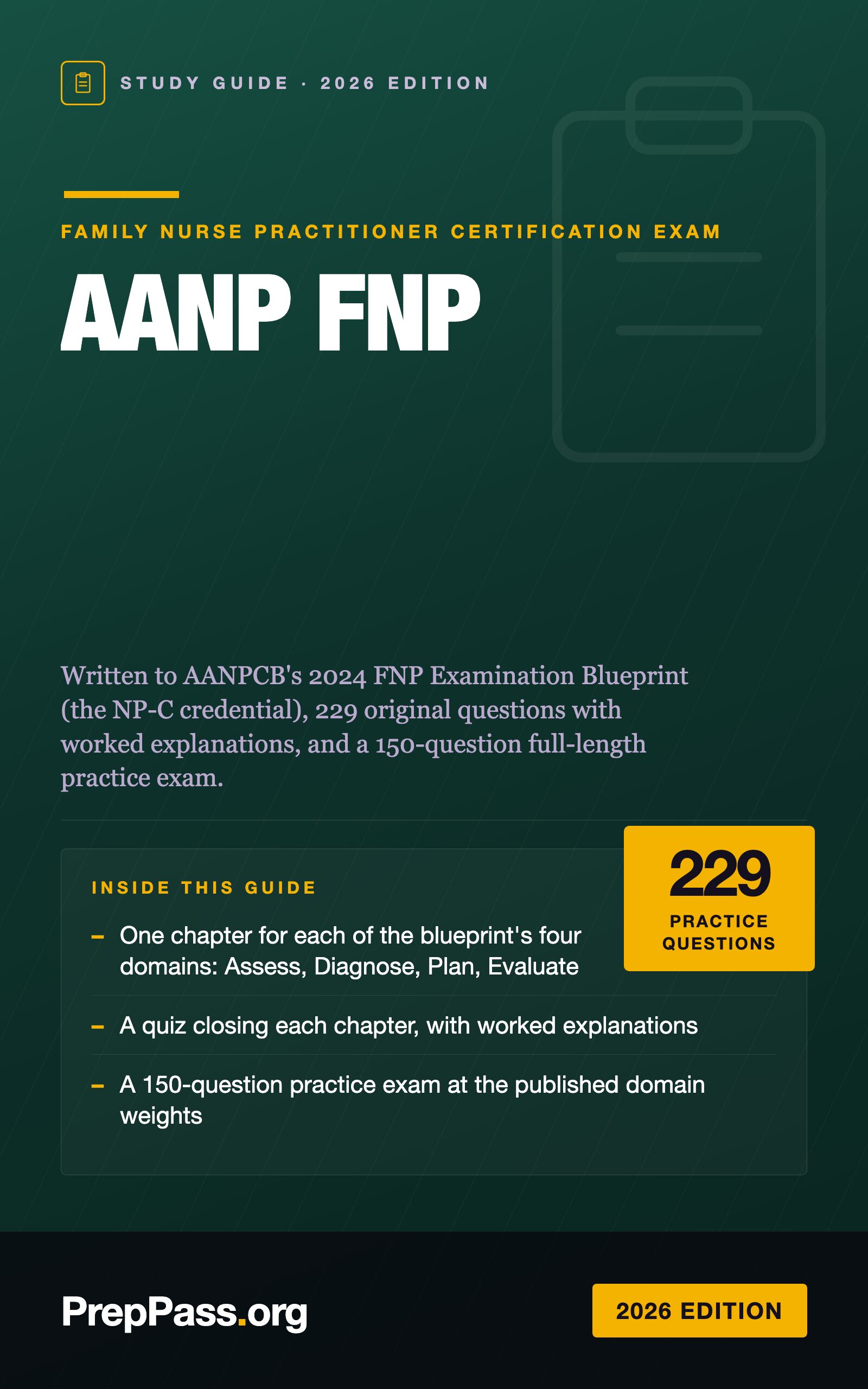
Written to AANPCB's 2024 FNP Examination Blueprint (the NP-C credential), 229 original questions with worked explanations, and a 150-question full-length practice exam. Not for ANCC's FNP-BC.
- 229 câu hỏi luyện tập FNP gốc, mỗi câu kèm lời giải, trong một bản PDF + EPUB bạn giữ
PDF + EPUB · tiếng Anh · 127 trang · $24.99 trả một lần
Sách này được viết bằng tiếng Anh — tệp PDF và EPUB bạn tải về đều bằng tiếng Anh.
Tải ngay sau khi thanh toán — không cần tài khoản, không thuê bao.
Đảm bảo hoàn tiền 14 ngày: không hài lòng vì bất kỳ lý do gì? Email support@preppass.org trong vòng 14 ngày kể từ khi mua để được hoàn tiền đầy đủ. Chính sách hoàn tiền
Thử 10 câu trước — miễn phí
Trả lời hết 10 câu, nộp bài xong sẽ thấy lời giải từng câu — kèm phần trong sách này dạy nội dung đó. Khoảng 5 phút, không cần đăng ký.
Bắt đầu 10 câu miễn phíXem bên trong cuốn sách
Ba trang thật, kết xuất thẳng từ tệp PDF bạn sẽ tải — lần lượt là một trang tra cứu, một trang giảng giải, và một câu hỏi có lời giải. Không trang nào được vẽ lại cho đẹp.
- Trang tra cứu nhanhChapter 1 — Assess · Trang 13 của PDF
Một trang để lật lại: các con số, mốc thời hạn hoặc thuật ngữ gom về một chỗ.
- Cách giảng dạySection 2 — answer key & explanations · Trang 85 của PDF
Trang giảng giải: kiến thức được trình bày bằng văn xuôi, theo trình tự kỳ thi kiểm tra.
- Một câu hỏi có lời giảiChapter 3 — Plan · Trang 46 của PDF
Một câu luyện tập kèm đáp án và lập luận đằng sau — không chỉ là đáp án.
Về chính kỳ thi này
| Cơ quan quản lý | American Academy of Nurse Practitioners Certification Board (AANPCB), doing business as Nurse Practitioners Certification Board (NPCB) — kỳ thi do Prometric tổ chức Nguồn: AANPCB (NPCB) — Family Nurse Practitioner Candidate Handbook (Updated 06/2026, PDF) |
|---|---|
| Số câu hỏi | 150 câu hỏi (135 câu tính điểm, 15 câu thử nghiệm không tính điểm) Nguồn: AANPCB (NPCB) — Family Nurse Practitioner Candidate Handbook (Updated 06/2026, PDF) |
| Thời gian làm bài | 180 phút Nguồn: AANPCB (NPCB) — Family Nurse Practitioner Candidate Handbook (Updated 06/2026, PDF) |
| Điểm đậu | NPCB không công bố Những trang chúng tôi đã đọc và không tìm thấy: AANPCB (NPCB) — Family Nurse Practitioner Candidate Handbook (Updated 06/2026, PDF) |
| Lệ phí |
|
| Ngôn ngữ thi | NPCB không công bố Những trang chúng tôi đã đọc và không tìm thấy: AANPCB (NPCB) — Family Nurse Practitioner Candidate Handbook (Updated 06/2026, PDF) |
Có gì — và không có gì
Bao gồm
- One chapter for each of the blueprint's four domains: Assess, Diagnose, Plan, Evaluate
- A quiz closing each chapter, with worked explanations
- A 150-question practice exam at the published domain weights
- 229 original questions, each explained and cited to its source
- Lifespan screening and immunization quick-reference appendix
- PDF + EPUB you keep
Không bao gồm
- Không gửi bản in — đây là tệp bạn tải về và có thể tự in
- Sách không kèm khoá video, giảng viên hay kèm riêng — video miễn phí trên trang là phần khác
- Không bao gồm lệ phí đăng ký thi hay phí trung tâm khảo thí — bạn vẫn nộp cho cơ quan chính thức
Mục lục
Xem 14 phần và trang bắt đầu của từng phần
- Chapter 1 — Assesstr. 8
- Chapter 2 — Diagnosetr. 24
- Chapter 3 — Plantr. 37
- Chapter 4 — Evaluatetr. 50
- Section 1 — Assess (48 questions)tr. 58
- Section 1 — answer key & explanationstr. 69
- Section 2 — Diagnose (40 questions)tr. 75
- Section 2 — answer key & explanationstr. 84
- Section 3 — Plan (40 questions)tr. 89
- Section 3 — answer key & explanationstr. 98
- Section 4 — Evaluate (22 questions)tr. 103
- Section 4 — answer key & explanationstr. 108
- Appendix A — Terms the exam expects you to use preciselytr. 111
- Appendix B — Lifespan screening and immunization quick- referencetr. 115
Lấy từ chính tệp PDF bạn tải về, kèm trang bắt đầu của từng phần — không phải gõ tay ở đây.
Đọc miễn phí trọn một chương
Trọn vẹn một chương, đúng như trong eBook. Cuộn cửa sổ để đọc ngay tại đây; không cần tải, không cần email.
Đọc chương 2 ngay tại đây, không rời trang
Chúng tôi không đưa phần mở đầu dễ dãi — chương miễn phí mở thẳng vào một trong những phần đậm đặc nhất của cuốn sách, để bạn đánh giá cách dạy ở đúng chỗ kỳ thi trở nên khó.
Diagnose is 27 percent of the scored exam — 36 items. The published task statements are to prioritize differential diagnoses and establish the primary diagnosis (the handbook prints this task statement twice in the blueprint table, an apparent duplication in the source document). Where Assess was about gathering data, Diagnose is about what you do with it: generating a ranked differential, ruling conditions out with the right test, and naming the diagnosis. The exam tests this across every system and every age group, so this chapter is organized by presentation — the way the questions arrive.
How diagnosis works on this exam
A good differential is ranked, not listed. Start with the most likely and the most dangerous, and know which one you must rule out first — chest pain means acute coronary syndrome until proven otherwise, a thunderclap headache means subarachnoid hemorrhage, calf pain with swelling means deep vein thrombosis. Then use the history and examination to move conditions up or down, and order the test that settles the question: the ECG for chest pain, the non-contrast head CT for a suspected stroke, the urinalysis with culture for dysuria, the A1C for suspected diabetes.
Learn to distinguish pairs the exam loves: osteoarthritis versus rheumatoid arthritis, migraine versus tension headache, irritable bowel syndrome versus inflammatory bowel disease, depression versus bipolar disorder. Each pair below is written to make that distinction testable.
Cardiovascular and pulmonary presentations
Chest pain is stratified by risk before it is diagnosed: pressure-like substernal pain with exertion, radiation to the arm or jaw, diaphoresis, and nausea point toward acute coronary syndrome and demand an ECG first. Sharp pain worse with inspiration points toward pleuritic or musculoskeletal causes; tearing pain radiating to the back is the classic description of aortic dissection.
Heart failure presents with dyspnea on exertion, orthopnea, paroxysmal nocturnal dyspnea, and edema; the examination finds crackles, an S3, and jugular venous distension. Atrial fibrillation — one of the most common arrhythmias, with risk rising with age — produces an irregularly irregular pulse and is confirmed on ECG[1]. Venous thromboembolism presents as a swollen, painful calf (deep vein thrombosis) or as sudden dyspnea and pleuritic chest pain (pulmonary embolism).
For cough and dyspnea, duration and pattern separate the diagnoses. Asthma is episodic wheezing with triggers and reversibility; COPD is progressive dyspnea in a smoker with a chronic productive cough. Community-acquired pneumonia presents with cough (sometimes with greenish, yellow, or bloody mucus), fever, shaking chills, and shortness of breath[2].
Endocrine and metabolic presentations
Diabetes is diagnosed by numbers, not symptoms: an A1C of 6.5 percent or higher, a fasting plasma glucose of 126 mg/dL or higher, or a 2-hour oral glucose tolerance result of 200 mg/dL or higher[3]. Polyuria, polydipsia, and unexplained weight loss support the diagnosis but are not required.
Hypothyroidism — most commonly from Hashimoto's disease, an autoimmune disorder that can cause hypothyroidism[4] — presents with fatigue, weight gain, cold intolerance, constipation, dry skin and hair, and slowed heart rate[4]. Hyperthyroidism is the mirror image: weight loss, heat intolerance, tremor, and palpitations. Iron deficiency anemia presents with fatigue, pallor, and pica, with microcytic red cells and low ferritin on labs.
Neurologic presentations
Migraine is moderate to severe throbbing pain, usually on one side of the head[5], lasting hours to days, with nausea and sensitivity to light and sound; migraine with aura adds visual symptoms such as dots, zigzags, or sparks, and sometimes speech changes[5]. Tension headache is bilateral, pressing, and milder.
A transient ischemic attack is a brief blockage of blood supply to part of the brain — a "mini-stroke" lasting only a few minutes with stroke-like symptoms that resolve[6]. TIAs are warning signs: about one-third of people who have a TIA will have a severe stroke in the future[6], so a TIA is never observed at home — it is worked up urgently.
Parkinson's disease shows tremor (uncontrollable shaking of the hands or fingers), stiffness, and bradykinesia — movements that are too slow[7]. Epilepsy is a chronic brain disorder in which groups of neurons sometimes send the wrong signals and cause seizures[8]; the history distinguishes it from syncope and from psychogenic events.
Musculoskeletal presentations
Osteoarthritis is the most common arthritis of older adults: joint pain with stiffness for a short period after rest or inactivity, affecting the hands, knees, hips, neck, and lower back[9]. Rheumatoid arthritis is a chronic autoimmune disease that mostly affects joints[10], occurring in a symmetrical pattern — if one hand is affected, the other often is too[10] — with joint stiffness and systemic features such as fatigue.
Gout announces itself: flares of severe joint pain and swelling that often begin in the big toe or a lower limb[11], caused by high urate levels forming needle-shaped crystals in and around the joint[11]. Fibromyalgia is chronic widespread pain throughout the body or in multiple areas, with fatigue and sleep disturbance[12] — a diagnosis of pattern recognition after other causes are excluded. Acute back pain with no red flags (no trauma, no neurologic deficit, no cancer history, no infection signs) is managed conservatively; red flags change everything.
Gastrointestinal presentations
GERD commonly causes heartburn and regurgitation when the lower esophageal sphincter weakens or relaxes inappropriately[13]. Peptic ulcer disease presents with epigastric pain, and its most common causes are H. pylori infection and NSAIDs[14]. Irritable bowel syndrome is repeated abdominal pain with changes in bowel movements — diarrhea, constipation, or both — without visible damage or disease in the digestive tract[15]; inflammatory bowel disease (Crohn's, ulcerative colitis) shows inflammation, bleeding, and weight loss.
Gallbladder attacks usually cause pain in the upper right abdomen[16], often after fatty meals, with radiation to the right shoulder or scapula. Kidney stones cause sharp pain in the back, side, lower abdomen, or groin, sometimes with blood in the urine[17] — flank pain radiating to the groin is the classic description.
Genitourinary and reproductive presentations
Urinary tract infection in women presents with dysuria, frequency, and urgency; the clean-catch urine culture identifies the bacteria and determines the best antibiotic for treatment[18]. In older men, difficulty starting the stream, weak flow, and nocturia point to benign prostatic hyperplasia — an enlarged prostate narrowing the urethra[19]. Chronic kidney disease is often silent until advanced; it is detected by a reduced glomerular filtration rate and albuminuria.
In a patient who could be pregnant, abdominal pain with vaginal bleeding must raise ectopic pregnancy: almost all ectopic pregnancies — more than 90 percent — occur in a fallopian tube[20], and rupture causes major internal bleeding that is a life-threatening emergency[20]. Polycystic ovary syndrome involves high levels of androgens[21], producing irregular periods, acne, hirsutism, and infertility. Endometriosis happens when tissue similar to the uterine lining grows outside the uterus[22], causing painful periods and pelvic pain. Menopause is diagnosed retrospectively after 12 months without menses, with hot flashes and night sweats as the hallmark vasomotor symptoms.
Psychiatric presentations
Major depression is different from passing sadness: it causes severe symptoms that affect how a person feels, thinks, and handles daily activities such as sleeping, eating, or working[23]. Bipolar disorder causes clear shifts between extremely "up," elated, irritable, or energized behavior (manic episodes) and very "down," sad, or hopeless periods (depressive episodes)[24] — and a manic history rules out unipolar depression, which changes treatment entirely. Generalized anxiety is excessive, hard-to-control worry with restlessness, fatigue, and sleep disturbance. In children, ADHD presents as persistent inattention, hyperactivity, and impulsivity across settings; autism spectrum disorder as persistent differences in social communication with restricted, repetitive behaviors.
Infectious disease presentations
Beyond pneumonia and UTI, the exam tests pattern recognition in HIV, tuberculosis, and sexually transmitted infections. Acute HIV may present as a mononucleosis-like illness; latent tuberculosis is asymptomatic and detected by screening in at-risk populations. Chlamydia and gonorrhea are often asymptomatic — which is why screening, not symptoms, finds them. Pelvic inflammatory disease presents with lower abdominal pain, cervical motion tenderness, and fever in a sexually active patient.
Anatomy, pathophysiology and co-morbidity: why the pattern fits
The published knowledge areas for the exam include anatomy, physiology, pathophysiology and co-morbidities. The exam rarely asks for them as isolated facts; it builds them into the presentation, and knowing the mechanism is how you pick the right diagnosis when two look alike. Carpal tunnel syndrome follows the anatomy of the median nerve, which supplies feeling to the palm, thumb, index finger, middle finger and the thumb side of the ring finger, so a spared little finger points away from the ulnar nerve[25]. Reflux follows the physiology of the lower esophageal sphincter: symptoms come when it weakens or relaxes when it should not[13]. Gout follows the chemistry of urate, which builds up over time and forms needle-shaped crystals in and around the joint[11]. PCOS follows androgen excess, which explains the hirsutism and acne[21].
Co-morbidity changes both the differential and the plan. About two-thirds of people with diabetes have nerve problems, so burning feet in a patient with diabetes are neuropathy until shown otherwise[26]. Kidney disease changes drug choice: metformin labeling tells patients with kidney disease that they will probably be told not to take it[27]. Pregnancy changes it too: lisinopril may harm the fetus and is not taken in pregnancy[28]. When a question gives you a second condition, it is usually there to change the answer.
Key numbers & deadlines
| Item | Number | Source |
|---|---|---|
| Diagnose weight | 36 items, 27% of scored exam | FNP Candidate Handbook (06/2026), App. A |
| Diabetes diagnosis | A1C ≥6.5%; FPG ≥126 mg/dL; OGTT ≥200 mg/dL | NIDDK diabetes tests |
| TIA → stroke | ~1 in 3 have a severe stroke later | NINDS TIA |
| Ectopic location | >90% in a fallopian tube | ACOG ectopic pregnancy |
| PHQ-9 bands | 5/10/15/20 = mild/mod/mod-severe/severe | PHQ-9 validation study, J Gen Intern Med 2001 |
Key takeaways
- Diagnose is 27 percent: rank the differential, rule out the dangerous diagnosis first, and know the test that settles each question.
- Learn the distinguishing pairs — OA versus RA, migraine versus tension headache, IBS versus IBD, depression versus bipolar — because the exam tests the boundary between them.
- Numbers diagnose: A1C, blood pressure, PHQ-9, and the TIA's one-in-three stroke risk are the quantitative anchors.
- Ectopic pregnancy, TIA, and chest pain are the "never miss" diagnoses — the exam punishes the clinician who watches and waits.
Chapter 2 quiz — 20 questions
1. A 38-year-old man has sudden sharp pain in his right flank radiating to the groin, with blood in his urine. What is the most likely diagnosis?
- A. Ureteral kidney stone
- B. Testicular torsion
- C. Urinary tract infection
- D. Acute appendicitis
2. A 71-year-old man has a resting tremor in his right hand, muscle stiffness, and very slow movements. Which additional finding supports Parkinson's disease?
- A. Symmetric joint swelling
- B. Bradykinesia with cogwheel rigidity
- C. Bilateral hearing loss
- D. Muscle weakness with fasciculations
3. A 66-year-old man had 10 minutes of right-hand weakness and slurred speech yesterday that resolved completely. What does this episode signify?
- A. Expected changes with normal aging
- B. An isolated seizure disorder episode
- C. A benign spell needing no workup
- D. Transient ischemic attack
4. A 29-year-old woman has repeated abdominal pain with alternating diarrhea and constipation. Colonoscopy is normal. What is the most likely diagnosis?
- A. Celiac sprue disease
- B. Ulcerative colitis
- C. Crohn's disease
- D. Irritable bowel syndrome
5. A 45-year-old woman develops steady pain in the upper right abdomen radiating to the right shoulder after a fatty meal. What is the most likely diagnosis?
- A. Acute pancreatitis
- B. Gallstone-induced gallbladder attack
- C. Peptic ulcer disease
- D. Ureteral kidney stone
6. A 48-year-old man reports burning chest discomfort after meals and a sour taste in his mouth. What is the most likely diagnosis?
- A. Gallbladder disease
- B. Gastroesophageal reflux disease
- C. Peptic ulcer disease
- D. Angina
7. A 52-year-old woman has symmetric swelling of the small joints of both hands with prolonged morning stiffness and fatigue. What is the most likely diagnosis?
- A. Rheumatoid arthritis
- B. Septic arthritis
- C. Osteoarthritis
- D. Gout
8. A patient's A1C is 7.1 percent on routine screening, confirmed on repeat. What does this result establish?
- A. Laboratory error
- B. Prediabetes range
- C. Normal tolerance
- D. Diabetes mellitus
9. A 70-year-old man has fever, shaking chills, productive cough, and shortness of breath. What is the most likely diagnosis?
- A. Heart failure
- B. Pulmonary embolism
- C. Asthma exacerbation
- D. Community-acquired pneumonia
10. A 28-year-old man has periods of extremely energized, irritable behavior with little need for sleep, alternating with very down, hopeless periods. What is the most likely diagnosis?
- A. Major depressive disorder
- B. Generalized anxiety disorder
- C. Schizophrenia
- D. Bipolar disorder
11. A 60-year-old man who takes daily ibuprofen for back pain develops epigastric pain. What is the most likely cause of a peptic ulcer in this patient?
- A. H. pylori/NSAID use
- B. Chronic emotional stress alone
- C. Spicy food consumption alone
- D. Gallbladder stones
12. A 26-year-old woman at 8 weeks of pregnancy has left-sided abdominal pain and vaginal spotting. What must be ruled out first?
- A. Ectopic fallopian tube pregnancy
- B. Normal round ligament pain
- C. Urinary tract infection
- D. Simple constipation
13. A 34-year-old woman reports recurrent headaches with moderate to severe throbbing pain on one side of her head, nausea, and sensitivity to light. Before the headache she sees zigzag lines. What is the most likely diagnosis?
- A. Chronic tension headache
- B. Migraine with aura
- C. Cluster headache
- D. Sinus headache
14. A 31-year-old woman has severe menstrual cramps, pain with intercourse, and infertility. What condition involves tissue similar to the uterine lining growing outside the uterus?
- A. Endometriosis
- B. Polycystic ovary syndrome
- C. Uterine fibroids
- D. Pelvic inflammatory disease
15. A 24-year-old woman has irregular periods, acne, and unwanted facial hair growth. Which hormonal finding characterizes polycystic ovary syndrome?
- A. High levels of androgens
- B. High levels of estrogen only
- C. Low levels of all hormones
- D. High prolactin alone
16. A patient has had two unprovoked seizures 3 months apart. Which statement best defines epilepsy?
- A. Brief fainting with rapid recovery
- B. A purely psychological nonepileptic event
- C. One seizure following a head injury
- D. Recurrent unprovoked seizures
17. A 55-year-old man wakes with severe pain, redness, and swelling in his right big toe. What is the most likely cause?
- A. Toe osteoarthritis
- B. Acute cellulitis
- C. Gouty arthritis
- D. Rheumatoid arthritis
18. A 36-year-old woman reports fatigue, weight gain, cold intolerance, and constipation. TSH is elevated. What is the most likely underlying cause?
- A. Iodine excess
- B. Graves' disease
- C. Hashimoto's thyroiditis
- D. Pituitary adenoma
19. A 42-year-old woman reports chronic pain in her arms, legs, back, and chest, with fatigue and poor sleep. Examination and labs are unremarkable. What is the most likely diagnosis?
- A. Polymyalgia rheumatica
- B. Osteoarthritis
- C. Rheumatoid arthritis
- D. Fibromyalgia
20. A 68-year-old woman has knee pain that is worst after sitting and eases after a few minutes of movement. The pattern is asymmetric. What is the most likely diagnosis?
- A. Rheumatoid arthritis
- B. Chronic fibromyalgia
- C. Gouty arthritis
- D. Knee osteoarthritis
Answer key & explanations
1. A. A kidney stone causes sharp pain in the back, side, lower abdomen, or groin, sometimes with blood in the urine. Flank pain radiating to the groin with hematuria is the classic presentation.[17]
2. B. Parkinson's disease causes uncontrollable shaking of the hands or fingers (tremor), stiffness, and bradykinesia — movements that are too slow — with rigidity that can feel lead-pipe or cogwheel. Symmetric joint swelling suggests rheumatoid arthritis instead.[7]
3. D. A transient ischemic attack is a brief blockage of blood supply to part of the brain — a "mini-stroke" lasting only minutes — and TIAs are often warning signs of stroke, with about one-third of patients having a severe stroke later. It requires urgent workup, not observation.[6]
4. D. Irritable bowel syndrome is a group of symptoms that occur together, including repeated pain in the abdomen and changes in bowel movements, which may be diarrhea, constipation, or both. Inflammatory bowel disease would show inflammation on colonoscopy.[15]
5. B. Gallbladder attacks usually cause pain in the upper right abdomen when gallstones block the bile ducts; gallstones are diagnosed with the medical history, a physical exam, and lab and imaging tests. Peptic ulcer pain is epigastric; kidney stone pain is flank-to-groin.[16]
6. B. Gastroesophageal reflux disease commonly causes heartburn and regurgitation when the lower esophageal sphincter weakens or relaxes inappropriately. Peptic ulcer causes epigastric pain rather than reflux symptoms.[13]
7. A. Rheumatoid arthritis is a chronic autoimmune disease that mostly affects joints and often occurs in a symmetrical pattern — both hands affected — with joint stiffness and systemic symptoms like fatigue. Osteoarthritis instead causes joint pain with stiffness for a short period after rest or inactivity.[9, 10]
8. D. Diabetes is diagnosed at an A1C of 6.5 percent or higher; 5.7 to 6.4 percent is prediabetes and below 5.7 percent is normal. A confirmed 7.1 percent establishes diabetes.[3]
9. D. The most common symptoms of pneumonia are cough (sometimes with greenish, yellow, or bloody mucus), fever, shaking chills, and shortness of breath. Asthma causes episodic wheezing; heart failure causes edema and orthopnea without fever.[2]
10. D. Bipolar disorder causes clear shifts between extremely "up," elated, irritable, or energized behavior (manic episodes) and very "down," sad, or hopeless periods (depressive episodes). Major depression lacks the manic episodes.[24]
11. A. The most common causes of peptic ulcers are H. pylori infection and NSAIDs such as ibuprofen. Daily ibuprofen is the key exposure.[14]
12. A. Almost all ectopic pregnancies — more than 90 percent — occur in a fallopian tube, and rupture causes major internal bleeding that is a life-threatening emergency. Abdominal pain with bleeding in early pregnancy must have ectopic ruled out first.[20]
Sources cited in this excerpt
- What Is Atrial Fibrillation? NHLBI, NIH. https://www.nhlbi.nih.gov/health/atrial-fibrillation
- Community-acquired pneumonia in adults: MedlinePlus Medical Encyclopedia. https://medlineplus.gov/ency/article/000145.htm
- Diabetes Tests & Diagnosis - NIDDK. National Institute of Diabetes and Digestive and Kidney Diseases. https://www.niddk.nih.gov/health-information/diabetes/overview/tests-diagnosis
- Hashimoto's Disease - NIDDK. National Institute of Diabetes and Digestive and Kidney Diseases. https://www.niddk.nih.gov/health-information/endocrine-diseases/hashimotos-disease
- Migraine | National Institute of Neurological Disorders and Stroke. https://www.ninds.nih.gov/health-information/disorders/migraine
- NINDS, Transient Ischemic Attack, captured 2026-09-23. https://www.ninds.nih.gov/health-information/disorders/transient-ischemic-attack-tia
- NINDS, Parkinson's Disease, captured 2026-09-23. https://www.ninds.nih.gov/health-information/disorders/parkinsons-disease
- Epilepsy and Seizures. National Institute of Neurological Disorders and Stroke. https://www.ninds.nih.gov/health-information/disorders/epilepsy-and-seizures
- NIAMS Health Information on Osteoarthritis. National Institute of Arthritis and Musculoskeletal and Skin Diseases. https://www.niams.nih.gov/health-topics/osteoarthritis
- Rheumatoid Arthritis. National Institute of Arthritis and Musculoskeletal and Skin Diseases. https://www.niams.nih.gov/health-topics/rheumatoid-arthritis
- Gout Symptoms, Causes, & Risk Factors | NIAMS. National Institute of Arthritis and Musculoskeletal and Skin Diseases. https://www.niams.nih.gov/health-topics/gout
- Fibromyalgia Symptoms, Causes, & Risk Factors | NIAMS. National Institute of Arthritis and Musculoskeletal and Skin Diseases. https://www.niams.nih.gov/health-topics/fibromyalgia
- Acid Reflux (GER & GERD) in Adults - NIDDK. National Institute of Diabetes and Digestive and Kidney Diseases. https://www.niddk.nih.gov/health-information/digestive-diseases/acid-reflux-ger-gerd-adults
- Peptic Ulcers (Stomach or Duodenal Ulcers) - NIDDK. National Institute of Diabetes and Digestive and Kidney Diseases. https://www.niddk.nih.gov/health-information/digestive-diseases/peptic-ulcers-stomach-ulcers
- Irritable Bowel Syndrome (IBS) - NIDDK. National Institute of Diabetes and Digestive and Kidney Diseases. https://www.niddk.nih.gov/health-information/digestive-diseases/irritable-bowel-syndrome
- Gallstones - NIDDK. National Institute of Diabetes and Digestive and Kidney Diseases. https://www.niddk.nih.gov/health-information/digestive-diseases/gallstones
- Kidney Stones - NIDDK. National Institute of Diabetes and Digestive and Kidney Diseases. https://www.niddk.nih.gov/health-information/urologic-diseases/kidney-stones
- Urinary tract infection - adults: MedlinePlus Medical Encyclopedia. https://medlineplus.gov/ency/article/000521.htm
- Enlarged Prostate (Benign Prostatic Hyperplasia) - NIDDK. National Institute of Diabetes and Digestive and Kidney Diseases. https://www.niddk.nih.gov/health-information/urologic-diseases/prostate-problems/enlarged-prostate-benign-prostatic-hyperplasia
- Ectopic Pregnancy. https://www.acog.org/womens-health/faqs/ectopic-pregnancy
- Polycystic ovary syndrome | Office on Women's Health. OASH | Office on Women's Health. https://womenshealth.gov/a-z-topics/polycystic-ovary-syndrome
- OWH womenshealth.gov, Endometriosis, captured 2026-09-23. https://womenshealth.gov/a-z-topics/endometriosis
- Depression - National Institute of Mental Health (NIMH). https://www.nimh.nih.gov/health/topics/depression
- Bipolar Disorder. National Institute of Mental Health (NIMH). https://www.nimh.nih.gov/health/topics/bipolar-disorder
- MedlinePlus Medical Encyclopedia, Carpal tunnel syndrome, captured 2026-09-23. https://medlineplus.gov/ency/article/000433.htm
- Peripheral Neuropathy. National Institute of Neurological Disorders and Stroke. https://www.ninds.nih.gov/health-information/disorders/peripheral-neuropathy
- MedlinePlus, Metformin drug information, captured 2026-09-23. https://medlineplus.gov/druginfo/meds/a696005.html
- MedlinePlus, Lisinopril drug information, captured 2026-09-23. https://medlineplus.gov/druginfo/meds/a692051.html
Trước khi mua
- Nhận sách thế nào?
- Thanh toán xong, mục tải xuống hiện ngay trên trang này. Liên kết cũng được gửi qua email. Không cần tài khoản.
- Nếu sách không hợp thì sao?
- Gửi email trong vòng 14 ngày để được hoàn tiền đầy đủ, không cần lý do.
- Phần luyện tập miễn phí có bị bỏ không?
- Không. Mọi câu hỏi luyện tập, bài thi thử tính giờ và các chương miễn phí trên trang vẫn miễn phí. Cuốn sách là nửa "học", không phải hàng rào quanh phần miễn phí.
- Đọc trên điện thoại được không?
- Được — EPUB cho điện thoại và máy đọc sách, PDF để in và dán tab. Bạn nhận cả hai.
Chi tiết
Written to AANPCB's 2024 FNP Examination Blueprint (the NP-C credential), 229 original questions with worked explanations, and a 150-question full-length practice exam. Not for ANCC's FNP-BC.
- Format: PDF + EPUB download · 127 pages
- 229 practice questions in the book, with a full answer key
- 117 free practice questions for this exam on PrepPass, included at no cost
- $24.99 one-time — no subscription
- 14-day money-back guarantee · refund policy
- Cross-referenced against: AANPCB/NPCB's FNP Candidate Handbook (June 2026) and FNP exam page
- Last updated: September 2026
- Đối chiếu từ nguồn chính thức(AANPCB/NPCB's FNP Candidate Handbook (June 2026) and FNP exam page)
- 117 câu hỏi luyện tập miễn phí
- Tải ngay, thuộc về bạn trọn đời
Một FNP certification review course có giá $449–$919. Cuốn sách này dạy cùng một kỳ thi — cùng quy định, đối chiếu theo chuẩn hiện hành — chỉ với $24.99 trả một lần, thuộc về bạn trọn đời.
Vì sao mua sách khi phần luyện tập miễn phí?
Câu hỏi luyện tập và bài thi thử tính giờ vẫn miễn phí — không có gì trên trang bị giấu sau cuốn sách này. Cuốn sách $24.99 là nửa "học": chính phần kiến thức, dạy theo trình tự, trong một tệp thuộc về bạn.
- Dạy có hệ thống — mọi phần thi giảng theo từng chương, từ đầu đến cuối, không chỉ là câu hỏi
- In ra & dán nhãn — PDF sẵn sàng để in, tô đậm, ghi chú và mang tới bàn học
- Học mọi nơi, ngoại tuyến — EPUB trên điện thoại hay máy đọc sách; không cần wifi, không cần tab trình duyệt
- Tất cả một chỗ — các chương và câu hỏi luyện tập trong một tệp
- Của bạn trọn đời — trả một lần $24.99, tải ngay, không thuê bao
Và không rủi ro: Đảm bảo hoàn tiền 14 ngày — không hài lòng? Email cho chúng tôi để hoàn tiền đầy đủ, không cần lý do. Xem chính sách hoàn tiền.
Đảm bảo hoàn tiền 14 ngày · hoàn tiền đầy đủ, không cần lý do.
Mua một lần, truy cập tải về trọn đời. eBook là trọn bộ hướng dẫn ôn AANP FNP — Family Nurse Practitioner Certification Exam (AANPCB) ở dạng PDF và EPUB. Bản tóm tắt mang tính giáo dục, không phải tư vấn chuyên môn hay pháp lý — luôn xác nhận quy định hiện hành với nguồn chính thức. Cập nhật lần cuối: September 2026.