Sách ôn thi · Ấn bản 2026
GED Study Guide 2026 — All Four Subjects, with 4 Full-Length Practice Tests
Math, Reasoning Through Language Arts, Science and Social Studies.
- Độ dài
- 304 trang
- Câu hỏi luyện tập trong sách
- 278
- Thi thử trực tuyến PrepPass
- 100 câu · 120 phút
- Thông tin kỳ thi đối chiếu
- tháng 9 năm 2026
- Tệp cập nhật lần cuối
- tháng 10 năm 2026
- Giao hàng
- PDF + EPUB · tiếng Anh · tải ngay
Vui lòng đọc trước khi mua: Independent study aid, not affiliated with or endorsed by GED Testing Service or ACE.
Đọc phần còn lại của thông báo
Practice-test scores are not converted to the 100–200 scale; use GED Ready to judge readiness.
Về cuốn sách này
Math, Reasoning Through Language Arts, Science and Social Studies — taught separately at the official weights, with one full-length practice test per subject timed to GED Testing Service's published testing times.
Thông tin kỳ thi, ai nên dùng và thay đổi
Về chính kỳ thi này
| Cơ quan quản lý | GED Testing Service LLC |
|---|---|
| Số câu hỏi | GED Testing Service không công bố Những trang chúng tôi đã đọc và không tìm thấy: GED Testing Service — Test Subjects |
| Thời gian làm bài | Không có một giới hạn thời gian chung — GED gồm bốn bài thi riêng, mỗi bài tính giờ riêng: Nghiên cứu Xã hội 70 phút, Khoa học 90 phút, Lập luận Toán học 115 phút (gồm 3 phút nghỉ giữa hai phần) và Lập luận qua Ngữ văn 150 phút (gồm 10 phút nghỉ giữa phần 2 và 3 và 45 phút cho bài luận). Mỗi thời lượng đã gồm 2 hoặc 3 phút hướng dẫn và rà soát cuối. GEDTS không công bố tổng thời gian cộng dồn và có thể thi các môn vào những ngày khác nhau. Những trang chúng tôi đã đọc và không tìm thấy: GED Testing Service — Test Subjects |
| Điểm đậu | Điểm quy đổi 145 trên thang 100–200 Nguồn: GED Testing Service — GED® test score scale history (fifth test series, 2014–present) |
| Lệ phí | GED Testing Service không công bố Những trang chúng tôi đã đọc và không tìm thấy: GED Testing Service — Test Subjects |
| Ngôn ngữ thi | Tiếng Anh · Tiếng Tây Ban Nha Nguồn: GED Testing Service — How to take the GED® in Spanish (GED.com blog, March 18, 2026) |
Xem bên trong cuốn sách
Ba trang thật, kết xuất thẳng từ tệp PDF bạn sẽ tải — lần lượt là một trang tra cứu, một trang giảng giải, và một câu hỏi có lời giải. Không trang nào được vẽ lại cho đẹp.
- Trang tra cứu nhanhPart 4 — Social Studies What this test asks of you · Trang 205 của PDF
Một trang để lật lại: các con số, mốc thời hạn hoặc thuật ngữ gom về một chỗ.
- Cách giảng dạyPart 3 — Science What this test asks of you · Trang 159 của PDF
Trang giảng giải: kiến thức được trình bày bằng văn xuôi, theo trình tự kỳ thi kiểm tra.
- Một câu hỏi có lời giảiPart 1 — Reasoning Through Language Arts What this test asks of you · Trang 62 của PDF
Một câu luyện tập kèm đáp án và lập luận đằng sau — không chỉ là đáp án.
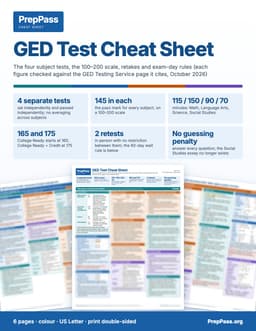
Thi trong vòng hai tuần?
Sách này là phần giảng dạy, đọc trong nhiều tuần. Nếu bạn thi trong vòng hai tuần, bảng tra cứu màu in được là sản phẩm còn lại: các con số then chốt, xếp theo từng phần.
6 trang · US Letter · PDF in được · giữ vĩnh viễn
How this book compares
GED Testing Service offers free test previews and sells GED Ready, its official practice test. This book teaches all four subjects with full-length practice tests; Mometrix sells a GED study guide with practice tests and videos.
| Resource | Price | What you get | Choose it if |
|---|---|---|---|
| This bookGED Study Guide 2026 — All Four Subjects, with 4 Full-Length Practice TestsPrepPass | $14.99 | Independent downloadable study guide for all four subjects
| Choose this book if you want the four subjects taught separately, each with full-length practice tests timed like the real ones. |
| From the exam bodyGED Ready — the official GED practice test (opens the publisher's page in a new tab)GED Testing Service | $7.99 per subject; $25.99 for all subjects | The official practice test, one per subject
| Choose GED Ready if you want the official measure of whether you are ready to book a subject. |
| AlternativeGED Secrets (opens the publisher's page in a new tab)Mometrix Test Preparation | $19.99 ebook; $24.99 printed book | Study guide with practice tests and videos
| Choose Mometrix if you want video tutorials or a printed copy. |
This book
GED Study Guide 2026 — All Four Subjects, with 4 Full-Length Practice Tests
PrepPass
- Price
- $14.99
- What you get
Independent downloadable study guide for all four subjects
- 278 practice questions with explanations
- 304 pages, PDF + EPUB
- Choose it if
- Choose this book if you want the four subjects taught separately, each with full-length practice tests timed like the real ones.
From the exam body
GED Ready — the official GED practice test (opens the publisher's page in a new tab)
GED Testing Service
- Price
- $7.99 per subject; $25.99 for all subjects
- What you get
The official practice test, one per subject
- Free GED test previews are also available on GED.com
- Choose it if
- Choose GED Ready if you want the official measure of whether you are ready to book a subject.
Alternative
GED Secrets (opens the publisher's page in a new tab)
Mometrix Test Preparation
- Price
- $19.99 ebook; $24.99 printed book
- What you get
Study guide with practice tests and videos
- Three full-length practice tests and 300+ online video tutorials (per the product title)
- Choose it if
- Choose Mometrix if you want video tutorials or a printed copy.
Other resources' prices and contents are as listed on each publisher's or seller's own page, checked September 24, 2026. Prices change; confirm on the linked page before you buy. This book's price and contents come from our own catalog.
Sources (3)
- https://www.ged.com/study/ged-ready.html — read September 24, 2026
- https://www.ged.com/study/free-online-ged-test.html — read September 24, 2026
- https://www.mometrix.com/studyguides/ged/ — read September 24, 2026
Có gì — và không có gì
Bao gồm
- Four subjects taught separately, because you sit and pass them separately
- Weights taken from the official Assessment Guides — including the Social Studies erratum most material still repeats wrong
Không bao gồm
- Không gửi bản in — đây là tệp bạn tải về và có thể tự in
- Sách không kèm khoá video, giảng viên hay kèm riêng — video miễn phí trên trang là phần khác
Toàn bộ phần bao gồm và không bao gồm
Bao gồm
- What the guides say is no longer tested, so you do not prepare an essay that was eliminated
- 4 full-length practice tests — 46 math, 46 RLA + an Extended Response, 36 science, 30 social studies — timed to the published testing times, with score grids by reporting category
- 120 warm-up questions, the same items as the free bank, printed beside the chapters they test
- Worked examples throughout, with every calculation checked
- PDF (print & tab it) + EPUB (phone / e-reader)
Không bao gồm
- Không bao gồm lệ phí đăng ký thi hay phí trung tâm khảo thí — bạn vẫn nộp cho cơ quan chính thức
Mục lục
Xem 17 phần và trang bắt đầu của từng phần
- Part 1 — Reasoning Through Language Arts What this test asks of youtr. 13
- Part 2 — Mathematical Reasoning What this test asks of youtr. 72
- Part 3 — Science What this test asks of youtr. 121
- Part 4 — Social Studies What this test asks of youtr. 163
- Part 5 — Four Full-Length Practice Teststr. 208
- Practice Test 1 — Mathematical Reasoningtr. 210
- Part 1 — no calculator (questions 1–5)tr. 210
- Part 2 — calculator allowed (questions 6–46)tr. 211
- Practice Test 2 — Reasoning Through Language Artstr. 221
- Section 1 (questions 1–25)tr. 221
- Section 2 — Extended Response (45 minutes)tr. 231
- Section 3 (questions 26–46)tr. 232
- Practice Test 3 — Sciencetr. 241
- Practice Test 4 — Social Studiestr. 253
- Part 5 — Answer Keys and Explanationstr. 263
- Appendix B — Glossarytr. 299
- Appendix C — Exam-day strategy Before the daytr. 302
Lấy từ chính tệp PDF bạn tải về, kèm trang bắt đầu của từng phần — không phải gõ tay ở đây.
Đọc miễn phí trọn một chương
Trọn vẹn một chương, đúng như trong eBook. Cuộn cửa sổ để đọc ngay tại đây; không cần tải, không cần email.
Đọc chương 2.4 ngay tại đây, không rời trang
Chúng tôi không đưa phần mở đầu dễ dãi — chương miễn phí mở thẳng vào một trong những phần đậm đặc nhất của cuốn sách, để bạn đánh giá cách dạy ở đúng chỗ kỳ thi trở nên khó.
Introduction
This is the largest single category on the test, about 30% of it, and for many adult candidates the least familiar. If school algebra ended for you around "solve for x" and never explained what x was doing there, slow down here.
Start with what algebra is for. Arithmetic answers a question about particular numbers: this many hours at this rate. Algebra answers a question about a relationship holding for any numbers: what happens to the total when the hours change, or what the hours must be to reach a target. A variable is a placeholder for a quantity that varies, and an equation is a claim that two expressions have the same value.
The skill the test rewards is translation: turn a paragraph about a rental agreement into symbols, operate on them, and translate the result back into a sentence about the rental agreement. The middle step can be learned mechanically; the two ends are where the thinking is, and where DOK level 2 items live.
Expressions: building them and simplifying them
An expression combines numbers, variables and operations with no equals sign: 3x + 7, 2(l + w). An equation sets two expressions equal. The distinction is not pedantic: you evaluate an expression and you solve an equation, and a question asking you to "write an expression for the total cost" is not asking you to solve anything.
Translating English into symbols
Most of the work is a small vocabulary, and the entries worth care are the ones people reverse.
| English | Symbols |
|---|---|
| the sum of x and 7; 7 more than x | x + 7 |
| 7 less than x | x − 7 |
| x less than 7 | 7 − x |
| the product of 5 and x | 5x |
| the quotient of x and 5 | x/5 |
| twice a number, increased by 9 | 2x + 9 |
| twice the sum of a number and 9 | 2(x + 9) |
"Seven less than x" reverses the order you read it in, and the last two rows differ only in where the parentheses sit — which changes the answer for every value of x. Name the quantity with its units — "let h = hours worked in week one" — so you do not solve for a number and then wonder what it counts.
Combining like terms and distributing
Like terms have the same variable to the same power. 4x and 7x combine to 11x; 4x and 4x² do not, and neither do 4x and 4y — four boxes plus seven crates is just four boxes and seven crates.
The distributive property says a(b + c) = ab + ac — the multiplier reaches every term inside. Two failures are common and both are expensive: distributing to only the first term, so that 3(2x − 5) becomes 6x − 5, and mishandling a negative multiplier, since −2(x − 4) is −2x + 8, not −2x − 8. Subtracting a parenthesized expression is distribution by −1, so (5x + 3) − (2x − 7) is 3x + 10. Every sign inside flips.
Exponent rules
Four rules cover this level, and each is just counting factors: xᵃ · xᵇ = xᵃ⁺ᵇ; xᵃ / xᵇ = xᵃ⁻ᵇ, because factors cancel in pairs; (xᵃ)ᵇ = xᵃᵇ; and x⁰ = 1 for nonzero x. A negative exponent means a reciprocal: x⁻² = 1/x². It does not mean a negative number, and that misreading is a standard distractor.
Solving linear equations
An equation is a balance: whatever you do to one side you must do to the other. Solving means peeling operations off the variable in reverse order of operations — undo addition and subtraction first, then multiplication and division, like unwrapping a parcel.
The procedure, in order: clear parentheses by distributing; clear fractions by multiplying every term on both sides by the common denominator; combine like terms on each side; move variable terms to one side and constants to the other; divide by the coefficient; and substitute your answer back into the original equation.
That last step is why algebra is safer than arithmetic — your answer is checkable, exactly. On a multiple-choice item you can also work backward, substituting each choice until one balances; on a fill-in-the-blank item you must solve forward and then check. When variables appear on both sides, move them to whichever side keeps the coefficient positive, which eliminates a class of sign errors for free.
Sometimes the variables cancel entirely. A true statement left over, like 7 = 7, means every number is a solution — the two sides were the same expression in disguise. A false one, like 7 = 3, means no number works. Neither means you made a mistake, and items are written to see whether you know that.
Rearranging formulas: the skill the formula sheet demands
Here the sheet stops helping. It gives you A = ½h(b₁ + b₂); suppose you have the area, the height and one base and need the other base. Nobody hands you a rearranged version.
Rearranging uses the same moves as solving — the other letters just come along for the ride. Treat the letter you want as "the variable" and every other letter as "a number whose value you happen not to know." If the target is multiplied by something, divide both sides by it: I = Prt solved for r is r = I/(Pt). If the target is added to something, subtract it: y = mx + b solved for b is b = y − mx.
There is a second route, easier for many candidates: substitute the numbers first, then solve the resulting simple equation. Use the general rearrangement when the item asks for a formula, and substitute-then-solve when it asks for a number.
Inequalities
An inequality says one side is larger, or at least as large, rather than equal. They are the language of constraints — budgets, capacities, weight limits — which is why they appear in workforce contexts constantly. "At most" and "no more than" are ≤; "at least" and "no less than" are ≥; "more than" and "exceeds" are strict >.
You solve one exactly like an equation, with one rule that has no equivalent in equation solving: multiplying or dividing both sides by a negative reverses the direction of the sign. The reason is visible on a number line — 3 is less than 5, but −3 is greater than −5. Note the precise condition: the flip comes from multiplying or dividing by a negative, not from a negative merely appearing. Solving x + 7 < 2 gives x < −5 with no flip.
The answer is a range, and in context it usually needs one more translation. If a mileage constraint solves to m ≤ 428.7, the practical answer is 428. Read the context to decide whether the boundary itself is allowed and whether fractional values make sense.
Quadratics
A quadratic equation has a squared variable and no higher power: y = ax² + bx + c in standard form. Squared relationships describe real things — areas, projectile heights, some revenue models. Before anything else, get the equation into the form ax² + bx + c = 0. Every method assumes it, and the most common error is applying a method to an equation that still has terms on both sides.
Factoring works when the numbers are friendly. For a leading coefficient of 1, find two numbers that multiply to c and add to b, then use the fact that makes factoring worth anything: if a product is zero, one of the factors must be zero.
The quadratic formula works always, and it is on your sheet: x = (−b ± √(b² − 4ac))/(2a). Identify a, b and c with their signs and compute the part under the root first. Errors cluster around signs: b² is positive even when b is negative, −4ac becomes a plus when a and c have opposite signs, and −b becomes positive when b is negative — in 2x² − 7x + 3 = 0, b is −7, so −b is +7.
Applied quadratics almost always produce two solutions of which only one makes sense. A width of −8 feet is arithmetically valid and physically meaningless — discard it explicitly and say why, since that discarding is part of what a reasoning-focused item is grading.
Worked examples
Example 1 — variables on both sides. Solve 3(2x − 5) + 4 = 5x + 1.
- Distribute:
6x − 15 + 4 = 5x + 1. - Combine on the left:
6x − 11 = 5x + 1. - Subtract
5x:x − 11 = 1, sox = 12.
Check: Substitute into the original. Left: 3(24 − 5) + 4 = 61. Right: 5(12) + 1 = 61. Balanced.
Example 2 — rearranging a formula from the sheet. A trapezoidal bed has area 162 sq ft, height 9 ft, and one parallel side of 22 ft. Find the other parallel side.
- Setup:
A = ½h(b₁ + b₂)with A = 162, h = 9, b₂ = 22. - Rearrange: multiply by 2 →
2A = h(b₁ + b₂); divide by h →2A/h = b₁ + b₂; subtract b₂ →b₁ = 2A/h − b₂. - Substitute:
b₁ = 324/9 − 22 = 36 − 22 =14 ft.
Check: Run the formula forward with b₁ = 14: ½ × 9 × (14 + 22) = 162. The substitute-first route lands in the same place: 162 = 4.5(b₁ + 22) → 36 = b₁ + 22 → b₁ = 14.
Example 3 — an inequality with a negative coefficient. Solve 5 − 3x ≥ 17.
- Subtract 5:
−3x ≥ 12. - Divide by −3 and reverse the sign:
x ≤ −4.
Check: Test three values. At x = −4: 5 + 12 = 17, and 17 ≥ 17 is true, so the boundary belongs. At x = −5: 20 ≥ 17, inside. At x = −3: 14 is not ≥ 17, outside. The direction is right.
Example 4 — a budget constraint. A van rents for $49.95 per day plus $0.35 per mile. With $200 for a one-day rental, what is the greatest whole number of miles?
- Setup: let m = miles.
49.95 + 0.35m ≤ 200. - Subtract 49.95:
0.35m ≤ 150.05, som ≤ 428.71…and the answer is 428 miles.
Check: Price both ends. At 428 miles: 149.80 + 49.95 = $199.75, within budget. At 429: 150.15 + 49.95 = $200.10, over. Rounding 428.71 up is the trap — the round-up rule from chapter 2.3 is for things you must buy enough of, not for a ceiling you must stay under.
Example 5 — factoring. Solve x² + 3x − 40 = 0.
- Already in standard form, so find two numbers multiplying to −40 and adding to +3.
- The factor pairs of 40 are 1 and 40, 2 and 20, 4 and 10, 5 and 8. The pair 5 and 8 differs by 3, so take +8 and −5.
(x + 8)(x − 5) = 0, sox = −8orx = 5.
Check: For x = 5: 25 + 15 − 40 = 0. For x = −8: 64 − 24 − 40 = 0. Both satisfy it.
Example 6 — a quadratic in context. A rectangular garden is 3 feet longer than twice its width and has an area of 65 square feet. Find its dimensions.
- Setup: let w = width. Length =
2w + 3, sow(2w + 3) = 65. - Set to zero:
2w² + 3w − 65 = 0. - Formula with a = 2, b = 3, c = −65: discriminant 9 + 520 = 529, and √529 = 23.
w = (−3 ± 23)/4, givingw = 5orw = −6.5. A width cannot be negative, so width 5 ft, length 13 ft.
Check: 5 × 13 = 65 square feet, and 13 is 3 more than twice 5. Both conditions hold.
Câu hỏi người mua thường hỏi
Nhận sách thế nào?
Thanh toán xong, mục tải xuống hiện ngay trên trang này. Liên kết cũng được gửi qua email. Không cần tài khoản.
Nếu sách không hợp thì sao?
Gửi email trong vòng 14 ngày để được hoàn tiền đầy đủ, không cần lý do.
Phần luyện tập miễn phí có bị bỏ không?
Không. Mọi câu hỏi luyện tập, bài thi thử tính giờ và các chương miễn phí trên trang vẫn miễn phí. Cuốn sách là nửa "học", không phải hàng rào quanh phần miễn phí.
Thêm câu hỏi (1)
Đọc trên điện thoại được không?
Được — EPUB cho điện thoại và máy đọc sách, PDF để in và dán tab. Bạn nhận cả hai.
Vì sao mua sách khi phần luyện tập miễn phí?
Câu hỏi luyện tập và bài thi thử tính giờ vẫn miễn phí — không có gì trên trang bị giấu sau cuốn sách này. Cuốn sách $14.99 là nửa "học": chính phần kiến thức, dạy theo trình tự, trong một tệp thuộc về bạn.
- Dạy có hệ thống — mọi phần thi giảng theo từng chương, từ đầu đến cuối, không chỉ là câu hỏi
- In ra & dán nhãn — PDF sẵn sàng để in, tô đậm, ghi chú và mang tới bàn học
- Học mọi nơi, ngoại tuyến — EPUB trên điện thoại hay máy đọc sách; không cần wifi, không cần tab trình duyệt
- Tất cả một chỗ — các chương và câu hỏi luyện tập trong một tệp
- Của bạn trọn đời — trả một lần $14.99, tải ngay, không thuê bao
Chi tiết
- Đối chiếu từ nguồn chính thức(GED Testing Service Assessment Guides for Educators (Math, RLA, Science, Social Studies) · ged.com state policy pages · Independent study aid — not affiliated with, endorsed by or approved by GED Testing Service or ACE)
- 401 câu hỏi luyện tập miễn phí
Mua một lần, truy cập tải về trọn đời. eBook là trọn bộ hướng dẫn ôn GED ở dạng PDF và EPUB. Bản tóm tắt mang tính giáo dục, không phải tư vấn chuyên môn hay pháp lý — luôn xác nhận quy định hiện hành với nguồn chính thức. Cập nhật lần cuối: October 2026.