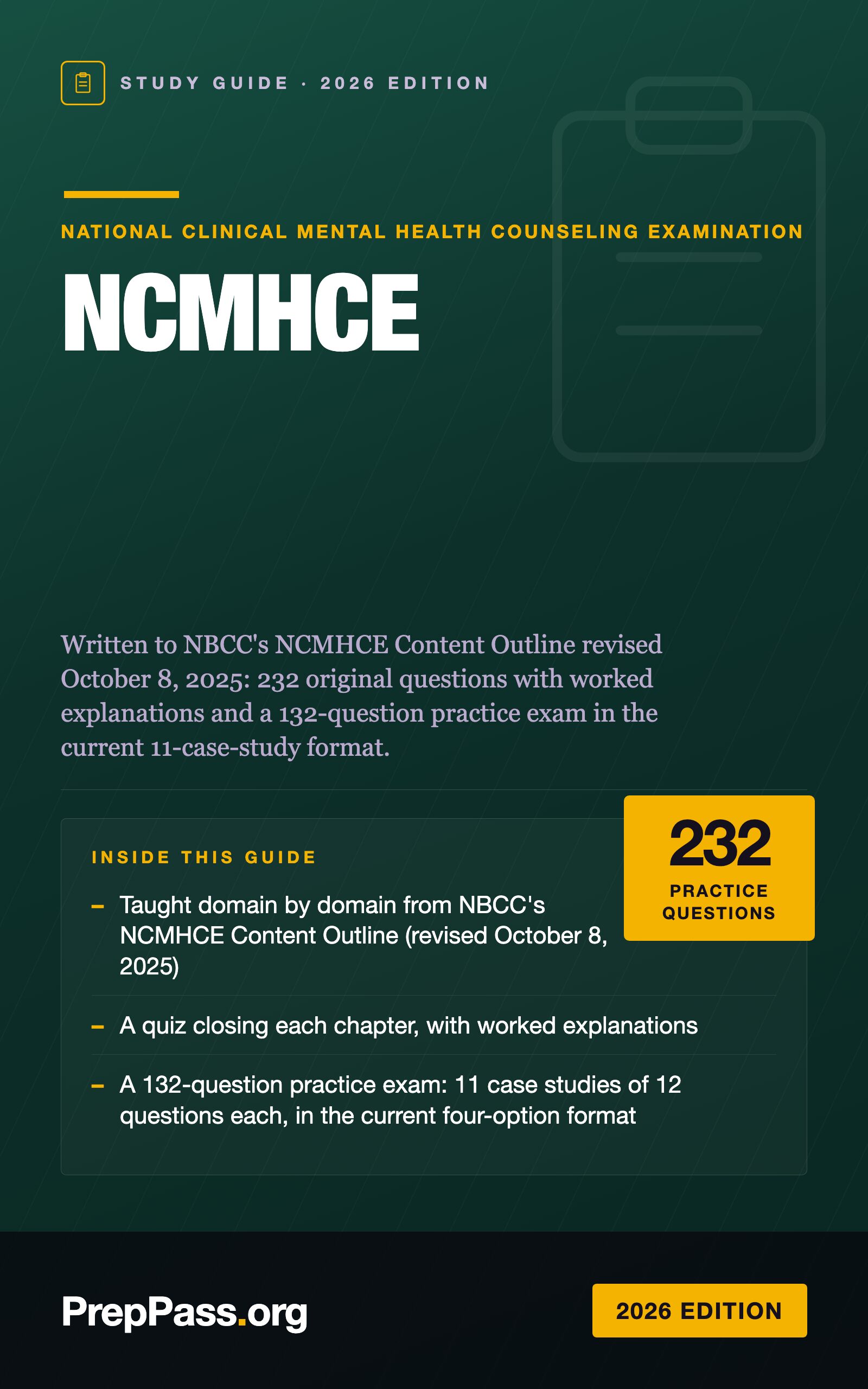
NCMHCE — National Clinical Mental Health Counseling Examination · Ấn bản 2026
NCMHCE Study Guide — 2026 Edition
Written to NBCC's NCMHCE Content Outline revised October 8, 2025: 232 original questions with worked explanations and a 132-question practice exam in the current 11-case-study format.
- 232 câu hỏi luyện tập NCMHCE gốc, mỗi câu kèm lời giải, trong một bản PDF + EPUB bạn giữ
PDF + EPUB · tiếng Anh · 157 trang · $24.99 trả một lần
Sách này được viết bằng tiếng Anh — tệp PDF và EPUB bạn tải về đều bằng tiếng Anh.
Tải ngay sau khi thanh toán — không cần tài khoản, không thuê bao.
Đảm bảo hoàn tiền 14 ngày: không hài lòng vì bất kỳ lý do gì? Email support@preppass.org trong vòng 14 ngày kể từ khi mua để được hoàn tiền đầy đủ. Chính sách hoàn tiền
Thử 10 câu trước — miễn phí
Trả lời hết 10 câu, nộp bài xong sẽ thấy lời giải từng câu — kèm phần trong sách này dạy nội dung đó. Khoảng 5 phút, không cần đăng ký.
Bắt đầu 10 câu miễn phíXem bên trong cuốn sách
Ba trang thật, kết xuất thẳng từ tệp PDF bạn sẽ tải — lần lượt là một trang tra cứu, một trang giảng giải, và một câu hỏi có lời giải. Không trang nào được vẽ lại cho đẹp.
- Trang tra cứu nhanhSection 3: Second subsequent counseling session · Trang 99 của PDF
Một trang để lật lại: các con số, mốc thời hạn hoặc thuật ngữ gom về một chỗ.
- Cách giảng dạyChapter 1 — Professional Practice and Ethics · Trang 19 của PDF
Trang giảng giải: kiến thức được trình bày bằng văn xuôi, theo trình tự kỳ thi kiểm tra.
- Một câu hỏi có lời giảiSection 3: Second subsequent counseling session · Trang 119 của PDF
Một câu luyện tập kèm đáp án và lập luận đằng sau — không chỉ là đáp án.
Về chính kỳ thi này
| Cơ quan quản lý | National Board for Certified Counselors, Inc. (NBCC) — kỳ thi do Pearson VUE tổ chức |
|---|---|
| Số câu hỏi | 130–150 câu hỏi |
| Thời gian làm bài | 225 phút |
| Điểm đậu | NBCC không công bố Những trang chúng tôi đã đọc và không tìm thấy: NBCC — Candidate Handbook for State Licensure, National Clinical Mental Health Counseling Examination (NCMHCE) (Revised Nov. 20, 2025, PDF) |
| Lệ phí |
Nguồn: NBCC — National Certified Counselor (Application Fees for Certification) |
| Ngôn ngữ thi | NBCC không công bố Những trang chúng tôi đã đọc và không tìm thấy: NBCC — Candidate Handbook for State Licensure, National Clinical Mental Health Counseling Examination (NCMHCE) (Revised Nov. 20, 2025, PDF) |
Có gì — và không có gì
Bao gồm
- Taught domain by domain from NBCC's NCMHCE Content Outline (revised October 8, 2025)
- A quiz closing each chapter, with worked explanations
- A 132-question practice exam: 11 case studies of 12 questions each, in the current four-option format
- 232 original questions, each explained and cited to its source
- Ethics taught from the NBCC Code of Ethics and the ACA Code of Ethics, cited provision by provision
- PDF + EPUB you keep
Không bao gồm
- Không gửi bản in — đây là tệp bạn tải về và có thể tự in
- Sách không kèm khoá video, giảng viên hay kèm riêng — video miễn phí trên trang là phần khác
- Không bao gồm lệ phí đăng ký thi hay phí trung tâm khảo thí — bạn vẫn nộp cho cơ quan chính thức
Mục lục
Xem 13 phần và trang bắt đầu của từng phần
- Chapter 1 — Professional Practice and Ethicstr. 7
- Chapter 2 — Intake, Assessment, and Diagnosistr. 22
- Chapter 3 — Areas of Clinical Focustr. 37
- Chapter 4 — Treatment Planningtr. 48
- Chapter 5 — Counseling Skills and Interventionstr. 59
- Chapter 6 — Core Counseling Attributestr. 77
- Section 1: Initial intake summarytr. 87
- Section 2: First subsequent counseling sessiontr. 88
- Section 3: Second subsequent counseling sessiontr. 88
- Section 2: First subsequent counseling session (two days later)tr. 143
- Section 3: Second subsequent counseling session (one week later)tr. 143
- Appendix A — Terms to knowtr. 149
- Appendix B — Quick reference Stages of change and the counselor’s focus (TIP 35)tr. 152
Lấy từ chính tệp PDF bạn tải về, kèm trang bắt đầu của từng phần — không phải gõ tay ở đây.
Đọc miễn phí trọn một chương
Trọn vẹn một chương, đúng như trong eBook. Cuộn cửa sổ để đọc ngay tại đây; không cần tải, không cần email.
Đọc chương 5 ngay tại đây, không rời trang
Chúng tôi không đưa phần mở đầu dễ dãi — chương miễn phí mở thẳng vào một trong những phần đậm đặc nhất của cuốn sách, để bạn đánh giá cách dạy ở đúng chỗ kỳ thi trở nên khó.
This is where the exam lives. Across eleven case studies, you will be asked what to say next, which intervention fits, and how to handle what the client brings into the room. The exam rewards interventions matched to the moment: reflection before advice, evocation before persuasion, safety before insight.
Core skills
The foundation is always the same: empathic listening, reflection of feeling and meaning, open questions, and validation. Reflections demonstrate understanding; questions gather information. When a client is flooded with emotion, reflect before you intervene. When a client asks for advice, explore before you answer. The exam's wrong answers are often premature advice, closed questions that shut down exploration, or interpretations the client is not ready to hear.
Cognitive behavioral therapy
CBT helps clients become aware of automatic ways of thinking that are inaccurate or harmful, question those thoughts, understand how thoughts affect emotions and behavior, and change self-defeating behavior patterns (NIMH). Core techniques include cognitive restructuring (examining the evidence for automatic thoughts), behavioral activation (scheduling rewarding activities), exposure (facing feared situations), and skills training. CBT is structured, present-focused, and collaborative — homework is expected.
Motivational interviewing
MI is a person-centered approach for resolving ambivalence and building intrinsic motivation toward change. Its spirit is partnership, acceptance, compassion, and evocation; its skills are open questions, affirmations, reflective listening, and summaries (Wigan MI guide). When a client is ambivalent, reflect both sides rather than arguing for change — arguing evokes defensiveness (sustain talk), while evocation draws out the client's own reasons (change talk). Match the approach to the stage of change: in precontemplation, build alliance and raise doubts and concerns (TIP 35).
Psychodynamic and humanistic approaches
Psychodynamic and humanistic approaches differ in focus: psychodynamic work attends to past experiences and unconscious patterns as they appear in the therapeutic relationship, while humanistic (person-centered) work emphasizes the client's own capacity for growth within an accepting relationship. The exam may ask which response reflects a given theory — match the response's focus to the theory.
Interpersonal and behavioral approaches
Interpersonal approaches focus on current relationships and role changes as the lever for mood improvement; behavioral approaches use reinforcement, modeling, and systematic exposure. Skills-based work targets emotion dysregulation with distress-tolerance and coping strategies. Match the modality to the problem: relationship-focused work for relationship-linked depression, exposure for phobic avoidance, behavioral activation for depressive withdrawal.
Trauma-informed interventions
Every intervention with a trauma survivor must embody the four R's: realize trauma's prevalence, recognize its signs, respond by integrating trauma knowledge, and resist re-traumatization — guided by safety, trustworthiness and transparency, peer support, collaboration and mutuality, empowerment, and cultural humility (National Council/SAMHSA). Do not push detailed trauma narration before the client is ready; ensure safety and build coping capacity first, resisting re-traumatization.
Crisis intervention and group skills
In crisis, the priorities are safety, stabilization, and connection to resources — including the 988 Lifeline (call or text, 24/7, free, confidential). Keep crisis responses brief, direct, and actionable. In groups, the counselor adjusts leadership to the group's early, middle and late phases (TIP 41), draws out quiet members, contains monopolizers, and links members' experiences — always protecting each individual's confidences — the NBCC Code bars revealing an individual's confidences in group work without prior written permission.
Termination
Endings are planned from the start. Counselors do not abandon or neglect clients (ACA); the NBCC Code bars abruptly terminating services without good cause — when services end, the counselor discusses it honestly and provides appropriate referrals rather than ending abruptly. Review gains, name the feelings about ending, and leave the door open appropriately.
The Domain 5 tasks, one by one
5.A Align intervention with client's developmental level
Adolescents need confidentiality explained in terms of what parents will and will not hear (NBCC Code, 38–39), and interventions that respect their growing autonomy.
5.B Align intervention with counseling modality
Groups and families bring their own tools — group rules and cohesion, family boundaries and communication patterns — that individual techniques do not replace (TIP 41; TIP 39).
5.C Align intervention with client population
Adapt interventions to the population's culture and history; counselors "demonstrate multicultural counseling competence in practice" (NBCC Code, 7).
5.D Implement individual counseling in relation to a plan of treatment
Each session's work ties back to the written plan's goals, which are revised as the case changes (NBCC Code, 35–36).
5.E Establish therapeutic alliance
"Counselors' use of empathy, not authority and power, is key to enhancing clients' motivation to change" (TIP 35).
5.F Apply theory-based counseling intervention(s)
CBT helps a person "become aware of automatic ways of thinking that are inaccurate or harmful ... and then question those thoughts"; exposure therapy helps people learn "to tolerate the distress caused by certain items, ideas, or imagined scenes" (NIMH). "Often, the type of treatment is tailored to the specific disorder" (NIMH).
5.G Address addiction issues
Match the approach to the stage of change: in precontemplation the counselor's focus is "to establish a strong counseling alliance and raise the client's doubts and concerns about substance use" (TIP 35).
5.H Address cultural considerations
Explore what culture means to the client rather than assuming; "culture affects the manner in which clients' problems are defined and experienced" (ACA Code, E.5.b).
5.I Address family composition and cultural considerations
"Appropriate boundaries vary from culture to culture," so a close extended family is not automatically enmeshed (TIP 39).
5.J Evaluate and explain systemic patterns of interaction
Families "use a limited repertoire of self-perpetuating relational patterns" (TIP 39); naming a cycle helps each member see their part.
5.K Explore family member interaction
Help members notice when someone "speaks about, rather than to, another person who is present" or "speaks for others" (TIP 39).
5.L Explore religious and spiritual values
Faith can be a support and a protective factor ("religious attendance and/or internalized spiritual teachings against suicide" appear among protective factors in TIP 50), explored without imposing the counselor's own values.
5.M Guide clients in the development of skills or strategies for dealing with their problems
Psychotherapy aims to help clients "identify ways to cope with stress and develop problem-solving strategies" (NIMH).
5.N Help clients develop support systems
Groups offer "positive peer support; a reduction in clients' sense of isolation; real-life examples of people in recovery" (TIP 41); mutual-support groups also help people with alcohol use disorder (NIAAA).
5.O Help facilitate clients' motivation to make the changes they desire
Use OARS — open questions, affirmations, reflections, summaries — and evoke change talk; "arguing for one side of ambivalence often leads people to defend the other" (MI guide).
5.P Improve interactional patterns
Replace attacks with "I" statements and reflective listening; practice in session, then at home.
5.Q Provide crisis intervention
Priorities are safety, stabilization and connection: a crisis evaluation when risk is high, a written safety plan, reduced access to means, and the 988 Lifeline, which offers "24/7, free and confidential support" (SAMHSA).
5.R Educate client about transference and defense mechanisms
When a client reacts to the counselor as to someone from the past, name the pattern gently and explore it; the counselor's own reactions are taken to supervision (NBCC Code, 5; TIP 41 lists "failure to recognize countertransference issues" among leader problems).
5.S Facilitate trust and safety
Trauma-informed care rests on safety, trustworthiness and transparency, peer support, collaboration and mutuality, and empowerment, voice and choice (National Council/SAMHSA framework).
5.T Build communication skills
Reflective listening — "REFLECT what the person says" — is taught to couples and families as well as used by the counselor (MI guide).
5.U Develop conflict resolution strategies
Agree on time-outs, structured dialogue and rules for speaking, and rehearse them on low-stakes topics first.
5.V Develop safety plans
A safety plan helps a person "recognize warning signs, and use coping strategies" (NIMH); TIP 50 adds a written card with a 24-hour crisis number, emergency contacts and the nearest emergency department.
5.W Facilitate systemic change
Families tend toward homeostasis — "a state of equilibrium ... that must be overcome if change is to occur" (TIP 39) — so change in one member often needs support from the whole system.
5.X Provide distance counseling or telemental health
Follow the laws of the states where counselor and client are located (NBCC Code, 92), verify identity, location and readiness at each contact (NBCC Code, 106), and give written emergency procedures naming responders near the client (NBCC Code, 105).
5.Y Provide education resources
Match resources to the problem — stress management, assertiveness, relapse prevention — and to the client's reading level and language.
5.Z Provide psychoeducation for client
Explaining symptoms reduces fear of them: after trauma, "common reactions include feeling anxious, sad, or angry; having trouble concentrating and sleeping," and most people's reactions lessen over time (NIMH).
5.AA Summarize
"SUMMARIZE — draw together the person's own perspectives on change" (MI guide).
5.AB Reframe/redirect
Offer a different way to see a problem — relapse as information rather than failure — and redirect sessions that drift from the plan.
5.AC Facilitate empathic responses
"Express empathy in ways that communicate that you are genuinely interested in the client's perspective and concerns" (TIP 35); "sympathy is not the same as empathy."
5.AD Use self-disclosure
Self-disclosure is used sparingly and only for the client's benefit; training in "the boundaries related to the therapist's or counselor's self-disclosure is an integral part" of professional preparation (TIP 39).
5.AE Use constructive confrontation
Confrontation "deftly points out inconsistencies in clients' thinking" (TIP 41), but in groups it is unwise before trust and cohesion have developed.
5.AF Facilitate awareness of here-and-now interactions
"Most leaders strive to keep the focus on the here and now as much as possible" (TIP 41).
5.AG Facilitate resolution of interpersonal conflict
Slow the exchange, have each person reflect the other's point, and look for the shared goal beneath the dispute.
5.AH Use linking and blocking in a group context
Linking connects one member's experience to another's; blocking stops a harmful exchange, such as scapegoating — "the group needs to feel safe without blaming or scapegoating an individual member" (TIP 41).
5.AI Management of leader–member dynamics
Conflicts that seem aimed at one member may be "displaced anger that a member feels toward the therapist" (TIP 41).
5.AJ Model giving and receiving of feedback
Groups provide "information and feedback from peers" (TIP 41); the leader models feedback that is specific, timely and kind.
5.AK Address impact of extended families
Extended-family involvement varies by culture; to some therapists it "may at times appear enmeshed and over-involved" when it is normal for the family (TIP 39).
5.AL Contain and manage intense feelings
Grounding helps "a person who is overwhelmed by memories or strong emotions or is dissociating" become aware of the here and now (TIP 57).
5.AM Explore the influence of family of origin patterns and themes
A genogram — "a pictorial chart of the people involved in a three generational relationship system" — maps patterns such as substance use across generations (TIP 39).
5.AN Address the impact of social support network
Map who helps and who harms; strengthen supports and, where needed, "clarifying boundaries between dysfunctional family members ... can alleviate stress" (TIP 39).
5.AO Use "structured" activities
Structured exercises — role-plays, worksheets, rehearsals — suit skills development groups, which "cultivate the skills needed to attain and sustain abstinence, such as those needed to manage anger or cope with urges" (TIP 41).
5.AP Promote and encourage interactions among group members
Early on, leaders emphasize "hope, group cohesion, and universality" (TIP 41) and invite members to respond to one another rather than only to the leader.
5.AQ Promote and encourage interactions with the group leader
The leader stays accessible and active in early groups, then steps back as members take on more of the work (TIP 41).
5.AR Use psychoeducation as a part of the group process
Psychoeducational groups are "a useful and necessary, but not sufficient, component of most treatment programs" (TIP 41).
5.AS Explain phases in the group process
Groups move through early, middle and late phases, and "clients' conditions will differ, requiring different therapeutic strategies and approaches to leadership" (TIP 41).
5.AT Identify and discuss group themes and patterns
Point out recurring themes — mistrust, avoidance, rescuing — and invite the group to explore them in the here and now.
5.AU Create intervention based on the stage of group development
Before trust and cohesion develop, "it is unwise to permit confrontation" (TIP 41); later, peer challenge becomes productive.
5.AV Challenge harmful group member behaviors
The leader "steps in to extinguish contratherapeutic norms that might damage group cohesion" (TIP 41), and takes reasonable precautions to protect members from harm (ACA Code, A.9.b).
5.AW Address the potential interaction of members outside of the group
Group agreements state whether outside contact is allowed; for interpersonal process groups "outside contacts may or may not be disallowed, depending on the particular group contract" (TIP 41).
Trước khi mua
- Nhận sách thế nào?
- Thanh toán xong, mục tải xuống hiện ngay trên trang này. Liên kết cũng được gửi qua email. Không cần tài khoản.
- Nếu sách không hợp thì sao?
- Gửi email trong vòng 14 ngày để được hoàn tiền đầy đủ, không cần lý do.
- Phần luyện tập miễn phí có bị bỏ không?
- Không. Mọi câu hỏi luyện tập, bài thi thử tính giờ và các chương miễn phí trên trang vẫn miễn phí. Cuốn sách là nửa "học", không phải hàng rào quanh phần miễn phí.
- Đọc trên điện thoại được không?
- Được — EPUB cho điện thoại và máy đọc sách, PDF để in và dán tab. Bạn nhận cả hai.
Chi tiết
Written to NBCC's NCMHCE Content Outline revised October 8, 2025: 232 original questions with worked explanations and a 132-question practice exam in the current 11-case-study format.
- Format: PDF + EPUB download · 157 pages
- 232 practice questions in the book, with a full answer key
- 124 free practice questions for this exam on PrepPass, included at no cost
- $24.99 one-time — no subscription
- 14-day money-back guarantee · refund policy
- Cross-referenced against: NBCC's NCMHCE Content Outline (revised October 8, 2025) and NCMHCE Handbook for State Licensure Candidates (revised November 20, 2025)
- Last updated: September 2026
- Đối chiếu từ nguồn chính thức(NBCC's NCMHCE Content Outline (revised October 8, 2025) and NCMHCE Handbook for State Licensure Candidates (revised November 20, 2025))
- 124 câu hỏi luyện tập miễn phí
- Tải ngay, thuộc về bạn trọn đời
Vì sao mua sách khi phần luyện tập miễn phí?
Câu hỏi luyện tập và bài thi thử tính giờ vẫn miễn phí — không có gì trên trang bị giấu sau cuốn sách này. Cuốn sách $24.99 là nửa "học": chính phần kiến thức, dạy theo trình tự, trong một tệp thuộc về bạn.
- Dạy có hệ thống — mọi phần thi giảng theo từng chương, từ đầu đến cuối, không chỉ là câu hỏi
- In ra & dán nhãn — PDF sẵn sàng để in, tô đậm, ghi chú và mang tới bàn học
- Học mọi nơi, ngoại tuyến — EPUB trên điện thoại hay máy đọc sách; không cần wifi, không cần tab trình duyệt
- Tất cả một chỗ — các chương và câu hỏi luyện tập trong một tệp
- Của bạn trọn đời — trả một lần $24.99, tải ngay, không thuê bao
Và không rủi ro: Đảm bảo hoàn tiền 14 ngày — không hài lòng? Email cho chúng tôi để hoàn tiền đầy đủ, không cần lý do. Xem chính sách hoàn tiền.
Đảm bảo hoàn tiền 14 ngày · hoàn tiền đầy đủ, không cần lý do.
Mua một lần, truy cập tải về trọn đời. eBook là trọn bộ hướng dẫn ôn NCMHCE — National Clinical Mental Health Counseling Examination ở dạng PDF và EPUB. Bản tóm tắt mang tính giáo dục, không phải tư vấn chuyên môn hay pháp lý — luôn xác nhận quy định hiện hành với nguồn chính thức. Cập nhật lần cuối: September 2026.