Sách ôn thi · Ấn bản 2026
Patient Care Technician (CPCT/A) — Complete Study Guide (2026)
Patient care, safety and infection control, phlebotomy, and EKG monitoring for the CPCT/A-style certification.
- Độ dài
- 59 trang
- Câu hỏi luyện tập trong sách
- 55
- Thi thử trực tuyến PrepPass
- 100 câu · 170 phút
- Thông tin kỳ thi đối chiếu
- tháng 9 năm 2026
- Tệp cập nhật lần cuối
- tháng 10 năm 2026
- Giao hàng
- PDF + EPUB · tiếng Anh · tải ngay
Về cuốn sách này
Patient care, safety and infection control, phlebotomy, and EKG monitoring for the CPCT/A-style certification — the CNA + phlebotomy + EKG skills in one guide.
Thông tin kỳ thi, ai nên dùng và thay đổi
Về chính kỳ thi này
| Cơ quan quản lý | National Healthcareer Association (NHA) — kỳ thi do a PSI testing center, a live remote proctoring provider, or the candidate's own school or employer tổ chức |
|---|---|
| Số câu hỏi | 120 câu hỏi (100 câu tính điểm, 20 câu thử nghiệm không tính điểm) Nguồn: NHA — Certified Patient Care Technician/Assistant (CPCT/A) Test Plan (job analysis 2018, PDF) |
| Thời gian làm bài | 120 phút Nguồn: NHA — Certified Patient Care Technician/Assistant (CPCT/A) Test Plan (job analysis 2018, PDF) |
| Điểm đậu | Điểm quy đổi 390 trên thang 200–500 |
| Lệ phí | Chưa kiểm tra |
| Ngôn ngữ thi | Tiếng Anh |
Xem bên trong cuốn sách
Ba trang thật, kết xuất thẳng từ tệp PDF bạn sẽ tải — lần lượt là một trang tra cứu, một trang giảng giải, và một câu hỏi có lời giải. Không trang nào được vẽ lại cho đẹp.
- Trang tra cứu nhanhChapter 2 — Safety and Infection Control · Trang 20 của PDF
Một trang để lật lại: các con số, mốc thời hạn hoặc thuật ngữ gom về một chỗ.
- Cách giảng dạyChapter 1 — Patient Care: Vital Signs, Mobility, Hygiene, and Daily Care · Trang 8 của PDF
Trang giảng giải: kiến thức được trình bày bằng văn xuôi, theo trình tự kỳ thi kiểm tra.
- Cách giảng dạyChapter 1 — Patient Care: Vital Signs, Mobility, Hygiene, and Daily Care · Trang 11 của PDF
Trang giảng giải: kiến thức được trình bày bằng văn xuôi, theo trình tự kỳ thi kiểm tra.
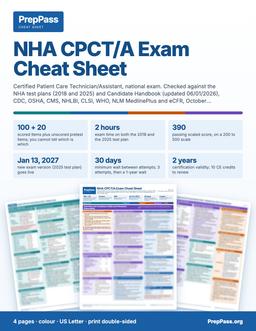
Thi trong vòng hai tuần?
Sách này là phần giảng dạy, đọc trong nhiều tuần. Nếu bạn thi trong vòng hai tuần, bảng tra cứu màu in được là sản phẩm còn lại: các con số then chốt, xếp theo từng phần.
4 trang · US Letter · PDF in được · giữ vĩnh viễn
Có gì — và không có gì
Bao gồm
- Vitals, positioning/transfers, hygiene, pressure-injury staging, I&O
- Infection control: precautions, PPE don/doff, sharps & exposure response
Không bao gồm
- Không gửi bản in — đây là tệp bạn tải về và có thể tự in
- Sách không kèm khoá video, giảng viên hay kèm riêng — video miễn phí trên trang là phần khác
Toàn bộ phần bao gồm và không bao gồm
Bao gồm
- Phlebotomy: order of draw, tube additives, venipuncture technique
- EKG monitoring: V1–V6 placement, calibration, basic rhythms
- 55 original practice questions with answer explanations
- PDF (print & tab it) + EPUB (phone / e-reader)
Không bao gồm
- Không bao gồm lệ phí đăng ký thi hay phí trung tâm khảo thí — bạn vẫn nộp cho cơ quan chính thức
Mục lục
Xem 7 phần và trang bắt đầu của từng phần
- Chapter 1 — Patient Care: Vital Signs, Mobility, Hygiene, and Daily Caretr. 7
- Chapter 2 — Safety and Infection Controltr. 16
- Chapter 3 — Professional and Administrative Responsibilitiestr. 22
- Chapter 4 — Phlebotomytr. 28
- Chapter 5 — EKG Monitoringtr. 33
- Practice Exam — 55 Questionstr. 38
- Answer Key with Explanationstr. 53
Lấy từ chính tệp PDF bạn tải về, kèm trang bắt đầu của từng phần — không phải gõ tay ở đây.
Đọc miễn phí trọn một chương
Trọn vẹn một chương, đúng như trong eBook. Cuộn cửa sổ để đọc ngay tại đây; không cần tải, không cần email.
Đọc chương 4 ngay tại đây, không rời trang
Chúng tôi không đưa phần mở đầu dễ dãi — chương miễn phí mở thẳng vào một trong những phần đậm đặc nhất của cuốn sách, để bạn đánh giá cách dạy ở đúng chỗ kỳ thi trở nên khó.
Phlebotomy is memorization-heavy and unforgiving: the order of draw, the tube additives, the angle, and the specimen handling are either right or wrong, and a small error invalidates a result. Build a mental table for the tubes and drill it until recall is instant. Two rules frame the whole chapter: follow the order of draw to prevent additive carryover, and label every tube at the bedside before you leave the room. (Reminder: whether a patient care technician draws blood at all is set by your state, certification, and employer — see the disclaimer.)
4.1 Order of Draw and Tube Additives
The order of draw exists to prevent additive from one tube contaminating the next, which would skew results. The standard venous order (CLSI GP41) is:
- Blood culture bottles / sterile tubes — first, always, to maintain sterility and prevent contamination.
- Light blue — sodium citrate (coagulation, e.g., PT/INR); drawn immediately after cultures.
- Red or gold/SST — serum. A plain red tube has no additive and yields serum after the blood clots; an SST (gold/tiger) adds a clot activator and gel separator.
- Green — heparin (plasma chemistry).
- Lavender (purple) — EDTA (hematology, e.g., CBC).
- Gray — sodium fluoride (preserves glucose and lactate).
Memorize what each additive is for: lavender/EDTA = CBC and hematology; green/heparin = plasma chemistry; gray/sodium fluoride = glucose/lactate; light blue/citrate = coagulation.
4.2 Venipuncture Technique
Angle. Insert the needle at a 15 to 30 degree angle, bevel up. Too steep (90°) passes through the vein; too shallow (parallel) never enters it.
Vein selection. The median cubital vein in the antecubital area is the first choice — large, well-anchored, and away from the artery and major nerves. The cephalic is a second choice; the basilic is used with caution because it lies near the brachial artery and nerves.
Tourniquet time. Leave the tourniquet on no longer than 1 minute to prevent hemoconcentration, which falsely elevates results such as potassium and protein. Release it once blood flow is established.
Identify the patient with two identifiers before collecting any specimen — full name and date of birth are typical. A room or bed location is never an identifier.
Choose the arm and site with care. Avoid drawing from an arm on the side of a mastectomy with lymph-node removal, an arm with an active IV above the intended site (which dilutes the sample), and any area of hematoma, scarring, edema, or a fistula/graft. When only an IV arm is available, the draw is done below the IV after it has been paused per protocol, or the other arm or a different site is used — decisions that belong to the nurse when in doubt.
Fill coagulation tubes completely. A light-blue citrate tube must be filled to the line to keep the 9-parts-blood-to-1-part-additive ratio; a short-draw blue tube is rejected because it falsely prolongs clotting times.
Manage a fainting patient. If a patient becomes pale, sweaty, and light-headed (presyncope) during a draw, stop immediately, remove the needle and apply pressure, and lower the patient's head or lay them flat while you stay with them. You never continue the draw "to finish quickly" or walk a woozy patient to a chair.
4.3 Capillary Collection
Infant heel sticks are performed on the medial or lateral (side) plantar surface of the heel, avoiding the center of the heel and the bone (calcaneus) beneath it.
The capillary order of draw differs from venous: collect blood gases first, then EDTA (hematology), then other additive tubes, then serum. EDTA is collected early in a capillary draw to get a well-mixed hematology sample before clotting begins. Wipe away the first drop when indicated, as it may be diluted with tissue fluid.
4.4 Specimen Handling and Quality
Mix, do not shake. Gently invert additive tubes the recommended number of times immediately after collection to mix the additive. Shaking causes hemolysis — ruptured red cells that falsely elevate results such as potassium — as do too-small needles and excessive tourniquet time.
Label at the bedside. Label every tube immediately after collection, in the patient's presence, with the patient's name, identifiers, date, time, and your initials. Labeling later at the desk, or pre-labeling before the patient arrives, invites a wrong-patient error.
Confirm fasting status. For fasting tests (typically 8–12 hours), confirm and document whether the patient actually fasted; if a patient scheduled for a fasting glucose reports eating, notify the nurse or provider and document the non-fasting status before proceeding.
Key Numbers & Facts — Chapter 4 (memorize cold)
| Item | Value / rule |
|---|---|
| Order of draw | Cultures → light blue → red/gold → green → lavender → gray |
| Blood cultures | First (sterility) |
| Lavender (EDTA) | CBC / hematology |
| Green | Heparin — plasma chemistry |
| Gray (sodium fluoride) | Glucose / lactate |
| Light blue | Sodium citrate — coagulation (PT/INR) |
| Red (plain) | No additive → serum after clotting |
| Venipuncture angle | 15–30°, bevel up |
| First-choice vein | Median cubital |
| Tourniquet time | ≤ 1 minute (hemoconcentration) |
| Avoid drawing from | Mastectomy side, IV-above side, hematoma/edema/fistula |
| Light-blue citrate fill | Fill completely (9:1 ratio) |
| Presyncope during draw | Stop, withdraw, pressure, lay flat, stay |
| Infant heel stick | Medial/lateral plantar heel |
| Capillary order | Blood gases → EDTA → other additive → serum |
| Mix additive tubes | Gentle inversions — never shake (hemolysis) |
| Hemolysis falsely raises | Potassium |
| Labeling | Bedside, immediately, in the patient's presence |
| Fasting | Typically 8–12 h; report non-fasting |
Clinical Walkthrough — A Multi-Tube Draw
Orders come in for a coagulation panel, a chemistry panel, and a CBC. You confirm the patient with two identifiers, apply the tourniquet, and select the median cubital vein. You cannot find it for almost two minutes of palpating — stop: the tourniquet has been on too long (over one minute), so you release it, rest the arm, and reapply just before puncture, or the potassium will read falsely high. You enter at about 20°, bevel up, and draw in order: light blue citrate for the coagulation panel, then red/gold for chemistry, then lavender EDTA for the CBC. You gently invert each additive tube — no shaking, which would hemolyze the CBC and raise the potassium — and label every tube at the bedside before leaving. Every decision traces back to a number in the cram box.
Exam Traps — Chapter 4
- The order-of-draw carryover trap. Cultures first; light blue before lavender and gray. EDTA carried into a chemistry tube skews potassium and calcium.
- The tube-to-test mismatch trap. CBC = lavender/EDTA; glucose = gray/sodium fluoride; coagulation = light blue/citrate. Test-writers pair the right tube with the wrong test.
- The angle trap. Venipuncture is 15–30°, bevel up — not 90°, not parallel.
- The shake trap. Additive tubes are gently inverted; shaking causes hemolysis and a redraw.
- The label-later trap. Label at the bedside immediately, never at the desk afterward and never before the patient arrives.
- The tourniquet trap. Over 1 minute causes hemoconcentration — release and reapply, don't push through.
Câu hỏi người mua thường hỏi
Nhận sách thế nào?
Thanh toán xong, mục tải xuống hiện ngay trên trang này. Liên kết cũng được gửi qua email. Không cần tài khoản.
Nếu sách không hợp thì sao?
Gửi email trong vòng 14 ngày để được hoàn tiền đầy đủ, không cần lý do.
Phần luyện tập miễn phí có bị bỏ không?
Không. Mọi câu hỏi luyện tập, bài thi thử tính giờ và các chương miễn phí trên trang vẫn miễn phí. Cuốn sách là nửa "học", không phải hàng rào quanh phần miễn phí.
Thêm câu hỏi (1)
Đọc trên điện thoại được không?
Được — EPUB cho điện thoại và máy đọc sách, PDF để in và dán tab. Bạn nhận cả hai.
Vì sao mua sách khi phần luyện tập miễn phí?
Câu hỏi luyện tập và bài thi thử tính giờ vẫn miễn phí — không có gì trên trang bị giấu sau cuốn sách này. Cuốn sách $14.99 là nửa "học": chính phần kiến thức, dạy theo trình tự, trong một tệp thuộc về bạn.
- Dạy có hệ thống — mọi phần thi giảng theo từng chương, từ đầu đến cuối, không chỉ là câu hỏi
- In ra & dán nhãn — PDF sẵn sàng để in, tô đậm, ghi chú và mang tới bàn học
- Học mọi nơi, ngoại tuyến — EPUB trên điện thoại hay máy đọc sách; không cần wifi, không cần tab trình duyệt
- Tất cả một chỗ — các chương và câu hỏi luyện tập trong một tệp
- Của bạn trọn đời — trả một lần $14.99, tải ngay, không thuê bao
Chi tiết
- Đối chiếu từ nguồn chính thức(CLSI order-of-draw / CDC precautions & PPE / ACC-AHA vitals / NPIAP staging / standard EKG references)
- 300 câu hỏi luyện tập miễn phí
Một patient care technician program có giá $800–$3,000. Cuốn sách này dạy cùng một kỳ thi — cùng quy định, đối chiếu theo chuẩn hiện hành — chỉ với $14.99 trả một lần, thuộc về bạn trọn đời.
Mua một lần, truy cập tải về trọn đời. eBook là trọn bộ hướng dẫn ôn Patient Care Technician (CPCT/A) ở dạng PDF và EPUB. Bản tóm tắt mang tính giáo dục, không phải tư vấn chuyên môn hay pháp lý — luôn xác nhận quy định hiện hành với nguồn chính thức. Cập nhật lần cuối: October 2026.