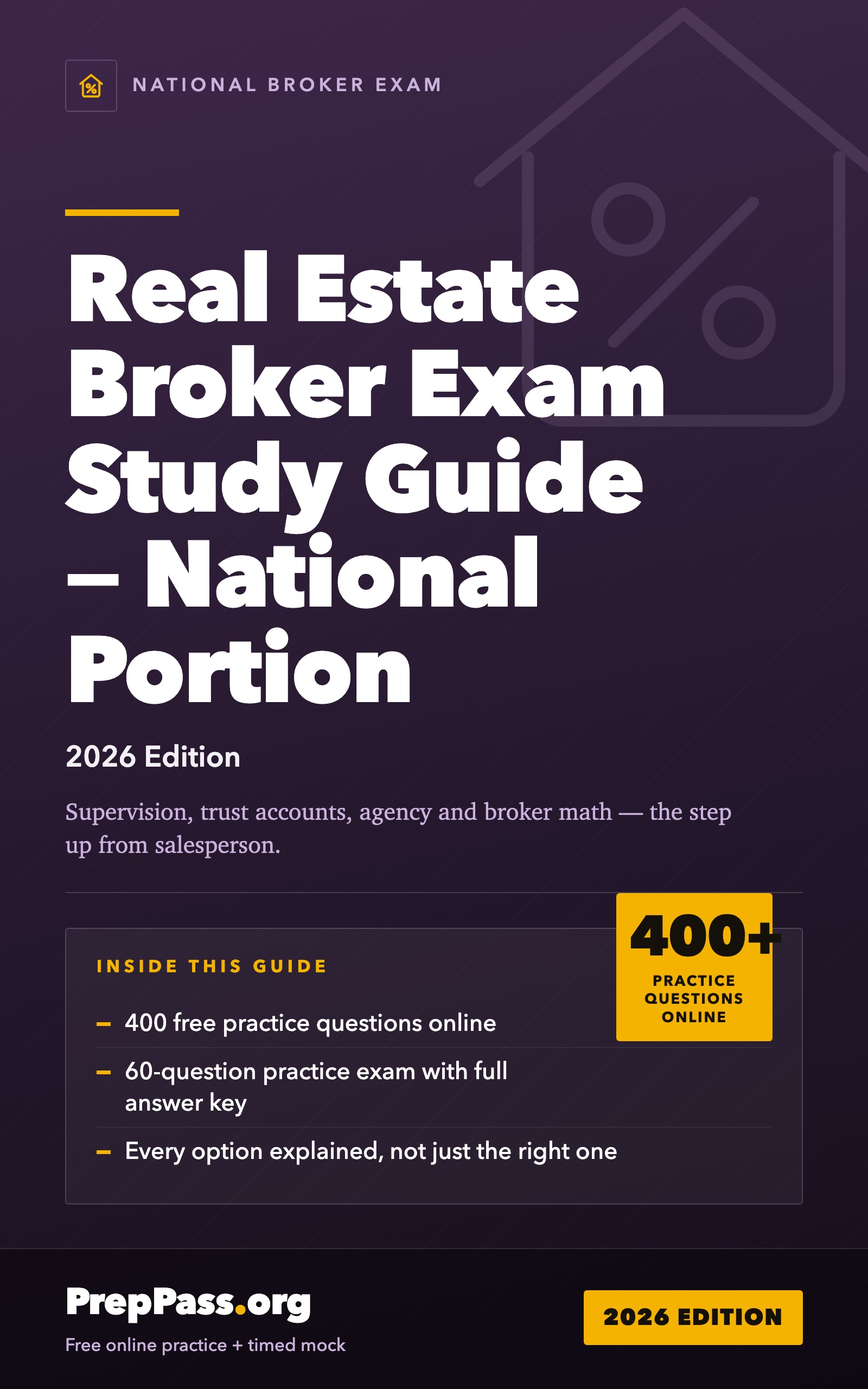
Real Estate Broker (National Portion) · Ấn bản 2026
Real Estate Broker Exam Study Guide — National Portion (2026)
The step up from salesperson: supervision, trust accounts, brokerage operation and broker math — national content only, so it is true in every state.
- 60 câu hỏi luyện tập trong sách, kèm đáp án đầy đủ
- 226 trang giảng giải theo từng chương — không phải một đống câu hỏi
- Đối chiếu với RESPA · TILA / Reg Z · ECOA · Fair Housing Act · ADA · Sherman Act · Title X lead disclosure
PDF + EPUB · tiếng Anh · 226 trang · $14.99 trả một lần
Sách này được viết bằng tiếng Anh — tệp PDF và EPUB bạn tải về đều bằng tiếng Anh.
Tải ngay sau khi thanh toán — không cần tài khoản, không thuê bao. Chính sách hoàn tiền
Xem bên trong cuốn sách
Ba trang thật, kết xuất thẳng từ tệp PDF bạn sẽ tải — một trang giảng giải, một câu hỏi có lời giải, và một trang tra cứu. Không trang nào được vẽ lại cho đẹp.
- Cách giảng dạyPart C — Fiduciary duties, at the level a broker is examined on · Trang 35 của PDF
Trang giảng giải: kiến thức được trình bày bằng văn xuôi, theo trình tự kỳ thi kiểm tra.
- Một câu hỏi có lời giảiAnswer Key and Explanations · Trang 141 của PDF
Một câu luyện tập kèm đáp án và lập luận đằng sau — không chỉ là đáp án.
- Trang tra cứu nhanhAppendix B — Glossary · Trang 207 của PDF
Một trang để lật lại: các con số, mốc thời hạn hoặc thuật ngữ gom về một chỗ.
Có gì — và không có gì
Bao gồm
- Written for brokers, not salespeople — supervision, vicarious liability, trust accounts, brokerage operation
- Every rule that varies by state is flagged as state-set rather than given a number that would be wrong somewhere
- A broker math appendix — cap rate, NOI, cash-on-cash, GRM, points, prorations — each with a worked instance
- A 60-question practice exam drawn from the same bank you drill online
- Every answer explains all four options — why the key is right and why each of the other three loses
- A worked example at the end of every chapter
- Quick-reference cheat sheet, glossary, and exam-day strategy appendices
- PDF (print & tab it) + EPUB (phone / e-reader)
Không bao gồm
- Không gửi bản in — đây là tệp bạn tải về và có thể tự in
- Sách không kèm khoá video, giảng viên hay kèm riêng — video miễn phí trên trang là phần khác
- Không bao gồm lệ phí đăng ký thi hay phí trung tâm khảo thí — bạn vẫn nộp cho cơ quan chính thức
Mục lục
Xem 28 chương và trang bắt đầu của từng chương
- Part C — Advertising and recordkeeping compliancetr. 12
- Part D — Consumer contact and transactiontr. 13
- 2. Trust Funds, Escrow, and the Client’s Moneytr. 20
- Part C — Records that survive an audittr. 22
- Part D — Disputed moneytr. 24
- 3. Agency at the Broker Leveltr. 30
- Part C — Fiduciary duties, at the level a broker is examined ontr. 34
- Part D — Dual agency, designated agency, and the alternativestr. 36
- 4. Contracts and Brokerage Agreementstr. 43
- Part C — Options, rights of first refusal, and installment contractstr. 48
- Part D — Between contract and closingtr. 48
- 5. Fair Housing, Accessibility, and Antitrust: The Exposure You Carry Personallytr. 59
- Part C — The exemptions, and why they rarely save anyonetr. 63
- Part D — Disability: the distinction the exam always teststr. 64
- 6. Ownership, Land Use Controls, and Transfer of Titletr. 71
- Part C — Encumbrances a broker must read off a title reporttr. 76
- Part D — Legal descriptionstr. 78
- 7. Valuation, Financing, and the Federal Lending Lawstr. 88
- Part C — The instrumentstr. 96
- Part D — Loan programs, structures, and qualifyingtr. 98
- 8. Disclosures, Environmental Risk, and Property Managementtr. 107
- Part C — The management agreement and the manager’s authoritytr. 113
- Part D — Leases and tenanciestr. 114
- Practice Exam — 60 Questionstr. 122
- Answer Key and Explanationstr. 138
- Appendix A — Broker Math Cheat Sheettr. 186
- Appendix B — Glossarytr. 207
- Appendix C — Exam-Day Strategytr. 222
Lấy từ chính tệp PDF bạn tải về, kèm trang bắt đầu của từng phần — không phải gõ tay ở đây.
Đọc miễn phí trọn một chương
Trọn vẹn một chương, đúng như trong eBook. Cuộn cửa sổ để đọc ngay tại đây; không cần tải, không cần email.
Đọc chương 2 ngay tại đây, không rời trang
Chúng tôi không đưa phần mở đầu dễ dãi — chương miễn phí mở thẳng vào một trong những phần đậm đặc nhất của cuốn sách, để bạn đánh giá cách dạy ở đúng chỗ kỳ thi trở nên khó.
PrepPass · Real Estate Broker Exam — National Portion · Chapter 2
Introduction
As a salesperson you held other people's money for about ninety seconds. A buyer handed you a check, you carried it to the office, and someone else deposited, posted, and reconciled it. If the month-end figures did not tie, that was a problem above you.
That is over. The trust account is now opened in your firm's name, under your license. When the bank balance and the ledgers disagree by fourteen hundred dollars, no one else will find the difference, restore it, or explain it to an investigator. The licensing authority calls you, and the fact that a bookkeeper made the entry will not move the conversation an inch.
The complaints that end brokerage careers have a family resemblance: a shortage nobody caught, a transfer that was supposed to be temporary, a deposit released to the side of a dispute the broker privately thought was right. The rules are not complicated; what is hard is running an office where they are followed on a Friday afternoon when payroll is due. Your exam tests this at the broker's altitude — not what earnest money is, but which of four items received in one week are trust funds, what to call a withdrawal the broker meant to replace, and who answers when an employee errs.
Learning objectives
After this chapter you should be able to:
- Identify which funds coming into the firm are trust funds and which are the firm's own income.
- Distinguish commingling from conversion and apply each to a fact pattern.
- Explain the narrow exception permitting a limited amount of the broker's own funds in trust.
- Perform and interpret a three-way reconciliation and diagnose what each mismatch means.
- Handle a disputed deposit lawfully, including the role of interpleader.
- Apply trust-fund rules to rents, security deposits, and unlicensed on-site staff.
- Separate the national principle from the figure or deadline your state sets.
Part A — What is a trust fund
A trust fund is money belonging to someone else that comes into your firm's hands in the course of the real estate business. That definition, not the label on the check, decides the question. Earnest money qualifies. So does a tenant's rent, a tenant's security deposit, and an owner's advance for a repair you have not made yet. Ownership creates trust status; no court order and no client instruction is required to bring it into being. Such money must reach the trust account promptly, and the number of days you have is set by your state.
The mirror image matters as much. A commission your firm has earned, or a franchise rebate received for its own account, is not a trust fund; it is firm income and belongs in the operating account. Depositing your own earned money into trust is commingling running the other way, and examiners charge it as readily.
Broker-level distinction: The tested question is rarely "is earnest money a trust fund." It is a mixed week — earnest money, a tenant's rent, an owner's repair advance, a rebate the firm earned — and you must sort four items, not recognize one.
The fiduciary duty of accounting is broader than the trust account. It reaches everything of value the client entrusts to the firm: funds, but also signed documents, instruments, and the keys in your lockbox drawer. The duty is affirmative — maintain the records and report without waiting to be asked, and certainly without waiting for a written request.
Part B — Commingling versus conversion
Keep these two words apart: the exam pays for the distinction and regulators punish them differently.
Commingling is mixing trust funds with the broker's own operating or personal funds. The classic fact pattern is innocent: an earnest money check deposited to the operating account by mistake. Nothing was spent, nobody profited, and it is still a violation. That is why offices build procedures — a single intake point, a receipt log, a deposit route that never touches the operating account.
Conversion is actually using trust funds for the broker's own benefit. Withdrawing $2,000 from trust to make payroll, fully intending to replace it next week, is conversion: not commingling, because the money was spent rather than merely mixed, and not a bookkeeping error, because the withdrawal was deliberate. An intention to repay is no defense. Prompt restoration may soften the sanction but does not undo the violation, and in the meantime a beneficiary's money is gone. Conversion draws the harshest discipline available.
One narrow exception is worth a question. Regulators commonly allow a broker to keep a small, documented amount of the broker's own money in the trust account to cover bank service charges or meet the bank's minimum balance, and that is not commingling. The permitted amount is set by your state. Two traps sit on either side: treating every personal dollar there as conversion overstates the rule, while parking a month of operating expenses there is the abuse the exception was written to prevent. No client waiver can authorize what the rules do not permit.
Part C — Records that survive an audit
The three-way reconciliation
Audit-ready trust records rest on a routine reconciliation that ties three figures to the same number:
- The bank statement balance, adjusted for outstanding checks and deposits in transit.
- The broker's control or checkbook balance — what your own books say the account holds.
- The sum of all individual beneficiary ledgers — what the people you hold for are owed.
Each leg answers a different question, which is why two figures are not enough. Bank against book tests whether your records match the outside world; a mismatch there is normally timing — a check not yet presented, a deposit not yet credited — or a bank error. Book against ledgers tests whether the money has an owner; a mismatch there is a posting error or a real shortage, and no amount of bank reconciling will surface it. Bank against ledgers is what the examiner cares about: is there enough in the account to pay everyone who is owed?
A ledger per beneficiary
You need a separate ledger for each beneficiary — each buyer whose deposit you hold, each owner whose rents you collect — showing every receipt and disbursement for that person. One combined ledger of the account's running balance is the classic wrong answer: it shows the account but never who owns what, so a shortage in one client's money hides behind another's. A ledger per property is no better, because ownership rather than the building defines the beneficiary. Filing bank statements inside transaction folders scatters the record and defeats reconciliation.
How often you reconcile, who may sign on the account, and how long you keep the records are all set by your state.
Delegation is not delegation of accountability
An office bookkeeper posts a deposit to the wrong client ledger and one beneficiary is short at month end. The bookkeeper is not the regulator's licensee. You are. The account is yours, the shortage is yours to restore, and delegating the entry never delegated the accountability. Lack of intent may soften discipline; it does not excuse a shortage in a client's money — which is why a broker reviews the reconciliation personally rather than initialing a summary.
Producing records in an audit
A routine trust-account audit follows the office rule set out in Chapter 1: you produce the records, without a subpoena and without client consent. Calling counsel when a matter turns serious is sensible; withholding records until he arrives is not.
Part D — Disputed money
A deal collapses and both parties demand the deposit. Your position is fixed: you never decide the dispute and you never pick a side. The funds stay in trust until the parties sign a written release, a court orders release, or another lawful route resolves it.
Interpleader is that route where it is available: you deposit the disputed funds with a court, name the competing claimants, and step out of the fight, leaving the parties to litigate their own contract. Availability and procedure are set by your state.
Know why each alternative fails, because the exam offers all of them. Returning the money to whoever paid it decides the dispute for the buyer; splitting it evenly decides it on terms neither party agreed to; handing it to the party the listing agent believes is right substitutes your firm's judgment for the parties' written contract; and moving it to the operating account adds commingling to the pile.
Tested trap: In an ordinary closing the purchase contract controls how the deposit is applied — typically credited to the buyer — and it governs disposition if the deal fails. Not the seller, not the listing broker, not local custom. Commission is paid under the listing agreement out of the seller's proceeds; the listing broker has no claim on the deposit.
Part E — Property-management trust money
Rents and security deposits are trust funds held for others, so a firm with a management department runs a property-management trust account separate from the firm's own funds, with a ledger per owner. Whether those funds may share one trust account with sales deposits or must sit in an account of their own is set by your state. You remit according to the management agreement rather than taking your fee off the top of incoming rent.
The hardest instruction comes from a client. An owner short of cash tells you to wire the tenants' security deposits to his personal account. You refuse. Those deposits are neither his working capital nor yours, and sending them would be conversion. An indemnity agreement does not authorize it: your duty runs to the parties beneficially entitled to the money and to your state's trust-fund rules, not to a client's promise to make you whole. Sending part of each deposit is the same violation in smaller pieces.
Deposit caps, interest, holding location, and deduction and refund deadlines are all set by state law, which you follow rather than the client's instruction.
On-site managers who handle money — unlicensed where your state exempts them from licensure — must be trained, supervised, and in many places bonded, with every dollar routed into the firm's trust account rather than a personal or building account. An owner's own accountant auditing the books once a year does not discharge your recordkeeping duty.
Key rules to memorize
| Concept | The rule |
|---|---|
| Trust fund | Money belonging to another, received in the course of the business |
| Not a trust fund | The firm's earned commission or franchise rebate — operating account |
| Accounting duty | Reaches funds, documents, and keys; affirmative, no written request needed |
| Commingling | Mixing trust funds with the broker's own funds |
| Conversion | Using trust funds for the broker's benefit; intent to repay is no defense |
| Service-charge exception | Permitted; amount set by your state; waivers cannot expand it |
| Three-way reconciliation | Bank = book = sum of beneficiary ledgers |
| Ledgers | One per beneficiary, never one combined running balance |
| Employee error | Broker answers and restores; delegation is not delegation of accountability |
| Routine audit | Produce the records; no subpoena or client consent required |
| Disputed deposit | Hold until written release, court order, or interpleader |
| Ordinary closing | The purchase contract directs the deposit, not custom or the seller |
| Rents and deposits | Trust funds; owner's instruction cannot release them |
Set by your state, not by this chapter: deposit deadlines, reconciliation frequency, the permitted amount of broker funds in trust, who may sign, record-retention periods, interpleader availability and procedure, security-deposit caps, interest, holding location, deduction and refund deadlines, and bonding requirements for unlicensed staff.
Chapter recap
Trust status follows ownership of the money, not the label on the check. Commingling mixes; conversion spends. The three-way reconciliation proves both the account and the ownership of what is in it, and a ledger per beneficiary makes the third leg possible. When money is disputed, hold it; do not judge it. When an employee errs, the shortage is still yours to restore. Learn the principle in full and let your state-law chapter supply every number.
Trước khi mua
- Nhận sách thế nào?
- Thanh toán xong, mục tải xuống hiện ngay trên trang này. Liên kết cũng được gửi qua email. Không cần tài khoản.
- Nếu sách không hợp thì sao?
- Gửi email trong vòng 14 ngày để được hoàn tiền đầy đủ, không cần lý do.
- Phần luyện tập miễn phí có bị bỏ không?
- Không. Mọi câu hỏi luyện tập, bài thi thử tính giờ và các chương miễn phí trên trang vẫn miễn phí. Cuốn sách là nửa "học", không phải hàng rào quanh phần miễn phí.
- Đọc trên điện thoại được không?
- Được — EPUB cho điện thoại và máy đọc sách, PDF để in và dán tab. Bạn nhận cả hai.
Chi tiết
The step up from salesperson: supervision, trust accounts, brokerage operation and broker math — national content only, so it is true in every state.
- Format: PDF + EPUB download · 226 pages
- 60 practice questions in the book, with a full answer key
- $14.99 one-time — no subscription
- 14-day money-back guarantee · refund policy
- Cross-referenced against: RESPA · TILA / Reg Z · ECOA · Fair Housing Act · ADA · Sherman Act · Title X lead disclosure
- Last updated: August 2026
- Đối chiếu từ nguồn chính thức(RESPA · TILA / Reg Z · ECOA · Fair Housing Act · ADA · Sherman Act · Title X lead disclosure)
- 456 câu hỏi luyện tập miễn phí
- Tải ngay, thuộc về bạn trọn đời
Một real estate broker pre-license course có giá $200–$1,000. Cuốn sách này dạy cùng một kỳ thi — cùng quy định, đối chiếu theo chuẩn hiện hành — chỉ với $14.99 trả một lần, thuộc về bạn trọn đời.
Vì sao mua sách khi phần luyện tập miễn phí?
Câu hỏi luyện tập và bài thi thử tính giờ vẫn miễn phí — không có gì trên trang bị giấu sau cuốn sách này. Cuốn sách $14.99 là nửa "học": chính phần kiến thức, dạy theo trình tự, trong một tệp thuộc về bạn.
- Dạy có hệ thống — mọi phần thi giảng theo từng chương, từ đầu đến cuối, không chỉ là câu hỏi
- In ra & dán nhãn — PDF sẵn sàng để in, tô đậm, ghi chú và mang tới bàn học
- Học mọi nơi, ngoại tuyến — EPUB trên điện thoại hay máy đọc sách; không cần wifi, không cần tab trình duyệt
- Tất cả một chỗ — các chương, thẻ tóm tắt từng chương và câu hỏi luyện tập trong một tệp
- Của bạn trọn đời — trả một lần $14.99, tải ngay, không thuê bao
Và không rủi ro: Đảm bảo hoàn tiền 14 ngày — không hài lòng? Email cho chúng tôi để hoàn tiền đầy đủ, không cần lý do. Xem chính sách hoàn tiền.
Đảm bảo hoàn tiền 14 ngày · hoàn tiền đầy đủ, không cần lý do.
Mua một lần, truy cập tải về trọn đời. eBook là trọn bộ hướng dẫn ôn Real Estate Broker (National Portion) ở dạng PDF và EPUB. Bản tóm tắt mang tính giáo dục, không phải tư vấn chuyên môn hay pháp lý — luôn xác nhận quy định hiện hành với nguồn chính thức. Cập nhật lần cuối: August 2026.