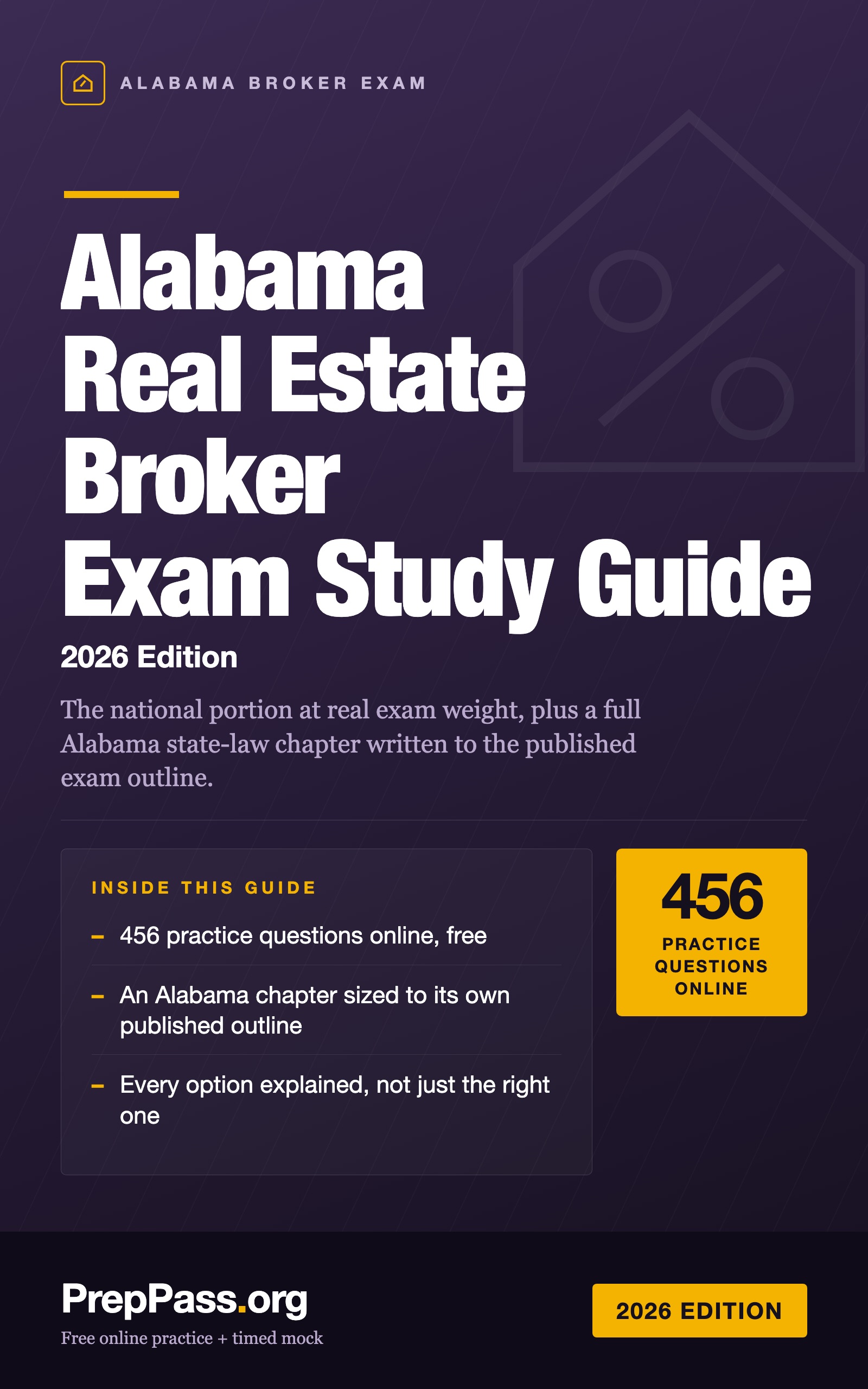
Alabama Real Estate Broker · Ấn bản 2026
Alabama Real Estate Broker Exam Study Guide (2026)
The national portion at real exam weight, plus an Alabama chapter. The Alabama chapter is sized to the published outline — 10 areas, 40 scored items — area by area, not flattened.
- Cả 8 chương phần thi toàn quốc cùng một chương đầy đủ về luật bất động sản Alabama — PDF + EPUB bạn giữ
- Một đề luyện phần thi toàn quốc gồm 60 câu, kèm đáp án giải thích cả bốn phương án chứ không riêng phương án đúng
- 20 câu hỏi riêng về luật bất động sản Alabama, kèm đáp án có giải thích
PDF + EPUB · tiếng Anh · 314 trang · $14.99 trả một lần
Sách này được viết bằng tiếng Anh — tệp PDF và EPUB bạn tải về đều bằng tiếng Anh.
Tải ngay sau khi thanh toán — không cần tài khoản, không thuê bao. Chính sách hoàn tiền
Thử 10 câu trước — miễn phí
Trả lời hết 10 câu, nộp bài xong sẽ thấy lời giải từng câu — kèm phần trong sách này dạy nội dung đó. Khoảng 5 phút, không cần đăng ký.
Bắt đầu 10 câu miễn phíXem bên trong cuốn sách
Ba trang thật, kết xuất thẳng từ tệp PDF bạn sẽ tải — một trang giảng giải, một câu hỏi có lời giải, và một trang tra cứu. Không trang nào được vẽ lại cho đẹp.
- Trang tra cứu nhanhPart C — Encumbrances a broker must read off a title report · Trang 102 của PDF
Một trang để lật lại: các con số, mốc thời hạn hoặc thuật ngữ gom về một chỗ.
- Một câu hỏi có lời giảiAnswer Key and Explanations · Trang 174 của PDF
Một câu luyện tập kèm đáp án và lập luận đằng sau — không chỉ là đáp án.
- Cách giảng dạySection 40-22-1(c) fixes the recording privilege tax on a conveyance at “$.50 · Trang 309 của PDF
Trang giảng giải: kiến thức được trình bày bằng văn xuôi, theo trình tự kỳ thi kiểm tra.
Có gì — và không có gì
Bao gồm
- An Alabama chapter written to the published exam outline, area by area
- Where Alabama law departs from the national rule — both stated, so neither is guessed
- Supervision, trust accounts, brokerage operation and broker math
- An Alabama practice set with every option explained, not just the right one
- 456 practice questions online, free, from the same bank
- PDF (print & tab it) + EPUB (phone / e-reader)
Không bao gồm
- Không gửi bản in — đây là tệp bạn tải về và có thể tự in
- Sách không kèm khoá video, giảng viên hay kèm riêng — video miễn phí trên trang là phần khác
- Không bao gồm lệ phí đăng ký thi hay phí trung tâm khảo thí — bạn vẫn nộp cho cơ quan chính thức
Mục lục
Xem 33 chương và trang bắt đầu của từng chương
- Part C — Advertising and recordkeeping compliancetr. 14
- Part D — Consumer contact and transaction integritytr. 16
- 2. Trust Funds, Escrow, and the Client’s Moneytr. 30
- Part C — Records that survive an audittr. 33
- Part D — Disputed moneytr. 34
- 3. Agency at the Broker Leveltr. 40
- Part C — Fiduciary duties, at the level a broker is examined ontr. 44
- Part D — Dual agency, designated agency, and the alternativestr. 46
- 4. Contracts and Brokerage Agreementstr. 55
- Part C — Options, rights of first refusal, and installment contractstr. 60
- Part D — Between contract and closingtr. 61
- 5. Fair Housing, Accessibility, and Antitrust: The Exposure You Carry Personallytr. 72
- Part C — The exemptions, and why they rarely save anyonetr. 78
- Part D — Disability: the distinction the exam always teststr. 79
- 6. Ownership, Land Use Controls, and Transfer of Titletr. 95
- Part C — Encumbrances a broker must read off a title reporttr. 101
- Part D — Legal descriptionstr. 103
- 7. Valuation, Financing, and the Federal Lending Lawstr. 113
- Part C — The instrumentstr. 121
- Part D — Loan programs, structures, and qualifyingtr. 123
- 8. Disclosures, Environmental Risk, and Property Managementtr. 136
- Part C — The management agreement and the manager’s authoritytr. 142
- Part D — Leases and tenanciestr. 144
- Practice Exam — 60 Questionstr. 153
- Answer Key and Explanationstr. 170
- Appendix A — Broker Math Cheat Sheettr. 221
- Appendix B — Glossarytr. 243
- Appendix C — Exam-Day Strategytr. 262
- Part II — Alabama State Law & Practicetr. 267
- Section 34-27-32, as amended by Act 2025-380, allows the arrangementtr. 305
- Section 34-27-31(b) sets two different caps and this fact pattern is governedtr. 306
- Section 40-22-1(c) fixes the recording privilege tax on a conveyance at “$.50tr. 308
- Section 34-27-36 has long made it a violation for a salesperson or associatetr. 310
Lấy từ chính tệp PDF bạn tải về, kèm trang bắt đầu của từng phần — không phải gõ tay ở đây.
Đọc miễn phí trọn một chương
Trọn vẹn một chương, đúng như trong eBook. Cuộn cửa sổ để đọc ngay tại đây; không cần tải, không cần email.
Đọc chương 9 ngay tại đây, không rời trang
Chúng tôi không đưa phần mở đầu dễ dãi — chương miễn phí mở thẳng vào một trong những phần đậm đặc nhất của cuốn sách, để bạn đánh giá cách dạy ở đúng chỗ kỳ thi trở nên khó.
This chapter covers Alabama law only. Agency theory, fair housing, RESPA and TILA, financing, valuation and the arithmetic are in the national portion you have just read, and they are the same for every broker candidate in the country. What follows is the 40 scored items that only an Alabama candidate sits — organized in the order Pearson VUE prints them, and sized to what each area is actually worth.
1. What the Alabama state portion actually is
Alabama's examination is administered by Pearson VUE under the Alabama Real Estate candidate handbook, publication #093300, the revision effective February 1, 2026. The broker paper is:
| Portion | Scored items | Time |
|---|---|---|
| National / general | 80 | 2 hours 30 minutes |
| Alabama state | 40 | 1 hour |
| Total | 120 scored | 3 hours 30 minutes |
On top of the 120 scored items you will see 10 to 15 unidentified pretest items that do not count. The passing standard is a scaled score of 70, and it is the same figure for salespersons and for brokers.
The handbook prints one Alabama state outline for both license levels, with two item columns side by side. Only the broker column matters to you, and the two columns do not agree. Here is the broker column, with the handbook's own line for each area:
| Outline area | Broker items | Share of the state portion |
|---|---|---|
| I. Purpose of license law/rules and role of Commission | 0 | 0% |
| II. Licensing requirements | 6 | 15% |
| III. License status | 2 | 5% |
| IV. Broker licenses, company licenses, and place of business | 6 | 15% |
| V. Recovery fund | 1 | 2.5% |
| VI. Disciplinary actions and process | 3 | 7.5% |
| VII. Estimated closing statement | 2 | 5% |
| VIII. Trust funds | 3 | 7.5% |
| IX. RECAD | 5 | 12.5% |
| X. Violations which may result in disciplinary actions | 12 | 30% |
Two figures in that table deserve to be said out loud, because they are the difference between studying Alabama and studying "a state."
Area I is worth nothing to you. The handbook line reads "I. PURPOSE OF LICENSE LAW/RULES AND REGULATION AND ROLE OF COMMISSION 1 0" — one item for a salesperson, zero for a broker. Alabama does not ask a broker candidate a single scored question about why the license law exists or what the Commission is for. If you are revising from a salesperson book, that is the first section you can close.
Area X is nearly a third of the paper. Twelve of forty items come out of one list: the prohibited acts in Ala. Code § 34-27-36, printed in the handbook as thirteen lettered violations, A through M. No other area comes close. Areas II and IV are six items each; everything else is three or fewer. Budget your revision that way, and be suspicious of any Alabama guide that gives the Recovery Fund — worth a single item — the same number of pages as the violations list.
Three smaller facts about the document itself:
- Areas VII, VIII and IX print no lettered subtopics at all. The handbook gives the heading and the item count and stops. Every other area's letters are reproduced in this chapter as the handbook prints them.
- The handbook publishes no Alabama statute or rule reference list. Its only reading list is eight general, national real estate textbooks, and those are for the national portion. Every citation in this chapter — every section number, every rule number — comes from primary sources: the enrolled 2025 acts, the Code of Alabama, and the official chapter PDFs of the Alabama Administrative Code. None of it comes from the vendor, because the vendor supplies none of it.
- The math note. The handbook's arithmetic instructions are printed with the national outline but they govern the two Alabama closing-statement items as well: a proration question will tell you whether to use a 360-day or a 365-day year and whether the day of closing belongs to the buyer or the seller; the only conversions you must have memorized are 43,560 square feet to the acre and 5,280 feet to the mile; personal calculators are barred and an on-screen calculator is provided.
One practical warning before you start verifying anything yourself. The Alabama Real Estate Commission's own law pages — ViewLaw.aspx, LawList.aspx and StatutoryChanges.aspx — currently answer every request with a redirect back to the same address, with or without cookies enabled. If those pages will not open for you, the problem is not your browser. The Code sections themselves and the Administrative Code chapters are available elsewhere, and that is where the text below was read.
2. Area II — Licensing requirements (6 items, 15%)
The handbook's letters: A. Activities which require a license · B. Cobrokering · C. Qualifications for a license · D. Renewal of a license · E. Continuing education · F. Post-license education · G. Temporary and original Salesperson licenses.
The line an unlicensed employee may not cross
§ 34-27-30 makes it unlawful to sell, offer, negotiate, list, auction, or procure prospects or properties for a fee without a license. § 34-27-2(b) then exempts owners dealing in their own property, attorneys performing their duties, persons acting without compensation under a power of attorney, fiduciaries and public officers, and apartment managers — but not on-site managers of a condominium. The exemption a broker has to police is § 34-27-2(b)(6), which covers "persons performing general clerical or administrative duties for a broker so long as the person does not physically show listed property." Rule 790-X-1-.04 states the same line from the employee's side: no clerical or office employee shall physically show listed property, solicit or accept listings, negotiate sales or leases, or hold himself out as engaged in the real estate business.
Where the rule bites: an assistant may order the lockbox, mail the signed copies and type the newspaper copy all day. The moment she walks a buyer through the house, the exemption ends — and it ends for everything she does, not just for that showing. The exposure is yours, not hers: Rule 790-X-3-.15(2) makes allowing an unlicensed person to engage in licensed activity a failure of broker supervision in its own right.
Broker qualification lives in § 34-27-32 — not § 34-27-33
This is worth stating flatly, because guides get it wrong. Ala. Code § 34-27-32 is the section that carries the broker gate:
- proof of an active real estate salesperson license in any state for at least 24 months of the 36-month period immediately preceding the date of application;
- proof of high school graduation or the equivalent; and
- proof of completion of a commission-approved course of at least 60 clock hours.
§ 34-27-33 is a different section titled "Examinations; temporary and original salesperson licenses; post license course requirements." It contains no broker experience requirement at all. If a study guide, a flashcard or a practice question attributes the 24-of-36-months rule to § 34-27-33, it is citing the wrong section.
Two wording points. The Pearson VUE handbook describes the experience as "an active real estate license in any state," while the statute says an active salesperson license. And the handbook gives a broker applicant six months after completing the course to pass the examination.
Cobrokering with an out-of-state broker now has two ceilings
§ 34-27-3, as amended by Act 2025-380, added limits that did not exist before. A co-brokerage agreement is limited to three transactions per calendar year, per licensed out-of-state principal broker — with the qualification that "a transaction may include multiple properties if the properties are part of the same portfolio" — and the same out-of-state principal broker may not use co-brokerage agreements for Alabama transactions totaling more than $50,000,000 in any calendar year. Two ceilings run at once and neither is unlimited.
The Alabama qualifying broker carries the paperwork and the risk. The agreement must be in writing and specify each parcel covered; a copy must be filed with the commission not more than 10 days after all parties sign; the Alabama broker must supervise the showing of the Alabama property and any subsequent negotiations; the Alabama broker's name must appear in all advertising of the property; and any earnest money must be held in escrow by the Alabama qualifying broker unless both buyer and seller agree in writing to relieve him of it.
Renewal: two dates and a price for the gap between them
§ 34-27-35(g) sets August 31 of the final year of the license period as the on-time filing date. File between September 1 and September 30 and the license still renews, but a $150 penalty is owed on top of the renewal fees. Miss September 30 and the license goes on inactive status the following October 1. Every license expires at midnight on September 30 of the final year; an expired license may still be renewed during the 12 months that follow; a licensee who misses that further year has a lapsed license and is subject to all requirements applicable to persons who have never been licensed.
Continuing education: the Broker course is what separates you
§ 34-27-35(j)(1) sets the statutory floor of not less than 15 clock hours per two-year renewal and adds that hours in excess of 15 are not cumulated or credited toward a later renewal. Rule 790-X-1-.11(2) composes the broker's fifteen: 3 hours of the Commission-approved Risk Management course, 3 hours of the Commission-approved Broker course, and 9 elective hours. Salespersons under paragraph (1) take the same 3 hours of Risk Management and then 12 elective hours. The Broker course is precisely the difference, and an answer that drops it is describing the salesperson requirement. There is no mandatory fair housing block in the composition, although Rule 790-X-1-.11(3) lists fair housing as acceptable elective subject matter.
The temporary salesperson license you will be supervising
§ 34-27-33(c) runs a one-year clock with a cliff in the middle of it. A temporary license is valid only for one year following the first day of the month after issuance. The holder must complete the 30-hour post-license course within six months and have the original license issued, or the temporary license is automatically placed on inactive status by the commission. The remaining six months are for catching up — the holder may still complete the course and have the original license issued during them, but Rule 790-X-2-.03(3) confirms the temporary license "may be on active status only during the six months following its issuance." It is not renewable: the statute says a temporary license "is not subject to renewal procedures in this chapter and may not be renewed." One reward for finishing on time is in § 34-27-33(c)(4) — the holder of an original license who completed the post-license course is not subject to continuing education for that license's first renewal.
A departure from most states: Alabama does not mandate E&O insurance
§ 34-27-35.1, the errors-and-omissions section, was repealed by Act 2003-298 effective June 18, 2003. Alabama has no mandatory errors-and-omissions requirement, and Rules 790-X-2-.22 and 790-X-2-.23 are titled optional errors and omissions insurance. Kentucky, Mississippi and many other states make E&O a condition of an active license; Alabama does not. Do not import the requirement from a national course or from a neighboring state's book.
3. Area III — License status (2 items, 5%)
The handbook's letters: A. Transferring a license · B. Inactive status · C. Reactivation of a license.
Changing qualifying brokers. Under § 34-27-34(b) the salesperson or associate broker gives written notice to the commission with a copy to the current qualifying broker; the new qualifying broker files the request for transfer together with a statement assuming liability for the licensee; a $25 fee is paid; and a new license certificate issues for the unexpired term of the original license.
The trap is subsection (e). No act requiring a license may be performed after the association with the qualifying broker has terminated, or during a change of brokers, "until a new active license has been issued by the commission." Every step on the way to that certificate — the new broker's signature, the fee, the old broker returning the certificate — is a step, not authority to practice. It is your problem as well as hers: Rule 790-X-3-.15(4) makes it a supervision failure to allow a person to work while that person's license is "expired, inactive, pending transfer, suspended, or revoked."
Inactive status and the price of coming back. § 34-27-35(k) provides that inactive licenses are held at the commission office and that no act requiring a license may be performed under one. Continuing education is not required to renew on inactive status (Rule 790-X-1-.13(1)) — but the hours are deferred, not forgiven. Rule 790-X-2-.13 requires 15 clock hours of approved continuing education to activate an inactive license the first time in a license period, and a further 15 to renew on active status for the next period. § 34-27-34(b)(6) charges $25 for the change of status from inactive to active and charges nothing for the move from active to inactive.
Trước khi mua
- Nhận sách thế nào?
- Thanh toán xong, mục tải xuống hiện ngay trên trang này. Liên kết cũng được gửi qua email. Không cần tài khoản.
- Nếu sách không hợp thì sao?
- Gửi email trong vòng 14 ngày để được hoàn tiền đầy đủ, không cần lý do.
- Phần luyện tập miễn phí có bị bỏ không?
- Không. Mọi câu hỏi luyện tập, bài thi thử tính giờ và các chương miễn phí trên trang vẫn miễn phí. Cuốn sách là nửa "học", không phải hàng rào quanh phần miễn phí.
- Đọc trên điện thoại được không?
- Được — EPUB cho điện thoại và máy đọc sách, PDF để in và dán tab. Bạn nhận cả hai.
Chi tiết
The national portion at real exam weight, plus an Alabama chapter. The Alabama chapter is sized to the published outline — 10 areas, 40 scored items — area by area, not flattened.
- Format: PDF + EPUB download · 314 pages
- 80 practice questions in the book, with a full answer key
- 456 free practice questions for this exam on PrepPass, included at no cost
- $14.99 one-time — no subscription
- 14-day money-back guarantee · refund policy
- Cross-referenced against: Pearson VUE #093300 (rev 2026-02-01)
- Last updated: September 2026
- Đối chiếu từ nguồn chính thức(Pearson VUE #093300 (rev 2026-02-01))
- 456 câu hỏi luyện tập miễn phí
- Tải ngay, thuộc về bạn trọn đời
Một real estate broker pre-license course có giá $200–$1,000. Cuốn sách này dạy cùng một kỳ thi — cùng quy định, đối chiếu theo chuẩn hiện hành — chỉ với $14.99 trả một lần, thuộc về bạn trọn đời.
Vì sao mua sách khi phần luyện tập miễn phí?
Câu hỏi luyện tập và bài thi thử tính giờ vẫn miễn phí — không có gì trên trang bị giấu sau cuốn sách này. Cuốn sách $14.99 là nửa "học": chính phần kiến thức, dạy theo trình tự, trong một tệp thuộc về bạn.
- Dạy có hệ thống — mọi phần thi giảng theo từng chương, từ đầu đến cuối, không chỉ là câu hỏi
- In ra & dán nhãn — PDF sẵn sàng để in, tô đậm, ghi chú và mang tới bàn học
- Học mọi nơi, ngoại tuyến — EPUB trên điện thoại hay máy đọc sách; không cần wifi, không cần tab trình duyệt
- Tất cả một chỗ — các chương, thẻ tóm tắt từng chương và câu hỏi luyện tập trong một tệp
- Của bạn trọn đời — trả một lần $14.99, tải ngay, không thuê bao
Và không rủi ro: Đảm bảo hoàn tiền 14 ngày — không hài lòng? Email cho chúng tôi để hoàn tiền đầy đủ, không cần lý do. Xem chính sách hoàn tiền.
Đảm bảo hoàn tiền 14 ngày · hoàn tiền đầy đủ, không cần lý do.
Mua một lần, truy cập tải về trọn đời. eBook là trọn bộ hướng dẫn ôn Alabama Real Estate Broker ở dạng PDF và EPUB. Bản tóm tắt mang tính giáo dục, không phải tư vấn chuyên môn hay pháp lý — luôn xác nhận quy định hiện hành với nguồn chính thức. Cập nhật lần cuối: September 2026.