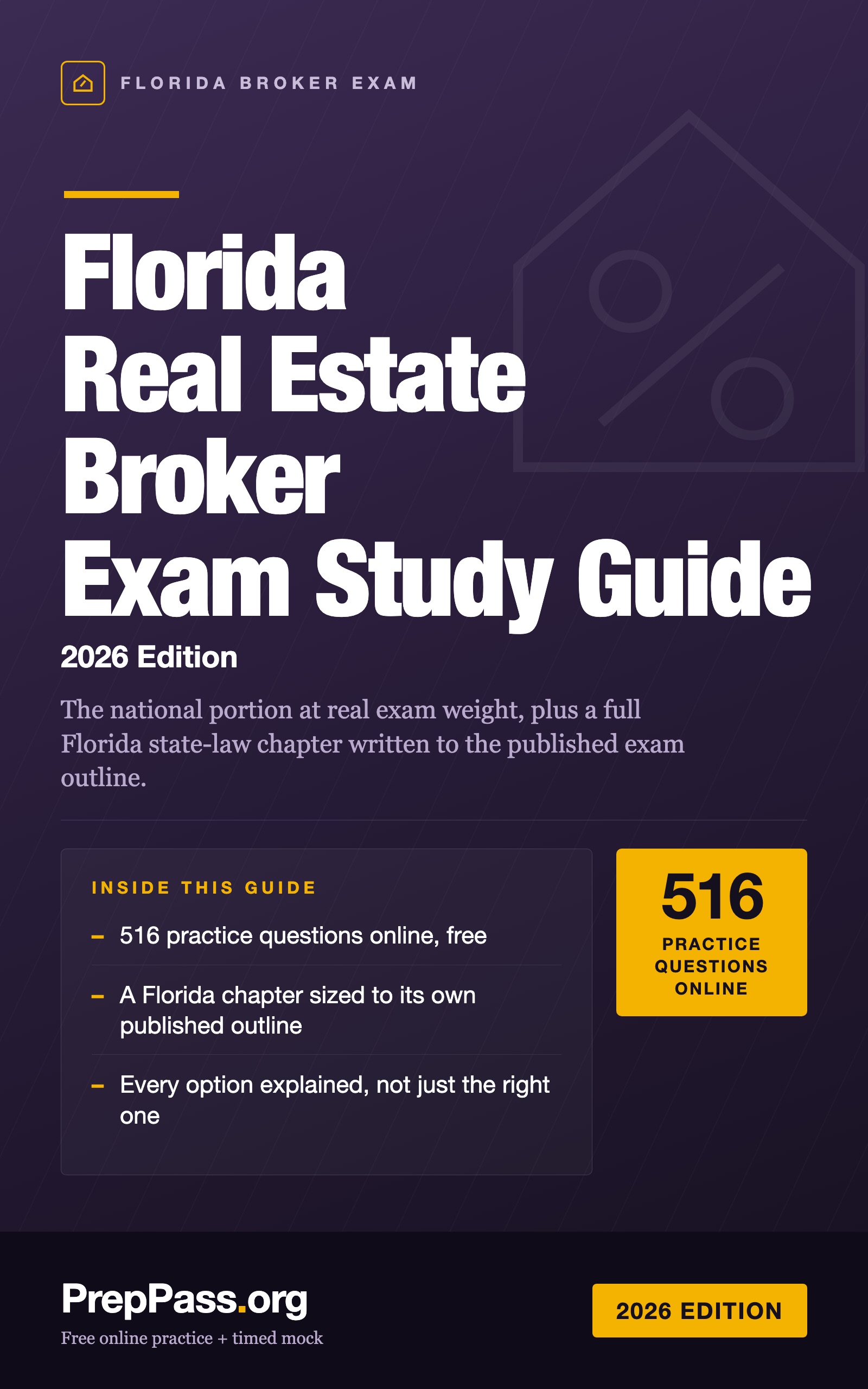
Florida Real Estate Broker · Ấn bản 2026
Florida Real Estate Broker Exam Study Guide (2026)
Florida runs a single integrated paper with no separate national portion, so the whole exam is Florida content. The Florida chapter is sized to the published outline — 12 areas, 100 scored items — area by area, not flattened.
- Cả 8 chương phần thi toàn quốc cùng một chương đầy đủ về luật bất động sản Florida — PDF + EPUB bạn giữ
- Một đề luyện phần thi toàn quốc gồm 60 câu, kèm đáp án giải thích cả bốn phương án chứ không riêng phương án đúng
- Một bộ đề luyện riêng về luật bất động sản Florida, kèm đáp án có giải thích
PDF + EPUB · tiếng Anh · 327 trang · $14.99 trả một lần
Sách này được viết bằng tiếng Anh — tệp PDF và EPUB bạn tải về đều bằng tiếng Anh.
Tải ngay sau khi thanh toán — không cần tài khoản, không thuê bao. Chính sách hoàn tiền
Thử 10 câu trước — miễn phí
Trả lời hết 10 câu, nộp bài xong sẽ thấy lời giải từng câu — kèm phần trong sách này dạy nội dung đó. Khoảng 5 phút, không cần đăng ký.
Bắt đầu 10 câu miễn phíXem bên trong cuốn sách
Ba trang thật, kết xuất thẳng từ tệp PDF bạn sẽ tải — một trang giảng giải, một câu hỏi có lời giải, và một trang tra cứu. Không trang nào được vẽ lại cho đẹp.
- Trang tra cứu nhanhPart C — Encumbrances a broker must read off a title report · Trang 102 của PDF
Một trang để lật lại: các con số, mốc thời hạn hoặc thuật ngữ gom về một chỗ.
- Một câu hỏi có lời giảiPart II — Florida State Law & Practice · Trang 319 của PDF
Một câu luyện tập kèm đáp án và lập luận đằng sau — không chỉ là đáp án.
- Cách giảng dạyPart II — Florida State Law & Practice · Trang 325 của PDF
Trang giảng giải: kiến thức được trình bày bằng văn xuôi, theo trình tự kỳ thi kiểm tra.
Có gì — và không có gì
Bao gồm
- A Florida chapter written to the published exam outline, area by area
- Where Florida law departs from the national rule — both stated, so neither is guessed
- Supervision, trust accounts, brokerage operation and broker math
- A Florida practice set with every option explained, not just the right one
- 516 practice questions online, free, from the same bank
- PDF (print & tab it) + EPUB (phone / e-reader)
Không bao gồm
- Không gửi bản in — đây là tệp bạn tải về và có thể tự in
- Sách không kèm khoá video, giảng viên hay kèm riêng — video miễn phí trên trang là phần khác
- Không bao gồm lệ phí đăng ký thi hay phí trung tâm khảo thí — bạn vẫn nộp cho cơ quan chính thức
Mục lục
Xem 29 chương và trang bắt đầu của từng chương
- Part C — Advertising and recordkeeping compliancetr. 14
- Part D — Consumer contact and transaction integritytr. 16
- 2. Trust Funds, Escrow, and the Client’s Moneytr. 30
- Part C — Records that survive an audittr. 33
- Part D — Disputed moneytr. 34
- 3. Agency at the Broker Leveltr. 40
- Part C — Fiduciary duties, at the level a broker is examined ontr. 44
- Part D — Dual agency, designated agency, and the alternativestr. 46
- 4. Contracts and Brokerage Agreementstr. 55
- Part C — Options, rights of first refusal, and installment contractstr. 60
- Part D — Between contract and closingtr. 61
- 5. Fair Housing, Accessibility, and Antitrust: The Exposure You Carry Personallytr. 72
- Part C — The exemptions, and why they rarely save anyonetr. 78
- Part D — Disability: the distinction the exam always teststr. 79
- 6. Ownership, Land Use Controls, and Transfer of Titletr. 95
- Part C — Encumbrances a broker must read off a title reporttr. 101
- Part D — Legal descriptionstr. 103
- 7. Valuation, Financing, and the Federal Lending Lawstr. 113
- Part C — The instrumentstr. 121
- Part D — Loan programs, structures, and qualifyingtr. 123
- 8. Disclosures, Environmental Risk, and Property Managementtr. 136
- Part C — The management agreement and the manager’s authoritytr. 142
- Part D — Leases and tenanciestr. 144
- Practice Exam — 60 Questionstr. 153
- Answer Key and Explanationstr. 170
- Appendix A — Broker Math Cheat Sheettr. 221
- Appendix B — Glossarytr. 243
- Appendix C — Exam-Day Strategytr. 262
- Part II — Florida State Law & Practicetr. 267
Lấy từ chính tệp PDF bạn tải về, kèm trang bắt đầu của từng phần — không phải gõ tay ở đây.
Đọc miễn phí trọn một chương
Trọn vẹn một chương, đúng như trong eBook. Cuộn cửa sổ để đọc ngay tại đây; không cần tải, không cần email.
Đọc chương 9 ngay tại đây, không rời trang
Chúng tôi không đưa phần mở đầu dễ dãi — chương miễn phí mở thẳng vào một trong những phần đậm đặc nhất của cuốn sách, để bạn đánh giá cách dạy ở đúng chỗ kỳ thi trở nên khó.
Read the sentence that follows before you read anything else in this book, because it changes how you should use the rest of it.
Florida has no national portion. The Department of Business and Professional Regulation does not split its broker paper into a general half and a state half. There is one integrated examination of 100 multiple-choice questions, three and a half hours, passing grade 75, covering twelve content areas — and every one of those twelve areas is Florida's own, written to Florida's outline, tested against Florida law.
That makes this chapter different from its counterparts in the other state editions of this book. Elsewhere, the national manuscript is the exam and the state chapter is the supplement. In Florida the packaging is inverted: the national manuscript is genuine background — good background, and a Florida broker will be a better broker for having read it — but the paper you actually sit is this chapter. Agency theory, valuation, financing, federal tax, investment analysis and market economics all appear on the Florida examination, but they appear inside Florida's twelve areas, sized to Florida's item counts, and are tested through Florida's statutes and FREC rules. So where the national portion treats a subject at general-principles level and Florida departs from the general rule, this chapter names both and tells you which one is on the answer sheet. Where Florida simply is the general rule, this chapter gives you the Florida cut — the Florida figure, the Florida citation, the Florida trap — and does not repeat the theory.
Read the national portion. Then read this chapter as though it were the whole examination, because it is.
1. What the Florida broker examination actually is
The vendor arrangement. Florida is one of a small number of states that self-administers its real estate licensing examinations. The examination is the DBPR's own instrument, developed and owned by the Florida Department of Business and Professional Regulation, Division of Real Estate, which supports the Florida Real Estate Commission (FREC). Pearson VUE schedules the appointment and delivers the test at the seat. That division of labor matters more than it sounds: it means the content authority is a Florida state agency, not a national test publisher, and the document that governs your day is the DBPR's Candidate Information Booklet for the Real Estate Broker Examination — a PDF authored 2024-08-09 — rather than a vendor bulletin written to cover forty states at once.
The booklet's own sentence describing the paper is worth having in front of you:
"The Broker's licensure examination consists of one hundred multiple choice questions. Candidates are given a total of three and half hours to complete the examination. The examination consists of questions covering twelve content areas."
| Questions | 100, multiple choice |
| Time | 3.5 hours (210 minutes) |
| Passing grade | 75 |
| Content areas | 12 |
| National portion | none |
The twelve areas, with their published item counts. Here is something worth pausing on, because it is unusual in this series. Florida publishes each area as a percentage, and because the paper is a single integrated 100-question instrument, each percentage converts to an item count one-for-one with no derivation at all. Nine percent means nine questions. Forty-three percent means forty-three questions. There is no weighting to unwind, no points-versus-questions mismatch to reconcile, no rounding to argue about. The numbers close. Several other states in this series publish percentages that do not sum to 100, or item counts that do not match the stated total; Florida's sum to exactly 100 on the first pass:
| Area | Published % | Items |
|---|---|---|
| I. Real Estate Brokerage Business | 43% | 43 |
| II. Valuing Real Property | 9% | 9 |
| III. Listing and Selling Real Property | 6% | 6 |
| IV. Contracts | 11% | 11 |
| V. Financing | 4% | 4 |
| VI. Closing Transactions | 12% | 12 |
| VII. Federal Income Tax Laws | 5% | 5 |
| VIII. Investment | 4% | 4 |
| IX. Zoning and Planning | 1% | 1 |
| X. Environmental Issues | 1% | 1 |
| XI. Property Management | 1% | 1 |
| XII. The Real Estate Market | 3% | 3 |
| 100% | 100 |
43 + 9 + 6 + 11 + 4 + 12 + 5 + 4 + 1 + 1 + 1 + 3 = 100.
Two facts in that table should govern how you spend the next month.
First: Area I is forty-three items in a single block. Real Estate Brokerage Business is nearly half the examination on its own. It is larger than areas II through XII put together with the single exception of Closing Transactions — that is, areas II, III, IV, V, VII, VIII, IX, X, XI and XII combined come to 45 items, barely more than Area I alone, and if you set Closing aside as well the remaining ten areas total 33 items against Area I's 43. Area I carries fifty-one printed subtopics across five lettered headings: licensure requirements, brokerage entities, brokerage ownership and management and supervision, escrow management, and Florida law and FREC rules. Its sources are chapter 475, part I, Florida Statutes and rule chapter 61J2, Florida Administrative Code, and essentially nothing else. If you learn chapter 475 part I and rule chapter 61J2 cold and learn nothing else at all, you are theoretically within one item of the pass mark — which is not a study plan, but it tells you where the mass is.
Second: three areas are worth exactly one item each. IX Zoning and Planning, X Environmental Issues, and XI Property Management are one question apiece. Be honest with yourself about what that means. Property Management has a seven-subtopic printed outline — introduction, markets, skills, rental process, owner-manager relationship, the Residential Landlord and Tenant Act, federal and state laws — and it is worth one scored item. Zoning and Planning gets three subtopics for its one item. Environmental Issues gets two. Studying any of these three the way you study Area I is not diligence; it is a misallocation that costs you items in the areas that carry weight. Learn one durable rule from each, spend twenty minutes apiece, and go back to escrow. This chapter deliberately gives each of those three areas a short section for exactly that reason — over-building a one-item area is the original defect in miniature, and doing it in a book is worse than doing it in your own notes, because a book teaches the misallocation to every reader.
What the exam is not. There is no separate Florida law supplement to sit, no general-knowledge paper to pass first, and no partial credit for passing "the state part." You sit 100 questions once and score 75 or better. And because there is no national half, a candidate who has passed a broker examination in another state has passed nothing that transfers to the score report — mutual recognition, where it applies, is an alternative route to the license, not a waiver of this paper for those who take it.
2. The twelve areas
I. Real Estate Brokerage Business — 43 items (43%)
Forty-three items. Fifty-one subtopics. Five lettered headings. This one area is the examination's center of gravity, and the sections below follow the booklet's own lettering so you can check your coverage against the printed outline.
A. Licensure requirements (subtopics A.1–A.12)
The base qualifications. Section 475.17(1)(a), F.S., sets the floor for any applicant: be at least 18 years of age, hold a high school diploma or its equivalent, and be "honest, truthful, trustworthy, and of good character." Those four adjectives are not decoration — they are the statutory hook that lets the department deny an application on a record that includes no license-law violation at all.
The broker tier adds experience, and this is where sales associates get caught. Section 475.17(2)(b), F.S., requires 24 months of qualifying activity during the preceding 5 years. What qualifies: an active real estate sales associate license — issued by Florida or by another jurisdiction — held in a licensed brokerage; a sales associate license held while salaried by a governmental agency; or an active broker license issued by another jurisdiction.
The trap. Candidates routinely assume the 24 months must be Florida months. They need not be. Out-of-state active sales associate time counts toward the Florida broker experience requirement. What the statute does insist on is that the months be active and that they fall inside the five-year lookback — inactive time is not experience, and active time from seven years ago is outside the window no matter how much of it there was.
Education. The broker prelicense course is Course II: rule 61J2-3.008(2)(a), F.A.C., fixes it at 72 hours of 50 minutes each, inclusive of the end-of-course examination. Distinguish it from the numbers that surround it. The sales associate prelicense course (Course I) is 63 hours; the sales associate postlicense course is 45 hours; the broker postlicense course is 60 hours. Four numbers, four different stages, and Florida writes distractors out of exactly this set.
Postlicensure education, and the harshest consequence in the chapter. Section 475.17(4)(a), F.S., requires a newly licensed broker to complete 60 classroom hours of 50 minutes each, inclusive of examination, prior to the first renewal following initial licensure. Section 475.17(4)(c), F.S., states the consequence in a single word: "The license of any broker who does not complete the postlicensure education requirement prior to the first renewal following initial licensure shall be considered null and void."
Where it bites. Null and void is not inactive, not suspended, and not curable by paying a late fee. The broker who missed the 60 hours does not have a lapsed license to reinstate; there is no license. To get back, the person must either requalify as a sales associate or retake the 72-hour Course II and sit the broker examination again. A newly licensed broker who spends the first two years building a book of business and treats the postlicense course as paperwork can lose everything at the first renewal date. Renewal is not a formality in Florida for a first-cycle broker.
Continuing education. Section 475.182(1)(a), F.S., requires 14 classroom hours each biennium. Rule 61J2-3.009(2), F.A.C., fixes the composition: 3 hours of Core Law and 3 hours of Business Ethics inside the 14, with specialty hours making up at least 8. The trap: the distractor set here is built from plausible-looking splits — 7 and 7, 4 and 4, Core Law paired with escrow management instead of ethics. Three and three, Core Law and Business Ethics.
Application timing. Section 475.181(2), F.S., gives an approved application a life of 2 years from the date the department received it, and it cuts the other way too: successful course completion becomes invalid if the applicant does not pass the examination within 2 years of completing the course. Two clocks, both two years, both running whether or not you are watching them.
Address and residency changes. Section 475.23, F.S., requires notice to the commission of a change of business address within 10 days, on the commission's form. A licensee who moves out of state and becomes a nonresident has a different and longer clock: 60 days under s. 475.180(2)(a), F.S., after which the nonresident requirements attach. Ten days for an address; sixty days for residency. Transposing them is a favorite item.
Inactive status, and how a license dies quietly. Florida separates voluntary inactive status (the licensee chose it) from involuntary inactive status (the licensee failed to renew). Section 475.183(2)(b), F.S., provides that a license involuntarily inactive for more than 2 years expires and becomes null and void. There is no education package that reactivates it after that point — the 14-hour and 28-hour reactivation packages exist for licenses still inside the window. The trap is that the answer sounds too harsh to be right. It is right.
Multiple licenses versus group licenses. These are different animals and the outline names both (A.10). Section 475.215(1), F.S., is the multiple license provision: a licensed broker may be issued more than one broker license where it is "clearly shown that the requested additional licenses are necessary to the conduct of real estate brokerage business" — a broker serving two unrelated brokerage entities, for instance. Discipline against one reaches all of them. Section 475.215(2), F.S., closes the door on the mirror image: "A sales associate or broker associate shall have no more than one registered employer at any one time." A group license, by contrast, is what a sales associate holds when registered with an owner-developer that operates through several entities — one registration covering several affiliated entities. Multiple license: one broker, several licenses. Group license: one registration, several entities.
Mutual recognition. Florida's mutual recognition agreements (A.2) are agreements with individual states, not a general reciprocity scheme, and they permit a qualified nonresident licensee to obtain a Florida license by passing a Florida-law examination rather than the full 100-question paper. They do not waive the requirement that the applicant be licensed and in good standing where they are; they are not a substitute for this examination for a Florida resident; and they do not cover every state.
Exemptions. Section 475.011, F.S., lists who does not need a license. The one tested most often is the entity acting for itself: a corporation, partnership, trust or joint venture that sells, exchanges or leases its own property is outside chapter 475 — the license requirement attaches to acting for another for compensation. Contrast the person paid per transaction to sell property an owner holds, the manager paid a commission to rent an owner's homes, and the person paid a fee to resell timeshare periods for several owners: each of those is acting for another, for compensation, and needs a license.
B. Brokerage entities, offices, signs, and advertising (B.1–B.5)
Registered versus licensed, and why the distinction is real. Section 475.15, F.S., requires each partnership, limited liability partnership, limited liability company, or corporation that acts as a broker to register with the commission. Entities are registered; natural persons are licensed. The entity's authority to broker is entirely derivative — it comes from the licensed broker officer, member or partner standing behind it.
Three consequences follow, and all three are examinable:
- Limited partnerships. Section 475.15 requires that only the general partners be licensed brokers or registered brokerage corporations. Limited partners are passive investors and need no license. The trap runs both ways: requiring every partner to be licensed would destroy the point of the form, and inverting the rule onto the limited partners is exactly backwards.
- The active-broker requirement is continuous. If a registered brokerage corporation is left with no active broker member whose license is in force, the registration is canceled automatically for that period of time. Not suspended after a hearing, not continued for a grace period while a replacement is recruited — canceled, automatically, by operation of the statute. Every transaction the entity purports to broker during that gap is brokered by an unregistered entity.
- Non-registered entities (B.2). Sole proprietorships and certain other arrangements are not registered as entities; the broker is licensed personally and the business operates under the broker's own license, with a trade name if one is registered.
Trade names (B.3). Rule 61J2-10.034, F.A.C., permits an individual broker, partnership or corporation to be registered under no more than one trade name at any given time. Not one per line of business, not one per branch, not any number as long as they are disclosed. One. Florida's Fictitious Name Act, s. 865.09, F.S., sits alongside this — and note for citation purposes that chapter 865 itself is titled "Violations of Certain Commercial Restrictions"; only s. 865.09 is the Fictitious Name Act. Citing "chapter 865, the Fictitious Name Act" is wrong; cite the section.
Office requirements (B.4). Section 475.22(1), F.S., is the operative sentence:
"Each active broker shall maintain an office, which shall consist of at least one enclosed room in a building of stationary construction."
Read what that does not say. It does not say commercially zoned — rule 61J2-10.022, F.A.C., expressly permits the required office to sit in a residential location where local zoning allows. It does not require two rooms, and it does not require a street-level public entrance. What it does require is an enclosed room in a building of stationary construction: a vehicle, a trailer that is moved, or a desk in an open shared space does not satisfy it.
Entrance signs (B.4.c) — and the first of this chapter's document defects. The same section, s. 475.22(1), F.S., requires a sign on or about the entrance of the principal office and each branch office, easily observed and read by a person about to enter, containing the broker's name together with any trade name, and requires that at a minimum the words "licensed real estate broker" or "lic. real estate broker" appear. Not "licensed real estate office," not "registered real estate brokerage," not "Florida real estate broker" — the words name the licensed individual, not the premises or the entity.
Now the defect, and it is worth money to you. The rule that used to govern entrance signs, rule 61J2-10.024, F.A.C., was repealed effective 3-15-2006 — twenty years ago — and it is still printed in the DBPR's outline as subtopic I.B.4.c. A candidate who takes the subtopic list at face value and goes looking for the rule will find a repealed rule, a broken link, or a study product that cites it anyway. The live source is s. 475.22(1), F.S. Section 4 of this chapter collects this and the other document defects the rebuild of this book turned up.
Branch offices. Rule 61J2-10.023, F.A.C., defines when a second location must be registered as a branch. A temporary shelter on a subdivision the broker is selling, where transactions are not closed and no sales associate is permanently assigned, is not a branch office and needs no branch registration. The registration trigger is the conduct of business at a fixed additional location, not the mere existence of a structure.
Trước khi mua
- Nhận sách thế nào?
- Thanh toán xong, mục tải xuống hiện ngay trên trang này. Liên kết cũng được gửi qua email. Không cần tài khoản.
- Nếu sách không hợp thì sao?
- Gửi email trong vòng 14 ngày để được hoàn tiền đầy đủ, không cần lý do.
- Phần luyện tập miễn phí có bị bỏ không?
- Không. Mọi câu hỏi luyện tập, bài thi thử tính giờ và các chương miễn phí trên trang vẫn miễn phí. Cuốn sách là nửa "học", không phải hàng rào quanh phần miễn phí.
- Đọc trên điện thoại được không?
- Được — EPUB cho điện thoại và máy đọc sách, PDF để in và dán tab. Bạn nhận cả hai.
Chi tiết
Florida runs a single integrated paper with no separate national portion, so the whole exam is Florida content. The Florida chapter is sized to the published outline — 12 areas, 100 scored items — area by area, not flattened.
- Format: PDF + EPUB download · 327 pages
- 80 practice questions in the book, with a full answer key
- 516 free practice questions for this exam on PrepPass, included at no cost
- $14.99 one-time — no subscription
- 14-day money-back guarantee · refund policy
- Cross-referenced against: Rule ch. 61J2-3, 61J2-10, 61J2-14, 61J2-24, F.A.C. · Rule 61J2-10.024, F.A.C. — Office Entrance Signs · s. 199.133(1), F.S. — nonrecurring intangible tax, 2 mills per dollar · ss. 689.02, 689.25, 689.261, 695.01, 712.02, 725.01, F.S. · Florida DBPR, Division of Real Estate (self-administered; Pearson VUE schedules and delivers) (rev Candidate Information Booklet, Real Estate Broker Examination; PDF authored 2024-08-09)
- Last updated: September 2026
- Đối chiếu từ nguồn chính thức(Rule ch. 61J2-3, 61J2-10, 61J2-14, 61J2-24, F.A.C. · Rule 61J2-10.024, F.A.C. — Office Entrance Signs · s. 199.133(1), F.S. — nonrecurring intangible tax, 2 mills per dollar · ss. 689.02, 689.25, 689.261, 695.01, 712.02, 725.01, F.S. · Florida DBPR, Division of Real Estate (self-administered; Pearson VUE schedules and delivers) (rev Candidate Information Booklet, Real Estate Broker Examination; PDF authored 2024-08-09))
- 516 câu hỏi luyện tập miễn phí
- Tải ngay, thuộc về bạn trọn đời
Một real estate broker pre-license course có giá $200–$1,000. Cuốn sách này dạy cùng một kỳ thi — cùng quy định, đối chiếu theo chuẩn hiện hành — chỉ với $14.99 trả một lần, thuộc về bạn trọn đời.
Vì sao mua sách khi phần luyện tập miễn phí?
Câu hỏi luyện tập và bài thi thử tính giờ vẫn miễn phí — không có gì trên trang bị giấu sau cuốn sách này. Cuốn sách $14.99 là nửa "học": chính phần kiến thức, dạy theo trình tự, trong một tệp thuộc về bạn.
- Dạy có hệ thống — mọi phần thi giảng theo từng chương, từ đầu đến cuối, không chỉ là câu hỏi
- In ra & dán nhãn — PDF sẵn sàng để in, tô đậm, ghi chú và mang tới bàn học
- Học mọi nơi, ngoại tuyến — EPUB trên điện thoại hay máy đọc sách; không cần wifi, không cần tab trình duyệt
- Tất cả một chỗ — các chương, thẻ tóm tắt từng chương và câu hỏi luyện tập trong một tệp
- Của bạn trọn đời — trả một lần $14.99, tải ngay, không thuê bao
Và không rủi ro: Đảm bảo hoàn tiền 14 ngày — không hài lòng? Email cho chúng tôi để hoàn tiền đầy đủ, không cần lý do. Xem chính sách hoàn tiền.
Đảm bảo hoàn tiền 14 ngày · hoàn tiền đầy đủ, không cần lý do.
Mua một lần, truy cập tải về trọn đời. eBook là trọn bộ hướng dẫn ôn Florida Real Estate Broker ở dạng PDF và EPUB. Bản tóm tắt mang tính giáo dục, không phải tư vấn chuyên môn hay pháp lý — luôn xác nhận quy định hiện hành với nguồn chính thức. Cập nhật lần cuối: September 2026.