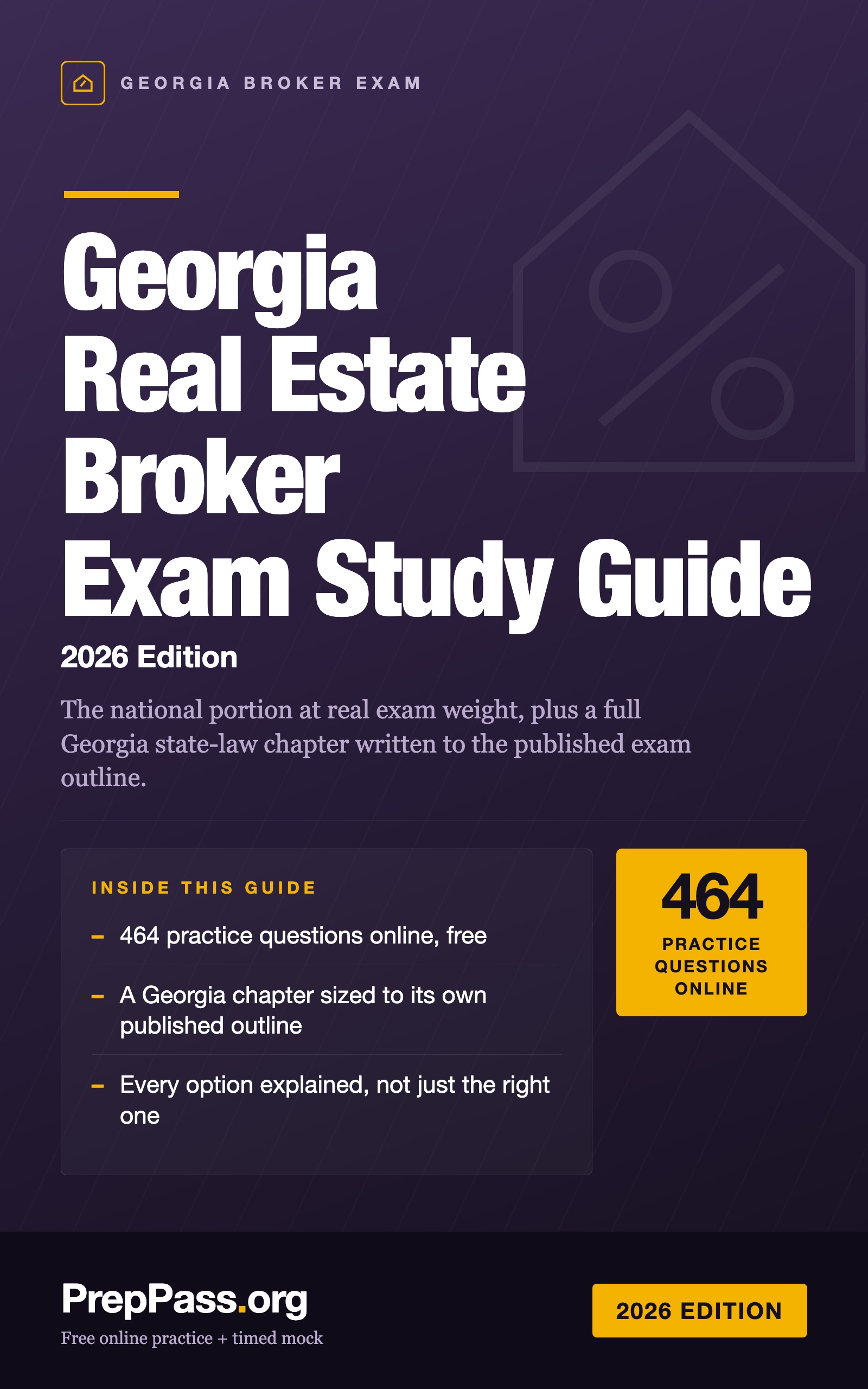
Georgia Real Estate Broker · Ấn bản 2026
Georgia Real Estate Broker Exam Study Guide (2026)
The national portion at real exam weight, plus a Georgia chapter. The Georgia chapter is sized to the published outline — 3 areas, 48 scored items — area by area, not flattened.
- Cả 8 chương phần thi toàn quốc cùng một chương đầy đủ về luật bất động sản Georgia — PDF + EPUB bạn giữ
- Một đề luyện phần thi toàn quốc gồm 60 câu, kèm đáp án giải thích cả bốn phương án chứ không riêng phương án đúng
- 20 câu hỏi riêng về luật bất động sản Georgia, kèm đáp án có giải thích
PDF + EPUB · tiếng Anh · 311 trang · $14.99 trả một lần
Sách này được viết bằng tiếng Anh — tệp PDF và EPUB bạn tải về đều bằng tiếng Anh.
Tải ngay sau khi thanh toán — không cần tài khoản, không thuê bao. Chính sách hoàn tiền
Thử 10 câu trước — miễn phí
Trả lời hết 10 câu, nộp bài xong sẽ thấy lời giải từng câu — kèm phần trong sách này dạy nội dung đó. Khoảng 5 phút, không cần đăng ký.
Bắt đầu 10 câu miễn phíXem bên trong cuốn sách
Ba trang thật, kết xuất thẳng từ tệp PDF bạn sẽ tải — một trang giảng giải, một câu hỏi có lời giải, và một trang tra cứu. Không trang nào được vẽ lại cho đẹp.
- Trang tra cứu nhanhPart C — Encumbrances a broker must read off a title report · Trang 102 của PDF
Một trang để lật lại: các con số, mốc thời hạn hoặc thuật ngữ gom về một chỗ.
- Một câu hỏi có lời giảiAnswer Key and Explanations · Trang 174 của PDF
Một câu luyện tập kèm đáp án và lập luận đằng sau — không chỉ là đáp án.
- Cách giảng dạyPart II — Georgia State Law & Practice · Trang 273 của PDF
Trang giảng giải: kiến thức được trình bày bằng văn xuôi, theo trình tự kỳ thi kiểm tra.
Có gì — và không có gì
Bao gồm
- A Georgia chapter written to the published exam outline, area by area
- Where Georgia law departs from the national rule — both stated, so neither is guessed
- Supervision, trust accounts, brokerage operation and broker math
- A Georgia practice set with every option explained, not just the right one
- 464 practice questions online, free, from the same bank
- PDF (print & tab it) + EPUB (phone / e-reader)
Không bao gồm
- Không gửi bản in — đây là tệp bạn tải về và có thể tự in
- Sách không kèm khoá video, giảng viên hay kèm riêng — video miễn phí trên trang là phần khác
- Không bao gồm lệ phí đăng ký thi hay phí trung tâm khảo thí — bạn vẫn nộp cho cơ quan chính thức
Mục lục
Xem 29 chương và trang bắt đầu của từng chương
- Part C — Advertising and recordkeeping compliancetr. 14
- Part D — Consumer contact and transaction integritytr. 16
- 2. Trust Funds, Escrow, and the Client’s Moneytr. 30
- Part C — Records that survive an audittr. 33
- Part D — Disputed moneytr. 34
- 3. Agency at the Broker Leveltr. 40
- Part C — Fiduciary duties, at the level a broker is examined ontr. 44
- Part D — Dual agency, designated agency, and the alternativestr. 46
- 4. Contracts and Brokerage Agreementstr. 55
- Part C — Options, rights of first refusal, and installment contractstr. 60
- Part D — Between contract and closingtr. 61
- 5. Fair Housing, Accessibility, and Antitrust: The Exposure You Carry Personallytr. 72
- Part C — The exemptions, and why they rarely save anyonetr. 78
- Part D — Disability: the distinction the exam always teststr. 79
- 6. Ownership, Land Use Controls, and Transfer of Titletr. 95
- Part C — Encumbrances a broker must read off a title reporttr. 101
- Part D — Legal descriptionstr. 103
- 7. Valuation, Financing, and the Federal Lending Lawstr. 113
- Part C — The instrumentstr. 121
- Part D — Loan programs, structures, and qualifyingtr. 123
- 8. Disclosures, Environmental Risk, and Property Managementtr. 136
- Part C — The management agreement and the manager’s authoritytr. 142
- Part D — Leases and tenanciestr. 144
- Practice Exam — 60 Questionstr. 153
- Answer Key and Explanationstr. 170
- Appendix A — Broker Math Cheat Sheettr. 221
- Appendix B — Glossarytr. 243
- Appendix C — Exam-Day Strategytr. 262
- Part II — Georgia State Law & Practicetr. 267
Lấy từ chính tệp PDF bạn tải về, kèm trang bắt đầu của từng phần — không phải gõ tay ở đây.
Đọc miễn phí trọn một chương
Trọn vẹn một chương, đúng như trong eBook. Cuộn cửa sổ để đọc ngay tại đây; không cần tải, không cần email.
Đọc chương 9 ngay tại đây, không rời trang
Chúng tôi không đưa phần mở đầu dễ dãi — chương miễn phí mở thẳng vào một trong những phần đậm đặc nhất của cuốn sách, để bạn đánh giá cách dạy ở đúng chỗ kỳ thi trở nên khó.
Everything up to this page is national. Agency theory, fair housing at the federal level, RESPA, TILA, financing instruments, valuation and the arithmetic of a settlement statement have all been covered, and they are covered because the Georgia broker examination has a national half. This chapter is the other half. It is Georgia law, Georgia rules, and Georgia numbers, and its most useful passages are the ones where Georgia does not do what the national chapters just told you the common rule is. Where that happens, both rules are named side by side, because the trap on this examination is answering a Georgia item with a national reflex.
What the Georgia portion actually is
The Georgia broker examination is administered by PSI for the Georgia Real Estate Commission. The controlling document is PSI candidate information bulletin 4672, revision date 2026-07-01. It describes two separately outlined halves: a 75-item national portion and the Georgia Broker Supplement Examination, 48 scored items. This chapter serves those 48 items.
The bulletin publishes the state content outline as three areas, in this order and with these counts:
| Area | Items | Share |
|---|---|---|
| I. State Laws and Rules | 31 | 65% |
| II. Management | 12 | 25% |
| III. Closing and Calculations | 5 | 10% |
That distribution is not a suggestion about how to feel about the material; it is the blueprint. Nearly two-thirds of your Georgia score comes from Area I, and this chapter is sized to match. If you study the three areas evenly you will have spent a quarter of your effort on five items.
The two halves are structurally different tests, and you should practice them differently. The bulletin's own description of the broker national portion reads: "scenario-based test questions are included to contain more than four options and ONLY ONE BEST option shall be selected... Each option is weighted as zero-point, one-point, or two-point." That is a best-answer instrument with partial credit — more than four options, and a wrong-but-defensible choice can still earn a point. Elimination-to-two, the habit most candidates bring from four-option practice, is the wrong reflex there; ranking options by how completely they answer the call of the question is the right one. The Georgia Supplement is not built that way. Your 48 state items are plain four-option multiple choice, exactly one of which is correct, no partial credit. So on the state half, elimination works, and a precise memory of a number — ten days, one business day, 60 days, $25,000, 40 percent, 62 months — decides items outright.
Two things bulletin 4672 does not publish, and you should know that they are absent rather than assume a competitor's number:
- No time limit is published for the Georgia broker examination. Not for the national portion, not for the supplement.
- No numeric passing score is published for the Georgia broker examination.
Any study guide that tells you the Georgia broker supplement is "75 percent to pass" or gives you a minute count is quoting the salesperson bulletin. The salesperson document, with its 100-national / 52-Georgia table, is a different examination and its figures do not transfer — the broker national portion is 75 items, not 100, and the broker supplement is 48 items, not 52. What is sourced on scoring is the Commission's own rule: GREC Rule 520-1-.04(3)(a) provides that the passing score is established by the Commission using psychometrically sound criterion-related methods and is published before the examination is administered. Practically, that means the cut score is a Commission determination announced in advance rather than a fixed statutory percentage, and the honest preparation strategy is to be able to answer every item rather than to aim at a number nobody has printed for you.
One more absence worth naming. Bulletin 4672 publishes no state statute or rule reference list at all. Its "Examination Study Materials" section lists national real estate textbooks only, identically for salesperson and broker candidates. There is no vendor-supplied list of the Georgia authorities the supplement tests. The citation list this chapter works from is ours, assembled from the Georgia Real Estate Commission's own License Law page, and you should not read it as the vendor's. Be aware also that every Code citation on that GREC page links to a single generic LexisNexis landing page rather than to the individual section, so currency cannot be taken on faith from the link — it has to be checked section by section, which is what the "What changed recently" part of this chapter exists to record.
Finally, eligibility, because it governs whether you sit at all: a Georgia broker or associate broker candidate must show an active license for at least three of the five years immediately preceding the application (GREC Rule 520-1-.04(5)(b)) and completion of the 60-hour Brokers Prelicense Course (O.C.G.A. § 43-40-8(c)(5)). Rule 520-2-.04(4) fixes what that course must contain — loan closings, office management, personnel policies, trust account record keeping, and the broker's responsibility for affiliated licensees — which is a fair preview of Area II. After passing, a broker candidate has 12 months to activate before the examination must be retaken.
Area I — State Laws and Rules (31 of 48 items)
Area I is the only area for which bulletin 4672 prints lettered subtopics. There are ten of them, and this section follows them in the bulletin's order. The per-subtopic item counts below are derived by us from the published lettered list and the published 31-item total; the letters and their titles are the bulletin's.
| Subtopic | Derived items |
|---|---|
| A. Unfair Practices | 4 |
| B. Trust Accounts | 4 |
| C. Substantive Regulations | 2 |
| D. Real Estate Practice in Georgia | 7 |
| E. Qualifications and Fees | 3 |
| F. Fair Housing Laws | 2 |
| G. Real Estate Education, Research and Recovery Fund | 2 |
| H. Complaints and Hearing Process and Attorney General's Opinions | 3 |
| I. Commission Organization and Procedures | 1 |
| J. Required Licensure | 3 |
Before the subtopics, the contrasts. These are the points at which the national chapters and Georgia give different answers to the same question, and they generate a disproportionate share of Area I:
| Question | National / common-law rule | Georgia rule |
|---|---|---|
| Is the broker a fiduciary to the client? | Yes — loyalty, obedience, disclosure, confidentiality, accounting, care | No. O.C.G.A. § 10-6A-4(a): only the duties in the chapter, plus reasonable care; expressly not a fiduciary |
| Is in-house designated agency a form of dual agency? | Commonly treated as dual agency requiring dual-agency consent | No. § 10-6A-13(b): neither broker, licensees nor firm is deemed a dual agent |
| Confidentiality vs. telling a customer the truth | Confidentiality is a fiduciary duty; the broker usually declines to answer | Truth wins. § 10-6A-9(c): the duty not to give customers false information prevails, and the broker is immunized |
| Does paying the commission establish agency? | An easy intuition, often wrong but rarely legislated | Legislated. § 10-6A-11: payment "shall not determine whether a brokerage relationship has been created" |
| Net listings | Permitted in many states if disclosed | Banned outright. GREC Rule 520-1-.06(1)(c) |
| May an owner always self-manage without a license? | Yes, the owner exemption is near-universal | Not always. § 44-7-25(b) switches off § 43-40-29(a)(7) and (a)(8) for non-resident landlords of single-family and duplex rentals |
| Is there a time limit on the regulator investigating? | Frequently none stated | Three years, with three exceptions, § 43-40-27(a) |
| Can an unlicensed person sue for a fee? | Usually barred | Barred, and pleading is not enough — § 43-40-24(a) requires alleging and proving licensure at the time |
Read that list once more for what is missing: there is no agency subtopic. A candidate arriving from the national half expects a heading for agency and, not finding one, concludes Georgia agency law is untested. It is heavily tested — it simply lives under D, Real Estate Practice in Georgia, which is the largest subtopic on the outline at a derived seven items. BRRETA, O.C.G.A. § 10-6A-1 et seq., is the single densest body of Georgia law on this examination and it is hiding under a generic heading.
A. Unfair Practices
O.C.G.A. § 43-40-25(b) is a list of thirty-six unfair trade practices, any one of which will support a sanction. Four of them generate most of the items.
Signs. Paragraph (b)(11) makes it a violation to place a sign on property offering it for sale or for rent without the written consent of the owner or the owner's authorized agent, and to fail "to remove such sign within ten days after the expiration of listing." Two obligations, one paragraph: written consent going up, ten days coming down. The clock runs from expiration of the listing, not from the day the seller asks or the day the licensee gets around to it. A licensee whose listing lapsed on the first and whose sign is still in the yard on the fifteenth is in violation whether or not the seller minds.
Listings. Paragraph (b)(18) requires that a listing carry a definite expiration date and that a copy be left with the principal. Georgia does not recognize an automatic-extension listing that runs until cancelled; BRRETA reinforces the point at § 10-6A-9(a)(2)(C), which caps a brokerage engagement with no stated expiration at one year.
Referral fees. Paragraph (b)(6)(C) makes it an unfair trade practice to fail "to disclose in writing to a principal in a real estate transaction... the receipt of anything of value for the referral of any service or product in a real estate transaction to a principal." The duty attaches to the licensee's receipt of value, not to who writes the check, and the Code sets no dollar floor below which it disappears. A $150 payment from a home-warranty company for sending a client its way must be disclosed in writing exactly as a $1,500 payment would. Nor will a spoken disclosure at the closing table satisfy a paragraph that says in writing. GREC Rule 520-1-.10(6)(a) does allow the disclosure to be made in advance on pre-established terms set out in the brokerage agreement, which is how most firms handle it, and Rule 520-1-.10(6)(c) makes clear the Georgia duty sits on top of federal requirements, not instead of them.
Interfering with another broker's exclusive. Paragraph (b)(14) bars negotiating a sale, exchange or lease directly with an owner, lessor, purchaser or tenant whom the licensee knows to be under a written outstanding exclusive listing or exclusive brokerage agreement with another broker — "unless the outstanding listing or brokerage agreement provides that the licensee holding such agreement will not provide negotiation services to the client." That carve-out is the only one the statute writes. Notice to the other broker is not a substitute. The fact that the owner started the conversation is not a defense. GREC Rule 520-1-.10(1) states the same limit from the offer side.
Net listings are flatly banned. This is a real departure. Many states permit a net listing if it is disclosed; GREC Rule 520-1-.06(1)(c) prohibits brokers from accepting net brokerage engagements outright and "makes it obligatory upon the broker, when securing the brokerage engagement, to add the broker's fee thereby notifying the client of the gross price of the property and the broker's services." A seller who says "get me $300,000 and keep the rest" must be refused and re-papered with a gross price and a stated fee. No amount of documentation rescues the arrangement — not a signed instruction, not a self-imposed cap on the broker's share, not a report to GREC after closing. The cure the rule prescribes is structural, not disclosural.
B. Trust Accounts
Whether you need an account. O.C.G.A. § 43-40-20(a) excuses a broker who accepts no trust funds from maintaining a trust account at all — and then closes the gap: "if a broker does not maintain such a trust or escrow account and later receives trust funds in a real estate brokerage transaction, such broker must open the designated trust or escrow account required by this subsection within one business day of the receipt of such trust funds." A broker who has never held an earnest money check and takes one on a Tuesday has until Wednesday. GREC Rule 520-1-.08(1)(a) then allows one month to notify the Commission of the institution and the account. Keep these two apart from the deposit deadline behind GREC's citation schedule, Rule 520-1-.14(3)(t), which fines a licensee whose deposit was made more than three business days after receipt unless the contract provides otherwise. Three deadlines, three lengths, one fact pattern.
When the broker may take a fee out of trust. O.C.G.A. § 43-40-20(e) provides that a broker "shall not be entitled to any part of the earnest money, security deposit, or other trust funds paid to the broker in connection with any real estate transaction as part or all of the broker's commission or fee until the transaction has been consummated or terminated." GREC Rule 520-1-.08(3)(d) says when the Commission treats that test as met: in a sale, the closing has occurred or the closing date and any extensions have passed; in a lease, possession has been delivered; or the broker holds a written agreement, separate from the sales contract, signed by all parties with an interest. Binding agreement, expired contingencies, a clean appraisal and a loan commitment are all milestones short of consummation or termination.
Disbursing a disputed deposit. Rule 520-1-.08(3)(b) lists the grounds on which a broker is deemed to have properly accounted for trust funds — a written agreement signed by all parties, an interpleader action, a court order, and "upon a reasonable interpretation of the contract which directed the broker to deposit the funds," among them. Subparagraph (c) attaches the condition that catches people: "When a broker makes a disbursal to which all parties to the contract do not expressly agree, the broker must immediately notify all parties in writing of the disbursal." GREC does not pre-approve disbursals, and interpleader is an alternative ground in (b), not a step that has to follow a disbursal already made on another ground.
A worked instance, because the deadlines interlock. Take a Marietta broker who has run a listing-only practice for years, holds no trust account, and on Tuesday the 3rd accepts a $10,000 earnest money check on a contract binding that day. By Wednesday the 4th — one business day — the designated trust or escrow account must exist, under § 43-40-20(a). By Friday the 6th the deposit itself should be made, or the broker is exposed to a citation under Rule 520-1-.14(3)(t) unless the contract provides otherwise. By the 3rd of the following month, GREC must have been told the institution and the account number under Rule 520-1-.08(1)(a). At the end of that month the first written reconciliation under Rule 520-1-.08(6) is due. And when the deal blows up in week six and the broker disburses to the seller on a reasonable interpretation of the contract, the written notice to both parties under Rule 520-1-.08(3)(c) must go out immediately — not when the buyer next calls. The broker who does everything right except that last notice has still committed a violation, and it is the step most often skipped because the money is already gone and the file feels closed.
Reconciliation. Rule 520-1-.08(6) requires the broker to cause to be made, at least monthly, a written reconciliation statement comparing total trust liability with the reconciled financial institution balance, and (6)(a) requires the broker to review it and keep copies three years. It stays in the broker's file; it is not routinely filed with GREC. A certified public accountant's report is something the Commission may accept in lieu of its own examination under Rule 520-1-.08(5)(b) — it is not an annual audit requirement.
C. Substantive Regulations
Advertising, GREC Rule 520-1-.09. A firm advertising specific real estate must include the firm name as registered with the Commission and a firm telephone number, and the rule then imposes a comparison test twice over: the firm name "shall appear in equal or greater size, prominence, and frequency than the name or names of any affiliated licensees," and the firm's telephone number likewise as against any affiliated licensee's number. The firm number must be one at which the public can reach a broker or a manager without going through the affiliated licensee named in the advertisement. So the billboard with the agent's face and mobile number in three-foot type and the firm name in the bottom corner is precisely what the rule exists to stop; the agent's own name is not banned, only subordinated. Internet advertising must carry firm name and number on every viewable web page, and outdated information must be updated or removed within 30 days. The only exception in (7)(a) is a lawful restriction — a covenant or ordinance — that forbids the firm name on a particular type of sign.
License numbers and records. Rule 520-1-.10(2) requires a licensee preparing or signing a brokerage engagement or an offer to include "the license number issued by the Commission of each firm and of each licensee participating in the transaction," and specifies the six-digit number. Both sides, firms and individuals — not merely the drafter, not merely the listing side. Buyers, sellers and unlicensed assistants hold no Commission number, so there is nothing for them to disclose. Rule 520-1-.10(4) and § 43-40-25(b)(27) require three-year retention of contracts, closing statements, brokerage engagements and trust records. Rule 520-1-.11 requires a licensee dealing as a principal to tell the broker in writing first and to disclose the license in advertising.
D. Real Estate Practice in Georgia — BRRETA
This is the largest subtopic on the outline, and it is where Georgia departs from the national manuscript most sharply.
Georgia does not apply common-law agency to brokerage. O.C.G.A. § 10-6A-2(a) records the legislative finding that applying the common law of agency to real estate brokerage produced "misunderstandings and consequences... contrary to the best interests of the public." Section 10-6A-4(a) states the consequence: "A broker who performs brokerage services for a client or customer shall owe the client or customer only the duties and obligations set forth in this chapter, unless the parties expressly agree otherwise in a writing signed by the parties. A broker shall not be deemed to have a fiduciary relationship with any party or fiduciary obligations to any party but shall only be responsible for exercising reasonable care in the discharge of its specified duties." The national chapters taught you the six common-law fiduciary duties. Georgia's answer is that the broker is not a fiduciary at all and owes reasonable care plus a statutory list. BRRETA displaces the common law rather than codifying it, and it is not limited to residential transactions. Duties still exist by default — §§ 10-6A-5 through 10-6A-8 set them out for sellers, landlords, buyers and tenants respectively.
Trước khi mua
- Nhận sách thế nào?
- Thanh toán xong, mục tải xuống hiện ngay trên trang này. Liên kết cũng được gửi qua email. Không cần tài khoản.
- Nếu sách không hợp thì sao?
- Gửi email trong vòng 14 ngày để được hoàn tiền đầy đủ, không cần lý do.
- Phần luyện tập miễn phí có bị bỏ không?
- Không. Mọi câu hỏi luyện tập, bài thi thử tính giờ và các chương miễn phí trên trang vẫn miễn phí. Cuốn sách là nửa "học", không phải hàng rào quanh phần miễn phí.
- Đọc trên điện thoại được không?
- Được — EPUB cho điện thoại và máy đọc sách, PDF để in và dán tab. Bạn nhận cả hai.
Chi tiết
The national portion at real exam weight, plus a Georgia chapter. The Georgia chapter is sized to the published outline — 3 areas, 48 scored items — area by area, not flattened.
- Format: PDF + EPUB download · 311 pages
- 80 practice questions in the book, with a full answer key
- 464 free practice questions for this exam on PrepPass, included at no cost
- $14.99 one-time — no subscription
- 14-day money-back guarantee · refund policy
- Cross-referenced against: O.C.G.A. Title 43, Chapter 40 · Ga. Comp. R. & Regs. Chapter 520-1 (rules.sos.ga.gov/gac/520-1) · Ga. Comp. R. & Regs. Chapter 520-2 (rules.sos.ga.gov/gac/520-2) · O.C.G.A. Title 10, Chapter 6A · PSI bulletin 4672 (Georgia Real Estate Commission) (rev 2026-07-01)
- Last updated: September 2026
- Đối chiếu từ nguồn chính thức(O.C.G.A. Title 43, Chapter 40 · Ga. Comp. R. & Regs. Chapter 520-1 (rules.sos.ga.gov/gac/520-1) · Ga. Comp. R. & Regs. Chapter 520-2 (rules.sos.ga.gov/gac/520-2) · O.C.G.A. Title 10, Chapter 6A · PSI bulletin 4672 (Georgia Real Estate Commission) (rev 2026-07-01))
- 464 câu hỏi luyện tập miễn phí
- Tải ngay, thuộc về bạn trọn đời
Một real estate broker pre-license course có giá $200–$1,000. Cuốn sách này dạy cùng một kỳ thi — cùng quy định, đối chiếu theo chuẩn hiện hành — chỉ với $14.99 trả một lần, thuộc về bạn trọn đời.
Vì sao mua sách khi phần luyện tập miễn phí?
Câu hỏi luyện tập và bài thi thử tính giờ vẫn miễn phí — không có gì trên trang bị giấu sau cuốn sách này. Cuốn sách $14.99 là nửa "học": chính phần kiến thức, dạy theo trình tự, trong một tệp thuộc về bạn.
- Dạy có hệ thống — mọi phần thi giảng theo từng chương, từ đầu đến cuối, không chỉ là câu hỏi
- In ra & dán nhãn — PDF sẵn sàng để in, tô đậm, ghi chú và mang tới bàn học
- Học mọi nơi, ngoại tuyến — EPUB trên điện thoại hay máy đọc sách; không cần wifi, không cần tab trình duyệt
- Tất cả một chỗ — các chương, thẻ tóm tắt từng chương và câu hỏi luyện tập trong một tệp
- Của bạn trọn đời — trả một lần $14.99, tải ngay, không thuê bao
Và không rủi ro: Đảm bảo hoàn tiền 14 ngày — không hài lòng? Email cho chúng tôi để hoàn tiền đầy đủ, không cần lý do. Xem chính sách hoàn tiền.
Đảm bảo hoàn tiền 14 ngày · hoàn tiền đầy đủ, không cần lý do.
Mua một lần, truy cập tải về trọn đời. eBook là trọn bộ hướng dẫn ôn Georgia Real Estate Broker ở dạng PDF và EPUB. Bản tóm tắt mang tính giáo dục, không phải tư vấn chuyên môn hay pháp lý — luôn xác nhận quy định hiện hành với nguồn chính thức. Cập nhật lần cuối: September 2026.