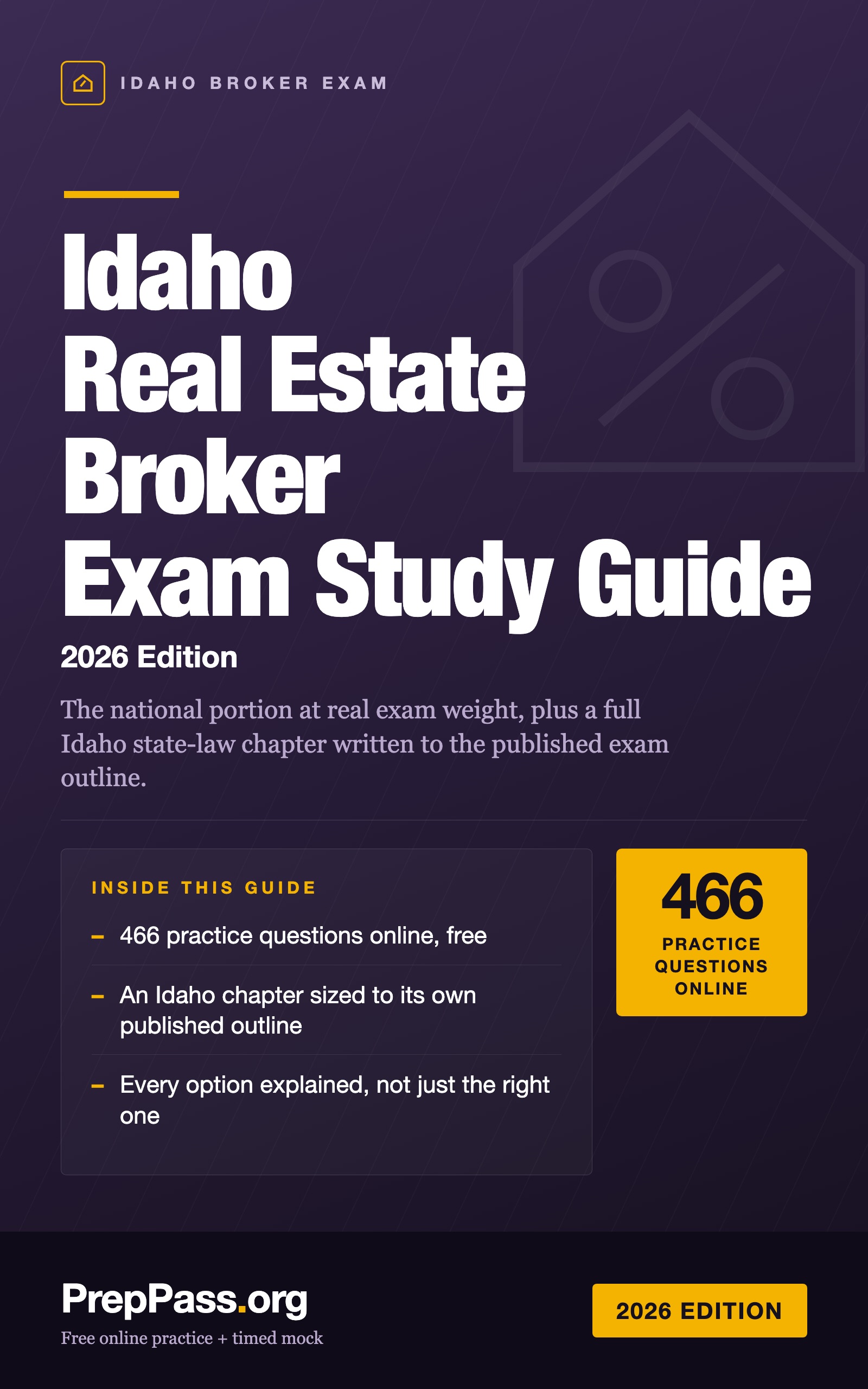
Idaho Real Estate Broker · Ấn bản 2026
Idaho Real Estate Broker Exam Study Guide (2026)
The national portion at real exam weight, plus an Idaho chapter. The Idaho chapter is sized to the published outline — 7 areas, 50 scored items — area by area, not flattened.
- Cả 8 chương phần thi toàn quốc cùng một chương đầy đủ về luật bất động sản Idaho — PDF + EPUB bạn giữ
- Một đề luyện phần thi toàn quốc gồm 60 câu, kèm đáp án giải thích cả bốn phương án chứ không riêng phương án đúng
- Một bộ đề luyện riêng về luật bất động sản Idaho, kèm đáp án có giải thích
PDF + EPUB · tiếng Anh · 299 trang · $14.99 trả một lần
Sách này được viết bằng tiếng Anh — tệp PDF và EPUB bạn tải về đều bằng tiếng Anh.
Tải ngay sau khi thanh toán — không cần tài khoản, không thuê bao. Chính sách hoàn tiền
Thử 10 câu trước — miễn phí
Trả lời hết 10 câu, nộp bài xong sẽ thấy lời giải từng câu — kèm phần trong sách này dạy nội dung đó. Khoảng 5 phút, không cần đăng ký.
Bắt đầu 10 câu miễn phíXem bên trong cuốn sách
Ba trang thật, kết xuất thẳng từ tệp PDF bạn sẽ tải — một trang giảng giải, một câu hỏi có lời giải, và một trang tra cứu. Không trang nào được vẽ lại cho đẹp.
- Cách giảng dạyPart D — Disability: the distinction the exam always tests · Trang 86 của PDF
Trang giảng giải: kiến thức được trình bày bằng văn xuôi, theo trình tự kỳ thi kiểm tra.
- Trang tra cứu nhanhPart C — Encumbrances a broker must read off a title report · Trang 102 của PDF
Một trang để lật lại: các con số, mốc thời hạn hoặc thuật ngữ gom về một chỗ.
- Một câu hỏi có lời giảiAnswer Key and Explanations · Trang 174 của PDF
Một câu luyện tập kèm đáp án và lập luận đằng sau — không chỉ là đáp án.
Có gì — và không có gì
Bao gồm
- An Idaho chapter written to the published exam outline, area by area
- Where Idaho law departs from the national rule — both stated, so neither is guessed
- Supervision, trust accounts, brokerage operation and broker math
- An Idaho practice set with every option explained, not just the right one
- 466 practice questions online, free, from the same bank
- PDF (print & tab it) + EPUB (phone / e-reader)
Không bao gồm
- Không gửi bản in — đây là tệp bạn tải về và có thể tự in
- Sách không kèm khoá video, giảng viên hay kèm riêng — video miễn phí trên trang là phần khác
- Không bao gồm lệ phí đăng ký thi hay phí trung tâm khảo thí — bạn vẫn nộp cho cơ quan chính thức
Mục lục
Xem 35 chương và trang bắt đầu của từng chương
- Part C — Advertising and recordkeeping compliancetr. 14
- Part D — Consumer contact and transaction integritytr. 16
- 2. Trust Funds, Escrow, and the Client’s Moneytr. 30
- Part C — Records that survive an audittr. 33
- Part D — Disputed moneytr. 34
- 3. Agency at the Broker Leveltr. 40
- Part C — Fiduciary duties, at the level a broker is examined ontr. 44
- Part D — Dual agency, designated agency, and the alternativestr. 46
- 4. Contracts and Brokerage Agreementstr. 55
- Part C — Options, rights of first refusal, and installment contractstr. 60
- Part D — Between contract and closingtr. 61
- 5. Fair Housing, Accessibility, and Antitrust: The Exposure You Carry Personallytr. 72
- Part C — The exemptions, and why they rarely save anyonetr. 78
- Part D — Disability: the distinction the exam always teststr. 79
- 6. Ownership, Land Use Controls, and Transfer of Titletr. 95
- Part C — Encumbrances a broker must read off a title reporttr. 101
- Part D — Legal descriptionstr. 103
- 7. Valuation, Financing, and the Federal Lending Lawstr. 113
- Part C — The instrumentstr. 121
- Part D — Loan programs, structures, and qualifyingtr. 123
- 8. Disclosures, Environmental Risk, and Property Managementtr. 136
- Part C — The management agreement and the manager’s authoritytr. 142
- Part D — Leases and tenanciestr. 144
- Practice Exam — 60 Questionstr. 153
- Answer Key and Explanationstr. 170
- Appendix A — Broker Math Cheat Sheettr. 221
- Appendix B — Glossarytr. 243
- Appendix C — Exam-Day Strategytr. 262
- Part II — Idaho State Law & Practicetr. 267
- Section 54-2056(2) requires the broker to submit a written application intr. 272
- Section 54-2054 is a list of prohibitions worth reading in the original: notr. 273
- Section 54-2045(4) governs the moment money appears in an associate’str. 274
- Section 54-2051(1) requires a broker or sales associate “as promptly astr. 276
- Section 54-2046 says plainly that funds “must be disbursed from the realtr. 277
- Section 54-2088(4)(a) lists four things a limited dual agent “shall nottr. 280
Lấy từ chính tệp PDF bạn tải về, kèm trang bắt đầu của từng phần — không phải gõ tay ở đây.
Đọc miễn phí trọn một chương
Trọn vẹn một chương, đúng như trong eBook. Cuộn cửa sổ để đọc ngay tại đây; không cần tải, không cần email.
Đọc chương 9 ngay tại đây, không rời trang
Chúng tôi không đưa phần mở đầu dễ dãi — chương miễn phí mở thẳng vào một trong những phần đậm đặc nhất của cuốn sách, để bạn đánh giá cách dạy ở đúng chỗ kỳ thi trở nên khó.
What the Idaho portion actually is
Pearson VUE delivers the Idaho broker examination in two portions in one sitting: a national/general portion of 80 scored items in 150 minutes, and the Idaho state portion of 50 scored items in 90 minutes — 130 scored items, four hours. Each portion also carries "five to ten (5-10) pretest items," unidentified and unscored. You cannot tell one from a scored item, so answer everything. The outline is Pearson VUE booklet #091306 (2025-04 printing; the Idaho outline inside it is effective 2017-07-15), and the regulator is the Idaho Real Estate Commission, created by Idaho Code 54-2005 and seated within the Division of Occupational and Professional Licenses.
Two things about the numbers must be said plainly, because a confident competitor prints them wrong.
The booklet publishes percentages, not item counts. The broker column runs 4 / 4 / 30 / 20 / 10 / 12 / 20 percent, and every one of those divides evenly into 50, so the counts below are exact rather than rounded. But Pearson VUE did not print them as counts. We derived them, and you should know that.
| Area | Published broker share | Items of 50 |
|---|---|---|
| I. Duties and Powers of the Real Estate Commission | 4% | 2 |
| II. Licensing Requirements | 4% | 2 |
| III. License Law and Rules of the Idaho Real Estate Commission | 30% | 15 |
| IV. Brokerage Representation (Agency Law) | 20% | 10 |
| V. Calculations and Closing Costs | 10% | 5 |
| VI. Idaho Principles and Practices | 12% | 6 |
| VII. Brokerage Management | 20% (broker only) | 10 |
Booklet #091306 publishes no passing score at all. That lives in the separate Idaho candidate handbook, Pearson VUE #091300, which reports a 0–100 scaled score, warns it "should not be interpreted as the percentage or number of questions answered correctly," and sets the passing point at 75 for broker (70 for salesperson). A scaled 75 is not 75% correct and not 38 of 50 items; it is a point on a scale equated across forms so a harder form does not punish the candidate who drew it. Fail one portion only and you retake just that portion, within a year.
Area VII, Brokerage Management, is marked (BROKER ONLY 20%) and is absent from the salesperson exam entirely — a study product built from a salesperson course covers none of one fifth of your state portion. Area V is 10% for brokers against 5% for salespersons. Between them, 30% of this exam is missing from or halved on the salesperson blueprint.
I. Duties and Powers of the Real Estate Commission — 2 of 50 items
Two items over three lettered subtopics: general powers; investigations, audits, hearings and appeals; and sanctions, split into fines and into suspension and revocation.
Idaho Code 54-2005 creates the Commission "for the purpose of administering this chapter" — five governor-appointed members, four of them licensees drawn one each from the northern, southeastern, southwestern and south central districts the section defines by county. Section 54-2007 charges it with administering and enforcing the whole chapter and vests it with power to make and enforce any reasonable rules it deems necessary. That pairing — a statute plus rules made under it — is why "who writes the rules that govern Idaho brokers" has a state answer and never a trade-association one.
Investigations begin under 54-2058(1) with the executive director, who investigates on a written complaint or on information received and reports in writing before the Commission decides whether to file an administrative complaint; subsection (2), the audit power, is taught in Area VII, where it bites the broker. Sanctions are 54-2059(1): temporary suspension or permanent revocation, a formal reprimand, and a civil penalty of not more than $5,000, with the grounds listed at 54-2060 — from fraudulent misrepresentation and failure to account for money belonging to another through to gross negligence in a regulated transaction. Civil penalties are credited to the occupational licenses fund and spent on Idaho real estate education. The trap is scale: the chapter's $10,000 figures (54-2059(2), 54-2065) reach an entity that acted with no license at all, and nothing in the chapter reaches twenty-five thousand dollars.
II. Licensing Requirements — 2 of 50 items
Two items over five lettered subtopics — activities requiring a license, eligibility, renewal, change of status, education.
Idaho Code 54-2002 forbids acting without an active Idaho license and makes a single act within the statutory definitions enough to constitute engaging in the business. Section 54-2003 excepts dealing for one's own account, an owner or the owner's regular employee, an attorney in fact for a single transaction, a fiduciary such as a receiver or personal representative, a person selling under a deed of trust's default provisions, and an attorney at law — then subsection (2) strips those exceptions from anyone holding an active license, so a licensee cannot climb into the "I was just the owner" exception.
Eligibility is 54-2012(1): at least eighteen, a high school graduate or equivalent, clear of the disciplinary and criminal bars, fingerprinted, insured for errors and omissions, associated with a designated broker. Prelicense education under 54-2022 is 90 classroom hours for a salesperson plus a minimum of 90 additional hours for a broker. The broker-only bar is 54-2012(2)(a): two years of full-time active licensed salesperson experience within the five years immediately preceding application — both halves, the count and the lookback, get tested, and the Commission may demand a report of listings and sales certified by the applicant's brokers. Renewal under 54-2018 runs to the licensee's birthday and is granted on certified continuing education, errors and omissions insurance and fees (fee amounts are verify-current); the education figure is 54-2023(1), two commission core courses plus twelve classroom hours. A license not renewed within a year of expiry is automatically terminated.
III. License Law and Rules of the Idaho Real Estate Commission — 15 of 50 items
Thirty percent of the state portion — the largest single block, and the only area in which every lettered subtopic the booklet prints carries at least one item. The distribution inside it is uneven: trust accounts carry three of the fifteen; advertising, commissions, document handling and offers carry two each; the remaining four carry one apiece. The nine headings below are the booklet's own.
A. Advertising and use of business name — 2 items
Idaho Code 54-2053(1) provides that "only licensees who are actively licensed in Idaho may be named by an Idaho broker in any type of advertising of Idaho real property, may advertise Idaho property in Idaho or may have a sign placed on Idaho property." Active Idaho licensure is the whole test — not association membership, not full-time status, not residence in the county where the property sits, since an Idaho license is statewide. In practice that removes two familiar names from a brokerage website: the unlicensed personal assistant who fields the calls, and the out-of-state licensee who sends referrals but holds no Idaho license.
Subsection (2) requires all advertising of listed property to contain the broker's licensed business name "clearly and conspicuously," (3) extends the rule to branch offices, and (4) forbids advertising misleading taken as a whole: a consumer must always be able to identify the licensed firm behind the ad. Two traps — a personal cell number is no substitute for the firm name, and a new business name may not be advertised until the Commission approves the change.
B. The broker-salesperson relationship — 1 item
Section 54-2056(2) requires the broker to submit a written application in the Commission's form for each associate who licenses with the brokerage. Termination then runs on two clocks candidates routinely swap. Under 54-2056(1) an associate who terminates a licensed association gives the broker written notice "no later than three (3) business days after the effective date," and the broker owes the mirror-image notice when the broker terminates — whatever the reason. Written notice to the Commission does not relieve either of the duty to notify the other, and under 54-2056(5) the departing associate must immediately turn over listings, keys, contracts and other property belonging to the broker. The trap is the ten-business-day figure: that clock is 54-2056(3), it runs only where the termination was for cause, it is a report to the Commission rather than to the other licensee, and it is taught in Area VII.
C. Sales commissions and fees — 2 items
Section 54-2054 is a list of prohibitions worth reading in the original: no action by an unlicensed person to collect a fee, no fee splitting with unlicensed persons, no finder's fees, no double contracts, no kickbacks and no unearned fees. Two subsections carry the scored items.
54-2054(7) bars charging or accepting "compensation from more than one (1) party in any one (1) transaction, without first making full disclosure in writing of the broker's intent to do so, to all parties involved in the transaction." Disclosure, in writing, in advance, to everyone, is the entire condition — and note what the statute does not ask for: the Commission pre-approves no fee arrangement, nothing is recorded, and halving the two fees changes the amount without touching the conflict. Subsection (6) adds written disclosure before closing of any rebate a licensee will receive from a service provider.
54-2054(9) is the flow-of-money rule: no sales associate may accept compensation for acts requiring a license "from any person except the real estate broker with whom the sales associate is licensed." Not the buyer at the closing table, which bypasses the broker who answers to the Commission for the file; not the title company, which merely disburses what the closing statement directs; not the cooperating brokerage, which pays the associate's own broker. The narrow exceptions let an associate share with another associate of the same broker where the broker authorizes it. Section 54-2055 covers the licensee's own transactions: disclose the active license in writing no later than presentation of the purchase and sale agreement, and run the deal through the broker.
D. Document handling and record keeping — 2 items
Section 54-2051(3) sets the delivery clock. On obtaining any document signed by a buyer or seller, the associate must get "a true and legible copy of such document to the designated broker or broker's office prior to the end of the next business day," and a fully executed agreement, counteroffer or addendum must reach both parties as well; 54-2050(4) applies the identical rule to signed representation agreements. The deadline exists to make the broker's review duty under 54-2038(1)(b) possible while the transaction is alive — three or ten business days would leave the accountable broker unaware of a live document for most of a week.
Section 54-2049 sets retention, and its list is worth memorizing: accepted, countered and rejected offers; representation agreements and consent-to-limited-dual-representation forms; transaction files; trust ledger records; and all reconciliation records. Every one is "kept by a broker for three (3) calendar years after the year in which the event occurred, the transaction closed, all funds were disbursed, or the agreement and any written extension expired." The clock runs from the end of the year, so a file from a January closing is held nearly four calendar years. Seven years is the property-tax recovery period in 63-602G(6), not a real estate rule.
E. Handling of monies and consideration — 1 item
Section 54-2045(4) governs the moment money appears in an associate's hands: "all consideration, including cash, checks held in uncashed form and promissory notes, received by a sales associate in connection with a real estate transaction shall be immediately delivered to the broker or the broker's office." A buyer handing over an earnest-money check with a written offer starts this clock. The associate never deposits it in a personal account — under 54-2041 the broker is responsible for everything entrusted to any licensee representing the broker — and may not endorse it over to the title company named in the offer, since 54-2041(1) requires the written instruction of both parties, which an unaccepted offer has not produced. Holding the check until acceptance is a question about deposit timing under 54-2045(2), not delivery; it still goes to the broker first.
F. Trust accounts — 3 items
The densest scoring ground on the Idaho state exam, and the one that most often ends a career.
The account. Section 54-2042 requires a noninterest-bearing account at an approved depository, identified as a "real estate trust account," under the broker's full control (54-2042(3)), holding no more than $300 of broker or firm funds for opening the account and paying anticipated bank service charges — disbursable for nothing else. A thousand or twenty-five hundred exceeds the cap and is commingling under 54-2041(3). Interest is the sharpest trap: the single-transaction exception in 54-2043 requires both parties' written direction and a written agreement on who receives the interest.
The deposit clock. Section 54-2045(1) requires money a broker receives for another to be "deposited on or before the banking day immediately following the receipt day of such funds, unless written instructions signed by the party or parties having an interest in the funds direct the broker to do otherwise." That instruction is the only lawful delay — typically a direction in the purchase and sale agreement to hold the buyer's check uncashed until the seller accepts (54-2045(2)). There is no three- or five-day grace, and holding to closing would leave client funds outside trust for the life of the deal. Section 54-2041(2) puts it harder: "immediately upon receipt, the broker shall deposit entrusted moneys in a neutral, qualified trust fund account."
The records. Section 54-2044(2) requires an individual trust ledger created "whenever a broker, or any licensed or unlicensed person representing the broker, receives earnest money or other consideration," showing the parties, the property, each deposit and disbursement and the current balance; subsection (1) requires a separate maintenance-fund ledger kept current at all times, and each account is reconciled monthly against the ledgers, check register and bank statement. A broker managing rentals for several owners sits inside all of it: one trust account, one ledger per owner, no pooled operating account, no summary standing in for the ledgers.
Disbursement and disputes. Section 54-2046 permits no disbursement without written, signed authorization from the parties or a court order, and 54-2046(4) holds any commission in the account until the buyer and seller have signed the closing statements and been paid what those statements show. Where more than one party demands the same funds, 54-2047(1) requires the broker first to "notify each party, in writing, of the demand of the other party." Only then do the options open: disburse in reasonable reliance on the terms of the purchase and sale agreement under (2) — which the statute warns may still expose the broker to civil liability — or hold the money under (3) pending a court order. The Commission audits trust accounts under 54-2058(2); it is not a depository, and splitting a disputed deposit substitutes the broker's convenience for the contract.
G. Offers, counteroffers and acceptance — 2 items
Section 54-2051(1) requires a broker or sales associate "as promptly as practicable, to tender to the seller every written offer to purchase obtained on the real estate involved, up until time of closing," and deems a purchase and sale agreement signed by a prospective buyer "in all respects an offer to purchase." The section also lists the specific terms an offer must contain.
Those five words — up until time of closing — decide the classic item. A second written offer arriving after the seller accepted the first still goes to the seller. Screening it against the accepted price, holding it until the pending deal collapses, or returning it because the property is under contract all substitute the licensee's judgment for the client's, and 54-2087(3) entitles the client to receive and timely consider all written offers. Whether the seller may lawfully accept it is a contract question for the seller's lawyer, not a reason to keep it off the kitchen table.
H. Office operations and business practices — 1 item
Section 54-2040(1) requires each designated broker to maintain a definite, physical place of business and to give the Commission written notice of any change of business name, location, mailing address or telephone number. It then states the consequence without discretion: "a change of business name or location without notification to the commission shall automatically inactivate the license previously issued." The same subsection bars using a new location as the main office until the Commission acknowledges proper notice.
So a broker who moves the office over a weekend and files the paperwork "next week" traded on an inactivated license in between, and every transaction written in that window is exposed. This is not a late-fee mechanism — late fees are 54-2018(3) and belong to renewal — and nothing transfers the designated broker's responsibility to a branch manager meanwhile (54-2039(4)).
I. Prohibited conduct — 1 item
Section 54-2046 says plainly that funds "must be disbursed from the real estate trust account only in accordance with this section" and that "failure to comply with this section is a violation of license law and will subject the broker to discipline." Paying the brokerage's office rent out of trust money and restoring it before closing is still the violation — there is no cure by replacement, and 54-2060(3) makes failure to account for money belonging to another an independent ground. Control of the account is why the duty attaches (54-2042(3), 54-2041(5)), and this is no private banking matter: 54-2058(2) authorizes the audit and 54-2059(1) the revocation.
Trước khi mua
- Nhận sách thế nào?
- Thanh toán xong, mục tải xuống hiện ngay trên trang này. Liên kết cũng được gửi qua email. Không cần tài khoản.
- Nếu sách không hợp thì sao?
- Gửi email trong vòng 14 ngày để được hoàn tiền đầy đủ, không cần lý do.
- Phần luyện tập miễn phí có bị bỏ không?
- Không. Mọi câu hỏi luyện tập, bài thi thử tính giờ và các chương miễn phí trên trang vẫn miễn phí. Cuốn sách là nửa "học", không phải hàng rào quanh phần miễn phí.
- Đọc trên điện thoại được không?
- Được — EPUB cho điện thoại và máy đọc sách, PDF để in và dán tab. Bạn nhận cả hai.
Chi tiết
The national portion at real exam weight, plus an Idaho chapter. The Idaho chapter is sized to the published outline — 7 areas, 50 scored items — area by area, not flattened.
- Format: PDF + EPUB download · 299 pages
- 80 practice questions in the book, with a full answer key
- 466 free practice questions for this exam on PrepPass, included at no cost
- $14.99 one-time — no subscription
- 14-day money-back guarantee · refund policy
- Cross-referenced against: Idaho Code 54-2038 · Idaho Code 54-2053 · Idaho Code 54-2054 · Pearson VUE #091306 (rev 2025-04 printing; Idaho state outline effective 2017-07-15. Pulled and pdftotext -layout'd 2026-08-31.)
- Last updated: September 2026
- Đối chiếu từ nguồn chính thức(Idaho Code 54-2038 · Idaho Code 54-2053 · Idaho Code 54-2054 · Pearson VUE #091306 (rev 2025-04 printing; Idaho state outline effective 2017-07-15. Pulled and pdftotext -layout'd 2026-08-31.))
- 466 câu hỏi luyện tập miễn phí
- Tải ngay, thuộc về bạn trọn đời
Một real estate broker pre-license course có giá $200–$1,000. Cuốn sách này dạy cùng một kỳ thi — cùng quy định, đối chiếu theo chuẩn hiện hành — chỉ với $14.99 trả một lần, thuộc về bạn trọn đời.
Vì sao mua sách khi phần luyện tập miễn phí?
Câu hỏi luyện tập và bài thi thử tính giờ vẫn miễn phí — không có gì trên trang bị giấu sau cuốn sách này. Cuốn sách $14.99 là nửa "học": chính phần kiến thức, dạy theo trình tự, trong một tệp thuộc về bạn.
- Dạy có hệ thống — mọi phần thi giảng theo từng chương, từ đầu đến cuối, không chỉ là câu hỏi
- In ra & dán nhãn — PDF sẵn sàng để in, tô đậm, ghi chú và mang tới bàn học
- Học mọi nơi, ngoại tuyến — EPUB trên điện thoại hay máy đọc sách; không cần wifi, không cần tab trình duyệt
- Tất cả một chỗ — các chương, thẻ tóm tắt từng chương và câu hỏi luyện tập trong một tệp
- Của bạn trọn đời — trả một lần $14.99, tải ngay, không thuê bao
Và không rủi ro: Đảm bảo hoàn tiền 14 ngày — không hài lòng? Email cho chúng tôi để hoàn tiền đầy đủ, không cần lý do. Xem chính sách hoàn tiền.
Đảm bảo hoàn tiền 14 ngày · hoàn tiền đầy đủ, không cần lý do.
Mua một lần, truy cập tải về trọn đời. eBook là trọn bộ hướng dẫn ôn Idaho Real Estate Broker ở dạng PDF và EPUB. Bản tóm tắt mang tính giáo dục, không phải tư vấn chuyên môn hay pháp lý — luôn xác nhận quy định hiện hành với nguồn chính thức. Cập nhật lần cuối: September 2026.