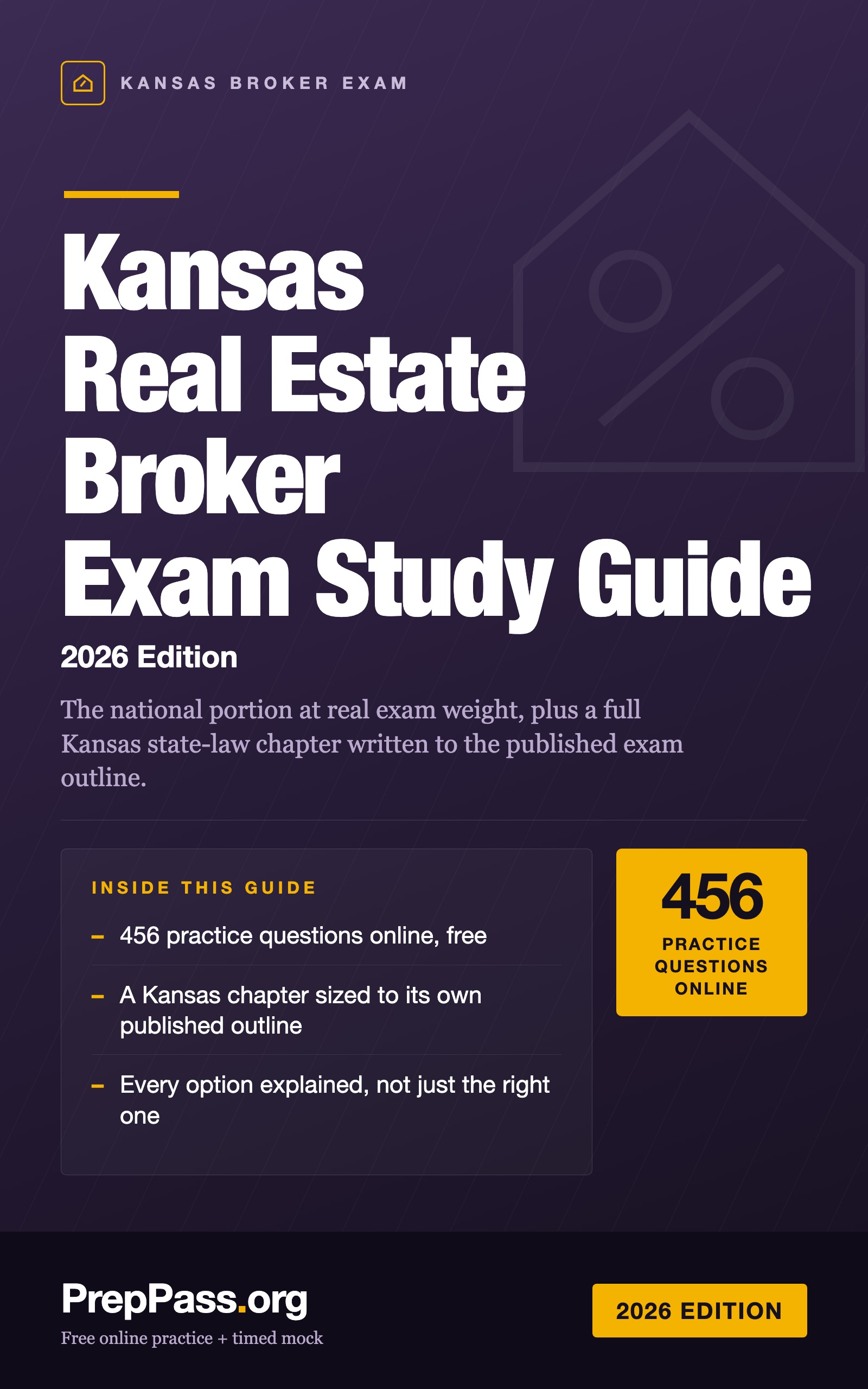
Kansas Real Estate Broker · Ấn bản 2026
Kansas Real Estate Broker Exam Study Guide (2026)
The national portion at real exam weight, plus a Kansas chapter. The Kansas chapter is sized to the published outline — 6 areas, 40 scored items — area by area, not flattened.
- Cả 8 chương phần thi toàn quốc cùng một chương đầy đủ về luật bất động sản Kansas — PDF + EPUB bạn giữ
- Một đề luyện phần thi toàn quốc gồm 60 câu, kèm đáp án giải thích cả bốn phương án chứ không riêng phương án đúng
- 20 câu hỏi riêng về luật bất động sản Kansas, kèm đáp án có giải thích
PDF + EPUB · tiếng Anh · 310 trang · $14.99 trả một lần
Sách này được viết bằng tiếng Anh — tệp PDF và EPUB bạn tải về đều bằng tiếng Anh.
Tải ngay sau khi thanh toán — không cần tài khoản, không thuê bao. Chính sách hoàn tiền
Thử 10 câu trước — miễn phí
Trả lời hết 10 câu, nộp bài xong sẽ thấy lời giải từng câu — kèm phần trong sách này dạy nội dung đó. Khoảng 5 phút, không cần đăng ký.
Bắt đầu 10 câu miễn phíXem bên trong cuốn sách
Ba trang thật, kết xuất thẳng từ tệp PDF bạn sẽ tải — một trang giảng giải, một câu hỏi có lời giải, và một trang tra cứu. Không trang nào được vẽ lại cho đẹp.
- Trang tra cứu nhanhPart C — Encumbrances a broker must read off a title report · Trang 102 của PDF
Một trang để lật lại: các con số, mốc thời hạn hoặc thuật ngữ gom về một chỗ.
- Một câu hỏi có lời giảiAnswer Key and Explanations · Trang 174 của PDF
Một câu luyện tập kèm đáp án và lập luận đằng sau — không chỉ là đáp án.
- Cách giảng dạyPart II — Kansas State Law & Practice · Trang 305 của PDF
Trang giảng giải: kiến thức được trình bày bằng văn xuôi, theo trình tự kỳ thi kiểm tra.
Có gì — và không có gì
Bao gồm
- A Kansas chapter written to the published exam outline, area by area
- Where Kansas law departs from the national rule — both stated, so neither is guessed
- Supervision, trust accounts, brokerage operation and broker math
- A Kansas practice set with every option explained, not just the right one
- 456 practice questions online, free, from the same bank
- PDF (print & tab it) + EPUB (phone / e-reader)
Không bao gồm
- Không gửi bản in — đây là tệp bạn tải về và có thể tự in
- Sách không kèm khoá video, giảng viên hay kèm riêng — video miễn phí trên trang là phần khác
- Không bao gồm lệ phí đăng ký thi hay phí trung tâm khảo thí — bạn vẫn nộp cho cơ quan chính thức
Mục lục
Xem 29 chương và trang bắt đầu của từng chương
- Part C — Advertising and recordkeeping compliancetr. 14
- Part D — Consumer contact and transaction integritytr. 16
- 2. Trust Funds, Escrow, and the Client’s Moneytr. 30
- Part C — Records that survive an audittr. 33
- Part D — Disputed moneytr. 34
- 3. Agency at the Broker Leveltr. 40
- Part C — Fiduciary duties, at the level a broker is examined ontr. 44
- Part D — Dual agency, designated agency, and the alternativestr. 46
- 4. Contracts and Brokerage Agreementstr. 55
- Part C — Options, rights of first refusal, and installment contractstr. 60
- Part D — Between contract and closingtr. 61
- 5. Fair Housing, Accessibility, and Antitrust: The Exposure You Carry Personallytr. 72
- Part C — The exemptions, and why they rarely save anyonetr. 78
- Part D — Disability: the distinction the exam always teststr. 79
- 6. Ownership, Land Use Controls, and Transfer of Titletr. 95
- Part C — Encumbrances a broker must read off a title reporttr. 101
- Part D — Legal descriptionstr. 103
- 7. Valuation, Financing, and the Federal Lending Lawstr. 113
- Part C — The instrumentstr. 121
- Part D — Loan programs, structures, and qualifyingtr. 123
- 8. Disclosures, Environmental Risk, and Property Managementtr. 136
- Part C — The management agreement and the manager’s authoritytr. 142
- Part D — Leases and tenanciestr. 144
- Practice Exam — 60 Questionstr. 153
- Answer Key and Explanationstr. 170
- Appendix A — Broker Math Cheat Sheettr. 221
- Appendix B — Glossarytr. 243
- Appendix C — Exam-Day Strategytr. 262
- Part II — Kansas State Law & Practicetr. 267
Lấy từ chính tệp PDF bạn tải về, kèm trang bắt đầu của từng phần — không phải gõ tay ở đây.
Đọc miễn phí trọn một chương
Trọn vẹn một chương, đúng như trong eBook. Cuộn cửa sổ để đọc ngay tại đây; không cần tải, không cần email.
Đọc chương 9 ngay tại đây, không rời trang
Chúng tôi không đưa phần mở đầu dễ dãi — chương miễn phí mở thẳng vào một trong những phần đậm đặc nhất của cuốn sách, để bạn đánh giá cách dạy ở đúng chỗ kỳ thi trở nên khó.
What the Kansas portion actually is
The Kansas broker examination is delivered by Pearson VUE. The numbers below are read out of Pearson VUE bulletin #091705 (04/2025), in which the Kansas state content outline carries an effective date of 6/11/24 and the national/general outline an effective date of 2025-04-24.
| Items | Time | |
|---|---|---|
| National/general portion | 80 scored | 2.5 hours |
| Kansas state portion | 40 scored | 1.5 hours |
| Total | 120 scored | 240 minutes |
Each portion also carries 10 unidentified pretest items. The bulletin's own words: "The exam also has 10 pretest items for salesperson and 10 pretest items for broker. These pretest items are not identified and will not affect a candidate's score in any way." You will therefore sit 50 Kansas questions and be scored on 40, without knowing which 40. Do not budget your 90 minutes as though there were 40 questions in front of you.
The passing standard is a scaled score of 70 on each portion, taken from the Kansas Real Estate Candidate Handbook #091700 (April 2025, rev. 7/25). A scaled score is not a raw percentage, and Kansas scores the two portions separately: a strong national score does not carry a failing Kansas score.
The area weights, and why a salesperson blueprint fails here
This is the single most important structural fact about the Kansas broker exam, and it is the reason a study guide built off the salesperson outline will mislead you. The broker state portion is 33 percent larger than the salesperson's — 40 items against 30 — and the growth is not spread evenly.
| # | Area | Broker items | Salesperson items | Broker share |
|---|---|---|---|---|
| I | Duties and Powers of the Kansas Real Estate Commission | 2 | 2 | 5% |
| II | Licensing Requirements | 3 | 4 | 7.5% |
| III | Requirements Governing Activities of Licensees | 8 | 5 | 20% |
| IV | Prohibited Acts | 8 | 8 | 20% |
| V | Brokerage Relationships in Real Estate Transactions Act (BRRETA) | 15 | 11 | 37.5% |
| VI | Broker Only Topics | 4 | — | 10% |
Read that table twice. Three things in it run against intuition.
First, Area II is smaller for brokers than for salespersons — three items against four. The extra items did not go to licensing.
Second, Area III jumps from five items to eight, a 60 percent increase, because the broker is the person who has to run the office the rules describe.
Third, Area VI has no salesperson item count at all. It is broker-only. A candidate revising from a salesperson book is not weak on Area VI; that candidate has never seen it.
And above all of it: BRRETA alone is 15 of 40 items, 37.5 percent of the Kansas portion. It is by a wide margin the largest single block on the exam, larger than Areas I, II, III and VI combined. This chapter is sized accordingly. If you allocate your revision time evenly across the six areas, you will have spent a third of it on material worth a fifth of the marks.
Two things the vendor does not publish, which you should know it does not publish
The vendor publishes no statute citations for Kansas. Under the heading "State Exam Resources" bulletin #091705 prints four unlinked resource names — the Kansas Real Estate Brokers' and Salespersons' License Act, the Brokerage Relationships in Real Estate Transactions Act, the Kansas Real Estate Commission, and the Rules and Regulations of the Kansas Real Estate Commission — plus a pointer to the Resources tab at www.krec.ks.gov. There is no section-level citation list, which means there is no vendor list to check against the statute books for repealed provisions. Every K.S.A. and K.A.R. citation in this chapter is ours, read out of the current statutes and regulations, and should not be mistaken for the vendor's.
Areas IV and V print no lettered subtopics. Every other area in the outline has an A-B-C-D breakdown under it. Areas IV and V do not — and together they are 23 of the 40 items, 57.5 percent of the exam. That absence is the finding, not an omission on our part. Where this chapter organizes Area IV and Area V internally, the organization follows the statutes themselves (K.S.A. 58-3062 for Area IV; K.S.A. 58-30,101 et seq. for Area V) and is ours, not the vendor's. We say so rather than dress a derived structure up as a published one.
The regulator throughout is the Kansas Real Estate Commission (KREC), office in Topeka.
Area I — Duties and Powers of the Kansas Real Estate Commission (2 items, 5%)
Two items. Do not overinvest here, but do not skip it either, because the two items are almost always about composition and about remedy.
The operative rule on composition. K.S.A. 74-4201(a) puts five members on the Commission, appointed by the governor, one from each congressional district and the remainder from the state at large, each a citizen and resident of Kansas for the five years preceding appointment. Not less than three must have been real estate brokers for five years; not less than one must never have engaged in the business as a broker and may not do so while serving. Successors serve four-year terms (subsection (b)), and K.S.A. 74-4202(a) makes a majority a quorum.
What it means in practice. The industry majority is deliberately balanced by a public member. The Commission is an appointed regulator, not an elected trade body, and the Kansas Association of Realtors — a private association — appoints nobody to it.
Where the rule bites. K.S.A. 74-4202 also requires the Commission to administer both acts, the license act and BRRETA. That is worth noticing early: in Kansas, agency law is not a separate common-law overlay policed by the courts. It is a statute the same regulator enforces with the same discipline.
The trap. Distractors offer an elected board, a Realtor-appointed board, or a treasurer-appointed board. All three are plausible-sounding governance models used somewhere; none is Kansas's.
The second operative rule: remedy against an unlicensed person. Since 2024, K.S.A. 58-3065(c) lets the Commission, on determining that a person has practiced without a valid license, issue a cease and desist order against that person in accordance with the Kansas administrative procedure act, in addition to any other penalty. This matters because the Commission's ordinary disciplinary power under K.S.A. 58-3050 operates on licensees and applicants — there is no license to revoke when the wrongdoer never had one. Before 2024 the answer to "what can KREC do about an unlicensed operator?" was, in substance, refer it for prosecution. It is not any more. See "What changed recently" below; guides printed before mid-2024 get this wrong.
Two supporting points that are examinable but rarely worth a whole item: proceedings run under the Kansas administrative procedure act (K.S.A. 58-3050(i)), costs of an adverse hearing may be assessed against the licensee (K.S.A. 58-3056), and the Commission may use emergency adjudicative proceedings to summarily suspend a licensee whose trust account is in unsound condition or who is misappropriating client funds (K.S.A. 58-3050(j)).
Area II — Licensing Requirements (3 items, 7.5%)
Three items, and — the inversion again — one fewer than the salesperson exam gets. The broker exam assumes you already know how licensing works and spends its extra items elsewhere.
License classes. Kansas has three, and the definitions are precise. A salesperson (K.S.A. 58-3035(o)). An associate broker (58-3035(c)): an individual who holds a broker's license and who is employed by, or associated as an independent contractor with, another broker. And the broker who is designated supervising broker of a primary office (58-3035(p)) or branch broker of a branch (58-3035(d)). Licenses issue only to individuals, never to a firm (K.S.A. 58-3042(b)).
Where this bites. A licensee who has met every broker qualification but works under someone else's roof is an associate broker — a full broker credential exercised under supervision. Kansas has no provisional, probationary or trainee salesperson class, and no license restricted to property management. Candidates reach for one of those inventions because other states have them.
Renewal, and the six-month cure. A license expires on a date set by the Commission's schedule, not more than two years from issuance or renewal (K.S.A. 58-3045(a)). Filing the renewal application on or before the expiration date lets the licensee keep operating until the Commission decides (subsection (d)). Failing to file automatically expires the license on that date (subsection (b)(2)). The cure is a late renewal filed within six months of expiration, with the renewal fee plus a $100 late fee (subsection (c)).
The trap. The subsection (d) protection — keep working while we decide — applies only to an application filed in compliance with subsection (b), that is, filed on time. It does not rescue a broker who let the date pass. The two-year figure in subsection (a) is the maximum term of a license, not a grace period, and there is no double-fee option anywhere in the act.
Education. An original broker applicant needs two courses, and candidates who prepare for one are caught by the other:
- a Kansas real estate fundamentals course, not less than 30 and no more than 45 hours, completed within the 12 months before the application is filed (K.S.A. 58-3046a(b)); and
- a Kansas real estate management course, not less than 30 and no more than 45 hours, completed within the six months immediately preceding the Commission's receipt of the application, for anyone applying on or after 1 January 2020 (subsection (d)). The statute says in terms that these hours are additional to the fundamentals hours.
An applicant already licensed in another jurisdiction takes a four-hour Kansas law course emphasizing BRRETA instead (subsection (e)). After licensure, every licensee completes not less than 12 hours of approved continuing education each renewal period (subsection (f)), and subsection (l) bars issuing or renewing until the applicable requirements are met.
Reinstatement after deactivation is tiered by K.S.A. 58-3047: up to two years, satisfy the education for the preceding period and pay the fee; more than two and up to five years, add six hours for each full year deactivated; more than five years, meet the examination requirements of an original applicant as well.
Area III — Requirements Governing Activities of Licensees (8 items, 20%)
Eight items, up from five on the salesperson exam. Seven lettered subtopics are printed: place of business and company names, records, reporting requirements, advertising, commissions and referral and relocation fees, required residential contract language, and supervision of affiliated licensees. Eight items against seven subtopics means one subtopic takes two, and in practice that subtopic is the first.
Place of business and company names
The operative rule. Each resident broker maintains a primary office in Kansas or an adjoining state (K.S.A. 58-3060(a)). A supervising broker is designated for the primary office and a branch broker for each additional place of business (subsection (b)); either office may be in that broker's residence (subsection (f)).
The definitional point candidates lose marks on. K.S.A. 58-3035(p) defines the supervising broker as "an individual, other than a branch broker," designated as responsible for the primary office and the licensees assigned to it. The exclusion is in the definition. The supervising broker does not answer for every office of the firm as a matter of definition; the branch broker supervises the branch. The two roles are separate by law, not merely by org chart.
Where it bites. A firm opens a second location. Somebody has to be designated branch broker of it — an associate broker can be, because an associate broker holds a broker's license, but it is the designation that creates the responsibility, not the seniority. And an unlicensed office manager cannot fill either role, because supervising licensed activity is itself licensed activity.
Notice deadlines. Written notice to the Commission within five days of a change in the broker's name, business name, trade name, office location or designated broker, and within five days of closing an office (K.S.A. 58-3060(c) and (d)).
Trade names. K.S.A. 58-3079(a) requires each supervising broker wanting to do business under a trade or business name other than the broker's own to register with and obtain approval from the Commission, which may disapprove a name that would be misleading or confusing to the public — including where that name or a similar one is in use, or has been in use during the past two years, in the same marketing area. Subsection (b): a branch office shall use the same trade or business name as the primary office. Not a different one. The register of deeds has no role here, and there is no surname requirement anywhere in the section.
Records
The operative rule. K.A.R. 86-3-10 requires each broker to retain for at least three years, in the broker's paper or digital files, a copy of all records relating to the broker's real estate business: sales contracts, option agreements and nonresidential lease agreements handled for an owner, purchaser, lessor or lessee; closing statements; each escrow agent's receipt required by K.S.A. 58-3062(d); correspondence; and the trust account records required by K.A.R. 86-3-18.
Two things to hold onto. The regulation says paper or digital — a rule confining the file to paper at one location misstates it. And the period runs from the record, not from the license, so it is not measured from expiration.
Companion rules. K.A.R. 86-3-22 requires a unique transaction number on each contract, option agreement and nonresidential lease and on every record kept under K.A.R. 86-3-10 and 86-3-18. K.S.A. 58-3061(e) requires the broker to make all records available for Commission inspection at such time as the Commission directs. K.A.R. 86-3-18 requires trust account records to be reconciled monthly.
Reporting requirements — and the two different clocks
This is a favorite because Kansas runs two deadlines that are easy to swap.
Ten days, for the licensee's own affairs. K.A.R. 86-3-15(a) requires each licensee to report to the Commission in writing within 10 days of the date of occurrence: any charge of, arrest or indictment for, plea of guilty or nolo contendere to, or conviction of any misdemeanor or any felony; any settlement of litigation against the licensee or a company the licensee owns in whole or part; any final judgment or dispositive order; a change of name, residence address or e-mail address on file; and any denial, suspension, revocation or other discipline of a real estate or other professional license by another jurisdiction.
Five days, for office administration. K.S.A. 58-3060(c) and (d), above.
The trap. The 10-day trigger is the charge, not the outcome, and it is not confined to felonies. A candidate who waits for a conviction, or who thinks a misdemeanor is beneath reporting, has the rule backwards: the point of a reporting rule is that the Commission learns of the event while it can still act.
Advertising
The operative rule. K.S.A. 58-3086(b): all advertising conducted by a licensee must be under the direct supervision of the supervising or branch broker and must include the supervising broker's trade name or business name, prominently and conspicuously displayed or announced in a readable and identifiable manner.
The regulation that inverts the candidate's instinct. K.A.R. 86-3-7 provides that a salesperson's or associate broker's name or team name may not use "realty," "brokerage," "company" or any term suggesting a separate firm; may not be more than two times larger in font size than the supervising broker's trade or business name; and must sit adjacent to that name in any internet, website, social media or social networking advertisement. So the salesperson's name is not the largest thing on the page — it is capped by reference to the broker's name.
Two narrow exceptions worth reading. Under K.S.A. 58-3086(c) the broker's name may be omitted where unlisted property is personally owned by a licensee or the licensee has an interest in it — but subsection (e) then requires that same advertising to inform the public that a licensee owns or has an interest in the property. Kansas requires no pre-publication approval by the Commission and no license numbers in ads.
Commissions, referral and relocation fees
The operative rule. K.S.A. 58-3076(a): a licensee shall not solicit a referral fee without reasonable cause, and defines reasonable cause exhaustively — it does not exist unless (1) an actual introduction of business has been made, (2) a contractual referral fee relationship exists, or (3) a contractual cooperative brokerage relationship exists. Three routes; no fourth.
Where it bites. Advertising a referral service creates none of the three. Nor does a client's written waiver, which the section does not contemplate at all. Nor is the test where the receiving broker is licensed: K.S.A. 58-3038(c) preserves the right of a person properly licensed in another jurisdiction to collect a referral fee, while K.S.A. 58-3062(a)(4) forbids paying a referral fee to any licensee, Kansas or not, if the licensee knows the payment will result in a rebate.
The rest of K.S.A. 58-3076 is aimed at relocation practice. Subsection (b) forbids threatening to reduce or withhold employee relocation benefits, otherwise acting adversely to another licensee's client, and counseling that client on how to terminate or amend an existing agency agreement or sales contract.
Required residential contract language
The operative rule. K.S.A. 58-3078(a), mandatory on and after 1 July 2008: each contract for the sale of residential real estate shall contain language stating that Kansas law requires persons convicted of certain crimes, including certain sexually violent crimes, to register with the sheriff of the county in which they reside, and that a buyer wanting information about those registrants may find it on the Kansas Bureau of Investigation homepage or by contacting the local sheriff's office.
Because the statute supplies the words, this is a drafting item and not a judgment call. Subsection (b) makes the section part of and supplemental to the license act, so omitting the paragraph is a license-law failure, not merely a contract defect.
Supervision of affiliated licensees
The operative rule. Failure to properly supervise an associated or employed licensee is a prohibited act in its own right under K.S.A. 58-3062(c)(3) — meaning the broker is exposed separately from whatever the licensee did. K.A.R. 86-3-31(a) then lists what it includes: permitting an unlicensed person to perform licensed work; permitting a licensee to practice on an expired, inactive, suspended or revoked license or to engage in dual agency; ignoring restrictions on a license; directing a violation; failing to prevent a known impending violation; failing to take timely action to correct or mitigate a known violation by an associated licensee; failing to review contracts and forms; failing to ensure that advertising by associated licensees complies; and failing to keep licensees able to reach the broker.
Trước khi mua
- Nhận sách thế nào?
- Thanh toán xong, mục tải xuống hiện ngay trên trang này. Liên kết cũng được gửi qua email. Không cần tài khoản.
- Nếu sách không hợp thì sao?
- Gửi email trong vòng 14 ngày để được hoàn tiền đầy đủ, không cần lý do.
- Phần luyện tập miễn phí có bị bỏ không?
- Không. Mọi câu hỏi luyện tập, bài thi thử tính giờ và các chương miễn phí trên trang vẫn miễn phí. Cuốn sách là nửa "học", không phải hàng rào quanh phần miễn phí.
- Đọc trên điện thoại được không?
- Được — EPUB cho điện thoại và máy đọc sách, PDF để in và dán tab. Bạn nhận cả hai.
Chi tiết
The national portion at real exam weight, plus a Kansas chapter. The Kansas chapter is sized to the published outline — 6 areas, 40 scored items — area by area, not flattened.
- Format: PDF + EPUB download · 310 pages
- 80 practice questions in the book, with a full answer key
- 456 free practice questions for this exam on PrepPass, included at no cost
- $14.99 one-time — no subscription
- 14-day money-back guarantee · refund policy
- Cross-referenced against: K.S.A. 74-4201, 74-4202 · K.S.A. 58-3034 to 58-3086 · K.S.A. 58-3035(p) and (d) · K.S.A. 58-3035(q) · Pearson VUE #091705 (rev 2025-04 (bulletin #091705 | 04/2025; Kansas state outline eff. 6/11/24; national/general outline eff. 2025-04-24))
- Last updated: September 2026
- Đối chiếu từ nguồn chính thức(K.S.A. 74-4201, 74-4202 · K.S.A. 58-3034 to 58-3086 · K.S.A. 58-3035(p) and (d) · K.S.A. 58-3035(q) · Pearson VUE #091705 (rev 2025-04 (bulletin #091705 | 04/2025; Kansas state outline eff. 6/11/24; national/general outline eff. 2025-04-24)))
- 456 câu hỏi luyện tập miễn phí
- Tải ngay, thuộc về bạn trọn đời
Một real estate broker pre-license course có giá $200–$1,000. Cuốn sách này dạy cùng một kỳ thi — cùng quy định, đối chiếu theo chuẩn hiện hành — chỉ với $14.99 trả một lần, thuộc về bạn trọn đời.
Vì sao mua sách khi phần luyện tập miễn phí?
Câu hỏi luyện tập và bài thi thử tính giờ vẫn miễn phí — không có gì trên trang bị giấu sau cuốn sách này. Cuốn sách $14.99 là nửa "học": chính phần kiến thức, dạy theo trình tự, trong một tệp thuộc về bạn.
- Dạy có hệ thống — mọi phần thi giảng theo từng chương, từ đầu đến cuối, không chỉ là câu hỏi
- In ra & dán nhãn — PDF sẵn sàng để in, tô đậm, ghi chú và mang tới bàn học
- Học mọi nơi, ngoại tuyến — EPUB trên điện thoại hay máy đọc sách; không cần wifi, không cần tab trình duyệt
- Tất cả một chỗ — các chương, thẻ tóm tắt từng chương và câu hỏi luyện tập trong một tệp
- Của bạn trọn đời — trả một lần $14.99, tải ngay, không thuê bao
Và không rủi ro: Đảm bảo hoàn tiền 14 ngày — không hài lòng? Email cho chúng tôi để hoàn tiền đầy đủ, không cần lý do. Xem chính sách hoàn tiền.
Đảm bảo hoàn tiền 14 ngày · hoàn tiền đầy đủ, không cần lý do.
Mua một lần, truy cập tải về trọn đời. eBook là trọn bộ hướng dẫn ôn Kansas Real Estate Broker ở dạng PDF và EPUB. Bản tóm tắt mang tính giáo dục, không phải tư vấn chuyên môn hay pháp lý — luôn xác nhận quy định hiện hành với nguồn chính thức. Cập nhật lần cuối: September 2026.