New Jersey Real Estate Broker · Ấn bản 2026
New Jersey Real Estate Broker Exam Study Guide (2026)
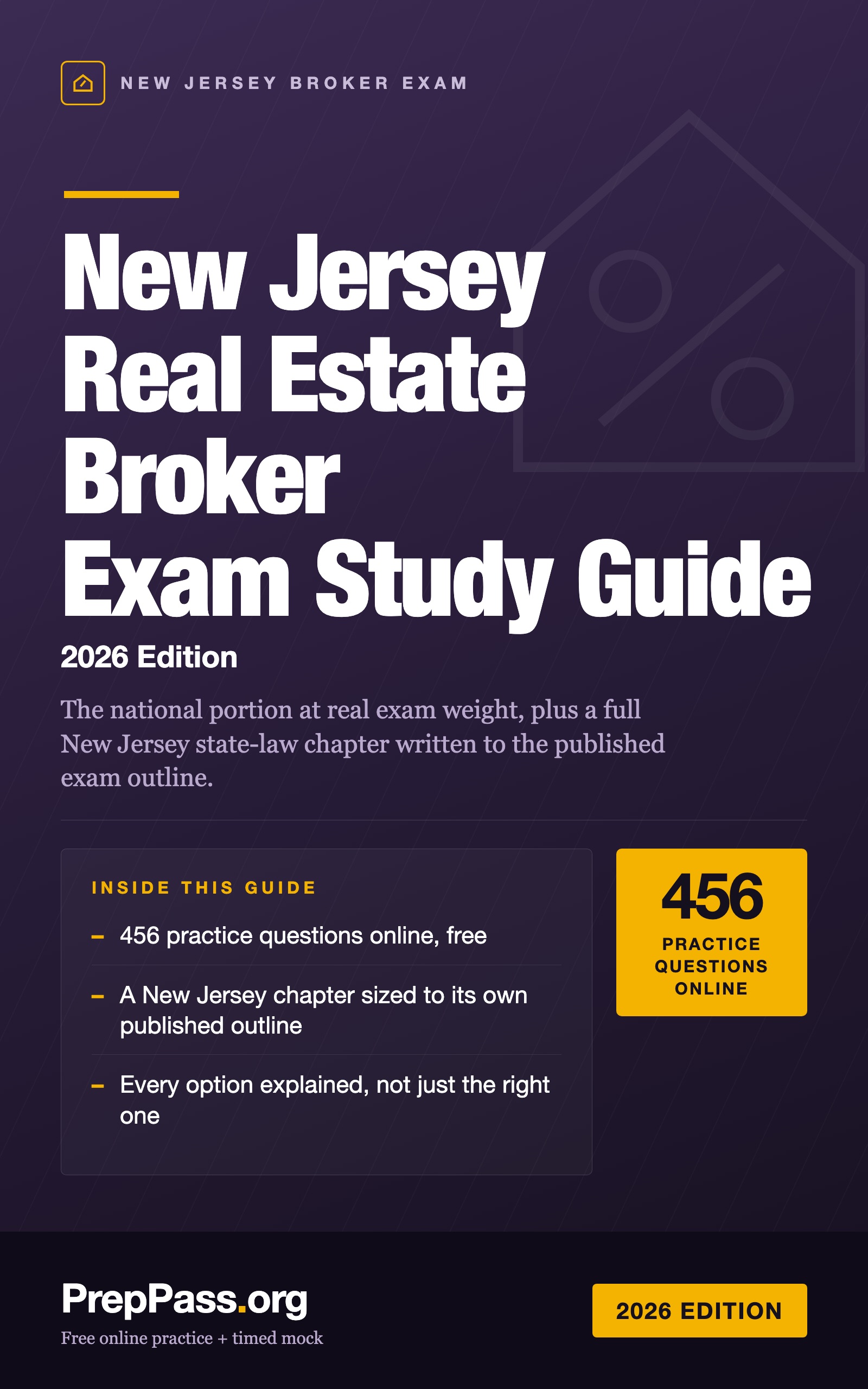
The national portion at real exam weight, plus a New Jersey chapter. The New Jersey chapter is sized to the published outline — 4 areas, 40 scored items — area by area, not flattened.
- Cả 8 chương phần thi toàn quốc cùng một chương đầy đủ về luật bất động sản New Jersey — PDF + EPUB bạn giữ
- Một đề luyện phần thi toàn quốc gồm 60 câu, kèm đáp án giải thích cả bốn phương án chứ không riêng phương án đúng
- 20 câu hỏi riêng về luật bất động sản New Jersey, kèm đáp án có giải thích
PDF + EPUB · tiếng Anh · 304 trang · $14.99 trả một lần
Sách này được viết bằng tiếng Anh — tệp PDF và EPUB bạn tải về đều bằng tiếng Anh.
Tải ngay sau khi thanh toán — không cần tài khoản, không thuê bao. Chính sách hoàn tiền
Thử 10 câu trước — miễn phí
Trả lời hết 10 câu, nộp bài xong sẽ thấy lời giải từng câu — kèm phần trong sách này dạy nội dung đó. Khoảng 5 phút, không cần đăng ký.
Bắt đầu 10 câu miễn phíXem bên trong cuốn sách
Ba trang thật, kết xuất thẳng từ tệp PDF bạn sẽ tải — một trang giảng giải, một câu hỏi có lời giải, và một trang tra cứu. Không trang nào được vẽ lại cho đẹp.
- Trang tra cứu nhanhPart C — Encumbrances a broker must read off a title report · Trang 102 của PDF
Một trang để lật lại: các con số, mốc thời hạn hoặc thuật ngữ gom về một chỗ.
- Một câu hỏi có lời giảiAnswer Key and Explanations · Trang 174 của PDF
Một câu luyện tập kèm đáp án và lập luận đằng sau — không chỉ là đáp án.
- Cách giảng dạyPart II — New Jersey State Law & Practice · Trang 301 của PDF
Trang giảng giải: kiến thức được trình bày bằng văn xuôi, theo trình tự kỳ thi kiểm tra.
Có gì — và không có gì
Bao gồm
- A New Jersey chapter written to the published exam outline, area by area
- Where New Jersey law departs from the national rule — both stated, so neither is guessed
- Supervision, trust accounts, brokerage operation and broker math
- A New Jersey practice set with every option explained, not just the right one
- 456 practice questions online, free, from the same bank
- PDF (print & tab it) + EPUB (phone / e-reader)
Không bao gồm
- Không gửi bản in — đây là tệp bạn tải về và có thể tự in
- Sách không kèm khoá video, giảng viên hay kèm riêng — video miễn phí trên trang là phần khác
- Không bao gồm lệ phí đăng ký thi hay phí trung tâm khảo thí — bạn vẫn nộp cho cơ quan chính thức
Mục lục
Xem 29 chương và trang bắt đầu của từng chương
- Part C — Advertising and recordkeeping compliancetr. 14
- Part D — Consumer contact and transaction integritytr. 16
- 2. Trust Funds, Escrow, and the Client’s Moneytr. 30
- Part C — Records that survive an audittr. 33
- Part D — Disputed moneytr. 34
- 3. Agency at the Broker Leveltr. 40
- Part C — Fiduciary duties, at the level a broker is examined ontr. 44
- Part D — Dual agency, designated agency, and the alternativestr. 46
- 4. Contracts and Brokerage Agreementstr. 55
- Part C — Options, rights of first refusal, and installment contractstr. 60
- Part D — Between contract and closingtr. 61
- 5. Fair Housing, Accessibility, and Antitrust: The Exposure You Carry Personallytr. 72
- Part C — The exemptions, and why they rarely save anyonetr. 78
- Part D — Disability: the distinction the exam always teststr. 79
- 6. Ownership, Land Use Controls, and Transfer of Titletr. 95
- Part C — Encumbrances a broker must read off a title reporttr. 101
- Part D — Legal descriptionstr. 103
- 7. Valuation, Financing, and the Federal Lending Lawstr. 113
- Part C — The instrumentstr. 121
- Part D — Loan programs, structures, and qualifyingtr. 123
- 8. Disclosures, Environmental Risk, and Property Managementtr. 136
- Part C — The management agreement and the manager’s authoritytr. 142
- Part D — Leases and tenanciestr. 144
- Practice Exam — 60 Questionstr. 153
- Answer Key and Explanationstr. 170
- Appendix A — Broker Math Cheat Sheettr. 221
- Appendix B — Glossarytr. 243
- Appendix C — Exam-Day Strategytr. 262
- Part II — New Jersey State Law & Practicetr. 267
Lấy từ chính tệp PDF bạn tải về, kèm trang bắt đầu của từng phần — không phải gõ tay ở đây.
Đọc miễn phí trọn một chương
Trọn vẹn một chương, đúng như trong eBook. Cuộn cửa sổ để đọc ngay tại đây; không cần tải, không cần email.
Đọc chương 9 ngay tại đây, không rời trang
Chúng tôi không đưa phần mở đầu dễ dãi — chương miễn phí mở thẳng vào một trong những phần đậm đặc nhất của cuốn sách, để bạn đánh giá cách dạy ở đúng chỗ kỳ thi trở nên khó.
Everything in the preceding chapters — agency theory, fair housing, RESPA, TILA, financing, valuation, contracts and the math — is national material tested on the 75 general questions. This chapter is New Jersey only. Where New Jersey departs from the rule you were just taught, the departure is named and both rules are stated, because that is precisely where candidates who studied a national book lose points.
What the New Jersey portion actually is
The examination is administered for the New Jersey Real Estate Commission by PSI, and the governing document is PSI candidate information bulletin 1663, revised 2026-02-01. Read the bulletin's own line for the broker examination: Broker* 115 (120 points) 70% (84 correct) 4 Hours.
Unpack that line, because four separate facts are buried in it.
One integrated examination. New Jersey does not give you a national test and then a state test. There is a single 115-question examination delivered in one 4-hour session, of which 75 items are national and 40 items are New Jersey. The state items are interleaved with the national ones; you will not be told which is which as you sit there.
One pass mark, and no separate state cut score. There is a single 70% standard. That has a consequence most candidates never hear: you can answer the New Jersey content badly — even catastrophically — and still pass the examination on national strength. No state subscore is separately reported for pass/fail purposes and none is separately required. Conversely, no amount of New Jersey mastery rescues a weak national performance, because 75 of the 115 items are national.
The "84" is a point figure, not a question figure. PSI prints the item count as 115 and the value of the examination as 120 points, and separately prints the pass mark as "70% (84 correct)." Notice that 70% of 115 is 80.5, while 70% of 120 is exactly 84. The reconciliation is that some national broker items carry up to two points each, which is why 115 questions are worth 120 points. So the honest reading is that you need 84 of 120 points. The bulletin does not identify which national items are double-weighted, so do not attempt to game it. Additionally, 5 to 10 unscored experimental items are added on top of the 115 and do not count either way — if a question looks unlike anything in this book, it may simply not count.
No published state time limit. The bulletin publishes 4 hours for the whole session. It publishes no separate time allowance for the state portion. Any book or course that tells you "you get 60 minutes for the New Jersey section" is inventing a number. Budget the 4 hours across all 115 items yourself.
The four published areas and their broker item counts
| # | Area | Broker items | Share of the state portion |
|---|---|---|---|
| 1 | Duties and Powers of the Real Estate Commission | 3 | 7.5% |
| 2 | Licensing Requirements | 4 | 10% |
| 3 | Statutes and Rules Governing Licensee Activities | 30 | 75% |
| 4 | Additional Requirements | 3 | 7.5% |
| Total | 40 | 100% |
Read that table twice. Three quarters of the New Jersey portion sits in one area. Ten of the forty items are spread across the Commission's powers, licensing definitions, and a grab-bag of consumer-protection statutes; thirty come from the statutes and rules that govern what a licensee may and may not do. This chapter is sized to that distribution on purpose. If you have limited time, the third part below is where every hour should go.
Note also what is not a top-level New Jersey area: agency. Despite being the single largest thing that changed in New Jersey law this decade, agency is not its own area on the outline — it sits inside Statutes and Rules. It is heavily tested there, but the bulletin does not give it a headline.
A note on the outline's sub-lists, and one thing the outline gets wrong
PSI prints lettered sub-lists beneath each area heading. What determines how the examination is assembled, however, is the area names and the item counts, and those are reproduced above exactly as the bulletin gives them. The internal organization of the long third part below is ours — arranged by statute and rule, and by what the tested material actually consists of — not a reproduction of the vendor's printed sub-list. Where we say "our organization," take that literally.
One published item deserves a warning. The outline refers to the "Farmland Reassessment Act." There is no New Jersey statute by that name. The statute is the Farmland Assessment Act of 1964, N.J.S.A. 54:4-23.1 et seq., implemented at N.J.A.C. 18:15. If an exam item uses the bulletin's wording, answer on the substance of farmland assessment and roll-back taxes; do not go looking for a "Reassessment Act" that does not exist.
Who regulates you, and how you got here
The New Jersey Real Estate Commission (NJREC) is part of the Department of Banking and Insurance. That is a genuine structural departure: most states park their real estate commission under a department of consumer affairs, licensing, or professional regulation. New Jersey puts it with the banking and insurance regulator, and the consequence is practical rather than cosmetic — DOBI issues bulletins, and a DOBI bulletin is how the Commission changed the Consumer Information Statement in 2024 without amending a rule.
The broker gate itself is a New Jersey fact worth memorizing: three years of full-time work as a licensed salesperson, plus 150 hours of prelicensure education — the 90-hour general course first, then two 30-hour courses. The experience must be approved by the Commission before PSI will seat you. Licenses run in two-year terms concluding on June 30 of the odd-numbered year.
Where New Jersey departs from the national rule
| Topic | The national rule you learned | New Jersey |
|---|---|---|
| Dual agency | One firm on both sides = divided loyalty | Designated agents "are not dual agents"; only the firm is a disclosed dual agent |
| Transaction/facilitator broker | Non-agent who still protects confidences | Statutorily "shall not be required to keep any information confidential" |
| Buyer-agency paperwork | Optional, market-driven | Written brokerage services agreement mandatory in residential deals |
| Deposit handling | Often "next business day" or 3 days | "Promptly" is defined as five business days |
| Trust reconciliation | Monthly is the standard | Rule floor is quarterly |
| Record retention | Commonly 3 years | Six years |
| Transfer-tax surcharge | Buyer pays the "mansion tax" | Grantor (seller) pays, on graduated rates |
| Attorney review | No such institution in most states | Three business days, with a sending-vs-delivery asymmetry |
| Protected classes | Federal Fair Housing Act's seven | NJLAD adds source of lawful income and more |
| Property management | Often license-exempt | Collecting rent for others for a fee is brokerage activity |
Area 1 — Duties and Powers of the Real Estate Commission (3 items)
Records: open by default, with a closed list. N.J.A.C. 11:5-1.5 lets any member of the public request records of any Commission function, in writing, at realestate@dobi.nj.gov or PO Box 328, Trenton. Subsection (g) then withholds a specific list: criminal complaints, indictments and judgments of conviction submitted with an application; records obtained as the result of a criminal history check; bankruptcy and assignment-for-creditors pleadings submitted on the question of unworthiness; orders of suspension or revocation from other licensing authorities; medical-disability records; records of an ongoing investigation, or of a completed investigation that produced no formal disciplinary action; and personal data including home address, home telephone number, date of birth and Social Security number. Ordinary licensing facts are not on that list and are published — who is licensed, under which broker, at what business address, for which term.
Where it bites: a consumer calls the Commission about a licensee who was investigated and cleared. The Commission will confirm the license and the broker of record, and will not confirm that any investigation ever occurred. The trap: candidates read the exemption as covering "the licensee's file" wholesale. It covers the sensitive material the applicant was compelled to hand over, not the fact of licensure.
Sanctions. N.J.S.A. 45:15-17 lets the Commission place a licensee on probation, suspend, or revoke, and impose "in addition or as an alternative ... a penalty of not more than $5,000 for the first violation, and a penalty of not more than $10,000 for any subsequent violation." Two sentences make those ceilings bite harder than they read: "Each transaction shall be construed as a separate offense," and on a third violation the Commission may deem the licensee a repeat offender and direct that no license be issued to that person thereafter.
The one emergency power. N.J.S.A. 45:15-17.1 lets the Commission temporarily suspend on its own motion, on prima facie evidence, only for a violation of subsection d. (failure to account for or pay over the money of others) or subsection o. (commingling and failure to maintain a separate special account) of N.J.S.A. 45:15-17. Client money is the single category where the Commission may act before a hearing, because it can disappear while a case is pending. Even then the licensee gets at least 24 hours' notice and an evidentiary hearing within 30 days.
Area 2 — Licensing Requirements (4 items)
Four items, and both of them turn on reading N.J.A.C. 11:5-1.3 closely.
What counts as brokerage activity. The definition readopted effective 2026-01-20 is deliberately long. Real estate brokerage activity means the sale, exchange, purchase or rental of real estate or an interest in it; listing for sale; offering or attempting to negotiate a sale, exchange, purchase or rental; "collecting or offering or attempting to collect rent for the use of real estate"; soliciting prospective purchasers; "assisting or directing in the procuring of prospects"; negotiating or closing any transaction that does or is contemplated to result in a sale, exchange, lease, rental or auction; negotiating a mortgage loan; and conducting a public or private competitive sale of land.
Where it bites: a property manager in Bergen County collects monthly rents for eleven owners for a percentage of collections and never shows a unit or negotiates a lease. That is licensed activity in New Jersey. In a good many states it is not, and this is one of the clearest departures from the national picture. Narrowing further, N.J.A.C. 11:5-6.5(a) provides that every person engaged in the business of referring, for a fee, prospective residential tenants to possible rental units must be licensed under the Real Estate Brokers and Salespersons Act. The trap: shifting the fee to the landlord side. The trigger is the fee for the referral, whoever pays it.
The license classes. A real estate broker is a person, firm or corporation engaging in brokerage activity for a fee, and includes anyone who supervises a real estate referral company. A broker-salesperson is "any natural person who is qualified to be licensed as a real estate broker but who ... operates under the supervision of a licensed real estate broker to perform the functions of a real estate salesperson" — this is the class that must supervise a branch office, and it is why the fee schedule lists three working classes rather than two. A real estate salesperson works under a broker's supervision.
The renamed fourth class. The 2026 readoption replaced "referral agent" throughout the operative text with "real estate salesperson licensed with a real estate referral company," short form "salesperson (referral)" — although the section heading at N.J.A.C. 11:5-3.6 still reads "Salespersons' and referral agents' licenses." The powers did not change with the name. Under N.J.A.C. 11:5-6.10(a) the activity is confined to directing prospects to sources of information generally available to the public, and referring prospects to the broker through whom they are licensed. Such a licensee may not hold a second license with another broker, may not simultaneously be a broker, broker-salesperson or salesperson, must state "Services limited to referring prospects to broker" on advertisements other than business cards, and may be paid by their broker only for referrals. The trap: an exam item that has this licensee showing a house or preparing a market analysis. Both are outside the boundary.
Area 3 — Statutes and Rules Governing Licensee Activities (30 items)
Thirty of forty items. Three quarters of the New Jersey portion. The organization below is ours, following the statutes and rules and the material actually tested, not the vendor's printed sub-list.
Advertising (N.J.A.C. 11:5-6.1)
The rule reaches everything: billboards, yard signs, print, email, websites, social posts. Three requirements carry most of the tested weight.
First, the broker's name governs. An advertisement must carry the broker's regular business name, and where it also names a salesperson or broker-salesperson, N.J.A.C. 11:5-6.1(b)1 requires that "the regular business name of the affiliated broker shall be displayed in a more prominent manner than the name of the salesperson or broker-salesperson." Not equal prominence — more prominent. The public deals with the firm that answers to the Commission, so the public should see the firm first. The trap: "same size and typeface" is the near-miss answer, and it is wrong.
Second, invoking the regulator costs you a disclaimer. Under subsection (p), a licensee may say in an advertisement that they are licensed by the Commission, but the reference must "immediately thereafter include the following statement: 'Licensure does not imply endorsement.'" Subsection (p)1 expressly exempts the exterior sign required by N.J.S.A. 45:15-12, which reads "Licensed Real Estate Broker" and must be conspicuously displayed at every place of business. Do not confuse the two; and do not confuse either with the franchisor disclosure at subsection (j)2, "Each office is independently owned and operated."
Third, and newest, quoting a rate triggers a negotiability statement. The 2026 readoption added N.J.A.C. 11:5-6.1(q): an advertisement referring to "a commission rate or compensation amount charged by the advertising licensee's brokerage firm or by one or more other brokerage firms" must include, clearly and conspicuously, "In New Jersey, broker compensation is fully negotiable and not set by law."
Where it bites: a Hoboken brokerage runs a Facebook campaign advertising a 2% listing fee, with the agent's name in 48-point type over the firm's logo. That single ad violates both (b)1 and (q).
Two more. A property under a fully executed contract that has emerged from attorney review must be advertised as "under contract." And N.J.A.C. 11:5-6.1(m) requires written disclosure to the recipient whenever a licensee participates in a promotion conferring a monetary benefit of greater than $1,000 retail, stating what the recipient must do to qualify, when the benefit is delivered, and what the licensee is paid. Subsection (m)2 flatly forbids any such offering that "involves a lottery, a contest, a game or a drawing, or the offering of a lot or parcel," a prohibition mirrored at N.J.S.A. 45:15-17(g).
The broker–salesperson agreement and the flow of money (N.J.A.C. 11:5-4.1)
New Jersey regulates the internal commission relationship, which many states leave entirely to contract. "Prior to engaging in any brokerage activity, the broker and salesperson must enter into a written agreement that contains the terms of their business relationship." Not before the first closing, not sometime in the first license term — before any brokerage activity at all. A copy of the fully executed agreement goes to the salesperson when the affiliation begins.
The agreement must state the compensation rate; the rate payable on transactions that close after the affiliation ends; a provision that the broker "will pay the salesperson their portion of commissions earned within 10 business days of their receipt, as soon as such funds have cleared the broker's bank account, or in accordance with a payment schedule explicitly set forth in the written agreement"; and a clause that later changes bind no one unless memorialized and signed by both. If the broker misses the payment deadline, subsection (d) requires a written explanation of the failure.
Keep the two money clocks apart, because the exam will put them side by side:
| Movement of money | Deadline | Rule |
|---|---|---|
| Compensation into the broker's general business account | 5 business days of receipt | 11:5-4.1(c) |
| Salesperson's share out to the salesperson | 10 business days of receipt, once cleared | 11:5-4.1(a)2 |
| Written accounting to a departing salesperson | 30 days of termination | 11:5-4.1(e) |
| Advance-fee accounting | 90 days | 11:5-5.3 |
Note that the five-business-day deposit clock runs from receipt, not from closing — a commission can arrive well after closing, or in a rental with no closing at all — and applies unless the compensation is debited from escrow under N.J.A.C. 11:5-5.1(d).
Where it bites: a salesperson leaves a Cherry Hill firm in March with four deals pending. Within 30 days the broker owes a written accounting of monies due as of termination and monies that may become due in the future; if that accounting differs from the post-termination clause in the written agreement, the broker owes a written explanation of the difference too. The broker keeps these documents, and proof of their delivery, for six years.
There is also a discipline hook here that candidates miss. Under N.J.A.C. 11:5-4.1(g), the Commission will not investigate a bare complaint that a broker did not pay a salesperson once the broker has met the written-agreement and accounting requirements — but if the salesperson wins an arbitration decision or a court judgment and the broker does not pay it within 30 days of its effective date, the broker is subject to sanctions under N.J.S.A. 45:15-17.
Trust funds and the special account (N.J.A.C. 11:5-5.1, 11:5-5.2)
Every resident broker must "establish and maintain, in an authorized financial institution in New Jersey ... a special account or special accounts, separate and apart from other business or personal accounts, for the deposit of all moneys" of others received as broker, escrow agent or temporary custodian. Two elements are tested: the institution must be an authorized New Jersey one (a broker holding a reciprocal license may use an institution in the state of their resident license), and the separation is from the broker's own business and personal accounts. A client ledger card records what happened; it does not segregate anything, and bookkeeping never substitutes for a separate account.
"Promptly" has a definition. N.J.A.C. 11:5-5.1(e): "the word 'promptly' means not more than five business days next following the receipt of the money or property of another." One carve-out: if within those five business days the offer is withdrawn before acceptance, or rejected with no counteroffer, the licensee may return the funds to the offeror in the same form in which they were received rather than depositing them. "In all other cases, the licensee must deposit such monies within five business days of receipt."
Trước khi mua
- Nhận sách thế nào?
- Thanh toán xong, mục tải xuống hiện ngay trên trang này. Liên kết cũng được gửi qua email. Không cần tài khoản.
- Nếu sách không hợp thì sao?
- Gửi email trong vòng 14 ngày để được hoàn tiền đầy đủ, không cần lý do.
- Phần luyện tập miễn phí có bị bỏ không?
- Không. Mọi câu hỏi luyện tập, bài thi thử tính giờ và các chương miễn phí trên trang vẫn miễn phí. Cuốn sách là nửa "học", không phải hàng rào quanh phần miễn phí.
- Đọc trên điện thoại được không?
- Được — EPUB cho điện thoại và máy đọc sách, PDF để in và dán tab. Bạn nhận cả hai.
Chi tiết
The national portion at real exam weight, plus a New Jersey chapter. The New Jersey chapter is sized to the published outline — 4 areas, 40 scored items — area by area, not flattened.
- Format: PDF + EPUB download · 304 pages
- 80 practice questions in the book, with a full answer key
- 456 free practice questions for this exam on PrepPass, included at no cost
- $14.99 one-time — no subscription
- 14-day money-back guarantee · refund policy
- Cross-referenced against: N.J.S.A. 45:15-17 · N.J.S.A. 46:15-7.2 · N.J.S.A. 45:15-17.1 · PSI bulletin 1663 (rev 2026-02-01)
- Last updated: September 2026
- Đối chiếu từ nguồn chính thức(N.J.S.A. 45:15-17 · N.J.S.A. 46:15-7.2 · N.J.S.A. 45:15-17.1 · PSI bulletin 1663 (rev 2026-02-01))
- 456 câu hỏi luyện tập miễn phí
- Tải ngay, thuộc về bạn trọn đời
Một real estate broker pre-license course có giá $200–$1,000. Cuốn sách này dạy cùng một kỳ thi — cùng quy định, đối chiếu theo chuẩn hiện hành — chỉ với $14.99 trả một lần, thuộc về bạn trọn đời.
Vì sao mua sách khi phần luyện tập miễn phí?
Câu hỏi luyện tập và bài thi thử tính giờ vẫn miễn phí — không có gì trên trang bị giấu sau cuốn sách này. Cuốn sách $14.99 là nửa "học": chính phần kiến thức, dạy theo trình tự, trong một tệp thuộc về bạn.
- Dạy có hệ thống — mọi phần thi giảng theo từng chương, từ đầu đến cuối, không chỉ là câu hỏi
- In ra & dán nhãn — PDF sẵn sàng để in, tô đậm, ghi chú và mang tới bàn học
- Học mọi nơi, ngoại tuyến — EPUB trên điện thoại hay máy đọc sách; không cần wifi, không cần tab trình duyệt
- Tất cả một chỗ — các chương, thẻ tóm tắt từng chương và câu hỏi luyện tập trong một tệp
- Của bạn trọn đời — trả một lần $14.99, tải ngay, không thuê bao
Và không rủi ro: Đảm bảo hoàn tiền 14 ngày — không hài lòng? Email cho chúng tôi để hoàn tiền đầy đủ, không cần lý do. Xem chính sách hoàn tiền.
Đảm bảo hoàn tiền 14 ngày · hoàn tiền đầy đủ, không cần lý do.
Mua một lần, truy cập tải về trọn đời. eBook là trọn bộ hướng dẫn ôn New Jersey Real Estate Broker ở dạng PDF và EPUB. Bản tóm tắt mang tính giáo dục, không phải tư vấn chuyên môn hay pháp lý — luôn xác nhận quy định hiện hành với nguồn chính thức. Cập nhật lần cuối: September 2026.