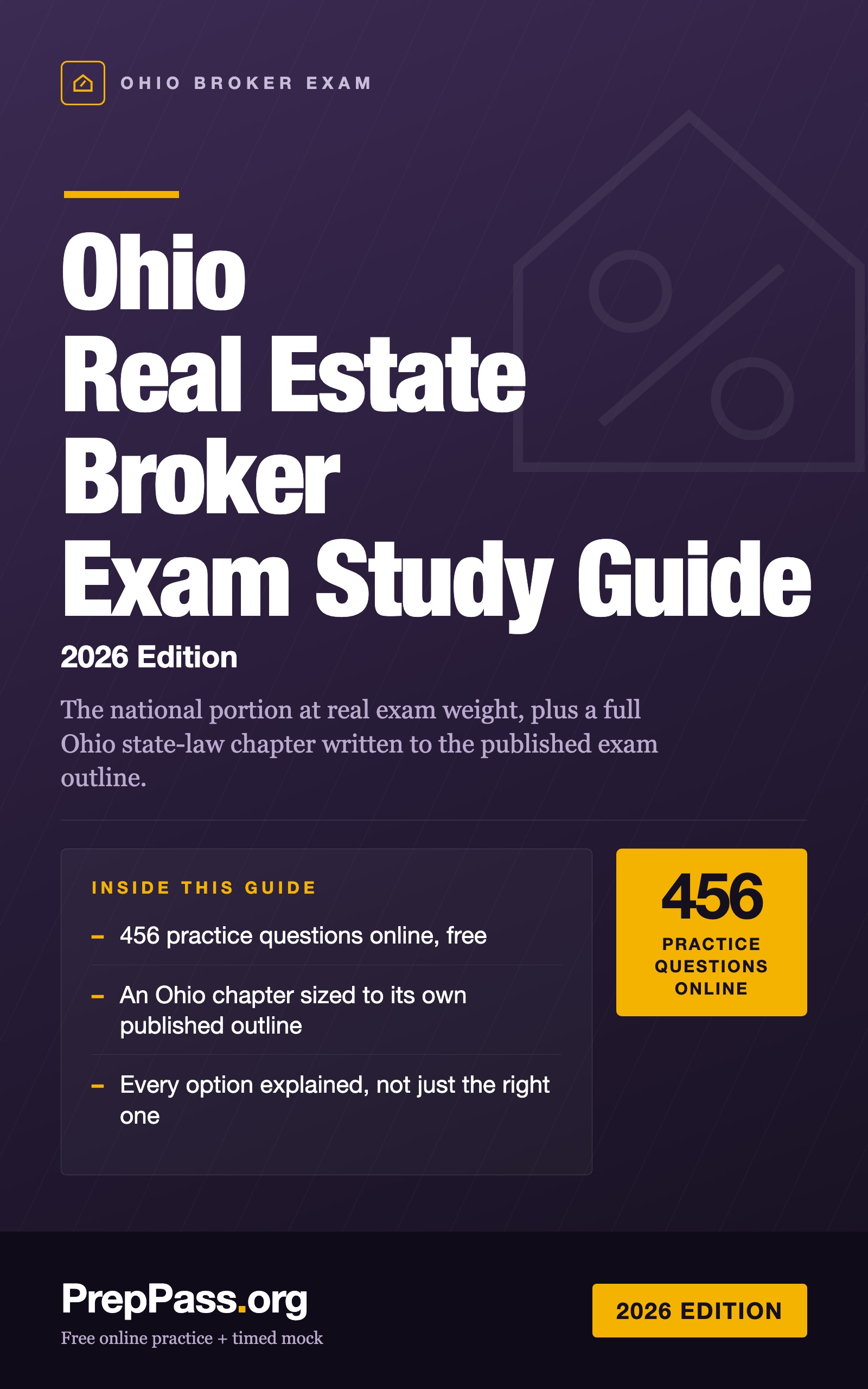
Ohio Real Estate Broker · Ấn bản 2026
Ohio Real Estate Broker Exam Study Guide (2026)
The national portion at real exam weight, plus an Ohio chapter. The Ohio chapter is sized to the published outline — 4 areas, 40 scored items — area by area, not flattened.
- Cả 8 chương phần thi toàn quốc cùng một chương đầy đủ về luật bất động sản Ohio — PDF + EPUB bạn giữ
- Một đề luyện phần thi toàn quốc gồm 60 câu, kèm đáp án giải thích cả bốn phương án chứ không riêng phương án đúng
- Một bộ đề luyện riêng về luật bất động sản Ohio, kèm đáp án có giải thích
PDF + EPUB · tiếng Anh · 304 trang · $14.99 trả một lần
Sách này được viết bằng tiếng Anh — tệp PDF và EPUB bạn tải về đều bằng tiếng Anh.
Tải ngay sau khi thanh toán — không cần tài khoản, không thuê bao. Chính sách hoàn tiền
Thử 10 câu trước — miễn phí
Trả lời hết 10 câu, nộp bài xong sẽ thấy lời giải từng câu — kèm phần trong sách này dạy nội dung đó. Khoảng 5 phút, không cần đăng ký.
Bắt đầu 10 câu miễn phíXem bên trong cuốn sách
Ba trang thật, kết xuất thẳng từ tệp PDF bạn sẽ tải — một trang giảng giải, một câu hỏi có lời giải, và một trang tra cứu. Không trang nào được vẽ lại cho đẹp.
- Trang tra cứu nhanhPart C — Encumbrances a broker must read off a title report · Trang 102 của PDF
Một trang để lật lại: các con số, mốc thời hạn hoặc thuật ngữ gom về một chỗ.
- Một câu hỏi có lời giảiAnswer Key and Explanations · Trang 174 của PDF
Một câu luyện tập kèm đáp án và lập luận đằng sau — không chỉ là đáp án.
- Cách giảng dạyPart II — Ohio State Law & Practice · Trang 300 của PDF
Trang giảng giải: kiến thức được trình bày bằng văn xuôi, theo trình tự kỳ thi kiểm tra.
Có gì — và không có gì
Bao gồm
- An Ohio chapter written to the published exam outline, area by area
- Where Ohio law departs from the national rule — both stated, so neither is guessed
- Supervision, trust accounts, brokerage operation and broker math
- An Ohio practice set with every option explained, not just the right one
- 456 practice questions online, free, from the same bank
- PDF (print & tab it) + EPUB (phone / e-reader)
Không bao gồm
- Không gửi bản in — đây là tệp bạn tải về và có thể tự in
- Sách không kèm khoá video, giảng viên hay kèm riêng — video miễn phí trên trang là phần khác
- Không bao gồm lệ phí đăng ký thi hay phí trung tâm khảo thí — bạn vẫn nộp cho cơ quan chính thức
Mục lục
Xem 29 chương và trang bắt đầu của từng chương
- Part C — Advertising and recordkeeping compliancetr. 14
- Part D — Consumer contact and transaction integritytr. 16
- 2. Trust Funds, Escrow, and the Client’s Moneytr. 30
- Part C — Records that survive an audittr. 33
- Part D — Disputed moneytr. 34
- 3. Agency at the Broker Leveltr. 40
- Part C — Fiduciary duties, at the level a broker is examined ontr. 44
- Part D — Dual agency, designated agency, and the alternativestr. 46
- 4. Contracts and Brokerage Agreementstr. 55
- Part C — Options, rights of first refusal, and installment contractstr. 60
- Part D — Between contract and closingtr. 61
- 5. Fair Housing, Accessibility, and Antitrust: The Exposure You Carry Personallytr. 72
- Part C — The exemptions, and why they rarely save anyonetr. 78
- Part D — Disability: the distinction the exam always teststr. 79
- 6. Ownership, Land Use Controls, and Transfer of Titletr. 95
- Part C — Encumbrances a broker must read off a title reporttr. 101
- Part D — Legal descriptionstr. 103
- 7. Valuation, Financing, and the Federal Lending Lawstr. 113
- Part C — The instrumentstr. 121
- Part D — Loan programs, structures, and qualifyingtr. 123
- 8. Disclosures, Environmental Risk, and Property Managementtr. 136
- Part C — The management agreement and the manager’s authoritytr. 142
- Part D — Leases and tenanciestr. 144
- Practice Exam — 60 Questionstr. 153
- Answer Key and Explanationstr. 170
- Appendix A — Broker Math Cheat Sheettr. 221
- Appendix B — Glossarytr. 243
- Appendix C — Exam-Day Strategytr. 262
- Part II — Ohio State Law & Practicetr. 267
Lấy từ chính tệp PDF bạn tải về, kèm trang bắt đầu của từng phần — không phải gõ tay ở đây.
Đọc miễn phí trọn một chương
Trọn vẹn một chương, đúng như trong eBook. Cuộn cửa sổ để đọc ngay tại đây; không cần tải, không cần email.
Đọc chương 9 ngay tại đây, không rời trang
Chúng tôi không đưa phần mở đầu dễ dãi — chương miễn phí mở thẳng vào một trong những phần đậm đặc nhất của cuốn sách, để bạn đánh giá cách dạy ở đúng chỗ kỳ thi trở nên khó.
What the Ohio state portion actually is
The Ohio broker examination is delivered by PSI in two portions, and only one of them is Ohio's. Candidate bulletin 1001, revision 7/1/2026, publishes the structure: a national portion of 75 scored questions worth 80 points in 120 minutes, and an Ohio state portion of 40 scored questions in 60 minutes. Together that is 115 questions, 120 points, 180 minutes. Everything before this chapter serves the first number. This chapter serves the second.
Ohio's state portion is the shortest in this series — 40 items where South Carolina and Virginia give 50 and Louisiana 55 — and that compression is the single most useful fact about it. There is no room for a wide, shallow sweep. PSI publishes four areas and their item counts:
| Area (published order) | Items | Share of the state portion |
|---|---|---|
| State Governance of the Real Estate Profession | 4 | 10% |
| Licensing Requirements | 6 | 15% |
| License Law and Rules of the Ohio Real Estate Commission | 16 | 40% |
| Brokerage Relationships (Agency Law) | 14 | 35% |
Three quarters of the Ohio state portion is those last two areas. Governance and Licensing together are 10 items of 40. A study guide that opens with a long tour of who appoints whom to the Commission and then rushes agency law has inverted the exam. This chapter is proportioned to the published counts, so the two big areas get roughly three quarters of the teaching prose, and the two small ones get roughly a quarter.
Passing. Ohio publishes a percentage: 75% on each portion, per bulletin 1001. That makes Ohio unusual in this series. South Carolina and Virginia publish points correct (36 of 50 and 38 of 50 on their state portions), and Louisiana publishes a scaled score that its handbook says is neither a raw count nor a percentage. Ohio's 75% is the plain thing it looks like, and it applies to each portion separately — a strong national score does not rescue a weak state score.
The regulator, and who does what. Two bodies share the work, and the exam tests the split. The superintendent of real estate, inside the Division of Real Estate & Professional Licensing at the Ohio Department of Commerce, administers Chapter 4735, issues orders, investigates complaints, appoints hearing examiners and administers the recovery fund (ORC 4735.05(B)). The Ohio Real Estate Commission adopts the canons of ethics, reviews the superintendent's orders on appeal, hears appeals on recovery-fund claims, and decides discipline (ORC 4735.03).
What PSI publishes as the study material, and what it does not. For the state portion the bulletin names exactly two sources: Ohio Revised Code Chapter 4735 and Ohio Administrative Code 1301:5. That is the whole list. There is no vendor bibliography of collateral statutes the way some states' bulletins carry one, so where this chapter cites outside those two — Ohio's broker lien law at ORC 1311.85 to 1311.93, the residential-property definition at ORC 5302.30, the landlord-tenant definitions at ORC 5321.01, the fair housing statute at ORC 4112.02 — it is because Chapter 4735 itself points there.
I. State Governance of the Real Estate Profession — 4 of 40 items
Four items. Keep it tight and know the numbers.
The Commission's composition. Five members appointed by the governor with the senate's consent: four licensed brokers of ten years' standing and one public member, serving five-year terms, with no more than three from one political party and no more than two consecutive full terms (ORC 4735.03).
The audit power, and why it surprises people. ORC 4735.05(B)(4) requires the superintendent to maintain an investigation and audit section, and gives its investigators and auditors "the right to review and audit the business records of licensees and continuing education course providers during normal business hours." No complaint, no Commission vote and no subpoena is needed first. The right runs with the license. Subpoena power under ORC 4735.05(C)(1) exists for a different job — compelling witnesses — and confusing the two is the trap here. What the auditors gather is held in confidence under ORC 4735.05(D).
Where it bites: a broker who keeps trust-account ledgers "at home, in a box" has no defense in the fact that nobody has complained. The auditor can walk in during business hours and ask for three years of records, and the failure to produce them is itself the violation under ORC 4735.18(A)(24).
The complaint clock and the sanctions. ORC 4735.051 sets the sequence: the superintendent acknowledges a signed written complaint within five business days, offers informal mediation if both sides request it, investigates if there is no accommodation, and reviews the investigator's report for "reasonable and substantial evidence" of a violation of ORC 4735.18. A hearing examiner then hears the matter under Chapter 119 and reports; the Commission decides. Under ORC 4735.051(I) the Commission may revoke, suspend, impose a fine not exceeding two thousand five hundred dollars per violation, issue a public reprimand, and require additional continuing education that does not count toward the ordinary requirement. Those fines go to the recovery fund. Unlicensed activity travels a separate road under ORC 4735.052, with a civil penalty capped at one thousand dollars per violation.
The Real Estate Recovery Fund. ORC 4735.12(B)(1) lets a person holding a final, uncollectible judgment against a licensee — for conduct violating Chapter 4735, arising from acts only a licensee may perform — apply in the Franklin County court of common pleas for payment of the applicant's actual and direct loss. Punitive damages, attorney's fees and interest are excluded by division (B)(2). The applicant must have exhausted appeals and pursued the judgment debtors, and must apply within one year of the end of all proceedings. Liability is capped at forty thousand dollars for any one licensee, and under division (E) that licensee's own license is automatically suspended on payment until the fund is repaid with interest.
The trap: the fund is a last-resort compensation mechanism, not a housing program and not the Division's payroll — the Division's operating money sits in a separate real estate operating fund created by ORC 4735.211. And the Commission itself does not order restitution. A consumer's money claim runs through a court judgment first, and only then, if it cannot be collected, through the fund.
II. Licensing Requirements — 6 of 40 items
Who needs a license. ORC 4735.01(A) makes a broker of anyone who, for another and for compensation, sells, exchanges, purchases, rents or leases real estate, negotiates or offers to negotiate such a transaction, lists or auctions property, deals in options, holds out as being in the business, procures prospects, or charges tenants a fee for rental referrals. Division (A)(5) is the one candidates miss: a person who, for a fee, "operates, manages, or rents... other than as custodian, caretaker, or janitor, any building or portions of buildings to the public as tenants" is acting as a broker. A paid property manager needs an Ohio license. Division (C) extends the same definition to salespersons.
The exemptions. ORC 4735.01(I)(1) puts the chapter aside for an owner dealing with property owned or "acquired on its own account in the regular course of, or as an incident to the management of the property and the investment in it" (subdivision (a)); a person acting as "executor, administrator, trustee, assignee, commissioner" or similar under the authority of a court (subdivision (b)); an attorney at law "in the performance of the attorney's duties" (subdivision (d)); public officers on official duty; brokers of business assets not involving real estate; sellers of manufactured or mobile homes; out-of-state commercial brokers complying with ORC 4735.022; and oil and gas land professionals.
Renewal, and the automatic consequences. Ohio runs a three-year cycle, due on the licensee's birthday three years after initial licensure and every three years after (ORC 4735.14(B), OAC 1301:5-1-22). Miss the filing deadline and the license is suspended automatically, without any action by the superintendent. It may be reactivated within twelve months on payment of the renewal fee plus a penalty of fifty per cent of that fee; if that window closes the license is revoked automatically (ORC 4735.14(C)). Revoked status is defined in ORC 4735.01(Q) as "void and not eligible for reactivation," which is what sends a person back to the examination. (Fee amounts change; verify current figures with the Division before relying on a dollar number.)
Two reporting clocks sit beside renewal and are separately tested. A licensee notifies the superintendent within thirty days of a change of personal residence address or e-mail address, and a broker within thirty days of a change of business location (ORC 4735.13(D)). Any licensee reports within fifteen days a felony conviction, a crime of moral turpitude, or a civil-rights or housing-discrimination finding (ORC 4735.13(C)).
Change in status. Chapter 4735 defines inactive status, broker's license on deposit, suspended, revoked and resigned. A licensee entering the armed forces may deposit the license with the Commission and need not renew until the renewal date following discharge, with a continuing-education extension matching the length of active duty; a licensee whose spouse's service took them out of state gets a comparable extension (ORC 4735.13(G)(1) and (G)(2)). Permanent resignation is available under ORC 4735.142, and a broker whose resignation will close the brokerage must notify affiliated salespersons in writing within three days.
Education after licensure — the broker number is not the salesperson number. A newly licensed broker owes ten hours of Commission-approved instruction, not earlier than the date of issue and not later than twelve months after it; failure suspends the license automatically, and a further twelve months without proof revokes it (ORC 4735.07(G)(1)). The parallel figure for a new salesperson is twenty hours (ORC 4735.09(J)). Reversing the two is the classic error, and it is easy to make because the larger number belongs to the junior license.
Continuing education is then thirty hours every three years, reported on the birthday that ends the cycle, and a broker, a broker on deposit, or a management level licensee must include a three-hour course on the duties of a principal broker (ORC 4735.141(A)). Licensees aged seventy or older within the reporting period report nine hours instead — plus that three-hour course if they are brokers. Note the direction of travel: brokers are not exempt from anything, they owe more.
III. License Law and Rules of the Ohio Real Estate Commission — 16 of 40 items
This is the largest area on the Ohio state portion and the widest. PSI publishes fifteen lettered subtopics, A through O, for sixteen items — roughly one item per subtopic. That ratio is unusually generous to a candidate, because it means the published sublist reads almost as an item map:
A. Advertising / use of business name / misrepresentation / team advertising · B. Broker/salesperson employment or independent contractor agreement · C. Commissions and fees paid through broker only / agent compensation · D. Document handling and record keeping (including contracts and listings) · E. Handling of monies / considerations (items of value) · F. Trust or special accounts (broker only) · G. Types of listings, rules · H. Offers, counteroffers, acceptance (including electronic documents) · I. Ohio Broker Lien Law (broker only) · J. Inducements · K. Ancillary trustee — procedure if a broker dies (broker only) · L. Property management (including leases) · M. Rentals · N. Broker's license display (broker only) · O. Ohio fair housing
Four of those are marked broker only in the published outline — trust accounts, the broker lien law, the ancillary trustee, and the broker's license display — and two more, the employment agreement and commissions-through-the-broker, are broker-facing in substance. Those six are precisely what a broker candidate is paying for, and they are where this section spends its words. Most of the answers sit in the disciplinary grounds of ORC 4735.18 and the rules in OAC 1301:5.
Advertising, business names and teams
A licensee advertising property the licensee does not own must be identified by name and must name the affiliated brokerage, which is "displayed in equal prominence with the name of the salesperson" (ORC 4735.16(B)(1) and (3)). OAC 1301:5-1-02(B) carries that into "all advertising, including internet websites, that are within the ownership or direct control of the licensee or the brokerage." Advertising property the licensee does own must say it is agent owned (ORC 4735.16(B)(2)). Internet advertising must disclose the brokerage on every viewable web page, and outdated information must be updated within fourteen days (OAC 1301:5-1-02(D) and (E)).
The requirement is identification by name, not by license number, and there is no pre-approval process — the Division polices advertising after the fact, and ORC 4735.16(B)(5) makes a non-conforming advertisement prima facie evidence of a violation of ORC 4735.18(A)(21), misleading or materially inaccurate advertising.
Teams. OAC 1301:5-1-21 is a rule a broker has to supervise, because the team is not itself licensed — paragraph (A) says so in terms. A team advertising under a group name must include the term "team" or "group" in the name, must not use "realty" or "associates" (paragraph (B)(5)), must show the brokerage "in equal or greater prominence with the team name and with the name of the salesperson," and must identify any unlicensed member as unlicensed (paragraph (B)(3)). It need name only at least one licensee, not every member (paragraph (B)(1)).
The trap: the two words a candidate's instinct reaches for as marks of legitimacy — "Realty" and "Associates" — are the two the rule forbids in a team name.
Compensation and the broker-only pipeline
A broker may not pay a commission to anyone who is not licensed (ORC 4735.20(A)). A salesperson may collect money in connection with a real estate transaction only "in the name of and with the consent of the licensed real estate broker... under whom the salesperson is licensed at the time the salesperson earned the commission," may sue only that broker for it, and may not assign a commission to an unlicensed person (ORC 4735.21). Running the other way, a broker who receives a commission must account to and pay the salesperson's earned share within a reasonable time (ORC 4735.18(A)(31)).
An Ohio broker may pay or receive a commission from a licensed broker of another state or country, under ORC 4735.20(B), and must keep records of those payments for three years under ORC 4735.20(C)(4) and (5).
Where it bites: a seller offers to hand the listing agent a check at the closing table to "save the broker's cut." Accepting it is exactly the prohibited direct collection, whatever the seller agreed to, and the agent's only cause of action for the money is against their own broker.
Records, documents and the three-year clock
ORC 4735.18(A)(24) makes it a disciplinary violation to have "failed to keep complete and accurate records of all transactions for a period of three years from the date of the transaction," and it names what those records are: copies of listing forms, earnest money receipts, offers to purchase and acceptances of them, and records of receipts and disbursements of all funds received by the licensee as broker. Nothing lengthens the period because litigation is threatened. Every party must be given a true copy of any listing or agreement at the time they sign it (ORC 4735.18(A)(25)).
Trust accounts — and the fact that Ohio makes you keep two
This is the broker-only subtopic that carries the most weight in practice. ORC 4735.18(A)(26) requires the broker to maintain at all times a special or trust bank account in a depository of a state or federally chartered institution located in Ohio, which "shall be noninterest-bearing, separate and distinct from any personal or other account of the broker," for the deposit and maintenance of all escrow funds, security deposits and other moneys received by the broker in a fiduciary capacity. The broker's own funds may sit there only to satisfy a minimum balance or a service charge, and OAC 1301:5-5-08(B) requires deposit tickets and checks to bear the words "trust account" or "special account."
Then ORC 4735.18(A)(27) requires a separate property management trust account, used exclusively for rents, security deposits, escrow funds and other fiduciary money received in the course of managing real property — and, unlike the earnest-money account, this one may earn interest, which is paid to the property owners on a pro rata basis. OAC 1301:5-5-11 fills in the operating detail: a separate ledger sheet for each owner (paragraph (A)), security deposits held in the property management trust account, clearly identified and credited to the tenant (paragraph (D)), and an accounting to each owner at least quarterly (paragraph (E)). Paragraph (G) confirms the two accounts are genuinely separate by exempting brokers engaged only in property management from ORC 4735.18(A)(26) altogether.
Learn the pairing as a contrast, because that is how it is tested: earnest money — noninterest-bearing, interest to nobody; property management — may earn interest, paid pro rata to the owners, quarterly accounting.
Disputed deposits. ORC 4735.24(A) requires the broker to maintain the money in the account "in accordance with the terms of the purchase agreement" until one of five things happens: the transaction closes and the money is disbursed under the agreement; both parties give the broker separate signed written instructions; the broker receives a copy of a final court order; the sale is cancelled by a record owner under ORC 5301.95(C)(1); or the money becomes unclaimed funds and is remitted to the director of commerce. Applying contested money to a commission the brokerage claims it has earned converts funds whose ownership is still unsettled — reachable under ORC 4735.18(A)(5) as a failure to account for money belonging to others.
Listings, offers and inducements
ORC 4735.01 defines the listing forms side by side. Under division (V), an exclusive agency agreement pays the broker if the broker "or any other person or entity produces a purchaser or tenant... unless the property is sold or leased solely through the efforts of the seller." Under division (U), an exclusive right to sell or lease listing agreement drops that carve-out and pays the broker "if the broker, the seller, or any other person or entity produces a purchaser or tenant." Both grant the broker the exclusive right to represent the seller, so neither permits simultaneous listings with several brokerages; that is the nonexclusive agency agreement of division (JJ).
Trước khi mua
- Nhận sách thế nào?
- Thanh toán xong, mục tải xuống hiện ngay trên trang này. Liên kết cũng được gửi qua email. Không cần tài khoản.
- Nếu sách không hợp thì sao?
- Gửi email trong vòng 14 ngày để được hoàn tiền đầy đủ, không cần lý do.
- Phần luyện tập miễn phí có bị bỏ không?
- Không. Mọi câu hỏi luyện tập, bài thi thử tính giờ và các chương miễn phí trên trang vẫn miễn phí. Cuốn sách là nửa "học", không phải hàng rào quanh phần miễn phí.
- Đọc trên điện thoại được không?
- Được — EPUB cho điện thoại và máy đọc sách, PDF để in và dán tab. Bạn nhận cả hai.
Chi tiết
The national portion at real exam weight, plus an Ohio chapter. The Ohio chapter is sized to the published outline — 4 areas, 40 scored items — area by area, not flattened.
- Format: PDF + EPUB download · 304 pages
- 80 practice questions in the book, with a full answer key
- 456 free practice questions for this exam on PrepPass, included at no cost
- $14.99 one-time — no subscription
- 14-day money-back guarantee · refund policy
- Cross-referenced against: ORC 4735.18 · ORC 4735.01 · ORC 4735.55 · PSI bulletin 1001 (rev 2026-07-01)
- Last updated: September 2026
- Đối chiếu từ nguồn chính thức(ORC 4735.18 · ORC 4735.01 · ORC 4735.55 · PSI bulletin 1001 (rev 2026-07-01))
- 456 câu hỏi luyện tập miễn phí
- Tải ngay, thuộc về bạn trọn đời
Một real estate broker pre-license course có giá $200–$1,000. Cuốn sách này dạy cùng một kỳ thi — cùng quy định, đối chiếu theo chuẩn hiện hành — chỉ với $14.99 trả một lần, thuộc về bạn trọn đời.
Vì sao mua sách khi phần luyện tập miễn phí?
Câu hỏi luyện tập và bài thi thử tính giờ vẫn miễn phí — không có gì trên trang bị giấu sau cuốn sách này. Cuốn sách $14.99 là nửa "học": chính phần kiến thức, dạy theo trình tự, trong một tệp thuộc về bạn.
- Dạy có hệ thống — mọi phần thi giảng theo từng chương, từ đầu đến cuối, không chỉ là câu hỏi
- In ra & dán nhãn — PDF sẵn sàng để in, tô đậm, ghi chú và mang tới bàn học
- Học mọi nơi, ngoại tuyến — EPUB trên điện thoại hay máy đọc sách; không cần wifi, không cần tab trình duyệt
- Tất cả một chỗ — các chương, thẻ tóm tắt từng chương và câu hỏi luyện tập trong một tệp
- Của bạn trọn đời — trả một lần $14.99, tải ngay, không thuê bao
Và không rủi ro: Đảm bảo hoàn tiền 14 ngày — không hài lòng? Email cho chúng tôi để hoàn tiền đầy đủ, không cần lý do. Xem chính sách hoàn tiền.
Đảm bảo hoàn tiền 14 ngày · hoàn tiền đầy đủ, không cần lý do.
Mua một lần, truy cập tải về trọn đời. eBook là trọn bộ hướng dẫn ôn Ohio Real Estate Broker ở dạng PDF và EPUB. Bản tóm tắt mang tính giáo dục, không phải tư vấn chuyên môn hay pháp lý — luôn xác nhận quy định hiện hành với nguồn chính thức. Cập nhật lần cuối: September 2026.