Tennessee Real Estate Broker · Ấn bản 2026
Tennessee Real Estate Broker Exam Study Guide (2026)
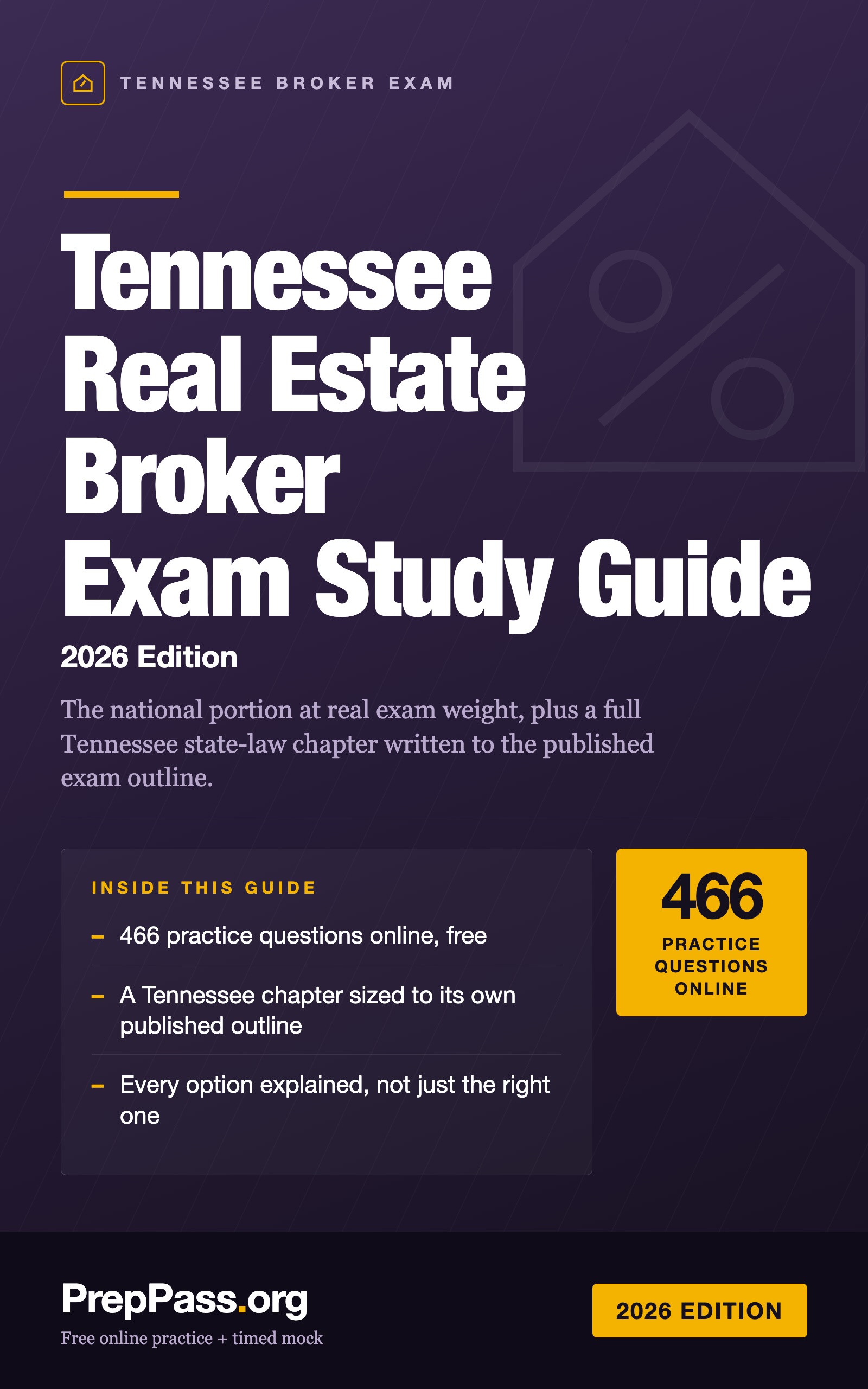
The national portion at real exam weight, plus a Tennessee chapter. The Tennessee chapter is sized to the published outline — 9 areas, 50 scored items — area by area, not flattened.
- Cả 8 chương phần thi toàn quốc cùng một chương đầy đủ về luật bất động sản Tennessee — PDF + EPUB bạn giữ
- Một đề luyện phần thi toàn quốc gồm 60 câu, kèm đáp án giải thích cả bốn phương án chứ không riêng phương án đúng
- 20 câu hỏi riêng về luật bất động sản Tennessee, kèm đáp án có giải thích
PDF + EPUB · tiếng Anh · 321 trang · $14.99 trả một lần
Sách này được viết bằng tiếng Anh — tệp PDF và EPUB bạn tải về đều bằng tiếng Anh.
Tải ngay sau khi thanh toán — không cần tài khoản, không thuê bao. Chính sách hoàn tiền
Thử 10 câu trước — miễn phí
Trả lời hết 10 câu, nộp bài xong sẽ thấy lời giải từng câu — kèm phần trong sách này dạy nội dung đó. Khoảng 5 phút, không cần đăng ký.
Bắt đầu 10 câu miễn phíXem bên trong cuốn sách
Ba trang thật, kết xuất thẳng từ tệp PDF bạn sẽ tải — một trang giảng giải, một câu hỏi có lời giải, và một trang tra cứu. Không trang nào được vẽ lại cho đẹp.
- Trang tra cứu nhanhPart C — Encumbrances a broker must read off a title report · Trang 102 của PDF
Một trang để lật lại: các con số, mốc thời hạn hoặc thuật ngữ gom về một chỗ.
- Một câu hỏi có lời giảiAnswer Key and Explanations · Trang 174 của PDF
Một câu luyện tập kèm đáp án và lập luận đằng sau — không chỉ là đáp án.
- Cách giảng dạySection 62-13-402 makes an engaged licensee a limited agent · Trang 315 của PDF
Trang giảng giải: kiến thức được trình bày bằng văn xuôi, theo trình tự kỳ thi kiểm tra.
Có gì — và không có gì
Bao gồm
- A Tennessee chapter written to the published exam outline, area by area
- Where Tennessee law departs from the national rule — both stated, so neither is guessed
- Supervision, trust accounts, brokerage operation and broker math
- A Tennessee practice set with every option explained, not just the right one
- 466 practice questions online, free, from the same bank
- PDF (print & tab it) + EPUB (phone / e-reader)
Không bao gồm
- Không gửi bản in — đây là tệp bạn tải về và có thể tự in
- Sách không kèm khoá video, giảng viên hay kèm riêng — video miễn phí trên trang là phần khác
- Không bao gồm lệ phí đăng ký thi hay phí trung tâm khảo thí — bạn vẫn nộp cho cơ quan chính thức
Mục lục
Xem 31 chương và trang bắt đầu của từng chương
- Part C — Advertising and recordkeeping compliancetr. 14
- Part D — Consumer contact and transaction integritytr. 16
- 2. Trust Funds, Escrow, and the Client’s Moneytr. 30
- Part C — Records that survive an audittr. 33
- Part D — Disputed moneytr. 34
- 3. Agency at the Broker Leveltr. 40
- Part C — Fiduciary duties, at the level a broker is examined ontr. 44
- Part D — Dual agency, designated agency, and the alternativestr. 46
- 4. Contracts and Brokerage Agreementstr. 55
- Part C — Options, rights of first refusal, and installment contractstr. 60
- Part D — Between contract and closingtr. 61
- 5. Fair Housing, Accessibility, and Antitrust: The Exposure You Carry Personallytr. 72
- Part C — The exemptions, and why they rarely save anyonetr. 78
- Part D — Disability: the distinction the exam always teststr. 79
- 6. Ownership, Land Use Controls, and Transfer of Titletr. 95
- Part C — Encumbrances a broker must read off a title reporttr. 101
- Part D — Legal descriptionstr. 103
- 7. Valuation, Financing, and the Federal Lending Lawstr. 113
- Part C — The instrumentstr. 121
- Part D — Loan programs, structures, and qualifyingtr. 123
- 8. Disclosures, Environmental Risk, and Property Managementtr. 136
- Part C — The management agreement and the manager’s authoritytr. 142
- Part D — Leases and tenanciestr. 144
- Practice Exam — 60 Questionstr. 153
- Answer Key and Explanationstr. 170
- Appendix A — Broker Math Cheat Sheettr. 221
- Appendix B — Glossarytr. 243
- Appendix C — Exam-Day Strategytr. 262
- Part II — Tennessee State Law & Practicetr. 267
- Section 62-13-312(g) adds that revoking or suspending a license alsotr. 298
- Section 62-13-402 makes an engaged licensee a limited agenttr. 299
Lấy từ chính tệp PDF bạn tải về, kèm trang bắt đầu của từng phần — không phải gõ tay ở đây.
Đọc miễn phí trọn một chương
Trọn vẹn một chương, đúng như trong eBook. Cuộn cửa sổ để đọc ngay tại đây; không cần tải, không cần email.
Đọc chương 9 ngay tại đây, không rời trang
Chúng tôi không đưa phần mở đầu dễ dãi — chương miễn phí mở thẳng vào một trong những phần đậm đặc nhất của cuốn sách, để bạn đánh giá cách dạy ở đúng chỗ kỳ thi trở nên khó.
What the Tennessee portion actually is
The Tennessee broker examination is delivered by PSI. The figures below are read out of PSI bulletin 511, revision date 1 July 2025 — the current Tennessee Real Estate Commission candidate information bulletin.
| Items | Points | Time | Pass | |
|---|---|---|---|---|
| Broker — national portion | 75 | scored to 80 | 150 minutes | 60 (75%) |
| Broker — Tennessee state portion | 50 | 50 | 90 minutes | 38 (75%) |
Two things in that table are worth a second look before you go further.
First, the national row really does say 75 items scored to 80 points. That is not a transcription slip. The two numbers are different because the national portion is scored on a points basis rather than a raw item count, and the pass mark of 60 is 75 percent of the 80 points, not of the 75 items. You cannot convert it into "get 56 questions right" and be confident.
Second, the state row is clean: 50 items, 50 points, pass 38. One item, one point. Thirty-eight of fifty is the number to carry into the room. You can miss twelve.
The other tier is a trap you can walk into without noticing. Tennessee licenses in two stages — affiliate broker first, broker second — and PSI publishes both examinations in the same bulletin. The Affiliate Broker examination is 80 national items and 40 state items, and it passes at 70 percent, which is 56 and 28. If you are reading a table that says 40 state items, or a pass mark of 28, or 70 percent, you are looking at the wrong tier. The broker state portion is 50 items at 75 percent.
The area table, in both columns
Tennessee's is the cleanest state outline in this program. PSI prints exact item counts, not ranges, and it prints both tiers side by side on every heading — "Duties and Powers of Real Estate Commission (Affiliate Broker - 4 Items, Broker - 6 Items)" and so on down the page. There is nothing to derive and nothing to estimate. Every number below is a number PSI printed. The Affiliate Broker column totals 40 and the Broker column totals 50, which is the arithmetic check that tells you which column you are reading.
| Area | Broker items | Affiliate items | Broker share |
|---|---|---|---|
| Duties and Powers of Real Estate Commission | 6 | 4 | 12% |
| Licensing Requirements | 5 | 4 | 10% |
| Advertising and Marketing | 7 | 7 | 14% |
| Broker/Affiliate Relationships | 6 | 5 | 12% |
| Handling of Documents and Record Keeping | 6 | 4 | 12% |
| Handling of Trust/Escrow Funds | 7 | 4 | 14% |
| Other Improper Activities and Consumer Protection | 3 | 3 | 6% |
| Agency and Disclosure Issues | 7 | 6 | 14% |
| Special Areas of Practice | 3 | 3 | 6% |
| Total | 50 | 40 |
Read down the two columns and you can see exactly what Tennessee thinks a broker is. Six of the ten extra items go to money and paper: Trust/Escrow rises from four items to seven — a 75 percent increase, the largest jump in the outline — and Handling of Documents and Record Keeping rises from four to six. Duties and Powers rises from four to six, Broker/Affiliate Relationships from five to six, Licensing Requirements from four to five, and Agency and Disclosure from six to seven.
Three areas are identical in both columns: Advertising and Marketing at seven, Other Improper Activities at three, and Special Areas of Practice at three. Those are the areas where Tennessee expects the same knowledge of everybody who holds a license.
The practical instruction is blunt. If you are revising from affiliate broker material you used two or three years ago, the material is weakest exactly where the broker exam is heaviest. Trust and escrow plus records together are 13 of your 50 items, 26 percent, against 8 of 40 — 20 percent — on the exam you already passed. Advertising and Marketing, Trust/Escrow and Agency are the three joint-largest areas at seven items apiece; between them they are 21 items, 42 percent of the state portion. This chapter is sized to those proportions rather than to how interesting the topics are.
What PSI publishes as your reference list, and why it is not enough
For the broker state portion PSI publishes exactly one reference. On page 10 of bulletin 511, under "STATE PORTION OF THE EXAMINATION", it prints: Tennessee Real Estate Broker's Licensing Act of 1973, T.C.A. 62-13-312(B)1-21, with a link.
The provision it names is current. Tenn. Code Ann. § 62-13-312(b) still runs (b)(1) through (b)(21), and none of the twenty-one subdivisions is repealed. But the reference has two defects that you should know about before you rely on it.
The scope is wrong. Section 62-13-312(b) is the grounds-for-discipline list and nothing else. The outline PSI itself prints tests parts 1 through 4 of chapter 13 and the whole of Tennessee Real Estate Commission rule chapters 1260-01 and 1260-02. A candidate who read only § 62-13-312(b) would have no source at all for advertising (rule 1260-02-.12), for trust accounts (rule 1260-02-.09), or for agency (Tenn. Code Ann. §§ 62-13-401 to -408). Those three areas alone are 21 items — about 40 percent of the state portion. The single published reference covers well under half of what is tested.
The link and the name are wrong. The URL points at lawserver.com, a third-party aggregator that is JavaScript-gated, rather than at the Tennessee code. And the statute's own short title, set by § 62-13-101, is the "Tennessee Real Estate Broker License Act of 1973" — not "Broker's Licensing Act". A small thing, but it is the sort of small thing that sends a candidate searching for a statute under a name that does not exist.
There is a second reference block on the same bulletin page, and it is not yours. It lists the Official Manual of the Real Estate Commission, sections 62-13 and 66-32, rules section 1260-1, and the Tennessee Human Rights Act at section 4-21. That block sits under the heading "TIMESHARE SALESPERSON EXAMINATION", which is a different license and a different test. Do not read it as the broker reference list.
Everything else cited in this chapter — every Tenn. Code Ann. section beyond § 62-13-312(b), and every Tenn. Comp. R. & Regs. rule — is ours, read out of the current code and the current rule chapters, not published by PSI. The regulator throughout is the Tennessee Real Estate Commission (TREC), which sits inside the Department of Commerce and Insurance.
One thing to fix in your head before you read any further
Tennessee displaces the common law of agency. It does not supplement it.
Section 62-13-402(c) provides that the duties in §§ 62-13-403 and -404 supersede the fiduciary or common-law duties owed on 1 January 1996, and § 62-13-408 provides that part 4 of the license act supersedes the common law where the two are inconsistent.
The national portion of this book — and every national broker text — builds agency out of the common law: fiduciary duty, the undivided loyalty framework, knowledge imputed from agent to principal, and the doctrine that an agency can arise by conduct. In Tennessee that whole framework is switched off and replaced by statute. Where the national chapter and part 4 disagree, part 4 wins, and the state portion tests part 4.
This is not a technicality confined to one area. It changes the answer to questions in Agency and Disclosure (14% of the exam), and it is the reason two other rules further down read the way they do — the non-vicarious discipline rule in § 62-13-310(c), and the abolition of imputed knowledge inside designated agency in § 62-13-406(c). If you take one structural idea out of this chapter, take this one.
Duties and Powers of the Real Estate Commission (6 items, 12%)
Six items, and the outline's four lettered subtopics tell you where they land: the purpose of the Commission, the persons and disputes not within its jurisdiction, complaints and hearings, and disciplinary actions. The second of those four is the one candidates never revise and the exam likes.
Purpose of the Commission
The operative rule. Tenn. Code Ann. § 62-13-201 creates the Tennessee Real Estate Commission and gives it nine members appointed by the governor: seven who have been principally engaged as a licensed broker or affiliate broker in Tennessee for at least five years, and two who are not in the business. Three come from each grand division of the state, terms run five years, and no member may serve more than one full successive term. Section 62-13-203 gives the Commission power to do all things necessary and proper for carrying out the Real Estate Broker License Act, to promulgate rules under the Uniform Administrative Procedures Act, and to establish canons of ethics and minimum standards of practice.
What it means in practice. Tennessee's three grand divisions — East, Middle and West — are a constitutional feature of the state, and they are written into the composition of the board. The seven-to-two split gives the industry a working majority balanced by two public members, and the one-successive-term cap keeps any individual from becoming the Commission.
Where it bites. The Commission is inside the Department of Commerce and Insurance, in its division of regulatory boards. That is not organizational trivia: it is why § 62-13-312(d) speaks of the director of the division of regulatory boards — not the Commission — as the official who may walk into your office and examine your escrow records.
The trap. Distractors offer the Tennessee Association of Realtors, the Secretary of State, and the Attorney General. The association is a private membership body whose rules bind only those who join, and it issues no license. The Secretary of State records business filings, so your firm's corporate registration lives there but your license does not. The Attorney General represents the state in litigation. Chapter 13 gives licensing power to none of them.
Persons and disputes not within Commission jurisdiction
The operative rule. Tenn. Comp. R. & Regs. 1260-02-.02(8) states flatly that the Commission will not intervene in the settlement of debts, loans, draws, or commission disputes between firms, brokers, and/or affiliates.
What it means in practice. A money quarrel between licensees is a civil matter — for the courts, or for whatever the firm's independent contractor agreement provides. The Commission's disciplinary jurisdiction under § 62-13-312 runs to misrepresentation, mishandling of trust money, failure to supervise and the rest of the twenty-one grounds. It does not run to who is owed what share of a commission.
Where it bites. Two licensees at the same firm fall out over a co-listing split after closing. Neither can improve their position by filing with the Commission, and a broker who threatens to do so is threatening something that will not happen.
The one place the Commission does referee between licensees. Rule 1260-01-.18 lets it refuse a firm name that is the same as, or confusingly similar to, an existing firm's, with an appeal to the executive director and then to the Commission, whose decision is final. That is the narrow exception; note how different it is in kind from a money dispute.
Complaints, notifications, hearings
The operative rule. Tenn. Code Ann. § 62-13-313(a)(1) requires the Commission, before refusing to issue a license or suspending or revoking one on a verified written complaint, to notify the accused in writing and enclose a copy of the complaint. Subdivision (a)(2) gives the accused ten days to file an answer, a copy of which is transmitted to the complainant. Only then does subdivision (a)(3) let the Commission decide, after investigation, that the matter should be set for hearing. Section 62-13-313(c) requires the affirmative vote of a majority of the commission to revoke or suspend.
The filing window. Section 62-13-313(e) sets when a complaint may be brought: two years from the violation, or the applicable criminal statute of limitations, or ten days after a criminal prosecution becomes final.
The trap on the vote. A majority of nine is five. Unanimity is not required and would make discipline nearly impossible; no two-thirds supermajority appears anywhere in chapter 13. And the executive director — who administers the office and decides firm-name appeals in the first instance — cannot revoke or suspend a license alone. Compare § 62-13-311, which sets a materially higher bar in a different situation: where a court has revoked a license as part of a judgment, reissuance requires the consenting vote of six commission members. Five to discipline, six to give it back.
The trap on the ten days. Ten days is the answer window. Sixty days is a different deadline entirely — § 62-13-312(f), reporting a criminal conviction — and candidates swap the two.
Disciplinary actions
The operative rule. Tenn. Code Ann. § 62-13-312(b) lists twenty-one grounds for refusing, suspending or revoking a license. Subsection (c) then adds a remedy that is distinctly Tennessee: the Commission may, in addition to or in lieu of any other lawful disciplinary action against a broker, order that the broker be downgraded to affiliate broker status.
Why that sanction exists. It is precisely calibrated. A downgraded licensee can still practice and still earn, but loses the authority to hold escrow money and to supervise others — which is exactly the authority a broker who has mishandled trust funds or failed to supervise should not have. The national manuscript's discipline chapter describes the usual ladder of reprimand, fine, suspension and revocation; Tennessee has a rung on it that most states do not.
The money. Rule 1260-02-.32(1) authorizes a civil penalty of $0 to $1,000 for each separate violation of a statute, rule or order pertaining to the Commission. Paragraph (2) applies the same range to an unlicensed person acting as a broker. Paragraph (3) is the one that matters: each day of a continued violation may constitute a separate violation. That is how a small daily figure becomes a large total. Paragraph (4) lists the factors weighed, including deterrence, severity, and the economic benefit gained by the violator.
The trap. Damages are awarded by courts, not by the Commission, and treble damages appear nowhere in chapter 13. The Commission cannot reassign a firm's listings, which are contracts between the firm and its clients. And retesting is a condition of reinstatement under the expired-license and revoked-license rules — not a disciplinary sanction available under § 62-13-312.
Trước khi mua
- Nhận sách thế nào?
- Thanh toán xong, mục tải xuống hiện ngay trên trang này. Liên kết cũng được gửi qua email. Không cần tài khoản.
- Nếu sách không hợp thì sao?
- Gửi email trong vòng 14 ngày để được hoàn tiền đầy đủ, không cần lý do.
- Phần luyện tập miễn phí có bị bỏ không?
- Không. Mọi câu hỏi luyện tập, bài thi thử tính giờ và các chương miễn phí trên trang vẫn miễn phí. Cuốn sách là nửa "học", không phải hàng rào quanh phần miễn phí.
- Đọc trên điện thoại được không?
- Được — EPUB cho điện thoại và máy đọc sách, PDF để in và dán tab. Bạn nhận cả hai.
Chi tiết
The national portion at real exam weight, plus a Tennessee chapter. The Tennessee chapter is sized to the published outline — 9 areas, 50 scored items — area by area, not flattened.
- Format: PDF + EPUB download · 321 pages
- 80 practice questions in the book, with a full answer key
- 466 free practice questions for this exam on PrepPass, included at no cost
- $14.99 one-time — no subscription
- 14-day money-back guarantee · refund policy
- Cross-referenced against: Tenn. Code Ann. section 62-13-312 · Tenn. Comp. R. and Regs. 1260-02-.09 · Tenn. Code Ann. 62-13-312 · PSI bulletin 511 (rev 2025-07-01)
- Last updated: September 2026
- Đối chiếu từ nguồn chính thức(Tenn. Code Ann. section 62-13-312 · Tenn. Comp. R. and Regs. 1260-02-.09 · Tenn. Code Ann. 62-13-312 · PSI bulletin 511 (rev 2025-07-01))
- 466 câu hỏi luyện tập miễn phí
- Tải ngay, thuộc về bạn trọn đời
Một real estate broker pre-license course có giá $200–$1,000. Cuốn sách này dạy cùng một kỳ thi — cùng quy định, đối chiếu theo chuẩn hiện hành — chỉ với $14.99 trả một lần, thuộc về bạn trọn đời.
Vì sao mua sách khi phần luyện tập miễn phí?
Câu hỏi luyện tập và bài thi thử tính giờ vẫn miễn phí — không có gì trên trang bị giấu sau cuốn sách này. Cuốn sách $14.99 là nửa "học": chính phần kiến thức, dạy theo trình tự, trong một tệp thuộc về bạn.
- Dạy có hệ thống — mọi phần thi giảng theo từng chương, từ đầu đến cuối, không chỉ là câu hỏi
- In ra & dán nhãn — PDF sẵn sàng để in, tô đậm, ghi chú và mang tới bàn học
- Học mọi nơi, ngoại tuyến — EPUB trên điện thoại hay máy đọc sách; không cần wifi, không cần tab trình duyệt
- Tất cả một chỗ — các chương, thẻ tóm tắt từng chương và câu hỏi luyện tập trong một tệp
- Của bạn trọn đời — trả một lần $14.99, tải ngay, không thuê bao
Và không rủi ro: Đảm bảo hoàn tiền 14 ngày — không hài lòng? Email cho chúng tôi để hoàn tiền đầy đủ, không cần lý do. Xem chính sách hoàn tiền.
Đảm bảo hoàn tiền 14 ngày · hoàn tiền đầy đủ, không cần lý do.
Mua một lần, truy cập tải về trọn đời. eBook là trọn bộ hướng dẫn ôn Tennessee Real Estate Broker ở dạng PDF và EPUB. Bản tóm tắt mang tính giáo dục, không phải tư vấn chuyên môn hay pháp lý — luôn xác nhận quy định hiện hành với nguồn chính thức. Cập nhật lần cuối: September 2026.