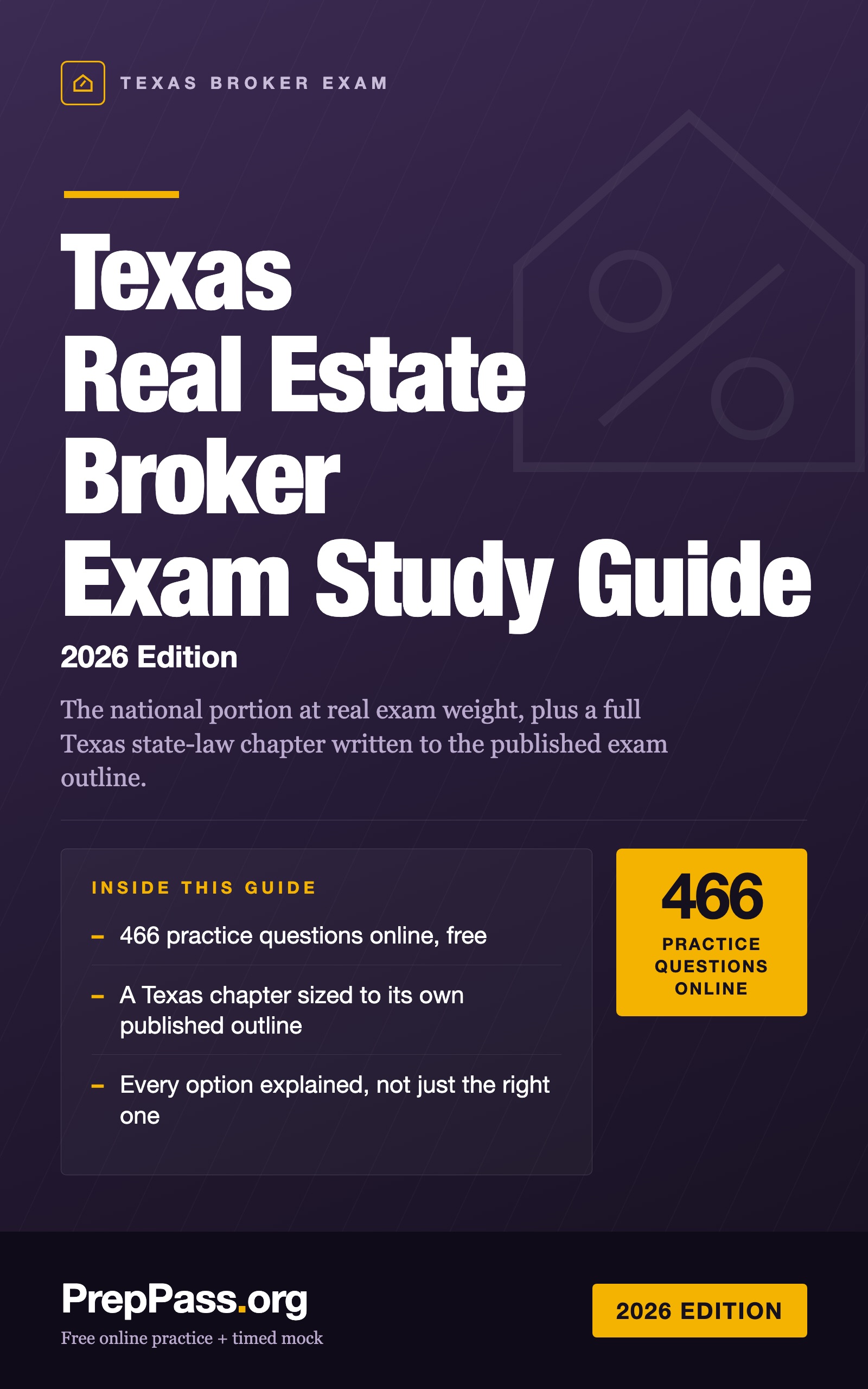
Texas Real Estate Broker · Ấn bản 2026
Texas Real Estate Broker Exam Study Guide (2026)
The national portion at real exam weight, plus a Texas chapter. The Texas chapter is sized to the published outline — 7 areas, 50 scored items — area by area, not flattened.
- Cả 8 chương phần thi toàn quốc cùng một chương đầy đủ về luật bất động sản Texas — PDF + EPUB bạn giữ
- Một đề luyện phần thi toàn quốc gồm 60 câu, kèm đáp án giải thích cả bốn phương án chứ không riêng phương án đúng
- Một bộ đề luyện riêng về luật bất động sản Texas, kèm đáp án có giải thích
PDF + EPUB · tiếng Anh · 309 trang · $14.99 trả một lần
Sách này được viết bằng tiếng Anh — tệp PDF và EPUB bạn tải về đều bằng tiếng Anh.
Tải ngay sau khi thanh toán — không cần tài khoản, không thuê bao. Chính sách hoàn tiền
Thử 10 câu trước — miễn phí
Trả lời hết 10 câu, nộp bài xong sẽ thấy lời giải từng câu — kèm phần trong sách này dạy nội dung đó. Khoảng 5 phút, không cần đăng ký.
Bắt đầu 10 câu miễn phíXem bên trong cuốn sách
Ba trang thật, kết xuất thẳng từ tệp PDF bạn sẽ tải — một trang giảng giải, một câu hỏi có lời giải, và một trang tra cứu. Không trang nào được vẽ lại cho đẹp.
- Trang tra cứu nhanhPart C — Encumbrances a broker must read off a title report · Trang 102 của PDF
Một trang để lật lại: các con số, mốc thời hạn hoặc thuật ngữ gom về một chỗ.
- Một câu hỏi có lời giảiAnswer Key and Explanations · Trang 174 của PDF
Một câu luyện tập kèm đáp án và lập luận đằng sau — không chỉ là đáp án.
- Cách giảng dạySECTION 11: the commission may act where a license holder “fails to enter · Trang 308 của PDF
Trang giảng giải: kiến thức được trình bày bằng văn xuôi, theo trình tự kỳ thi kiểm tra.
Có gì — và không có gì
Bao gồm
- A Texas chapter written to the published exam outline, area by area
- Where Texas law departs from the national rule — both stated, so neither is guessed
- Supervision, trust accounts, brokerage operation and broker math
- A Texas practice set with every option explained, not just the right one
- 466 practice questions online, free, from the same bank
- PDF (print & tab it) + EPUB (phone / e-reader)
Không bao gồm
- Không gửi bản in — đây là tệp bạn tải về và có thể tự in
- Sách không kèm khoá video, giảng viên hay kèm riêng — video miễn phí trên trang là phần khác
- Không bao gồm lệ phí đăng ký thi hay phí trung tâm khảo thí — bạn vẫn nộp cho cơ quan chính thức
Mục lục
Xem 30 chương và trang bắt đầu của từng chương
- Part C — Advertising and recordkeeping compliancetr. 14
- Part D — Consumer contact and transaction integritytr. 16
- 2. Trust Funds, Escrow, and the Client’s Moneytr. 30
- Part C — Records that survive an audittr. 33
- Part D — Disputed moneytr. 34
- 3. Agency at the Broker Leveltr. 40
- Part C — Fiduciary duties, at the level a broker is examined ontr. 44
- Part D — Dual agency, designated agency, and the alternativestr. 46
- 4. Contracts and Brokerage Agreementstr. 55
- Part C — Options, rights of first refusal, and installment contractstr. 60
- Part D — Between contract and closingtr. 61
- 5. Fair Housing, Accessibility, and Antitrust: The Exposure You Carry Personallytr. 72
- Part C — The exemptions, and why they rarely save anyonetr. 78
- Part D — Disability: the distinction the exam always teststr. 79
- 6. Ownership, Land Use Controls, and Transfer of Titletr. 95
- Part C — Encumbrances a broker must read off a title reporttr. 101
- Part D — Legal descriptionstr. 103
- 7. Valuation, Financing, and the Federal Lending Lawstr. 113
- Part C — The instrumentstr. 121
- Part D — Loan programs, structures, and qualifyingtr. 123
- 8. Disclosures, Environmental Risk, and Property Managementtr. 136
- Part C — The management agreement and the manager’s authoritytr. 142
- Part D — Leases and tenanciestr. 144
- Practice Exam — 60 Questionstr. 153
- Answer Key and Explanationstr. 170
- Appendix A — Broker Math Cheat Sheettr. 221
- Appendix B — Glossarytr. 243
- Appendix C — Exam-Day Strategytr. 262
- Part II — Texas State Law & Practicetr. 267
- SECTION 11: the commission may act where a license holder “fails to entertr. 302
Lấy từ chính tệp PDF bạn tải về, kèm trang bắt đầu của từng phần — không phải gõ tay ở đây.
Đọc miễn phí trọn một chương
Trọn vẹn một chương, đúng như trong eBook. Cuộn cửa sổ để đọc ngay tại đây; không cần tải, không cần email.
Đọc chương 9 ngay tại đây, không rời trang
Chúng tôi không đưa phần mở đầu dễ dãi — chương miễn phí mở thẳng vào một trong những phần đậm đặc nhất của cuốn sách, để bạn đánh giá cách dạy ở đúng chỗ kỳ thi trở nên khó.
What the Texas state portion actually is
The Texas broker examination is delivered by Pearson VUE in two portions. The national portion is 80 scored items in 150 minutes. The Texas state law portion is 50 scored items in 90 minutes, and the booklet adds that the examination "also contains 5-10 pretest items" that are not scored. Together that is 130 scored items across 240 minutes.
The content outline is Pearson VUE booklet #094401. Two dates matter and they are not the same date: the state outline is effective April 15, 2020, while the booklet you can download today is the January 2026 printing. Texas real estate law moved substantially between those two points — an entire brokerage concept was repealed and two new sections were added on January 1, 2026 — so parts of this outline describe a statute that has since changed underneath it. Where that happens, this chapter tells you which is which.
Here is the published breakdown, at the booklet's own item counts:
| Area (published order) | Items | Share |
|---|---|---|
| I. Commission Duties & Powers | 3 | 6% |
| II. Licensing | 4 | 8% |
| III. Standards of Conduct | 9 | 18% |
| IV. Agency & Brokerage | 10 | 20% |
| V. Contracts | 8 | 16% |
| VI. Special Topics | 6 | 12% |
| VII. Case Studies | 10 | 20% |
Read areas I and II again: seven items out of fifty. The Commission's composition and the license ladder are 14% of the Texas state portion, and a study guide that opens with two thousand words on them has spent a quarter of its space on a seventh of the exam. This chapter is proportioned to the published counts. Standards of Conduct, Agency & Brokerage, Contracts and Case Studies are 74% of the exam and get roughly 74% of the teaching.
Three things about this outline you should know before you study
First: one fifth of the Texas state portion is case studies, and no other state in this series has them. Area VII is 10 items. The booklet describes them as "both narrative cases and contract cases. Narrative cases require candidates to read a case study and respond to multiple associated items. Contract cases require candidates to respond to items based on use of TREC-promulgated contracts." You will be reading fact patterns and working promulgated forms, not recalling definitions. Section VII of this chapter teaches that skill specifically.
Second: the booklet publishes no list of governing statutes. Unlike PSI's South Carolina bulletin, which prints its study materials, #094401 ends at the content outline. The only source note in the whole document is the box printed beside area VII: "On the exam, all references to The Act refer to The Real Estate License Act in Texas. Additionally, references TREC Rules refer to the rules promulgated by the Texas Real Estate Commission." That is the entire bibliography. The absence is itself the finding, and it is why this chapter carries a section number for every rule it states: the per-area citations here were derived from the booklet's own lettered subtopics and then verified against the primary text. They are not a vendor-published list, and this chapter does not present them as one. "The Act" is Occupations Code Chapter 1101 (TRELA); "TREC Rules" are 22 Texas Administrative Code Part 23.
Third: the sales agent outline is printed in the same booklet and it is a different exam. Its counts are I-3 / II-3 / III-9 / IV-11 / V-9 / VI-5 — and it has no case-study area at all. A broker candidate who picks up the sales agent weights walks in with no preparation for ten case-study items, a fifth of the paper. Check the heading on the page you are reading.
Passing. Texas reports raw cut scores rather than a single published percentage — approximately 60 of 80 on the national portion and 38 of 50 on the state portion. Treat those as approximate and confirm them with TREC or the current Pearson VUE handbook before your exam date. The regulator is the Texas Real Estate Commission (TREC); fingerprinting is handled through IDEMIA.
I. Commission Duties & Powers — 3 of 50 items
Three items. Learn the composition, the committee, and the money.
The Commission. Occupations Code § 1101.051(a): "The Texas Real Estate Commission consists of nine members appointed by the governor with the advice and consent of the senate as follows: (1) six members who have been engaged in the brokerage business as licensed brokers as their major occupation for the five years preceding appointment; and (2) three members who represent the public." Nobody is elected to it, and the three public seats exist so that the regulated trade does not hold every vote.
The Broker-Lawyer Committee. The contract forms Texas license holders must use are not written by TREC staff. Section 1101.252(a) creates the Texas Real Estate Broker-Lawyer Committee of 13 members: six appointed by the Commission, six members of the State Bar of Texas appointed by the state bar president, and one public member appointed by the governor. The committee drafts and revises the forms; the Commission adopts them by rule at 22 TAC §§ 537.20-537.69. The Commission fills fewer than half the seats — that is the point of a body designed to put brokers and lawyers in the same room.
Discipline and the money. TREC investigates complaints under § 1101.204 and may suspend or revoke under § 1101.652. An administrative penalty may not exceed $5,000 for each violation, and each day a violation continues may be counted separately (§ 1101.702(a)). Acting as a broker or sales agent without a license is a Class A misdemeanor under § 1101.758.
The Real Estate Recovery Trust Account is a fund of last resort, not a claims desk. A consumer reaches it only after a final judgment, execution returned nulla bona, and a perfected judgment lien (§ 1101.606(a)). Payments are capped by § 1101.610: $125,000 for a single transaction, "regardless of the number of claimants," including attorney's fees, interest and court costs; and $250,000 for one license holder until the license holder has reimbursed the account. Subsection (c) makes the court reduce claims proportionately once they exceed the limits, and subsection (e) counts a business entity and its designated broker as a single license holder for the $250,000 ceiling.
II. Licensing — 4 of 50 items
Who needs a license. Section 1101.351(a): "Unless a person holds a license issued under this chapter, the person may not: (1) act as or represent that the person is a broker or sales agent; or (2) act as a residential rental locator." That second clause is the one candidates miss — a person paid to find tenants an apartment is doing licensed work. Subsection (c) adds that a sales agent may not engage in brokerage unless sponsored by a broker and acting for that broker, and subsection (a-1) bars an unlicensed business entity from acting as a broker.
Who does not. Section 1101.005 lifts the chapter off a list, including an attorney licensed in this state; an attorney-in-fact authorized to conduct not more than three real estate transactions annually; a licensed auctioneer conducting a sale by auction "if the auctioneer does not perform another act of a broker"; an on-site manager of an apartment complex; and an owner or the owner's employee leasing the owner's real estate. Notice how narrow the auctioneer's exemption is — it survives only while the auctioneer does nothing else a broker would do.
Entities and the designated broker. A business entity must "designate one of its managing officers as its broker" (§ 1101.355(a)(1)) and may not act as a broker unless that designated broker "is a licensed individual broker in active status and good standing" (§ 1101.355(b)). 22 TAC § 535.53 repeats that the designation must be an individual with managing authority — never another entity. Where the designated broker owns less than 10 percent of the entity, § 1101.355(a)(2) requires errors-and-omissions insurance of at least $1 million for each occurrence.
Getting the broker license — and the number that changed. 22 TAC § 535.56 requires 270 hours of qualifying real estate courses, including the 30-hour real estate brokerage course taken within two years of applying; a further 630 classroom hours of related education, of which a bachelor's degree is deemed to satisfy 300; and the six-hour Broker Responsibility Course. On experience, § 1101.356(a)(1) requires "at least four years of active experience as a license holder during the 60 months preceding the date the application is filed," and § 535.56(b) requires "not less than 720 points of qualifying practical experience," reported on TREC No. BL-A, with at least one transaction per year in four of the five years.
Trap. The points floor rose from 360 to 720. Secondhand study material still carries 360, and 360 is a plausible-looking wrong answer. The four-of-five-years requirement is the part that did not change.
Renewal. 22 TAC § 535.92(a): 18 hours of continuing education, comprising a four-hour Legal Update I, a four-hour Legal Update II, three hours on real estate contracts, and the six-hour Broker Responsibility Course for a broker or a delegated supervisor. For a broker those blocks account for 17 of the 18 hours, so the "18 free elective hours" answer is wrong even though it names the right total. Occupations Code § 1101.458(a), as amended effective January 1, 2026, now makes the broker responsibility course a statutory requirement of every broker and of a sales agent who supervises another license holder. (Fees and course-hour figures can change; verify with TREC before relying on them.)
III. Standards of Conduct — 9 of 50 items
The booklet's own heading for this area is "STANDARDS OF CONDUCT", and its subtopics are professional ethics and conduct, grounds for discipline, unauthorized practice of law, trust accounts, splitting fees, rebates, and advertising. It is often mislabeled in third-party material as "statutory requirements governing licensees"; use the booklet's heading, because it tells you what is actually inside.
The Canons
The Canons of Professional Ethics and Conduct at 22 TAC §§ 531.1-531.4 impose fidelity, integrity and competency. Section 531.2 (Fidelity) is the one that gets tested: a license holder acting as an agent for another is a fiduciary, and the special obligations "demand: that the primary duty of the license holder is to represent the interests of the client... that, however, the license holder, in performing duties to the client, shall treat other parties to a transaction fairly... and that the license holder place no personal interest above that of the client."
Two lines in that sentence do a lot of work. Fairness is owed to the other party; loyalty is not. And loyalty is fixed by who is represented, not by who pays — § 1101.557(a) makes the broker the agent of the party represented, so a seller-paid fee does not turn the buyer's broker into the seller's agent.
Grounds for discipline, and the newest one
Section 1101.652 is the list. Since January 1, 2026 it has a new entry: § 1101.652(b)(34), added by SB 1968 (89th Legislature), SECTION 11, reaching a license holder who "fails to enter into a written agreement with a prospective buyer as required by Section 1101.563."
Note where it sits. It is in subsection (b) — the list of grounds for conduct "while engaged in real estate brokerage" — placed immediately after (b)(33). It is not in subsection (a). SECTION 18 of the bill applies "Section 1101.652(b), as amended by this Act" to conduct on or after the effective date. Candidates who half-remember the amendment tend to place it in (a); the subsection is the detail worth carrying.
Two older grounds are easy to confuse with it. § 1101.652(a)(7) has long required notice of a felony conviction "not later than the 30th day after the date of a final conviction" — real, but not new. And § 1101.652(b)(23) is the advertising ground, which is how team-name rules at 22 TAC § 535.154 are enforced; SB 1968 wrote nothing about team names.
Unauthorized practice of law
22 TAC § 537.11(b) bars a license holder from practicing law, from giving "advice or opinions as to the legal effect of any contract forms," and — subdivision (b)(5) — from "draft[ing] or recommend[ing] language to be included in a contract form defining or affecting the rights, obligations, or remedies of the principals of a real estate transaction, including escalation, appraisal, or contingency clauses."
What is permitted is narrow and precise:
- § 537.11(c)(2) — explaining to the license holder's principals "the meaning of informational items or choices in a contract form," so long as the license holder does not practice law.
- § 537.11(d)(2) — "if specifically instructed in writing by a principal, add language to or strike language from a contract form, as long as any change is made conspicuous, including underlining additions, striking through deletions, or employing some other method which clearly indicates the change being made."
Where it bites: a buyer emails her agent, "strike the sentence about the survey." The agent may strike it and must make the strike conspicuous. If instead the buyer says "write me something that lets me walk if the appraisal is low," the agent may not compose it — TREC has already promulgated the form for that, and § 537.11(b)(5) names appraisal clauses in terms.
Trust money
Two provisions of 22 TAC § 535.146 stack, and they put the duty and the deadline on different people.
- § 535.146(b)(2): "A sales agent shall not maintain a trust account. Any trust money received by a sales agent must be immediately delivered to the sales agent's sponsoring broker." That duty does not wait on the seller's acceptance.
- § 535.146(b)(3): the broker must deposit the money in a trust account, or deliver it to an authorized escrow agent, "not later than the close of business of the second working day after the date the broker receives the trust money," unless the principals agree otherwise in writing. Working days, not calendar days.
Section 535.146(b)(4) forbids the broker to commingle trust money with personal or other non-trust money or to hold it "in a personal account or any kind of business account," and (b)(5) makes placing trust money in the operating account prima facie evidence of commingling — however the entry is labeled, and worse if the firm earns interest on someone else's deposit. Disbursement may be made only "in accordance with the agreement under which the money was received" (§ 535.146(d)(1)); on a written demand the broker has 30 days; and where the right party cannot be determined, § 535.146(d)(5) lets the broker interplead rather than decide the dispute.
Fees, rebates and advertising
Who a broker may pay. § 1101.651(a): a broker may not compensate anyone for performing an act of a broker unless that person is "(1) a license holder; or (2) a real estate broker licensed in another state who does not conduct in this state any of the negotiations for which the commission or other compensation is paid." So an out-of-state referral is payable, provided the negotiating did not happen in Texas — 22 TAC § 535.4(b) confirms the Act "does not prohibit cooperative arrangements between foreign brokers and Texas brokers." A sales agent may accept compensation only from the sponsoring broker (§ 1101.651(b)).
The agent's own company. 22 TAC § 535.147(c) bars a broker from sharing a commission "with an unlicensed business entity created by a license holder for the purpose of collecting a commission or fees on behalf of the license holder," unless the entity is exempt under § 535.5 and § 1101.355(d) — which requires the entity to be an LLC or S corporation, to perform no other acts of a broker, to be registered with the Commission, and to be at least 51 percent owned by the license holder. An unregistered LLC fails.
Rebates run the other way and are allowed. 22 TAC § 535.147(d): "A license holder may rebate or pay a portion of the license holder's fee or commission to a party in the transaction when the sales agent has the written consent of the sales agent's sponsoring broker and the party represented by the license holder." The rule turns on consent, not on who writes the check or when. Do not confuse a rebate with an undisclosed fee: § 535.148(a) is about taking money "from a person other than the person the license holder represents" without telling the client — money flowing the opposite way.
Advertising. 22 TAC § 535.155 requires each advertisement to include, in a readily noticeable location, "the name of the license holder or team placing the advertisement; and the broker's name in at least half the size of the largest contact information for any sales agent, associated broker, or team name contained in the advertisement." The rule defines advertisement broadly — publications, brochures, radio and television, email, text messages, social media, the Internet, stationery, business cards, displays, signs and billboards — so the standard follows the advertisement into every medium. Occupations Code § 1101.652(b)(23)(C) makes disciplinable an advertisement that "implies that a sales agent is responsible for the operation of the broker's real estate brokerage business," and 22 TAC § 535.2(g) makes the broker responsible for ensuring a sponsored agent's advertising complies.
Trước khi mua
- Nhận sách thế nào?
- Thanh toán xong, mục tải xuống hiện ngay trên trang này. Liên kết cũng được gửi qua email. Không cần tài khoản.
- Nếu sách không hợp thì sao?
- Gửi email trong vòng 14 ngày để được hoàn tiền đầy đủ, không cần lý do.
- Phần luyện tập miễn phí có bị bỏ không?
- Không. Mọi câu hỏi luyện tập, bài thi thử tính giờ và các chương miễn phí trên trang vẫn miễn phí. Cuốn sách là nửa "học", không phải hàng rào quanh phần miễn phí.
- Đọc trên điện thoại được không?
- Được — EPUB cho điện thoại và máy đọc sách, PDF để in và dán tab. Bạn nhận cả hai.
Chi tiết
The national portion at real exam weight, plus a Texas chapter. The Texas chapter is sized to the published outline — 7 areas, 50 scored items — area by area, not flattened.
- Format: PDF + EPUB download · 309 pages
- 80 practice questions in the book, with a full answer key
- 466 free practice questions for this exam on PrepPass, included at no cost
- $14.99 one-time — no subscription
- 14-day money-back guarantee · refund policy
- Cross-referenced against: Pearson VUE #094401 (rev outline eff. 2020-04-15 (booklet #094401, 01/2026 printing))
- Last updated: September 2026
- Đối chiếu từ nguồn chính thức(Pearson VUE #094401 (rev outline eff. 2020-04-15 (booklet #094401, 01/2026 printing)))
- 466 câu hỏi luyện tập miễn phí
- Tải ngay, thuộc về bạn trọn đời
Một real estate broker pre-license course có giá $200–$1,000. Cuốn sách này dạy cùng một kỳ thi — cùng quy định, đối chiếu theo chuẩn hiện hành — chỉ với $14.99 trả một lần, thuộc về bạn trọn đời.
Vì sao mua sách khi phần luyện tập miễn phí?
Câu hỏi luyện tập và bài thi thử tính giờ vẫn miễn phí — không có gì trên trang bị giấu sau cuốn sách này. Cuốn sách $14.99 là nửa "học": chính phần kiến thức, dạy theo trình tự, trong một tệp thuộc về bạn.
- Dạy có hệ thống — mọi phần thi giảng theo từng chương, từ đầu đến cuối, không chỉ là câu hỏi
- In ra & dán nhãn — PDF sẵn sàng để in, tô đậm, ghi chú và mang tới bàn học
- Học mọi nơi, ngoại tuyến — EPUB trên điện thoại hay máy đọc sách; không cần wifi, không cần tab trình duyệt
- Tất cả một chỗ — các chương, thẻ tóm tắt từng chương và câu hỏi luyện tập trong một tệp
- Của bạn trọn đời — trả một lần $14.99, tải ngay, không thuê bao
Và không rủi ro: Đảm bảo hoàn tiền 14 ngày — không hài lòng? Email cho chúng tôi để hoàn tiền đầy đủ, không cần lý do. Xem chính sách hoàn tiền.
Đảm bảo hoàn tiền 14 ngày · hoàn tiền đầy đủ, không cần lý do.
Mua một lần, truy cập tải về trọn đời. eBook là trọn bộ hướng dẫn ôn Texas Real Estate Broker ở dạng PDF và EPUB. Bản tóm tắt mang tính giáo dục, không phải tư vấn chuyên môn hay pháp lý — luôn xác nhận quy định hiện hành với nguồn chính thức. Cập nhật lần cuối: September 2026.