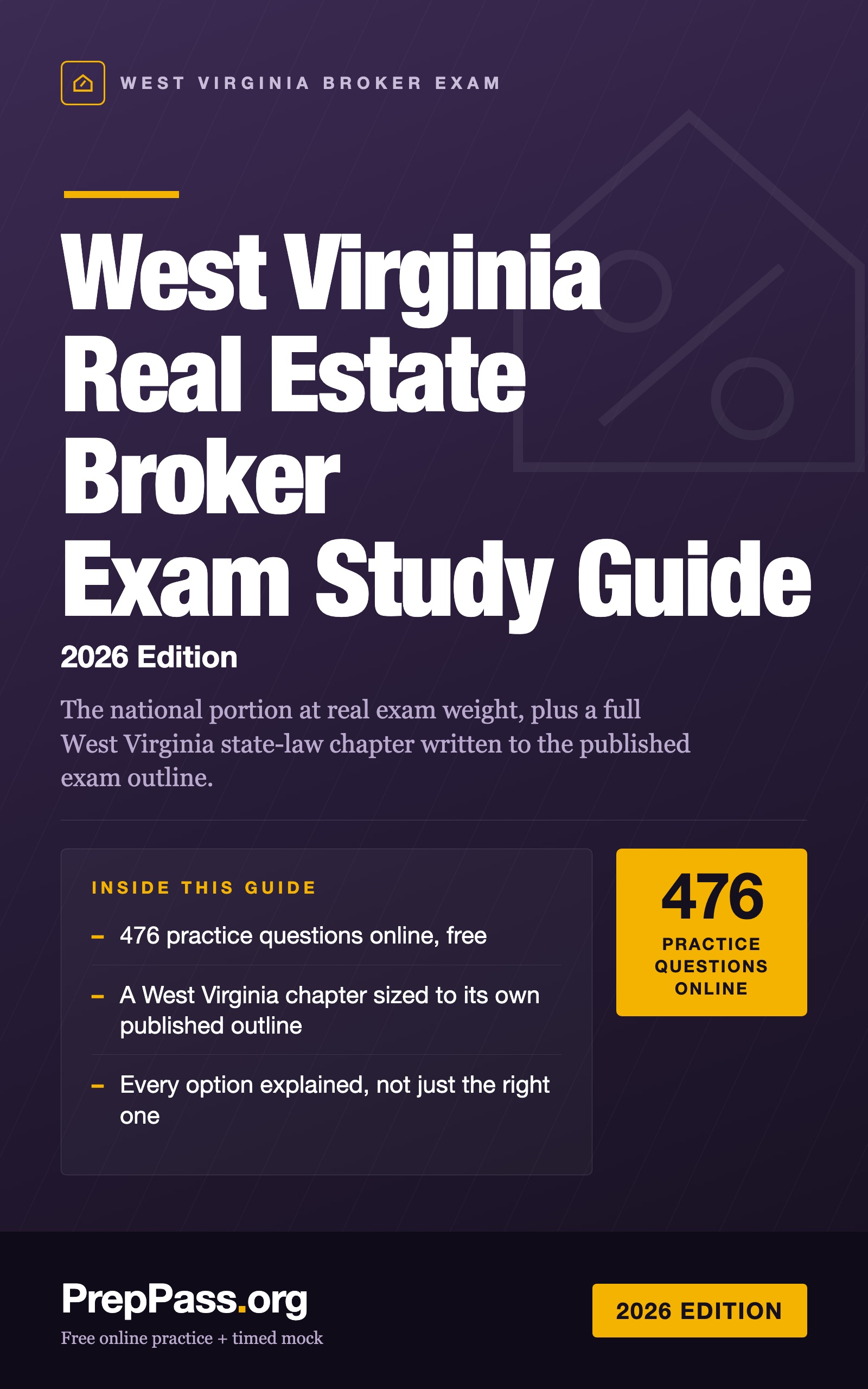
West Virginia Real Estate Broker · Ấn bản 2026
West Virginia Real Estate Broker Exam Study Guide (2026)
The national portion at real exam weight, plus a West Virginia chapter. The West Virginia chapter is sized to the published outline — 6 areas, 60 scored items — area by area, not flattened.
- Cả 8 chương phần thi toàn quốc cùng một chương đầy đủ về luật bất động sản West Virginia — PDF + EPUB bạn giữ
- Một đề luyện phần thi toàn quốc gồm 60 câu, kèm đáp án giải thích cả bốn phương án chứ không riêng phương án đúng
- 20 câu hỏi riêng về luật bất động sản West Virginia, kèm đáp án có giải thích
PDF + EPUB · tiếng Anh · 314 trang · $14.99 trả một lần
Sách này được viết bằng tiếng Anh — tệp PDF và EPUB bạn tải về đều bằng tiếng Anh.
Tải ngay sau khi thanh toán — không cần tài khoản, không thuê bao. Chính sách hoàn tiền
Thử 10 câu trước — miễn phí
Trả lời hết 10 câu, nộp bài xong sẽ thấy lời giải từng câu — kèm phần trong sách này dạy nội dung đó. Khoảng 5 phút, không cần đăng ký.
Bắt đầu 10 câu miễn phíXem bên trong cuốn sách
Ba trang thật, kết xuất thẳng từ tệp PDF bạn sẽ tải — một trang giảng giải, một câu hỏi có lời giải, và một trang tra cứu. Không trang nào được vẽ lại cho đẹp.
- Trang tra cứu nhanhPart C — Encumbrances a broker must read off a title report · Trang 102 của PDF
Một trang để lật lại: các con số, mốc thời hạn hoặc thuật ngữ gom về một chỗ.
- Một câu hỏi có lời giảiAnswer Key and Explanations · Trang 174 của PDF
Một câu luyện tập kèm đáp án và lập luận đằng sau — không chỉ là đáp án.
- Cách giảng dạyPart II — West Virginia State Law & Practice · Trang 310 của PDF
Trang giảng giải: kiến thức được trình bày bằng văn xuôi, theo trình tự kỳ thi kiểm tra.
Có gì — và không có gì
Bao gồm
- A West Virginia chapter written to the published exam outline, area by area
- Where West Virginia law departs from the national rule — both stated, so neither is guessed
- Supervision, trust accounts, brokerage operation and broker math
- A West Virginia practice set with every option explained, not just the right one
- 476 practice questions online, free, from the same bank
- PDF (print & tab it) + EPUB (phone / e-reader)
Không bao gồm
- Không gửi bản in — đây là tệp bạn tải về và có thể tự in
- Sách không kèm khoá video, giảng viên hay kèm riêng — video miễn phí trên trang là phần khác
- Không bao gồm lệ phí đăng ký thi hay phí trung tâm khảo thí — bạn vẫn nộp cho cơ quan chính thức
Mục lục
Xem 29 chương và trang bắt đầu của từng chương
- Part C — Advertising and recordkeeping compliancetr. 14
- Part D — Consumer contact and transaction integritytr. 16
- 2. Trust Funds, Escrow, and the Client’s Moneytr. 30
- Part C — Records that survive an audittr. 33
- Part D — Disputed moneytr. 34
- 3. Agency at the Broker Leveltr. 40
- Part C — Fiduciary duties, at the level a broker is examined ontr. 44
- Part D — Dual agency, designated agency, and the alternativestr. 46
- 4. Contracts and Brokerage Agreementstr. 55
- Part C — Options, rights of first refusal, and installment contractstr. 60
- Part D — Between contract and closingtr. 61
- 5. Fair Housing, Accessibility, and Antitrust: The Exposure You Carry Personallytr. 72
- Part C — The exemptions, and why they rarely save anyonetr. 78
- Part D — Disability: the distinction the exam always teststr. 79
- 6. Ownership, Land Use Controls, and Transfer of Titletr. 95
- Part C — Encumbrances a broker must read off a title reporttr. 101
- Part D — Legal descriptionstr. 103
- 7. Valuation, Financing, and the Federal Lending Lawstr. 113
- Part C — The instrumentstr. 121
- Part D — Loan programs, structures, and qualifyingtr. 123
- 8. Disclosures, Environmental Risk, and Property Managementtr. 136
- Part C — The management agreement and the manager’s authoritytr. 142
- Part D — Leases and tenanciestr. 144
- Practice Exam — 60 Questionstr. 153
- Answer Key and Explanationstr. 170
- Appendix A — Broker Math Cheat Sheettr. 221
- Appendix B — Glossarytr. 243
- Appendix C — Exam-Day Strategytr. 262
- Part II — West Virginia State Law & Practicetr. 267
Lấy từ chính tệp PDF bạn tải về, kèm trang bắt đầu của từng phần — không phải gõ tay ở đây.
Đọc miễn phí trọn một chương
Trọn vẹn một chương, đúng như trong eBook. Cuộn cửa sổ để đọc ngay tại đây; không cần tải, không cần email.
Đọc chương 9 ngay tại đây, không rời trang
Chúng tôi không đưa phần mở đầu dễ dãi — chương miễn phí mở thẳng vào một trong những phần đậm đặc nhất của cuốn sách, để bạn đánh giá cách dạy ở đúng chỗ kỳ thi trở nên khó.
What the West Virginia portion actually is
The West Virginia broker examination is delivered by Pearson VUE, and the numbers in this chapter are read out of the West Virginia candidate handbook #094900. The copy this rebuild worked from carries a PDF CreationDate of 2026-01-30 and a ModDate of 2026-04-17; the state content outline printed inside it carries an effective date of January 1, 2024. Hold both dates in mind. The handbook is recent. The outline inside it is not, and one of the rules it points you at has been amended since — see "What changed recently."
| Scored items | Time allotted | |
|---|---|---|
| National/general portion | 80 | — |
| West Virginia state portion | 60 | 90 minutes |
Ninety minutes for sixty scored items is a minute and a half apiece before you allow anything for the unscored items sitting among them. That is not a leisurely paper.
Two outlines on facing pages, and only one of them is yours
Handbook #094900 prints the West Virginia outlines on two facing pages, and they are different examinations.
Page 26 is headed "West Virginia Real Estate Salesperson Licensing Examination Content Outline" and states that the state-specific examinations are comprised of "fifty (50) scored items for sales candidates." Its five areas sum to 9 + 17 + 15 + 4 + 5 = 50.
Page 27 is headed "West Virginia Real Estate Broker Licensing Examination Content Outline / Effective: January 1, 2024," with the footer "West Virginia Exam Content Outline for Brokers," and states that "The state-specific examinations are comprised of sixty (60) scored items for broker candidates." Its six areas sum to 9 + 14 + 11 + 4 + 4 + 18 = 60.
| # | Area | Broker items | Salesperson items | Broker share |
|---|---|---|---|---|
| I | General Powers and Duties of the Real Estate Commission | 9 | 9 | 15% |
| II | Licensing | 14 | 17 | 23.3% |
| III | Real Estate Practice | 11 | 15 | 18.3% |
| IV | Agency Relationships | 4 | 4 | 6.7% |
| V | West Virginia Fair Housing | 4 | 5 | 6.7% |
| VI | Broker Management | 18 | — | 30% |
Read the last two columns against each other, because the arithmetic is not what candidates expect.
The broker paper is bigger — sixty items against fifty — and yet three of its five shared areas are smaller than the salesperson's. Licensing drops from 17 items to 14. Real Estate Practice drops from 15 to 11. Fair Housing drops from 5 to 4. Agency Relationships is unchanged at 4. The whole of the growth, and then some, lands in one place: Broker Management, 18 items, which does not exist on the salesperson page at all.
That is the structural fact this chapter is built around. Broker Management alone is 30 percent of the West Virginia state portion — nearly a third of the paper — and it is exactly the material a candidate revising from salesperson notes has never been shown. Meanwhile Agency Relationships is 4 items, 6.7 percent, which is unusually low for this exam family; in several neighboring states agency is the single largest block on the state paper. In West Virginia it is the second smallest.
This chapter is sized to those published numbers rather than to habit. Broker Management gets roughly 30 percent of the pages that follow and Agency Relationships roughly 6.7 percent, and if that feels backwards to you, that feeling is precisely the misallocation the weighting exists to punish. Spend your revision the way the exam spends its items.
Three things the source does not settle, and you should know it does not
The handbook contradicts itself on pretest items. The "Available Exams and Time Allotted" table on handbook page 8 states 5 pretest questions per part. Both outline pages — the salesperson's and the broker's — state "five to ten (5-10) pretest items." Those cannot both be the ceiling. Nothing in the document reconciles them, so the safe reading is the larger one: budget your 90 minutes as though you will face up to 70 West Virginia questions and be scored on 60, without being told which 60. If the real number turns out to be 65, you finish early. Plan the other way and you run out of clock.
The vendor publishes no statute or rule reference list for West Virginia. This is worth saying plainly because most candidates assume there is an official reading list. There is not. The only bibliography #094900 carries is a list of commercial textbooks — Dearborn, OnCourse Learning, Performance Programs — printed beside the national/general outline, and Pearson VUE expressly does not endorse them. They are not a source of West Virginia law and they are not attached to the West Virginia pages at all. Every W. Va. Code and W. Va. C.S.R. citation in this chapter is therefore ours, taken from the primary sources, and it is labeled as ours so you never mistake it for something the vendor published and guaranteed.
Area V prints no lettered subtopics. Every other area on the broker page carries an A-B-C breakdown. Area V — West Virginia Fair Housing, 4 items — carries none. That absence was confirmed in both the layout-preserving and the raw text extractions of page 27, so it is a fact about the source and not an omission from this transcription. Where this chapter organizes Area V internally, the organization is derived by us from the Fair Housing Act's own sections, and it is flagged as derived in that section rather than dressed up as a published structure.
The regulator throughout is the West Virginia Real Estate Commission. The governing law is W. Va. Code chapter 30, article 40 — the West Virginia Real Estate License Act, §§30-40-1 to 30-40-28 — together with the Commission's legislative rules at W. Va. C.S.R. Series 174.
Area I — General Powers and Duties of the Real Estate Commission (9 items, 15%)
Nine items, the same nine the salesperson gets, and the outline breaks them into three lettered subtopics: audits; complaints, investigations and hearings; and penalties for violations and cost of proceedings, the last of which is itself split into fines and other disciplinary action, and suspension and revocation.
A. Audits
The operative rule. W. Va. Code §30-40-7(q) puts among the Commission's general powers that it "may perform compliance audits on real estate brokerage offices, education providers or any other person regulated by the commission."
What it means in practice. The audit power is drawn by who is regulated, not by who has been accused. A brokerage that has never had a complaint filed against it is audit-eligible on the same footing as one that has, and so is an education provider, which is not a brokerage at all.
The rule that puts the auditor through the door. §30-40-18(h) requires the broker to keep records of all funds deposited into the trust fund account and provides that all records "shall be open to inspection by the commission or its duly authorized representative at all times during regular business hours at the broker's place of business." Rule 174-1-10.3 repeats that the records are open at the broker's usual place of business and adds a practical requirement the statute does not: the broker must give the Commission enough space to conduct the inspection without interference.
Where it bites. A representative arrives unannounced during business hours and asks for the trust account records. The broker produces them. Asking for a subpoena first reads the statute backwards — the Commission does hold subpoena power under §30-40-7(d), but it does not need to invoke it to see records the law has already declared open. Offering only closed files hides the pending deposits an audit exists to trace. Offering to mail everything in a month substitutes a schedule of the broker's choosing for the on-site access the statute grants.
The trap. Do not confuse §30-40-7(q) with §30-40-7(k), which is a narrower, complaint-driven power to examine the books of a licensee who has been charged, expressly confined to the specific violation alleged. One power follows regulation; the other follows a charge. Distractors are built by swapping them.
B. Complaints, investigations, hearings
The two-year bar. §30-40-20(a): "no disciplinary action may be brought against a licensee upon any complaint that is filed more than two years after the acts or omissions alleged in the complaint." A discovery rule of the same length runs for fraud, deceit or misrepresentation, and the period is tolled while an ongoing criminal matter keeps material evidence from the Commission.
The trap on the two-year bar. The five-year figure that lives next door in §30-40-19(a)(28) and rule 174-1-10.3 is the record retention period. It tells the broker how long to keep paper. It does not tell a consumer how long there is to complain, and a candidate who reaches for "five years" here has crossed two different rules that happen to sit in the same statute.
The licensee's clock. §30-40-20(c): the Commission gives the licensee a copy of the complaint, and "[t]he accused party shall file an answer within 20 days of the date of service." Failure to respond may be treated as an admission of the allegations. The same subsection lets the Commission grant an extension — firm, but not unforgiving.
What follows probable cause. §30-40-20(f): on a probable cause determination "the commission may hold a hearing in compliance with §30-40-21 of this code or may dispose of the matter informally through a consent agreement or otherwise." Both routes are open at the Commission's election, which is why most disciplinary files in practice close by agreement rather than by contested hearing.
The hearing clock. §30-40-21(b): hearings "shall be held at a time and place determined by the commission, but in no event less than 30 days after the notice of hearing is given." That is a floor protecting the licensee's ability to prepare, not a ceiling on the Commission.
Hold the three numbers apart. Two years to file. Twenty days to answer. Thirty days minimum between notice and hearing. They belong to three different moments in the same file and are the easiest items in Area I to lose by swapping.
The final decision must contain findings of fact, conclusions of law and the discipline imposed, and judicial review runs to the circuit court under §29A-5-4. Note the forum point: the circuit court appears after the agency has acted, on review. It is not the trial court for a licensing charge.
C. Penalties for violations and cost of proceedings
C.1 — Fines and other disciplinary action. §30-40-7(l) lets the Commission impose one or more sanctions and lists them: denial, probation, suspension, revocation, restitution, censure, required additional education, downgrade of license, an order returning compensation collected from an injured consumer, and an "administrative fine not to exceed $1,000 per day per violation."
Read the fine formula, not just the figure. It is per day and per violation, so a continuing violation accumulates well past $1,000 in total; the number caps the daily unit, not the exposure.
§30-40-21(g) adds the piece the outline names in the same breath: "[i]n addition to any other sanction imposed, the commission may require a licensee to pay the costs of the proceeding." Costs sit on top of the sanction rather than replacing it.
Where West Virginia separates the agency track from the court track. Everything above is the Commission's. §30-40-22 is a court's. A first misdemeanor violation carries up to 90 days in jail; the $5,000 figure is a criminal fine ceiling for a second individual offense or a first entity offense; and §30-40-22(g) lets a court award a penalty of up to three times the compensation a person received for unlicensed acts, recoverable by the aggrieved person. None of that is Commission-imposed, and no provision of the article gives the Commission a lien on a licensee's property.
Two sanctions in the §30-40-7(l) list repay a second look, because candidates read past them. Downgrade of license is a sanction in its own right — the Commission can move a broker to a lesser class rather than choosing between doing nothing and revoking. And an order returning compensation collected from an injured consumer is restitution: it puts the consumer back, it is measured by what the licensee took, and it is imposed by the Commission. Do not confuse it with the treble figure in §30-40-22(g), which is a court-awarded penalty measured at up to three times the compensation and recoverable by the aggrieved person in a civil action. One restores; the other punishes; and only one of them belongs to the Commission.
A structural point about where discipline comes from. The Commission's sanctions in §30-40-7(l) are the menu; the grounds are elsewhere, in §30-40-19, whose lettered subdivisions appear all through this chapter — failure to account for money, failure to supervise, net listings, unauthorized signs, accepting compensation from the wrong payer, discrimination, failure to preserve records. Area I is about the machinery. Areas II through VI supply most of the conduct that machinery acts on, which is why an Area I item often reads like a question about some other area with a procedural answer.
C.2 — Suspension and revocation. The provision to memorize is §30-40-19(e): "[t]he revocation of a broker's license shall automatically suspend the license of every associate broker and salesperson affiliated with the broker." The Commission then issues a replacement license under a new broker without charge on a proper application filed during the same license term.
Why the rule is shaped that way. An associate broker or salesperson may practice only under a broker. When the broker's license goes, the platform under the affiliated licensees goes with it — hence automatic suspension. But those licensees did nothing, so West Virginia does not make them pay for their broker's misconduct, and it does not make them requalify. Suspended, not revoked; free replacement, not re-examination. Both halves are tested.
Trước khi mua
- Nhận sách thế nào?
- Thanh toán xong, mục tải xuống hiện ngay trên trang này. Liên kết cũng được gửi qua email. Không cần tài khoản.
- Nếu sách không hợp thì sao?
- Gửi email trong vòng 14 ngày để được hoàn tiền đầy đủ, không cần lý do.
- Phần luyện tập miễn phí có bị bỏ không?
- Không. Mọi câu hỏi luyện tập, bài thi thử tính giờ và các chương miễn phí trên trang vẫn miễn phí. Cuốn sách là nửa "học", không phải hàng rào quanh phần miễn phí.
- Đọc trên điện thoại được không?
- Được — EPUB cho điện thoại và máy đọc sách, PDF để in và dán tab. Bạn nhận cả hai.
Chi tiết
The national portion at real exam weight, plus a West Virginia chapter. The West Virginia chapter is sized to the published outline — 6 areas, 60 scored items — area by area, not flattened.
- Format: PDF + EPUB download · 314 pages
- 80 practice questions in the book, with a full answer key
- 476 free practice questions for this exam on PrepPass, included at no cost
- $14.99 one-time — no subscription
- 14-day money-back guarantee · refund policy
- Cross-referenced against: W. Va. C.S.R. §174-2-1 et seq. — Schedule of Fees · W. Va. Code ch. 5, art. 11A — former West Virginia Fair Housing Act · Pearson VUE #094900 (rev handbook PDF CreationDate 2026-01-30, ModDate 2026-04-17 (outline eff. 2024-01-01))
- Last updated: September 2026
- Đối chiếu từ nguồn chính thức(W. Va. C.S.R. §174-2-1 et seq. — Schedule of Fees · W. Va. Code ch. 5, art. 11A — former West Virginia Fair Housing Act · Pearson VUE #094900 (rev handbook PDF CreationDate 2026-01-30, ModDate 2026-04-17 (outline eff. 2024-01-01)))
- 476 câu hỏi luyện tập miễn phí
- Tải ngay, thuộc về bạn trọn đời
Một real estate broker pre-license course có giá $200–$1,000. Cuốn sách này dạy cùng một kỳ thi — cùng quy định, đối chiếu theo chuẩn hiện hành — chỉ với $14.99 trả một lần, thuộc về bạn trọn đời.
Vì sao mua sách khi phần luyện tập miễn phí?
Câu hỏi luyện tập và bài thi thử tính giờ vẫn miễn phí — không có gì trên trang bị giấu sau cuốn sách này. Cuốn sách $14.99 là nửa "học": chính phần kiến thức, dạy theo trình tự, trong một tệp thuộc về bạn.
- Dạy có hệ thống — mọi phần thi giảng theo từng chương, từ đầu đến cuối, không chỉ là câu hỏi
- In ra & dán nhãn — PDF sẵn sàng để in, tô đậm, ghi chú và mang tới bàn học
- Học mọi nơi, ngoại tuyến — EPUB trên điện thoại hay máy đọc sách; không cần wifi, không cần tab trình duyệt
- Tất cả một chỗ — các chương, thẻ tóm tắt từng chương và câu hỏi luyện tập trong một tệp
- Của bạn trọn đời — trả một lần $14.99, tải ngay, không thuê bao
Và không rủi ro: Đảm bảo hoàn tiền 14 ngày — không hài lòng? Email cho chúng tôi để hoàn tiền đầy đủ, không cần lý do. Xem chính sách hoàn tiền.
Đảm bảo hoàn tiền 14 ngày · hoàn tiền đầy đủ, không cần lý do.
Mua một lần, truy cập tải về trọn đời. eBook là trọn bộ hướng dẫn ôn West Virginia Real Estate Broker ở dạng PDF và EPUB. Bản tóm tắt mang tính giáo dục, không phải tư vấn chuyên môn hay pháp lý — luôn xác nhận quy định hiện hành với nguồn chính thức. Cập nhật lần cuối: September 2026.