Sách ôn thi · Ấn bản 2026
Florida Real Estate Sales Associate Exam — Complete Study Guide (2026)
The FL sales associate exam, taught from Florida Statutes Chapter 475 and FREC rules.
- Độ dài
- 87 trang
- Câu hỏi luyện tập trong sách
- 30
- Thi thử trực tuyến PrepPass
- 100 câu · 210 phút
- Thông tin kỳ thi đối chiếu
- tháng 9 năm 2026
- Giao hàng
- PDF + EPUB · tiếng Anh · tải ngay
Vui lòng đọc trước khi mua: This is an independent study aid, not affiliated with or endorsed by the Florida DBPR, FREC, or the exam vendor.
Đọc phần còn lại của thông báo
It is authored from Florida Statutes Chapter 475, FREC rules, and standard real-estate principles. FL real-estate rules and figures (license/CE requirements, fees, documentary-stamp & intangible taxes) change — this guide teaches the rules and flags changeable figures to 'verify current with FREC/DBPR'; it is general educational information, not legal advice.
Về cuốn sách này
The FL sales associate exam, taught from Florida Statutes Chapter 475 and FREC rules — licensing & agency (the transaction-broker default), escrow, contracts, finance, valuation, and the real-estate math you'll be tested on.
Thông tin kỳ thi, ai nên dùng và thay đổi
Về chính kỳ thi này
| Cơ quan quản lý | Florida Department of Business and Professional Regulation (DBPR), for the Florida Real Estate Commission — kỳ thi do Pearson VUE tổ chức |
|---|---|
| Số câu hỏi | 100 câu hỏi |
| Thời gian làm bài | 210 phút |
| Điểm đậu | đúng 75 trên 100 câu |
| Lệ phí |
|
| Ngôn ngữ thi | Tiếng Anh · Tiếng Tây Ban Nha |
Xem bên trong cuốn sách
Ba trang thật, kết xuất thẳng từ tệp PDF bạn sẽ tải — lần lượt là một trang tra cứu, một trang giảng giải, và một câu hỏi có lời giải. Không trang nào được vẽ lại cho đẹp.
- Trang tra cứu nhanhCHAPTER 2 — Florida License Law and Brokerage Relationships · Trang 33 của PDF
Một trang để lật lại: các con số, mốc thời hạn hoặc thuật ngữ gom về một chỗ.
- Cách giảng dạyCHAPTER 5 — Property Valuation and Appraisal · Trang 64 của PDF
Trang giảng giải: kiến thức được trình bày bằng văn xuôi, theo trình tự kỳ thi kiểm tra.
- Một câu hỏi có lời giảiCHAPTER 1 — Real Estate Principles and Property Ownership · Trang 19 của PDF
Một câu luyện tập kèm đáp án và lập luận đằng sau — không chỉ là đáp án.
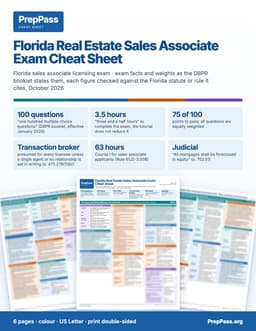
Thi trong vòng hai tuần?
Sách này là phần giảng dạy, đọc trong nhiều tuần. Nếu bạn thi trong vòng hai tuần, bảng tra cứu màu in được là sản phẩm còn lại: các con số then chốt, xếp theo từng phần.
6 trang · US Letter · PDF in được · giữ vĩnh viễn
Có gì — và không có gì
Bao gồm
- All exam areas at real weight, with FL specifics (Ch. 475, FREC)
- The transaction-broker default (§475.278) + escrow timelines
Không bao gồm
- Không gửi bản in — đây là tệp bạn tải về và có thể tự in
- Sách không kèm khoá video, giảng viên hay kèm riêng — video miễn phí trên trang là phần khác
Toàn bộ phần bao gồm và không bao gồm
Bao gồm
- Homestead (all three senses) + Save Our Homes; construction liens (Ch. 713)
- Worked FL math (doc-stamp on deed+note, intangible tax, prorations, millage)
- In-book practice questions with explanations (400+ more free on the site)
- A key-figures reference (changeable figures flagged verify-current) — PDF + EPUB
Không bao gồm
- Không bao gồm lệ phí đăng ký thi hay phí trung tâm khảo thí — bạn vẫn nộp cho cơ quan chính thức
Mục lục
Xem 6 phần và trang bắt đầu của từng phần
- CHAPTER 1 — Real Estate Principles and Property Ownershiptr. 9
- CHAPTER 2 — Florida License Law and Brokerage Relationshipstr. 21
- CHAPTER 3 — Real Estate Contracts and Listing Agreementstr. 35
- CHAPTER 4 — Real Estate Finance and Mortgagestr. 46
- CHAPTER 5 — Property Valuation and Appraisaltr. 57
- CHAPTER 6 — Real Estate Mathematicstr. 67
Lấy từ chính tệp PDF bạn tải về, kèm trang bắt đầu của từng phần — không phải gõ tay ở đây.
Đọc miễn phí trọn một chương
Trọn vẹn một chương, đúng như trong eBook. Cuộn cửa sổ để đọc ngay tại đây; không cần tải, không cần email.
Đọc chương 6 ngay tại đây, không rời trang
Real-estate math is the part most candidates fear — so that's the chapter you can read free: the exam's math patterns, worked step by step. If the teaching works here, it works everywhere.
About 13% of the exam. Math appears throughout the test and in daily practice. This chapter drills the calculations you must own: commissions and splits, seller's net, financing math (down payment, LTV, interest, points), area and land measurement, prorations (365-day and 360-day), and property taxes and percentages. Work every example on paper — the exam rewards doing, not reading.
The rule: convert, then apply the base formula
Almost every problem reduces to part = whole × rate, with the rate in decimal form (move the decimal two places left: 6% → 0.06). Rearranged: whole = part ÷ rate and rate = part ÷ whole. The single most valuable habit is to plug your answer back into the relationship to check it.
Worked example — commission and splits
A home sells for $325,000 at a 6% total commission. The listing and selling brokerages split it 50/50, and the listing agent keeps 60% of the brokerage's share.
- Total commission = 325,000 × 0.06 = $19,500.
- Each brokerage's side = 19,500 × 0.50 = $9,750.
- Listing agent = 9,750 × 0.60 = $5,850; brokerage keeps 9,750 − 5,850 = $3,900.
Work whole → part: total first, then split the sides, then split each side between brokerage and agent.
Worked example — seller's net (working backward)
A seller wants to net $188,000 after a 6% commission and no other costs.
- Price = net ÷ (1 − rate) = 188,000 ÷ (1 − 0.06) = 188,000 ÷ 0.94 = $200,000.
- Check: 200,000 × 0.06 = $12,000 commission; 200,000 − 12,000 = $188,000. ✓
Do not multiply the net by the rate and add it back — that understates the price.
Worked example — down payment, LTV, and points
A buyer purchases a $250,000 home (appraised at value) at 80% LTV with 2 points.
- Loan = 250,000 × 0.80 = $200,000.
- Down payment = 250,000 − 200,000 = $50,000.
- Points = 200,000 × 0.02 = $4,000 (on the loan).
To find LTV from a loan and value: LTV = loan ÷ value. A $180,000 loan on a $240,000 property = 180,000 ÷ 240,000 = 0.75 = 75%.
Worked example — simple interest, annual and monthly
A $200,000 loan at 5% interest, interest-only.
- Annual interest = 200,000 × 0.05 = $10,000.
- Monthly interest = 10,000 ÷ 12 = $833.33.
Interest = principal × rate × time. For part of a year, multiply by the fraction of the year (for example, 90 days ÷ 360, or ÷ 365 if the problem so specifies).
Worked example — area, acres, and the survey system
- A lot 80 ft × 120 ft = 80 × 120 = 9,600 sq ft.
- One acre = 43,560 sq ft. A 21,780 sq ft parcel = 21,780 ÷ 43,560 = 0.5 acre. A 3-acre tract = 3 × 43,560 = 130,680 sq ft.
- Cost estimate: a 2,000 sq ft house at $120/sq ft = 2,000 × 120 = $240,000.
- Government survey: a section = 1 square mile = 640 acres; a quarter-section = 640 ÷ 4 = 160 acres; a quarter of a quarter = 160 ÷ 4 = 40 acres.
- Triangle (corner lot): area = ½ × base × height.
Keep units consistent before multiplying (convert yards/inches to feet first) and label the result.
Worked example — proration on a 365-day year (taxes in arrears)
Annual taxes are $3,650, and the seller owned the property 120 days of the year through the day before closing. Florida taxes are paid in arrears, so the seller credits the buyer.
- Daily rate = 3,650 ÷ 365 = $10.00/day.
- Seller's share = 10.00 × 120 = $1,200, credited to the buyer at closing.
On a 360-day (banker's) year, the daily rate would be 3,650 ÷ 360 = $10.14/day — which is why the problem must state the method. Confirm who is charged for the closing date (contract or custom).
Worked example — property tax by millage
A property has a taxable value of $200,000 and a millage rate of 20 mills (recall 1 mill = $1 per $1,000).
- Tax = (200,000 ÷ 1,000) × 20 = 200 × 20 = $4,000 (equivalently, 200,000 × 0.020 = $4,000).
In Florida, taxable value = assessed value minus exemptions (like homestead); use the figure the problem provides, and remember exemption amounts and caps change — verify current with the county property appraiser.
Worked example — percentage change
A property rose from $250,000 to $280,000.
- Change = 280,000 − 250,000 = $30,000.
- Percent change = change ÷ original = 30,000 ÷ 250,000 = 0.12 = 12% increase.
To recover the original after a known increase: original = new ÷ (1 + rate) = 280,000 ÷ 1.12 = $250,000. Always divide the change by the original, never the new, amount.
The rule: the T-method for any part-whole problem
Many candidates organize percentage problems with a T (or circle): the total on top, the part and the rate on the bottom. Cover the unknown and the T shows the operation: part = total × rate; total = part ÷ rate; rate = part ÷ total. It works for commissions (price, rate, commission), interest (principal, rate, interest), and taxes (value, rate, tax). Label which number is the whole, which is the part, and which is the rate, then read the operation off the T. This single tool converts a large share of the math section into mechanical steps.
Worked example — profit and loss
An investor buys a property for $200,000, spends $30,000 on improvements, and sells for $276,000. What is the percent profit on total cost?
- Total cost = 200,000 + 30,000 = $230,000.
- Profit = 276,000 − 230,000 = $46,000.
- Percent profit = profit ÷ cost = 46,000 ÷ 230,000 = 0.20 = 20%.
Always divide profit by cost (the original investment), not by the sale price.
Worked example — appreciation
A home worth $250,000 appreciates 4% per year. Its value after two years:
- Compounded: Year 1 = 250,000 × 1.04 = $260,000; Year 2 = 260,000 × 1.04 = $270,400.
- Simple (add 4% of the original twice): 250,000 + 2 × (250,000 × 0.04) = 250,000 + 20,000 = $270,000.
Read whether the problem compounds or not — the answers differ.
Worked example — combined Florida transfer taxes
A property sells for $360,000 with a new $288,000 mortgage. Using common rates (deed $0.70/$100, note $0.35/$100, intangible 2 mills — verify current):
- Deed doc stamps: 360,000 ÷ 100 = 3,600 × $0.70 = $2,520.
- Note doc stamps: 288,000 ÷ 100 = 2,880 × $0.35 = $1,008.
- Intangible tax: 288,000 × 0.002 = $576.
- Total = 2,520 + 1,008 + 576 = $4,104.
Keep the bases straight: the deed tax is on the price; the note and intangible taxes are on the loan.
Worked example — prorating rent at closing
A rented property closes on the 20th of a 30-day month; the tenant paid $1,500 for the full month to the seller. The buyer owns from the 20th through the 30th (11 days, if the buyer is charged the closing date).
- Daily rent = 1,500 ÷ 30 = $50.00.
- Buyer's share = 50.00 × 11 = $550, credited to the buyer at closing (the seller collected rent for days the buyer will own).
Confirm the day count and whether the buyer or seller is charged for the closing date; prepaid rent means the seller credits the buyer for the unused days.
Worked example — mortgage payoff with accrued interest
A seller pays off a $120,000 loan balance at closing; interest is 6% and 15 days have accrued since the last payment (30-day-month convention).
- Monthly interest = 120,000 × 0.06 ÷ 12 = $600.
- 15 days = half a month = $300 accrued interest.
- Payoff = principal + accrued interest = 120,000 + 300 = $120,300 (plus any fees).
The payoff exceeds the balance because interest accrues to the payoff date.
Worked example — area of an irregular (L-shaped) lot
A lot is an L shape: a 100 ft × 60 ft rectangle with a 40 ft × 30 ft corner removed.
- Full rectangle = 100 × 60 = 6,000 sq ft.
- Removed corner = 40 × 30 = 1,200 sq ft.
- Area = 6,000 − 1,200 = 4,800 sq ft. In acres: 4,800 ÷ 43,560 = 0.11 acre.
Alternatively, split the L into two rectangles and add them — same result.
Worked example — graduated commission split
An agent is on a 70/30 split up to $50,000 of company-earned commission this year, then 100% after the cap. This deal earns the brokerage $9,000 gross, and the agent has already generated $46,000 toward the cap.
- The agent's 70% applies to the first $4,000 (reaching the $50,000 cap): 4,000 × 0.70 = $2,800.
- The remaining $5,000 is past the cap at 100%: 5,000 × 1.00 = $5,000.
- Agent total from this deal = 2,800 + 5,000 = $7,800.
Split-cap problems apply each rate to the portion in its tier — work in pieces, like a tax bracket.
Worked example — seller net with costs and a loan payoff
A seller wants to net $100,000 cash. They owe $180,000 on their mortgage and will pay a 6% commission and $4,000 in other closing costs. What sale price is needed?
- Required proceeds before commission = net $100,000 + payoff $180,000 + costs $4,000 = $284,000.
- Commission is 6% of price, so price × (1 − 0.06) = 284,000 → price × 0.94 = 284,000.
- Price = 284,000 ÷ 0.94 = $302,127.66, about $302,128.
Build the required proceeds first, then divide by (1 − commission rate). Check: commission ≈ $18,128; price − commission = $284,000; minus loan and costs leaves ≈ $100,000. ✓
Worked example — solving for the interest rate
A borrower pays $9,600 in interest in the first year on a $160,000 interest-only loan. What is the rate?
- Rate = interest ÷ principal = 9,600 ÷ 160,000 = 0.06 = 6%.
Rearranging interest = principal × rate × time lets you solve for any one unknown when you know the other three.
Worked example — square footage and price per square foot
A house has a main floor of 40 ft × 30 ft and a second floor of 40 ft × 20 ft. It is listed at $396,000.
- Main floor = 40 × 30 = 1,200 sq ft.
- Second floor = 40 × 20 = 800 sq ft.
- Total living area = 1,200 + 800 = 2,000 sq ft.
- Price per square foot = 396,000 ÷ 2,000 = $198/sq ft.
To compare with a comparable listed at $210/sq ft, multiply that rate by this home's area: 210 × 2,000 = $420,000 — showing the subject is priced below the comparable per foot. Add multi-level areas before dividing.
Worked example — the seller's net after commission and payoff (quick form)
A property sells for $400,000. The seller pays a 6% commission, owes $220,000 on the mortgage, and pays $3,000 in other costs. What does the seller net?
- Commission = 400,000 × 0.06 = $24,000.
- Seller's proceeds = price − commission − payoff − costs = 400,000 − 24,000 − 220,000 − 3,000 = $153,000.
Work top-down: start with the price, subtract each cost and the loan payoff. (Compare this to the reverse "net-to-price" problem, where you divide the required proceeds by (1 − rate).)
Worked example — capitalization to find value, income, or rate
The income approach's core relationship — Value = Net Operating Income ÷ Capitalization Rate — rearranges three ways:
- Value: NOI $90,000 at an 8% cap rate → 90,000 ÷ 0.08 = $1,125,000.
- NOI: a $1,000,000 property at a 7% cap rate → 1,000,000 × 0.07 = $70,000 of NOI.
- Cap rate: $84,000 NOI on an $1,200,000 property → 84,000 ÷ 1,200,000 = 0.07 = 7%.
Cover the unknown in the IRV triangle (Income on top, Rate and Value on the bottom) and read the operation: I = R × V, V = I ÷ R, R = I ÷ V.
Câu hỏi người mua thường hỏi
Nhận sách thế nào?
Thanh toán xong, mục tải xuống hiện ngay trên trang này. Liên kết cũng được gửi qua email. Không cần tài khoản.
Nếu sách không hợp thì sao?
Gửi email trong vòng 14 ngày để được hoàn tiền đầy đủ, không cần lý do.
Phần luyện tập miễn phí có bị bỏ không?
Không. Mọi câu hỏi luyện tập, bài thi thử tính giờ và các chương miễn phí trên trang vẫn miễn phí. Cuốn sách là nửa "học", không phải hàng rào quanh phần miễn phí.
Thêm câu hỏi (1)
Đọc trên điện thoại được không?
Được — EPUB cho điện thoại và máy đọc sách, PDF để in và dán tab. Bạn nhận cả hai.
Vì sao mua sách khi phần luyện tập miễn phí?
Câu hỏi luyện tập và bài thi thử tính giờ vẫn miễn phí — không có gì trên trang bị giấu sau cuốn sách này. Cuốn sách $14.99 là nửa "học": chính phần kiến thức, dạy theo trình tự, trong một tệp thuộc về bạn.
- Dạy có hệ thống — mọi phần thi giảng theo từng chương, từ đầu đến cuối, không chỉ là câu hỏi
- In ra & dán nhãn — PDF sẵn sàng để in, tô đậm, ghi chú và mang tới bàn học
- Học mọi nơi, ngoại tuyến — EPUB trên điện thoại hay máy đọc sách; không cần wifi, không cần tab trình duyệt
- Tất cả một chỗ — các chương và câu hỏi luyện tập trong một tệp
- Của bạn trọn đời — trả một lần $14.99, tải ngay, không thuê bao
Chi tiết
- Đối chiếu từ nguồn chính thức(Florida Statutes Chapter 475 + FREC rules)
- 416 câu hỏi luyện tập miễn phí
Một FL 63-hour pre-license course có giá $100–$400. Cuốn sách này dạy cùng một kỳ thi — cùng quy định, đối chiếu theo chuẩn hiện hành — chỉ với $14.99 trả một lần, thuộc về bạn trọn đời.
Mua một lần, truy cập tải về trọn đời. eBook là trọn bộ hướng dẫn ôn Florida Real Estate Sales Associate Exam ở dạng PDF và EPUB. Bản tóm tắt mang tính giáo dục, không phải tư vấn chuyên môn hay pháp lý — luôn xác nhận quy định hiện hành với nguồn chính thức.