Sen Lin, Người sáng lập PrepPass · Đối chiếu với NCSBN — National Council of State Boards of Nursing · Quy trình kiểm tra
Miễn phí · in được · không cần đăng ký
Phiếu Ôn Cấp Tốc Kỳ Thi NCLEX-PN Nursing (2026)
Phiếu Ôn Cấp Tốc miễn phí, in được cho kỳ thi NCLEX-PN Nursing: 120 điểm trọng tâm nhất, chia thành 6 phần theo các lĩnh vực nội dung của kỳ thi, mỗi phần kèm trọng số đã công bố.
- Miễn phí đọc, in và giữ lại — không cần đăng ký, không cần email, không có tường phí.
- In trực tiếp từ trình duyệt (Ctrl-P, hoặc Cmd-P trên Mac) — thanh điều hướng, các nút và liên kết không xuất hiện trong bản in.
- 400 câu hỏi luyện tập NCLEX-PN Nursing miễn phí trên cùng nội dung, câu nào cũng có giải thích.
- Cập nhật lần cuối: tháng 9 năm 2026.
Học theo trình tự?
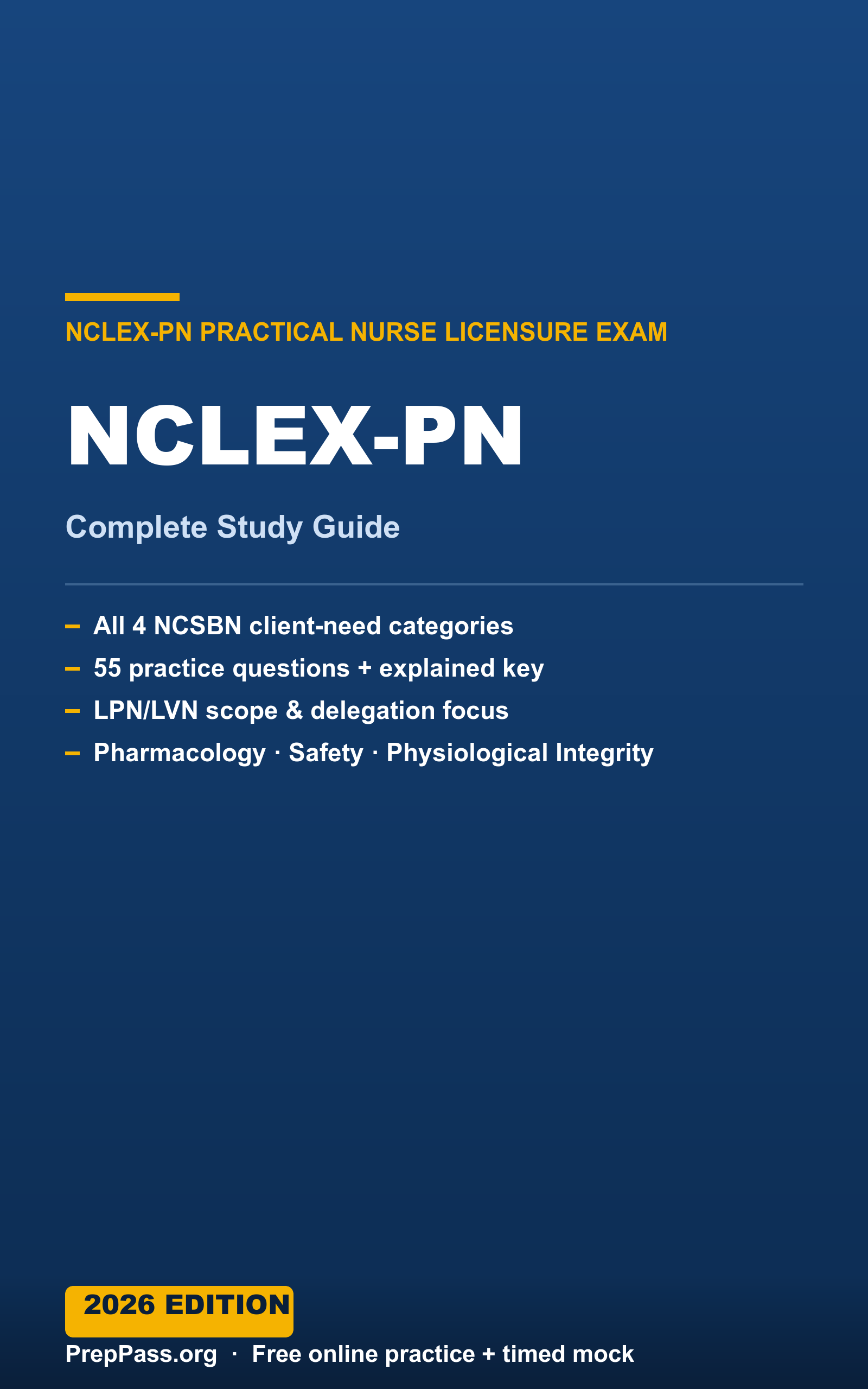
Luyện tập vẫn miễn phí. Trọn bộ hướng dẫn NCLEX-PN là chính phần kiến thức, dạy từ đầu đến cuối — tệp PDF + EPUB tải về, thuộc về bạn.
Coordinated Care
14% của kỳ thi- Know the LPN/LVN scope
- LPN/LVNs collect data, administer many medications, and provide basic care; they do not perform the initial assessment, create the care plan, or give initial teaching.
- Delegate only stable, routine tasks to UAP
- UAP may perform hygiene, feeding of clients without swallowing risk, ambulation, and recording of intake and output for stable clients.
- Never delegate the nursing process
- Assessment, planning, evaluation, and clinical judgment cannot be delegated to UAP.
- Use the five rights of delegation
- Delegate the right task, under the right circumstances, to the right person, with the right direction and the right supervision.
- Honor client autonomy
- Competent adults may refuse treatment; document the refusal and notify the RN or provider.
- Report unsafe or dishonest practice
- Falsified documentation, impaired coworkers, and unsafe conditions must be reported through the chain of command.
- Act as a mandatory reporter
- Suspected abuse or neglect of children, elders, or vulnerable adults must be reported to authorities.
- Support informed consent
- The provider explains the procedure and obtains consent; the nurse witnesses the signature and notifies the provider of client questions.
- Share on a need-to-know basis
- Only members of the care team who need information to provide care may access it.
- Avoid casual disclosure
- Do not discuss clients in public areas or with people not involved in care.
- Follow authorized exceptions
- Mandatory reporting and communication with the treating team are permitted disclosures.
- Protect records and screens
- Log off computers and secure printed records to prevent unauthorized access.
- Use the ABCs
- Address airway, breathing, and circulation problems before other needs.
- Apply Maslow's hierarchy
- Meet physiologic and safety needs before comfort, teaching, or self-esteem needs.
- Identify actual over potential problems
- Real, life-threatening problems generally take priority over potential risks.
- Communicate changes promptly
- Report new or worsening findings to the RN so the plan of care can be adjusted.
- Use SBAR for hand-off
- Report the Situation, Background, Assessment, and Recommendation to organize communication.
- Document objectively
- Record specific, factual, measurable data with the time of the observation.
- Read back verbal orders
- Write down and read back verbal or telephone orders and have them signed per policy.
- Chart promptly and correct properly
- Document care after it is provided and correct errors according to facility policy without obscuring the original entry.
Safety and Infection Control
12% của kỳ thi- Use two identifiers
- Verify at least two client identifiers such as name and date of birth; never use room number alone.
- Follow the rights of medication administration
- Confirm the right client, drug, dose, route, time, and documentation before giving any medication.
- Check the label three times
- Compare the medication label to the order when retrieving, preparing, and administering it.
- Do not leave medications unattended
- Give medications directly and observe the client take them rather than leaving them at the bedside.
- Screen for fall risk
- Assess age, mobility, medications, and history of dizziness or falls.
- Keep the environment safe
- Keep the bed low and locked, the call light within reach, and pathways clear.
- Use assistive measures
- Provide nonskid footwear, gait belts, and assistance with ambulation as needed.
- Use restraints only as a last resort
- Restraints require a time-limited provider order, less restrictive alternatives first, and frequent monitoring; never for convenience.
- Follow RACE for fire
- Rescue anyone in danger, Activate the alarm, Contain the fire, and Extinguish or Evacuate.
- Use PASS for extinguishers
- Pull the pin, Aim at the base, Squeeze the handle, and Sweep side to side.
- Protect during seizures
- Cushion the head, turn the client to the side, and never force objects into the mouth or restrain movements.
- Handle oxygen safely
- Prohibit smoking and open flames, post warning signs, and secure tanks upright.
- Perform hand hygiene
- Clean hands before and after every client contact and after removing gloves.
- Use personal protective equipment appropriately
- Wear gloves, gowns, masks, and eye protection based on anticipated exposure.
- Handle sharps safely
- Dispose of needles in puncture-resistant containers and never recap needles by hand.
- Treat all body fluids as infectious
- Apply precautions to blood and body fluids from every client.
- Apply contact precautions
- Use gloves and gowns for organisms spread by contact; wash with soap and water for C. difficile because alcohol does not kill spores.
- Apply droplet precautions
- Wear a surgical mask within close range for organisms spread by large respiratory droplets.
- Apply airborne precautions
- Use an N95 respirator and a negative-pressure room for tuberculosis, measles, and varicella.
- Maintain a closed catheter system
- Keep urinary drainage bags below bladder level and the system intact to prevent infection.
Health Promotion and Maintenance
14% của kỳ thi- Know infant milestones
- Infants typically achieve head control, then sit unsupported around 6 months, and stand and take steps near 12 months.
- Recognize toddler skills
- A 2-year-old usually walks up stairs and uses two-word phrases.
- Support adolescent development
- Adolescents develop identity, seek independence, and value peer relationships.
- Anticipate older adult changes
- Aging brings slower metabolism and increased risk of falls and constipation, requiring tailored teaching.
- Encourage recommended screenings
- Support blood pressure checks, colorectal screening around age 45, and breast and cervical screening per guidelines.
- Teach that wellness does not replace screening
- Clients need screening even when they feel well, because many conditions are silent early.
- Promote skin cancer prevention
- Advise broad-spectrum sunscreen, protective clothing, and avoiding tanning beds and peak sun.
- Reinforce follow-up of abnormal findings
- Elevated readings such as a blood pressure of 148/94 mmHg warrant lifestyle changes and provider follow-up.
- Start hepatitis B at birth
- The first hepatitis B dose is given shortly after birth to prevent perinatal transmission.
- Follow the childhood schedule
- Multiple vaccines are given in the first two years to build early immunity.
- Address mild expected reactions
- Low-grade fever and soreness are common after vaccination and are usually self-limiting.
- Support catch-up and adult vaccines
- Encourage adolescents and adults to stay current per recommendations.
- Promote balanced activity
- General guidance suggests about 150 minutes of moderate aerobic activity weekly plus strength training.
- Prevent constipation naturally
- Adequate fiber, fluids, and activity support normal bowel function without routine laxatives or enemas.
- Support bone health
- Adequate calcium and vitamin D with weight-bearing exercise helps prevent osteoporosis.
- Introduce solids appropriately
- Solid foods begin around 6 months with single-ingredient foods, and honey is avoided in the first year.
- Encourage folic acid
- Folic acid before and during early pregnancy helps prevent neural tube defects.
- Recognize normal pregnancy changes
- Mild dependent edema, breast tenderness, and urinary frequency are common.
- Report pregnancy danger signs
- Vaginal bleeding with cramping, severe or facial swelling, and severe headache must be reported promptly.
- Teach safe infant sleep
- Place infants supine on a firm surface without loose bedding to reduce the risk of sudden infant death syndrome.
Psychosocial Integrity
12% của kỳ thi- Use open-ended and reflective techniques
- Invite the client to say more, and paraphrase or reflect feelings to confirm understanding.
- Acknowledge emotions
- Naming and validating feelings such as anger or fear helps identify underlying concerns.
- Avoid nontherapeutic responses
- Do not give false reassurance, offer advice, minimize feelings, or change the subject.
- Allow silence and pacing
- Give clients time to respond and follow their pace, especially after trauma.
- Reinforce adaptive coping
- Support social support, relaxation techniques, and problem-solving.
- Identify maladaptive coping
- Recognize alcohol use, social withdrawal, and denial as unhealthy responses.
- Support body-image adjustment
- Acknowledge feelings about changes such as a new colostomy before self-care teaching.
- Reduce stimulation during anxiety
- Stay with an anxious client, use a calm voice, and give short, simple directions.
- Recognize grief responses
- Denial, anger, bargaining, depression, and acceptance may occur in any order.
- Support the grieving client
- Provide presence, listening, and honest, compassionate communication.
- Respect individual and cultural expressions
- Grief varies among individuals and cultures and should not be judged.
- Involve support systems
- Encourage family, spiritual, and community resources as the client wishes.
- Assess suicide risk directly
- Warning signs include giving away possessions and saying goodbye; ask directly and ensure safety.
- Report suspected abuse
- Nurses are mandatory reporters and must report suspected abuse or neglect.
- Manage withdrawal safely
- Provide a quiet, low-stimulation environment and close monitoring during alcohol withdrawal.
- De-escalate agitation
- Use a calm approach, reduce stimulation, and ensure environmental safety.
- Respect decision-making preferences
- Honor a competent client's wish to involve family in decisions.
- Provide culturally sensitive care
- Adapt communication and care to the client's values and beliefs.
- Support spiritual needs
- Facilitate access to spiritual resources the client requests.
- Reassure confused clients
- Offer orientation, calm presence, and comfort to reduce anxiety in confused older adults.
Physiological Integrity
26% của kỳ thi- Prevent pressure injuries
- Reposition immobile clients at least every 2 hours and keep skin clean and dry; avoid vigorous massage of reddened areas.
- Support safe swallowing
- Position clients upright and provide thickened liquids as ordered for dysphagia to prevent aspiration.
- Elevate for tube feeding
- Keep the head of the bed at least 30 degrees during enteral feeding to reduce aspiration risk.
- Promote elimination
- Monitor intake and output and maintain closed urinary drainage systems below bladder level.
- Report worsening heart failure
- A sudden weight gain suggests fluid retention and should be reported promptly.
- Recognize fluid imbalances
- Dry mucous membranes and poor turgor suggest deficit; edema and crackles suggest overload.
- Watch urine output
- Report output persistently below 30 mL per hour as it may indicate impaired perfusion.
- Monitor neurovascular status
- After casting, report severe unrelieved pain and numbness that may indicate compartment syndrome.
- Prevent respiratory complications
- Encourage incentive spirometry, coughing, and deep breathing to prevent atelectasis and pneumonia.
- Protect surgical sites
- Maintain positioning such as abduction after hip replacement to prevent dislocation.
- Recognize embolism
- Sudden dyspnea, chest pain, and confusion after a long-bone fracture may signal fat or pulmonary embolism.
- Monitor invasive devices
- Report continuous bubbling in a chest tube water seal and never clamp a chest tube unnecessarily.
- Treat hypoglycemia promptly
- For glucose around 55 mg/dL with symptoms, give 15 grams of fast-acting carbohydrate and recheck.
- Recognize thyroid patterns
- Hypothyroidism causes fatigue, cold intolerance, and constipation; hyperthyroidism causes the opposite.
- Watch for post-thyroidectomy hypocalcemia
- Tingling around the mouth and muscle twitching require prompt reporting.
- Teach diabetic foot care
- Daily foot inspection and well-fitting shoes prevent injury and support ulcer healing.
- Titrate oxygen carefully in COPD
- Use low-flow oxygen such as 2 L per minute to avoid suppressing respiratory drive.
- Position for breathing
- Use semi-Fowler's or Fowler's position for ascites and respiratory distress.
- Recognize transfusion reactions
- Fever, chills, and flank pain require stopping the transfusion and notifying the RN.
- Identify common presentations
- Right lower quadrant rebound pain suggests appendicitis, and burning with frequency suggests urinary tract infection.
Pharmacology and Medication Administration
22% của kỳ thi- Apply the rights of administration
- Confirm the right client, drug, dose, route, time, reason, and documentation.
- Verify concerns before giving
- If a client says a pill looks unfamiliar, hold it and verify the order and drug.
- Calculate carefully
- Use desired over available times the volume, and double-check high-alert calculations.
- Use scored tablets correctly
- Only scored tablets may be halved to reach an ordered dose such as 1.5 tablets.
- Give intramuscular injections safely
- The ventrogluteal site is preferred because it avoids major nerves and vessels.
- Administer subcutaneous heparin correctly
- Do not aspirate or massage the site to reduce bruising.
- Instill eye and ear drops properly
- Place eye drops in the lower conjunctival sac; pull the adult pinna up and back for ear drops.
- Give medications through feeding tubes
- Verify placement, flush before and after, and do not crush enteric-coated tablets.
- Check apical pulse before digoxin
- Count the apical rate for a full minute and hold for a rate below 60 in adults.
- Monitor anticoagulation
- Warfarin is monitored with prothrombin time and INR.
- Watch electrolytes with diuretics
- Loop diuretics like furosemide can cause hypokalemia.
- Hold potassium when elevated
- Do not give supplemental potassium when the serum level is high, such as 5.8 mEq/L.
- Respond to opioid respiratory depression
- Hold the opioid, stimulate the client, and notify the RN for a rate of 8 and sedation.
- Stop infusions for allergic reactions
- Itching, hives, and facial swelling require stopping the infusion and notifying the RN.
- Report ACE inhibitor cough
- A persistent dry cough should be reported for possible medication change.
- Teach expected versus serious effects
- Iron causes harmless dark stools, while metformin-related muscle pain and dyspnea may signal lactic acidosis.
- Prevent acetaminophen toxicity
- Do not exceed the maximum daily dose and check combination products for acetaminophen.
- Complete antibiotic courses
- Finish the full prescription and do not save or share antibiotics to reduce resistance.
- Teach correct timing
- Take levothyroxine in the morning on an empty stomach and separate tetracyclines from dairy and antacids.
- Do not stop certain drugs abruptly
- Taper corticosteroids as directed to avoid adrenal insufficiency.
Giờ hãy chứng minh bạn nhớ
Đọc qua đề cương không giống với nhớ được khi vào phòng thi. Luyện các câu hỏi NCLEX-PN Nursing miễn phí để tìm ra những lĩnh vực bạn hay sai, rồi làm một đề mô phỏng có tính giờ.
Tài liệu hỗ trợ học tập, không thay thế tài liệu chính thức — luôn kiểm tra quy định hiện hành với NCSBN — National Council of State Boards of Nursing.