Holding and Service
Once food is cooked, the job is not over — holding and serving it safely keeps pathogens from growing before it reaches the guest. This chapter covers hot and cold holding, using time as a control, self-service rules, and re-service.
Hot and Cold Holding
Holding equipment keeps food safe but does not heat or cool it, so food must already be at a safe temperature before it goes in. Hot TCS food must be held at 135°F or higher, and cold TCS food at 41°F or lower. Check internal temperatures at least every four hours with a clean, calibrated thermometer, and take action the moment food drifts — many operations check every two hours so there is time to correct a problem before food must be thrown out. Never use hot-holding equipment like a steam table to reheat food; bring food up to temperature on the stove first. Stir hot food to keep the temperature even, keep lids on to retain heat, and protect food with sneeze guards or covers. Discard TCS food that has been in the danger zone too long.
Time as a Public Health Control (TPHC)
Sometimes an operation holds food without temperature control, using time alone as the safeguard — for example, a pizza sitting out at a busy counter. This is allowed only with a written plan and clear rules. If cold food starts at 41°F or lower or hot food starts at 135°F or higher, it may be held without temperature control for up to four hours, then it must be sold, served, or discarded. Alternatively, cold food may be held for up to six hours if it starts at 41°F or lower and never exceeds 70°F, checking the temperature along the way. The food must be labeled with the time it was removed from temperature control and the discard time. Once the time is up, you cannot cool it and reuse it — it must be thrown away.
Self-Service and Displays
Buffets, salad bars, and self-service displays put food within reach of the public, so they need extra protection. Provide sneeze guards or food shields to block contamination from coughs and sneezes, and keep hot and cold food at the correct holding temperatures with clean, working equipment. Supply clean serving utensils for each dish and change them regularly. Do not let customers refill a dirty plate or reuse a glass at a self-service line — they must take a clean one each trip. Label all food so guests know what it is, which also helps with allergens. Assign a staff member to monitor the display, refill using clean containers rather than topping off old food, and check temperatures on schedule. Raw, unpackaged animal food such as raw fish for sushi generally may not be offered for self-service.
Re-Service and Leftovers
A common question is what can be served again after it leaves the kitchen. The rule is strict: food that has been served to one customer cannot be re-served to another. That means uneaten bread in a basket, garnishes on a plate, or an opened but untouched condiment cannot go to the next table. There are narrow exceptions for unopened, prepackaged items in good condition, such as a sealed packet of crackers or an unopened bottle of ketchup, which may be re-served. Condiments in squeeze bottles or covered dispensers are fine because they are protected. When it comes to leftovers you prepared and cooled properly, you may reheat them once to 165°F for hot holding, but food should not be cooled and reheated repeatedly. When in doubt, throw it out.
Last updated: October 2026
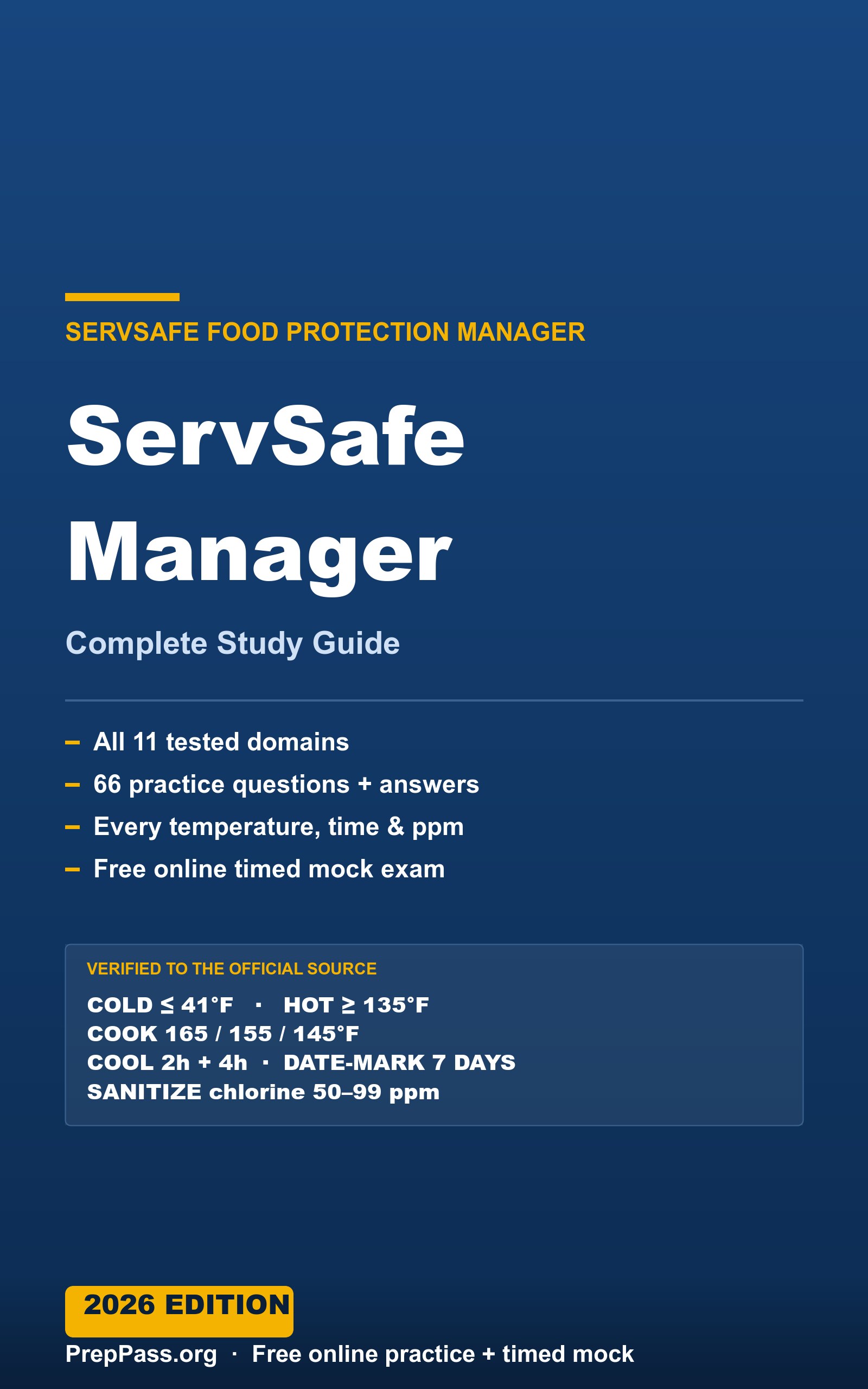
Trong sách hướng dẫn ServSafe Food Protection Manager: Mỗi chương trong 8 chương đều khép lại bằng một bài kiểm tra, kèm đáp án giải thích từng câu. Luyện tập ở đây vẫn miễn phí.