Preparation and Cooking
The prep line and the stove are where temperature control is won or lost. Correct thawing, hitting minimum internal cooking temperatures, and cooling leftovers fast are the core skills. This chapter gives you the exact numbers to teach and verify.
Safe Thawing
Frozen food must be thawed in a way that keeps it out of the danger zone. There are only four approved methods. First, thaw in the refrigerator at 41°F or lower — the safest but slowest, requiring planning a day ahead. Second, thaw submerged under running potable water at 70°F or lower, with the water flowing fast enough to wash food particles into the overflow, for no more than two hours. Third, thaw in a microwave, but only if the food will be cooked immediately afterward. Fourth, thaw as part of the cooking process, such as dropping a frozen patty straight onto the grill. Never thaw food at room temperature on the counter, because the outside sits in the danger zone for hours while the center is still frozen. Always plan thawing so food never lingers between 41°F and 135°F.
Minimum Internal Cooking Temperatures
Cooking to the correct internal temperature is what destroys pathogens, and different foods need different temperatures held for a specific time. Poultry, stuffing, stuffed meats, and any dish combining raw and cooked TCS ingredients must reach 165°F for one second. Ground meat such as hamburger, sausage, and ground pork, plus injected meats and ground seafood, must reach 155°F for 17 seconds. Seafood, steaks and chops of pork, beef, veal, and lamb, and shell eggs cooked for immediate service must reach 145°F for 15 seconds. Roasts of pork and beef must reach 145°F held for four minutes. Commercially processed ready-to-eat food that is only being reheated for hot holding needs 135°F. Always check the temperature in the thickest part with a calibrated thermometer, and check more than one spot on large items.
Cooling Cooked Food
Cooling is one of the riskiest steps because hot food passes slowly through the danger zone, giving surviving spores a chance to grow. The Food Code requires a two-stage cool: hot TCS food must drop from 135°F to 70°F within the first two hours, then from 70°F to 41°F or lower within the next four hours, for a total of six hours. If the food does not reach 70°F within the first two hours, you must reheat it and start over or discard it. Speed up cooling by dividing food into smaller or shallow portions, using an ice-water bath, adding ice as an ingredient, stirring with an ice paddle, and placing loosely covered pans in a blast chiller or the coldest part of the walk-in. Never cool large covered pots on the counter — they hold heat for hours.
Reheating for Hot Holding
When you reheat TCS food that will be hot-held, you must reheat it quickly and to a high enough temperature to kill any pathogens that grew during storage. Food reheated for hot holding must reach an internal temperature of 165°F for at least 15 seconds within two hours. The two-hour limit matters: reheating slowly in a steam table or holding unit lets food dwell in the danger zone, so use a stove, oven, or microwave to bring it up fast, then transfer to holding equipment. Commercially processed and packaged ready-to-eat food, like canned soup or pre-cooked items, only needs to reach 135°F when reheated for hot holding. Food that is reheated for immediate service to a customer can be served at any temperature, since it was already safely cooked.
Last updated: October 2026
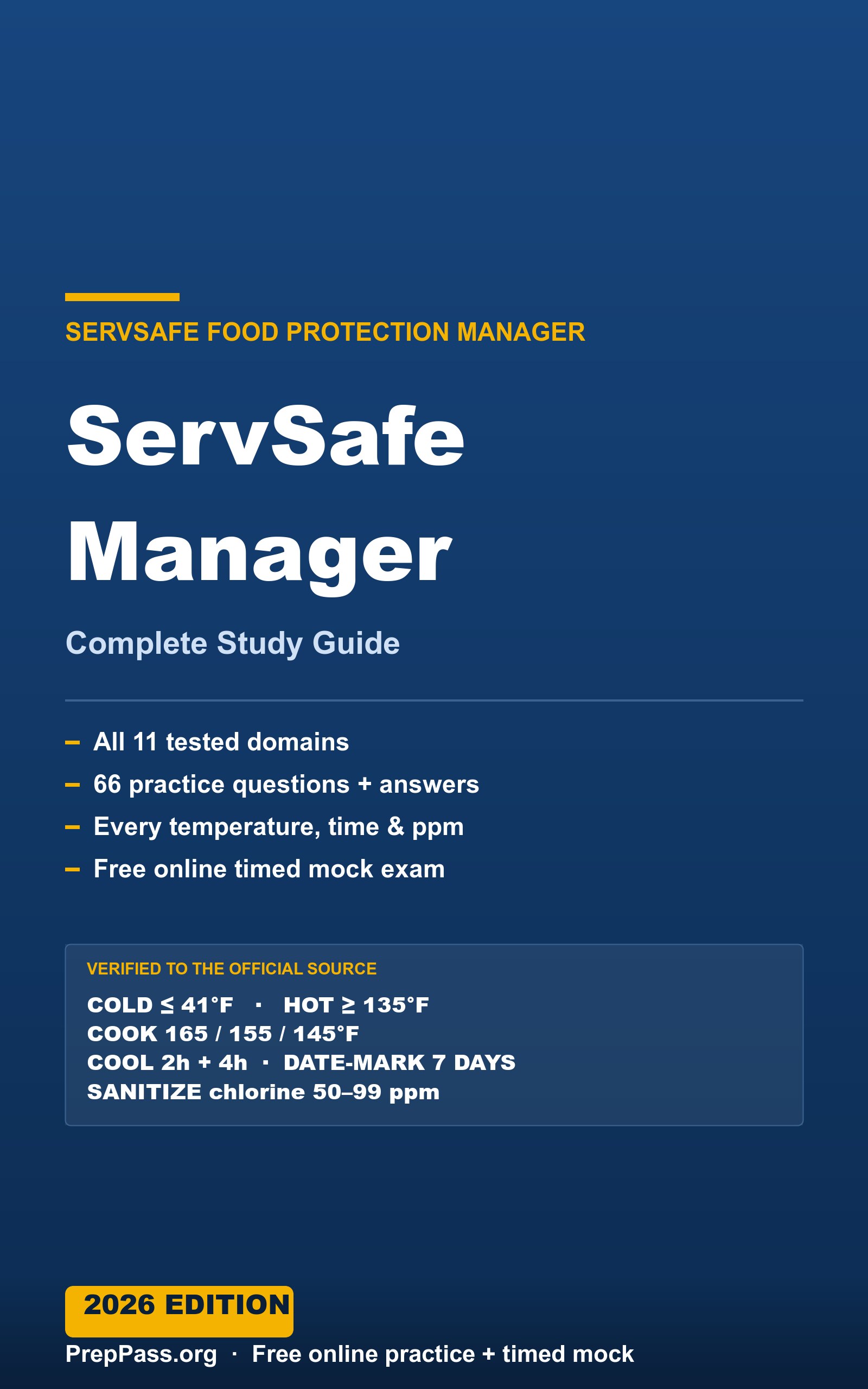
Trong sách hướng dẫn ServSafe Food Protection Manager: Mỗi chương trong 8 chương đều khép lại bằng một bài kiểm tra, kèm đáp án giải thích từng câu. Luyện tập ở đây vẫn miễn phí.