Cosmetology State Board · 2026 版
Cosmetology State Board Exam — Complete Study Guide (2026)
The NIC-based written theory exam — infection control plus hair, skin, and nail science.
- 书内 64 道练习题,配完整答案解析
- 88 页逐章讲解 —— 不是一堆题目的堆砌
- 已与NIC content outline / EPA / OSHA逐条核对
$14.99一次买断 · 永久下载 · 无订阅
PDF + EPUB · 英文 · 88 页 · $14.99 一次买断
本书为英文版,下载的 PDF 与 EPUB 均为英文。
付款后立即下载 —— 无需注册账号,无订阅。
14 天退款保证:任何原因不满意?购买后 14 天内发邮件至 support@preppass.org 即可全额退款。 这是电子下载,无需寄回任何东西。 退款政策
购买前请阅读: Not written for California's exam: this book follows the NIC national content outline and does not teach California's own laws and rules.
阅读本声明的其余部分
California's written exam has been PSI's national exam since July 2022; if you test there, read PSI's California content outline alongside this book.
先做 10 题,看看讲解 —— 免费
先答完这 10 题,交卷后每题都有解析 —— 还会指出本指南里讲这一点的那一节。约 5 分钟,无需注册。
开始 10 道免费题翻开这本书看看
三页真实内页,直接从你将下载的 PDF 渲染而来 —— 依次是一页速查、一页讲解、一道带解析的例题。没有任何一页是为了好看而重画的。
- 速查页7. Nail Care — Manicuring & Pedicuring · PDF 第 67 页
一页可以随时翻回来的内容:把数字、期限或术语集中在一处。
- 怎么讲7. Nail Care — Manicuring & Pedicuring · PDF 第 60 页
讲解页:用文字把知识讲清楚,顺序与考试考查的顺序一致。
- 一道题的完整解析Chapter 1 — Infection Control, Safety & Sanitation · PDF 第 69 页
一道练习题,连同答案和背后的推理 —— 不只是一个答案键。
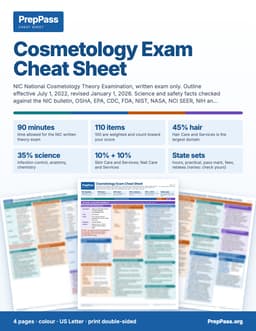
两周内就要考试?
这本指南是系统讲解,要花几周读。如果两周内就考,可打印的彩色速查表是另一款产品:考试涉及的关键数字,按章节排好。
4 页 · US Letter · 可打印 PDF · 永久保存
How this book compares
Since 1 July 2022 California's Board of Barbering and Cosmetology has given the national written exam developed by PSI, and the Board links PSI's candidate bulletin with each exam's content outline. This book is written from the NIC national content outline, not from PSI's California outline, and does not teach California's own laws and rules.
| Resource | Price | What you get | Choose it if |
|---|---|---|---|
| This bookCosmetology State Board Exam — Complete Study Guide (2026)PrepPass | $14.99 | Downloadable review of the science on cosmetology written (theory) exams
| Choose this book for infection control and hair, skin and nail science taught in writing. Read your own state's exam outline and rules alongside it; California's law is not in this book. |
| From the exam bodyPSI Candidate Information Bulletin and content outlines (opens the publisher's page in a new tab)PSI, for the California Board of Barbering and Cosmetology | Free, linked from the Board's exam page | The outline and reference list California's written exam is built from | Read it in any case if you test in California: it is the outline your exam is written to. |
| AlternativeCosmetology Exam Secrets (opens the publisher's page in a new tab)Mometrix Test Preparation | $39.99 ebook; $44.99 printed book | Study guide with practice questions | Choose Mometrix if you want a printed copy. |
This book
Cosmetology State Board Exam — Complete Study Guide (2026)
PrepPass
- Price
- $14.99
- What you get
Downloadable review of the science on cosmetology written (theory) exams
- 64 practice questions with explanations
- 88 pages, PDF + EPUB
- Choose it if
- Choose this book for infection control and hair, skin and nail science taught in writing. Read your own state's exam outline and rules alongside it; California's law is not in this book.
From the exam body
PSI Candidate Information Bulletin and content outlines (opens the publisher's page in a new tab)
PSI, for the California Board of Barbering and Cosmetology
- Price
- Free, linked from the Board's exam page
- What you get
The outline and reference list California's written exam is built from
- Choose it if
- Read it in any case if you test in California: it is the outline your exam is written to.
Alternative
Cosmetology Exam Secrets (opens the publisher's page in a new tab)
Mometrix Test Preparation
- Price
- $39.99 ebook; $44.99 printed book
- What you get
Study guide with practice questions
- Choose it if
- Choose Mometrix if you want a printed copy.
Other resources' prices and contents are as listed on each publisher's or seller's own page, checked September 24, 2026. Prices change; confirm on the linked page before you buy. This book's price and contents come from our own catalog.
Sources (2)
- https://www.barbercosmo.ca.gov/applicants/national.shtml — read September 24, 2026
- https://www.mometrix.com/studyguides/cosmetology/ — read September 24, 2026
包含什么,不包含什么
包含
- A “key facts” cram box in every chapter — the numbers, times and disinfectant rules on one page each
- A worked scenario and the exam traps, chapter by chapter, so you practice the wording the board actually uses
- All 4 NIC theory domains, weighted like the NIC written exam
- Infection control: EPA-registered disinfectants, wet disinfection, OSHA bloodborne
- Verified science: pH, the acid mantle, peroxide volumes, oxidation-color chemistry
- Hair, skin, and nail structure, disorders, and services
- 64 original practice questions with answer explanations
- State-set rules taught and flagged — confirm the numbers with your board
不包含
- 不寄送纸质书 —— 这是一份你下载后可自行打印的文件
- 购书不含视频课程、讲师或一对一辅导 —— 站上的免费视频是另一回事
- 不含考试报名费与考点费用,这些仍需向官方机构缴纳
目录
查看 11 个部分及各部分起始页
- 7. Nail Care — Manicuring & Pedicuring第 58 页
- Practice Questions第 69 页
- Chapter 1 — Infection Control, Safety & Sanitation第 69 页
- Chapter 2 — Anatomy & Physiology第 71 页
- Chapter 3 — Bacteriology, Chemistry, Electricity & Light第 72 页
- Chapter 4 — Hair Care Services第 74 页
- Chapter 5 — Chemical Texture & Haircoloring第 76 页
- Chapter 6 — Skin Care & Facials第 77 页
- Chapter 7 — Nail Care第 79 页
- Chapter 8 — Salon Business & Ethics第 81 页
- Answer Key & Explanations第 83 页
取自你将下载的那份 PDF,并标明各章起始页 —— 不是在此手工录入的。
免费读完整一章
完整的一章,与电子书正文一字不差。直接在此窗口滚动阅读;无需下载,无需邮箱。
在本页直接阅读第 1 章
Introduction
If the exam had a single most important chapter, this is it — and not only because a large block of questions comes from it. Infection control is the part of cosmetology where a mistake can actually hurt a client, which is exactly why every state board writes it into law and why the NIC blueprint lists it first. The good news is that this material is highly learnable: it is definitions, a short hierarchy of "how clean is clean," a handful of disease-causing organisms, and a set of rules from two federal agencies — the EPA and OSHA — that the outline names directly.
The traps here are careful distinctions the exam builds wrong answers out of. Cleaning is not disinfection, and neither is sterilization. A single-use (disposable) item is not the same as a multi-use (reusable) item, and the two are handled in opposite ways. An EPA-registered hospital-grade disinfectant is a specific legal category, not just "a strong cleaner." And the number of minutes an implement must sit in that disinfectant is not a national fact — it is set by your state board. Learn the concept, and flag the number.
This chapter covers the three levels of decontamination; the categories of infection-causing organisms (bacteriology in brief — we return to it in Chapter 3); how disease is transmitted and how cross-contamination is prevented; EPA-registered disinfectants and correct "wet disinfection"; single-use versus multi-use tools; and the OSHA rules — the Bloodborne Pathogens Standard and Safety Data Sheets — that govern a blood-exposure incident and every chemical on your shelf.
Learning objectives
After this chapter you should be able to:
- Rank the three levels of decontamination — sterilization > disinfection > cleaning (sanitation) — and state what each does and does not destroy.
- Explain why a salon disinfects (it does not sterilize) most tools, and what an EPA-registered, hospital-grade disinfectant must be labeled to kill.
- Perform correct immersion ("wet") disinfection: fully submerge a cleaned implement for the manufacturer's stated contact time in a covered container, made fresh per the label.
- Distinguish single-use (disposable) items — used once, then thrown away — from multi-use (reusable) items that can be cleaned and disinfected.
- Identify the roles of the EPA (registers disinfectants) and OSHA (worker safety — Bloodborne Pathogens Standard and Hazard Communication / Safety Data Sheets).
- Apply a correct blood-exposure (exposure-incident) procedure, and recognize that the rule on discarding vs. disinfecting a blood-contaminated implement is state-set.
- Recognize the main routes of disease transmission and how cross-contamination is prevented in a salon.
Part A — The three levels of decontamination
"Decontamination" is the removal of pathogens and dirt from tools and surfaces. There are three levels, and the exam tests the order and the boundary between them constantly.
- Cleaning (sanitizing) — the lowest level. Mechanically removing visible dirt, debris, oils, and most microbes with soap or detergent and water. Cleaning reduces the number of organisms; it does not kill enough of them to make a tool safe on its own. Cleaning is always the required first step before disinfection — a disinfectant cannot work through a layer of hair, oil, or product. In salons, "sanitizing" (for example, a hand sanitizer, or wiping a station) is this lowest level.
- Disinfection — the middle level, and the salon's workhorse. Using a chemical agent (an EPA-registered disinfectant) to destroy most microorganisms on hard, non-porous surfaces and implements. Disinfection is strong enough to control disease on tools like metal shears, combs, and nippers, but it does not kill bacterial spores. This is the level state boards require for multi-use implements between clients.
- Sterilization — the highest level. Destroying all microbial life, including bacterial spores. True sterilization requires an autoclave (steam under pressure). Salons rarely sterilize; it is mostly relevant where instruments break the skin. Because most cosmetology tools do not need it, the correct salon standard for reusable tools is disinfection, not sterilization — a favorite exam distinction.
Memory hook: C-D-S climbs uphill — Clean, then Disinfect, and only medical/ spore situations need Sterilize. You always clean before you disinfect.
Source: NIC Content Outline I-A-2 (differentiate sanitation, disinfection, sterilization). Sterilization defined as destruction of all microbial life including spores; disinfection does not kill spores — standard EPA/CDC framework.
Part B — The organisms you are controlling (bacteriology in brief)
You are disinfecting against something. The exam expects you to know the broad categories. (Chapter 3 revisits bacterial shapes in detail.)
- Bacteria — one-celled microorganisms. Pathogenic (disease-causing, "harmful") bacteria are the minority; most bacteria are non-pathogenic (harmless or helpful). Bacteria are classified by shape into cocci (round), bacilli (rod-shaped), and spirilla (spiral). Some bacteria form spores — a resistant coating that survives heat and disinfectants, which is exactly why disinfection (which does not kill spores) is a step below sterilization.
- Viruses — much smaller than bacteria; they replicate only inside a host's living cells. Bloodborne viruses (hepatitis B and C, HIV) are the reason for the OSHA blood rules below.
- Fungi — molds, mildews, and yeasts. In the salon these show up as tinea infections (ringworm; tinea pedis is athlete's foot) and nail infections.
- Parasites — organisms that live on another organism. Pediculosis capitis (an infestation of head lice) and scabies (an itch mite) are the two the exam names; both are contagious and are contraindications to service.
An infection occurs when pathogens enter the body and multiply. A local infection is confined to one area (a pimple, an infected nail fold shows pus, a sign of infection). A general (systemic) infection has spread through the bloodstream to the whole body. A contagious (communicable) disease spreads from one person to another — the salon's whole job is to break that chain.
Source: NIC I-A-1 (cause/transmission of disease). Standard microbiology as taught in cosmetology fundamentals.
Part C — How disease spreads, and how cross-contamination is prevented
Pathogens move by direct transmission (touching, coughing, sharing an infected implement) and indirect transmission (touching a contaminated surface, tool, or towel). Cross-contamination is the spread of pathogens from one person, tool, or surface to another — for example, using a comb on a client with a scalp infection and then on the next client without disinfecting it.
The prevention rules the exam rewards:
- Clean and disinfect every multi-use tool between every client — no exceptions.
- Use single-use items once, then discard them. Never "double-dip": do not return a used wax applicator to the wax pot, and do not put a used implement back into a clean supply.
- Never contaminate a product container. Dispense creams and waxes with a clean spatula, not fingers; pour disinfectant or lotion out rather than dipping used tools into the bottle.
- Store clean and dirty separately. Disinfected implements go in a clean, covered, labeled container; used tools go in a separate labeled container until they are cleaned.
- Wash hands before and after each client, and after any contact with the face, scalp, or broken skin.
Part D — EPA-registered disinfectants and correct wet disinfection
State boards do not let salons use just any cleaner. They require an EPA-registered disinfectant — a product the U.S. Environmental Protection Agency has reviewed and assigned an EPA registration number (the EPA registers disinfectants because they are legally classified as pesticides). For salon implements, boards typically require one labeled as hospital-grade and effective as a bactericide, virucide, and fungicide (able to kill bacteria, viruses, and fungi). Some boards additionally require it to be tuberculocidal or pseudomonacidal — an example of a state-set requirement to confirm locally.
Correct immersion ("wet") disinfection — the tested procedure:
- Clean first. Wash the implement with soap and water to remove all hair, debris, and product. Disinfectant cannot penetrate soil.
- Fully immerse the cleaned implement in the disinfectant so all surfaces, including handles and hinges, are submerged.
- Leave it for the full contact time on the manufacturer's label. Many states require at least 10 minutes, but the exact required time is state-set and product-specific — the precise number of minutes is set by your state board and the product label, so confirm it in your state's rules and follow the label.
- Use a covered container (a "wet sanitizer" jar with a lid).
- Mix fresh and change it per the label — commonly daily, and immediately if it becomes cloudy or contaminated.
- Remove, rinse if the label says to, and store the implement in a clean, covered container.
Surfaces vs. immersion: hard non-porous surfaces (stations, chairs, shampoo bowls) are disinfected by spraying or wiping with the same EPA-registered disinfectant and letting it stay wet for the label's contact time. Porous items that absorb (emery boards, wooden pushers, foam buffers, paper) generally cannot be disinfected and must be treated as single-use.
Source: NIC I-A-5 (identify requirements of EPA); state salon rules (e.g., Connecticut, Florida, Texas board regulations) uniformly require EPA-registered, hospital-grade bactericidal/virucidal/fungicidal disinfectants with immersion for the label's contact time. Exact minutes and any tuberculocidal/pseudomonacidal add-on are state-set.
Part E — Single-use vs. multi-use
| Single-use (disposable) | Multi-use (reusable) | |
|---|---|---|
| Definition | Used once, on one client, then discarded | Can be cleaned and disinfected for reuse |
| Examples | Emery boards, wooden/orangewood pushers, cotton, gauze, wax strips, neck strips, gloves, buffers/foam | Metal shears, combs, brushes, metal nippers/pushers, clips, non-porous bowls |
| Why | Porous — they absorb and cannot be disinfected | Hard, non-porous — disinfectant reaches all surfaces |
| Rule | Throw away after one use | Clean → disinfect between every client |
The exam's trap: it will describe a porous item (an emery board, a buffer) and ask how to "disinfect" it. The correct answer is that you do not disinfect it — you discard it. Only hard, non-porous tools can be disinfected.
Part F — OSHA, Safety Data Sheets, and the blood-exposure procedure
Where the EPA governs the disinfectant, OSHA (the federal Occupational Safety and Health Administration) governs worker and client safety. Two OSHA rules are on the outline:
- Hazard Communication Standard → Safety Data Sheets (SDS). Every hazardous product in the salon (developers, relaxers, acetone, disinfectants) must have a Safety Data Sheet from the manufacturer, kept accessible to staff. The SDS lists the ingredients, hazards, safe handling and storage, first-aid, and what to do in a spill or fire. Knowing the SDS is where you go for chemical-safety information is a common test point. (The SDS was formerly called the "MSDS.")
- Bloodborne Pathogens Standard. Because services can nick skin, OSHA requires precautions against bloodborne pathogens — chiefly hepatitis B (HBV), hepatitis C (HCV), and HIV. The core idea is Universal (Standard) Precautions: treat all human blood and body fluids as if they are infectious, every time.
Exposure-incident procedure (if a client is cut and bleeds):
- Stop and protect. Put on gloves.
- Care for the client — stop the service, clean the wound, and apply an antiseptic and a dressing.
- Handle the blood. Discard blood-contaminated single-use items (cotton, wipes) in a proper container. Whether a multi-use implement that contacted blood must be discarded or may be cleaned and disinfected (or sterilized) is set by your state board — some states require discarding it, others allow disinfection, so confirm the rule in your state's regulations.
- Clean and disinfect the station and any contaminated surfaces.
- Remove gloves, wash hands, and (per employer/OSHA policy) document the incident.
Key facts — cram box
| Item | Fact |
|---|---|
| Three levels (low→high) | Cleaning/sanitizing → Disinfection → Sterilization |
| Cleaning | Removes debris & most microbes; always first, before disinfection |
| Disinfection | Kills most microbes on hard non-porous tools; does NOT kill spores; salon standard for reusables |
| Sterilization | Kills all life including spores; needs an autoclave |
| Salon disinfectant | EPA-registered, hospital-grade, labeled bactericidal + virucidal + fungicidal |
| EPA vs. OSHA | EPA registers disinfectants; OSHA = worker safety (Bloodborne Pathogens, SDS) |
| Wet disinfection | Clean first → fully immerse → full contact time (label) → covered container → fresh solution |
| Contact time (minutes) | State-set (often ≥10 min) — confirm in your state's rules and follow the label |
| Single-use (porous) | Emery boards, wax strips, buffers, cotton, gloves → discard after one use |
| Multi-use (non-porous) | Shears, combs, metal nippers → clean + disinfect between clients |
| Bloodborne pathogens | HBV, HCV, HIV; use Universal Precautions — treat all blood as infectious |
| After blood contact | Discard-vs-disinfect an implement is state-set — confirm in your state's rules |
| SDS | Where you find a product's hazards, handling, first-aid (formerly MSDS) |
购买前
- 怎么拿到?
- 付款后下载入口立即出现在本页,链接同时发到你的邮箱。无需注册账号。
- 不合适怎么办?
- 14 天内发邮件即可全额退款,无需理由。
- 免费练习会取消吗?
- 不会。站上的每一道练习题、计时模考和免费章节都继续免费。这本书是「学」的那一半,不是把免费部分围起来的门。
- 能在手机上看吗?
- 可以 —— EPUB 适合手机和电子书阅读器,PDF 适合打印和贴标签,两种都给你。
详细信息
The NIC-based written theory exam — infection control plus hair, skin, and nail science.
- Format: PDF + EPUB download · 88 pages
- 64 practice questions in the book, with a full answer key
- 320 free practice questions for this exam on PrepPass, included at no cost
- $14.99 one-time — no subscription
- 14-day money-back guarantee · refund policy
- Cross-referenced against: NIC content outline / EPA / OSHA
- Last updated: August 2026
- 官方来源核验(NIC content outline / EPA / OSHA)
- 320 道免费练习题
- 即时下载,永久拥有
“I liked that I could study the explanation instead of only seeing right or wrong.”
均为学员本人授权分享的个人经历,不代表通过率。
练习免费,为什么还要买书?
我们的练习题和计时模考一直免费 —— 网站上的东西不会因为这本书而收起来。这本 $14.99 的书是「学」的那一半:知识本身,按顺序讲清楚,存成一份属于你的文件。
- 系统讲解 —— 每个考试部分按章节从头讲到尾,不只是题目
- 可打印可贴标签 —— 一份适合打印的 PDF,能划重点、做批注、带到书桌前
- 随处离线学 —— EPUB 放手机或电子书阅读器;不用 wifi,不用一堆浏览器标签
- 全在一处 —— 章节和练习题都在同一份文件里
- 永久归你 —— 一次 $14.99,即时下载,无订阅
而且零风险:14 天退款保证 —— 不满意?发邮件即可全额退款,无需理由。 详见退款政策。
14 天退款保证 · 全额退款,无需理由。
一次购买,永久下载访问。此电子书是完整的 Cosmetology State Board 学习指南,含 PDF 与 EPUB。仅为教育性摘要,非专业或法律意见 —— 请始终以官方来源核实当前规定。最后更新:August 2026。