California Guard Card (BSIS Security Guard) · 2026 版
California Guard Card — Complete Study Guide (2026)
Powers to arrest, appropriate use of force, liability, observation & report writing, and terrorism awareness — California statute, cited to BSIS + Penal Code.
- 书内 50 道练习题,配完整答案解析
- 89 页逐章讲解 —— 不是一堆题目的堆砌
- 已与CA BSIS / B&P §7580+ / Penal Code / 16 CCR逐条核对
$9.99一次买断 · 永久下载 · 无订阅
PDF + EPUB · 英文 · 89 页 · $9.99 一次买断
本书为英文版,下载的 PDF 与 EPUB 均为英文。
付款后立即下载 —— 无需注册账号,无订阅。
14 天退款保证:任何原因不满意?购买后 14 天内发邮件至 support@preppass.org 即可全额退款。 这是电子下载,无需寄回任何东西。 退款政策
考试事实最近一次对照官方资料核对:2026年9月。
先做 10 题,看看讲解 —— 免费
先答完这 10 题,交卷后每题都有解析 —— 还会指出本指南里讲这一点的那一节。约 5 分钟,无需注册。
开始 10 道免费题翻开这本书看看
三页真实内页,直接从你将下载的 PDF 渲染而来 —— 依次是一页速查、一页讲解、一道带解析的例题。没有任何一页是为了好看而重画的。
- 速查页Chapter 2 — Appropriate Use of Force · PDF 第 28 页
一页可以随时翻回来的内容:把数字、期限或术语集中在一处。
- 怎么讲Chapter 1 — Powers to Arrest · PDF 第 12 页
讲解页:用文字把知识讲清楚,顺序与考试考查的顺序一致。
- 一道题的完整解析Part II — Practice Exam · PDF 第 66 页
一道练习题,连同答案和背后的推理 —— 不只是一个答案键。
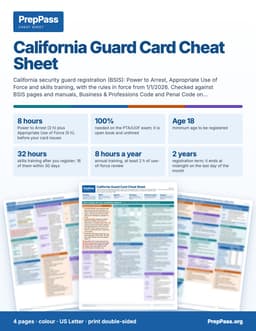
两周内就要考试?
这本指南是系统讲解,要花几周读。如果两周内就考,可打印的彩色速查表是另一款产品:考试涉及的关键数字,按章节排好。
4 页 · US Letter · 可打印 PDF · 永久保存
关于这场考试本身
| 主管机构 | Bureau of Security and Investigative Services (BSIS), California Department of Consumer Affairs —— 考试由 a BSIS-approved training school, or the employer where it has a Bureau-qualified instructor 承办 来源: 16 CCR § 628(b) — BSIS Regulations (BSIS-published compilation, PDF) |
|---|---|
| 题目数量 | BSIS 未公布 我们查阅但未找到该数据的来源: BSIS — Power to Arrest Answer Key (released to instructors on request) |
| 考试时限 | 该考试不计时:BSIS 要求主考方给予不限时的作答时间。BSIS 规定的课时是课程时长——逮捕权 3 小时、适当武力使用 5 小时——而非考试时长。 我们查阅但未找到该数据的来源: BSIS — Power to Arrest and Appropriate Use of Force Training Manual (revised July 2023, PDF) |
| 及格标准 | 100% 来源: 16 CCR § 628(b) — BSIS Regulations (BSIS-published compilation, PDF) |
| 费用 |
来源: BSIS — Licensing Fees (fee schedule dated September 2025, PDF) |
| 考试语言 | BSIS 未公布 我们查阅但未找到该数据的来源: BSIS — Resources and Training Materials |
包含什么,不包含什么
包含
- Every chapter ends the same way: key numbers & deadlines, the exam traps named one by one, and the takeaways — so the night before is a re-read, not a re-study
- A worked California example in each chapter: the rule applied to a real guard scenario
- Powers to arrest vs peace-officer arrest; citizen's arrest (PC §837)
- Appropriate use of force (PC §835a) and the observe-and-report rule
- Liability, detention limits, and merchant's privilege (PC §490.5(f))
- Observation, documentation, and courtroom-ready report writing
- 50 original practice questions with answer explanations
- PDF (print & tab it) + EPUB (phone / e-reader)
不包含
- 不寄送纸质书 —— 这是一份你下载后可自行打印的文件
- 购书不含视频课程、讲师或一对一辅导 —— 站上的免费视频是另一回事
- 不含考试报名费与考点费用,这些仍需向官方机构缴纳
目录
查看 11 个部分及各部分起始页
- Part I — The Study Guide第 8 页
- Chapter 1 — Powers to Arrest第 9 页
- Chapter 2 — Appropriate Use of Force第 22 页
- Chapter 3 — Liability & Legal Aspects第 31 页
- Chapter 4 — Observation, Documentation & Report Writing第 39 页
- Chapter 5 — Communication, Public Relations & Ethics第 46 页
- Chapter 6 — Emergency Procedures & Officer Safety第 53 页
- Chapter 7 — Terrorism Awareness & Weapons of Mass Destruction第 59 页
- Part II — Practice Exam第 66 页
- Part III — Answer Key & Explanations第 79 页
- Appendix — Quick statute & standard reference第 88 页
取自你将下载的那份 PDF,并标明各章起始页 —— 不是在此手工录入的。
免费读完整一章
完整的一章,与电子书正文一字不差。直接在此窗口滚动阅读;无需下载,无需邮箱。
在本页直接阅读第 4 章
我们没有拿轻松的绪论充数 —— 免费章节直接翻到书里最见功力的部分,让你在考试真正难的地方检验这本书讲得好不好。
Introduction
A security guard's real product is information — accurate observation, clearly documented, delivered to the people who need it. The camera does not testify; you do. A theft, an assault, a slip-and-fall, a use of force: months later, the only reliable record of what happened is the report you wrote and the notes behind it. A vague, editorial, or contradictory report loses cases; a specific, factual, chronological one wins them. This chapter teaches you to see deliberately, note contemporaneously, and write in a way that would satisfy a judge reading it five years from now.
It covers patrol technique and situational awareness, the discipline of note-taking and the 5W + H report structure, systematic suspect and vehicle descriptions, and the legal limits on photography and audio recording in a two-party-consent state.
Learning objectives
After working through this chapter you should be able to:
- Patrol with varied patterns and situational awareness (Cooper's color codes; the OODA loop), using all your senses.
- Take contemporaneous notes and write a report answering Who, What, When, Where, Why, How with facts, not conclusions.
- Give a systematic head-to-toe suspect description and a CYMBALS vehicle description.
- Apply the two-party consent rule for audio (Penal Code §632) and the privacy limits on recording (Penal Code §647(j)), and treat images as evidence.
- Explain how contemporaneous notes refresh recollection for later testimony (Evidence Code §771).
Part A — Patrol patterns and situational awareness
Good patrols are neither random wandering nor predictable loops. A predictable patrol teaches a hostile actor exactly when you will be at the back dock; a varied patrol — changing direction, timing, and route, with deliberate pauses to listen — denies them that. Practical habits: walk against vehicle traffic so you can see drivers; use your nose (smoke, fuel, marijuana often register before anything is visible) and your ears (breaking glass, raised voices, alarms) as much as your eyes.
Two mental models anchor awareness:
- Cooper's color codes. White = oblivious (never acceptable on duty); Yellow = relaxed alert (your normal on-duty baseline); Orange = a specific possible threat identified, plan forming; Red = acting on the threat. Live in Yellow.
- The OODA loop. Observe, Orient, Decide, Act — cycle continuously so you keep updating on fresh information instead of locking onto your first guess.
Your post orders define the patrol path; your awareness determines whether the patrol accomplishes anything.
Part B — Notes and reports: the 5W + H, written contemporaneously
Every incident report answers six questions:
- Who — everyone involved, with full names where available, detailed descriptions where not, witness contact information, and your own name and post.
- What — what happened, in plain chronological order, with concrete facts ("the man swung his right fist at the cashier"), not conclusions ("he became aggressive").
- When — specific times from your watch or radio log, for each step.
- Where — the exact location on the property, detailed enough that a stranger could find it.
- Why — the hardest box: stick to facts and reported statements; do not guess at motive unless the subject told you.
- How — how the events unfolded and how they were resolved.
Take notes during the incident if it is safe, or immediately after while it is fresh. The bridge from raw notes to clean report to courtroom testimony months later is California Evidence Code §771, which allows a witness to refresh recollection from a writing made when the events were fresh. Two rules make a report defensible: write facts over conclusions ("the subject said he had three beers," not "the subject was drunk"), and apply the stranger test — could someone who was not there reconstruct what happened from your report alone? If not, rewrite it.
Part C — Suspect and vehicle descriptions that hold up
Build a suspect description head to toe so a responding officer can broadcast it without gaps: gender and approximate age; race/ethnicity if discernible; height and build; hair (color, length, style); eyes; facial hair, glasses, scars, tattoos; hat; shirt and outerwear with colors; pants; shoes; anything in the hands; and direction of travel. Practice the sequence out loud on slow shifts — the time to learn the script is not while someone is running away.
For vehicles, a common California mnemonic is CYMBALS: Color, Year, Make, Body style, All other (damage, decals, distinguishing marks), License, State. The license plate beats every other identifier — get it first if you can; if you cannot, get a partial plate and the state. For weapons, describe what you actually saw ("a black semi-automatic pistol with a stainless slide"), rather than guessing make and model. Use compass directions for travel, not "that way."
Part D — Photography, recording, and privacy
Phones make documentation easy and legally complicated at once.
- Video without sound, in a public space or your employer's premises where there is no reasonable expectation of privacy, is generally allowed.
- Audio is the harder line. California is a two-party (all-party) consent state under Penal Code §632: it is a crime to record a confidential communication without the consent of all parties. Body cameras that capture audio in private areas implicate §632 — know whether your company policy or a posted written notice supplies the needed consent.
- Privacy crimes. Penal Code §647(j) makes it a crime to photograph or record a person in a place where they have a reasonable expectation of privacy — restrooms, dressing rooms, hotel rooms — even with no audio.
- Treat images as evidence. Do not edit them, do not post them to social media, and turn them over to your supervisor with a clear chain of custody.
Write and photograph as if a judge will read and view it tomorrow — because one might.
California worked example
At 9:42 p.m. a guard hears glass break near the loading dock, moves to Yellow-to-Orange, and sees a man throw a laptop bag over a fence and run west toward Elm Street in a gray hooded sweatshirt.
The report writes itself if the observation was disciplined. When: 9:42 p.m. (from the radio log). Where: northeast loading dock, exterior. Who/What (facts): "I heard glass breaking; I observed a male adult, approximately 20–30, ~5'10", medium build, gray hooded sweatshirt, dark pants, throw a dark laptop bag over the north fence and run west on Elm Street." Suspect description head-to-toe, finishing with direction of travel (west). Vehicle, if one was used, in CYMBALS order with the plate captured first. The guard does not write "the burglar" (a conclusion) but "a male adult who threw a bag and fled." If the guard used a phone to photograph the broken window, those images are evidence — unedited, handed to the supervisor, not posted anywhere. Notes taken now let the guard refresh recollection (Evidence Code §771) if called to testify next year.
Key numbers & deadlines
Awareness models: Cooper's color codes (White / Yellow / Orange / Red — operate in Yellow); OODA loop (Observe, Orient, Decide, Act). Vary patrol patterns; use all senses. Report structure: 5W + H (Who, What, When, Where, Why, How); chronological, specific times/names/locations, facts over conclusions. Descriptions: suspect head-to-toe, ending with direction of travel; vehicle CYMBALS (Color, Year, Make, Body, All-other, License, State). Plate beats all other IDs. Recording law: audio = two-party consent, Penal Code §632 (crime to record a confidential communication without all-party consent). Penal Code §647(j) — criminal invasion of privacy (restrooms, dressing rooms, etc.). Treat images as evidence (no edits, chain of custody). Testimony: contemporaneous notes refresh recollection — Evidence Code §771.
Named exam traps
- "A good patrol follows the same reliable route every time." No — predictable patrols are exploitable. Vary route and timing.
- "Write your conclusion so it's clear ('he was drunk / he was the thief')." No — write facts ("said he had three beers"; "threw a bag and fled"). Conclusions belong to others.
- "Guess the make and model of the gun so the report looks complete." No — describe what you saw. Guessing invents evidence.
- "You can record any conversation on duty." No — audio needs all-party consent (§632); recording a confidential conversation without it is a crime.
- "A photo is just a photo — edit or share it freely." No — images are evidence; no edits, no social media, keep a chain of custody. Recording in restrooms/dressing rooms violates §647(j).
- "Notes don't matter once you file the report." No — contemporaneous notes are what let you refresh recollection (Evidence Code §771) in court months later.
Key takeaways
- Patrol with varied patterns and stay in Cooper's Yellow; run the OODA loop and use every sense.
- Write 5W + H, chronological, specific, and factual — pass the stranger test.
- Describe suspects head-to-toe (end with direction of travel) and vehicles by CYMBALS, capturing the plate first.
- Audio recording needs all-party consent (§632); respect privacy (§647(j)); treat images as evidence.
- Contemporaneous notes refresh recollection at trial (Evidence Code §771).
Sources
Cited to leginfo.legislature.ca.gov (Penal Code, Evidence Code). Awareness models (Cooper's color codes, OODA, CYMBALS) are standard security-training frameworks, not statutes.
- Cal. Penal Code §632 — recording of confidential communications (two-party consent).
- Cal. Penal Code §647(j) — invasion of privacy by recording/photography.
- Cal. Evidence Code §771 — refreshing recollection from a writing.
- Security-training frameworks: Cooper's color codes; the OODA loop (J. Boyd); CYMBALS vehicle- description mnemonic; the 5W + H report standard.
购买前
- 怎么拿到?
- 付款后下载入口立即出现在本页,链接同时发到你的邮箱。无需注册账号。
- 不合适怎么办?
- 14 天内发邮件即可全额退款,无需理由。
- 免费练习会取消吗?
- 不会。站上的每一道练习题、计时模考和免费章节都继续免费。这本书是「学」的那一半,不是把免费部分围起来的门。
- 能在手机上看吗?
- 可以 —— EPUB 适合手机和电子书阅读器,PDF 适合打印和贴标签,两种都给你。
详细信息
Powers to arrest, appropriate use of force, liability, observation & report writing, and terrorism awareness — California statute, cited to BSIS + Penal Code.
- Format: PDF + EPUB download · 89 pages
- 50 practice questions in the book, with a full answer key
- 200 free practice questions for this exam on PrepPass, included at no cost
- $9.99 one-time — no subscription
- 14-day money-back guarantee · refund policy
- Cross-referenced against: CA BSIS / B&P §7580+ / Penal Code / 16 CCR
- Last updated: September 2026
- 官方来源核验(CA BSIS / B&P §7580+ / Penal Code / 16 CCR)
- 200 道免费练习题
- 即时下载,永久拥有
BSIS guard card training course 要 $50–$150。这本书讲的是同一门考试 —— 同样的规则、核对到最新标准 —— 只需一次性 $9.99,永久归你。
练习免费,为什么还要买书?
我们的练习题和计时模考一直免费 —— 网站上的东西不会因为这本书而收起来。这本 $9.99 的书是「学」的那一半:知识本身,按顺序讲清楚,存成一份属于你的文件。
- 系统讲解 —— 每个考试部分按章节从头讲到尾,不只是题目
- 可打印可贴标签 —— 一份适合打印的 PDF,能划重点、做批注、带到书桌前
- 随处离线学 —— EPUB 放手机或电子书阅读器;不用 wifi,不用一堆浏览器标签
- 全在一处 —— 章节和练习题都在同一份文件里
- 永久归你 —— 一次 $9.99,即时下载,无订阅
而且零风险:14 天退款保证 —— 不满意?发邮件即可全额退款,无需理由。 详见退款政策。
14 天退款保证 · 全额退款,无需理由。
一次购买,永久下载访问。此电子书是完整的 California Guard Card (BSIS Security Guard) 学习指南,含 PDF 与 EPUB。仅为教育性摘要,非专业或法律意见 —— 请始终以官方来源核实当前规定。最后更新:September 2026。