California RBS (Responsible Beverage Service) · 2026 版
California RBS — Responsible Beverage Service Study Guide (2026)
ABC laws, signs of intoxication, refusing service, checking ID and detecting fakes, and civil/criminal liability — California-specific, with worked BAC math.
- 书内 90 道练习题,配完整答案解析
- 107 页逐章讲解 —— 不是一堆题目的堆砌
- 已与California ABC Act (B&P §25680+) / Title 4 CCR / leginfo逐条核对
$9.99一次买断 · 永久下载 · 无订阅
PDF + EPUB · 英文 · 107 页 · $9.99 一次买断
本书为英文版,下载的 PDF 与 EPUB 均为英文。
付款后立即下载 —— 无需注册账号,无订阅。
14 天退款保证:任何原因不满意?购买后 14 天内发邮件至 support@preppass.org 即可全额退款。 这是电子下载,无需寄回任何东西。 退款政策
考试事实最近一次对照官方资料核对:2026年9月。
先做 10 题,看看讲解 —— 免费
先答完这 10 题,交卷后每题都有解析 —— 还会指出本指南里讲这一点的那一节。约 5 分钟,无需注册。
开始 10 道免费题翻开这本书看看
三页真实内页,直接从你将下载的 PDF 渲染而来 —— 依次是一页速查、一页讲解、一道带解析的例题。没有任何一页是为了好看而重画的。
- 速查页Chapter 1 — ABC Laws & Regulations · PDF 第 16 页
一页可以随时翻回来的内容:把数字、期限或术语集中在一处。
- 怎么讲Chapter 5 — Checking ID & Detecting Fakes · PDF 第 46 页
讲解页:用文字把知识讲清楚,顺序与考试考查的顺序一致。
- 一道题的完整解析Part II — Practice Exam · PDF 第 68 页
一道练习题,连同答案和背后的推理 —— 不只是一个答案键。
两周内就要考试?
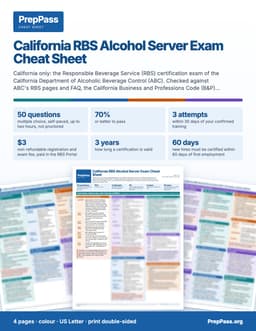
这本指南是系统讲解,要花几周读。如果两周内就考,可打印的彩色速查表是另一款产品:考试涉及的关键数字,按章节排好。
4 页 · US Letter · 可打印 PDF · 永久保存
关于这场考试本身
| 主管机构 | California Department of Alcoholic Beverage Control (ABC) —— 考试由 ABC itself, through the RBS Portal; the training beforehand is bought from a private ABC-approved RBS training provider 承办 来源: California ABC — Responsible Beverage Service (RBS) Training Program |
|---|---|
| 题目数量 | 50 道题 |
| 考试时限 | 考试为自定进度,ABC 不设作答时限。ABC 估计「最多可能需要两小时完成」——这是时长估计,不是截止限制。ABC 真正执行的是日历期限:须在确认完成培训后 30 天内通过考试,并在入职 60 天内取得认证。 我们查阅但未找到该数据的来源: California ABC — RBS Frequently Asked Questions |
| 及格标准 | 70% |
| 费用 |
|
| 考试语言 | 英语 · 中文 · 印地语 · 韩语 · 旁遮普语 · 西班牙语 · 他加禄语 · 越南语 来源: California ABC — Responsible Beverage Service (RBS) Training Program |
免费的 California RBS (Responsible Beverage Service) 练习题与学习章节 →
包含什么,不包含什么
包含
- California ABC laws (B&P §§25680–25684) and the RBS mandate
- Alcohol effects + worked BAC math the exam actually tests
- Refusing service, de-escalation, and obvious-intoxication cues
- Checking ID, detecting fakes, and the decoy (ABC Rule 141) rules
- 90 original practice questions with answer explanations
- PDF (print & tab it) + EPUB (phone / e-reader)
不包含
- 不寄送纸质书 —— 这是一份你下载后可自行打印的文件
- 购书不含视频课程、讲师或一对一辅导 —— 站上的免费视频是另一回事
- 不含考试报名费与考点费用,这些仍需向官方机构缴纳
目录
查看 13 个部分及各部分起始页
- Part I — The Study Guide第 7 页
- Chapter 1 — ABC Laws & Regulations第 8 页
- Chapter 2 — Alcohol Effects on the Body第 20 页
- Chapter 3 — Identifying Signs of Intoxication第 29 页
- Chapter 4 — Refusing Service & De-escalation第 36 页
- Chapter 5 — Checking ID & Detecting Fakes第 44 页
- Chapter 6 — Civil & Criminal Liability第 53 页
- Chapter 7 — Special Situations第 60 页
- Part II — Practice Exam第 68 页
- Part III — Answer Key & Explanations第 80 页
- Part IV — Practice Exam B (Rapid Review)第 89 页
- Appendix A — Statute & Number Quick-Reference第 103 页
- Appendix B — Glossary of Key Terms第 106 页
取自你将下载的那份 PDF,并标明各章起始页 —— 不是在此手工录入的。
免费读完整一章
完整的一章,与电子书正文一字不差。直接在此窗口滚动阅读;无需下载,无需邮箱。
在本页直接阅读第 3 章
我们没有拿轻松的绪论充数 —— 免费章节直接翻到书里最见功力的部分,让你在考试真正难的地方检验这本书讲得好不好。
Introduction
Chapter 1 gave you the legal command — do not serve an obviously intoxicated person (B&P §25602). Chapter 2 explained the chemistry. This chapter is the eyes-and-ears skill that connects them: how a trained server actually recognizes intoxication in real time, without a breathalyzer, on a busy floor, in bad lighting. The word "obviously" is doing a lot of work in the statute — it means the standard is what a reasonable person, observing the customer, would conclude. No chemical test, no confession, no medical diagnosis. Just trained observation.
The exam tests two things here: a framework for spotting the signs, and the discipline of tracking and pacing so you catch impairment as it builds rather than after it explodes.
Learning objectives
After this chapter you should be able to:
- Apply the SCAN observation framework — Speech, Coordination, Appearance, Notable behavior — and recognize that a pattern across two or more categories meets the "obviously intoxicated" standard.
- Explain that §25602 uses an objective, observational ("reasonable person") standard, not a BAC test.
- Distinguish early-stage signs (the intervention window) from late-stage signs (mandatory, immediate cut-off).
- Use tracking, pacing, and cumulative observation — counting drinks, watching change over time, and handing off information at shift change.
- Handle difficult cases where a sign may not mean intoxication (disability, medication, accent, language) without either over-refusing or under-refusing.
- Recognize that a customer who arrives already intoxicated may not be served — there is no "first drink" exception.
Part A — The SCAN framework
RBS training organizes the visible signs of impairment into four categories, commonly taught with the mnemonic SCAN:
- S — Speech. Slurring, mumbling, thick or slow speech, loss of the conversational thread, repeating oneself, or a sudden change in volume (loud if previously quiet, or the reverse).
- C — Coordination. Swaying or stumbling, leaning on the bar for support, spilling drinks, missing the glass or the mouth, fumbling with money or a credit card, dropping a wallet or phone, difficulty with familiar fine-motor tasks.
- A — Appearance. Glassy or bloodshot eyes, droopy eyelids, flushed face, disheveled or sweaty look, unfocused gaze.
- N — Notable behavior. Aggression, belligerence, crying or sudden mood swings, overly friendly or sexual conduct toward strangers, inappropriate risk-taking, falling asleep at the bar, arguing over the tab.
(These map onto the same idea as the older "speech, behavior, appearance, judgment" domains — the labels differ, the observation is the same.)
The single most important rule: look for a pattern, not one cue. No single sign proves intoxication. A person can have glassy eyes from allergies, slur from a speech condition, or stumble on a bad knee. What establishes "obviously intoxicated" is multiple signs across multiple SCAN categories, especially when they worsen over the visit and accelerate after each drink. Glassy eyes plus leaning on the bar plus slowed speech is three categories at once — that is obviously intoxicated, and service must stop.
California example. A bartender watches a patron order "one more vodka soda." His eyes are red and glassy (Appearance), he is leaning heavily on the bar (Coordination), and his speech has slowed and thickened (Speech). That is three SCAN categories — the "obviously intoxicated" standard is met. Continued service is a §25602 misdemeanor. The bartender politely refuses, offers water and food, and helps arrange a ride. A diluted or "weaker" version of the drink would still be a sale of alcohol and still a violation.
Part B — Tracking, pacing, and cumulative observation
Because impairment lags behind intake, the customer who looks fine as you pour the fourth shot may be a problem fifteen minutes later when it fully hits. The defense is not a better guess in the moment — it is a system.
- Count drinks per customer. Use the POS, a written tab, or a deliberate mental count for each individual (not "the table"). Recall from Chapter 2 that a "double" is two standard drinks and a craft beer may be 1.5.
- Pace against the ~one-drink-per-hour elimination rate. A customer drinking faster than the body clears is building BAC, even if they still look fine right now. Slow the rounds, bring water with every drink, offer food, and steer toward lower-ABV options.
- Cumulative observation means watching change over time — a single ambiguous slurred word means little; the same word plus a stumble ten minutes later confirms the trend. A brief SCAN glance each time you approach the customer catches the slide early.
- Communicate at shift change. A classic patron move is to wait for a fresh bartender who has no baseline. Verbal handoffs and a note near the well ("table 6 is heavy tonight") close that gap.
- Watch the red flags that don't prove intoxication but predict a fast BAC climb: ordering rapid rounds (three shots in ten minutes), ordering the next before finishing the last, "two-fisting," or one person ordering rounds for a heavy-drinking friend. The response is heightened observation and slower service — not necessarily refusal yet.
Note what is not a red flag: ordering water, paying with a card, or tipping generously. Do not let normal behavior drive service decisions.
California example. A customer downs four shots in twenty minutes and still seems okay as the fourth is poured — the alcohol has not fully absorbed. The server who counted and paced knows the BAC is about to spike, stops further rounds, and brings water and food now, before the SCAN signs bloom. The server who only reacts to visible drunkenness will serve a fifth and own the incident.
Part C — Difficult cases, and the customer who arrives drunk
Not everyone who shows a "sign" is intoxicated, and treating every cue as proof leads to unlawful, discriminatory refusals. Use the pattern test and a brief conversation.
- Disability and medical conditions. A customer with a stroke history, Parkinson's, or a speech impediment may slur or move unsteadily sober. A prosthetic or an injury can cause an uneven gait. Refuse for intoxication, never for disability — refusing someone because of a disability can violate the ADA and California's Unruh Civil Rights Act (Civil Code §51). The question is always: are there multiple signs, are they worsening, do they track the drinking?
- Medication. Drowsiness may come from a prescription, not the drink — but recall that medications amplify alcohol, so pace slowly and refuse early if impairment appears.
- Accent and language. An unfamiliar accent or limited English is not impairment. "I can't easily understand this person" is different from "this person is slurring." Refusing on accent risks national-origin discrimination.
- The coherence check. When you genuinely cannot tell, talk to the customer. Ask their order back, ask an easy question, watch whether their answers make sense. A customer whose responses are coherent and whose pace is slow is not §25602 intoxicated; one whose coherence deteriorates after each round is.
- Tolerance (from Chapter 2): a heavy regular may not look drunk at a BAC well over 0.08. High tolerance is not a defense — the ABC has held so — and you can still be cited for serving them.
The customer who arrives already intoxicated. A patron who walks in already obviously intoxicated is a §25602 problem the moment you pour the first drink. Your liability does not require that you served the drinks that got them there. Bar-hoppers, wedding guests who pre-gamed, travelers who drank on the plane, the person who finished a flask in the parking lot — the framework does not change. Observe at the door, at the order, and at delivery. If they arrive drunk, the answer is no service, plus water/food if they will stay calm, and a safe ride out.
California example. A patron arrives slurring, with a stumbling gait, and orders a beer "— I haven't even had anything here yet." There is no first-drink exception under §25602: he is already obviously intoxicated, so he cannot lawfully be served at all. Serving "just one" is a misdemeanor. The right response is a polite refusal, water and a seat, and help arranging transportation.
Key numbers & deadlines
Legal standard: §25602 — do not serve an obviously intoxicated person. This is an objective, observational ("reasonable person") test — no breathalyzer, no confession, no diagnosis required. SCAN: Speech · Coordination · Appearance · Notable behavior. A pattern across two or more categories = obviously intoxicated → stop service. Pattern, not a single sign. One cue (glassy eyes, a slur, a stumble) can have innocent causes; multiple signs, worsening over time, tracking the drinking = intoxicated. Impairment lags intake — count drinks, pace to ~1 standard drink/hour, observe cumulatively, and hand off at shift change. Early window (relaxed, loud, disinhibited) = slow down, water/food. Late signs (slurring, stumbling, vomiting, falling asleep, blackout) = mandatory immediate cut-off; consider 911. No "first drink" exception: a customer who arrives obviously intoxicated may not be served at all (§25602). Never refuse for a protected trait — disability, accent, or national origin (Civil Code §51). Refuse for behavior/intoxication.
Named exam traps
- "One sign is enough to refuse." No — look for a pattern across ≥2 SCAN categories. (But equally, do not wait for someone to be unconscious — that is far too late.)
- "A weaker/diluted drink is okay for an intoxicated patron." It is still a sale of alcohol and still a §25602 violation.
- "He hasn't had anything here yet, so I can serve one." No first-drink exception — already-intoxicated means no service.
- "Slurring/stumbling always means drunk." Not if it is disability or a medical condition; use the pattern test and a coherence check.
- "An accent or poor English is a sign of intoxication." Never — refusing on that basis is discrimination.
- "Wait and see what happens after this drink." Reactive observation means the harm has already occurred; intervene early.
- "Rapid rounds prove intoxication." They are a red flag warranting closer watch, not proof by themselves — but they demand action.
Key takeaways
- §25602 intoxication is judged by trained observation, not a chemical test.
- Use SCAN (Speech, Coordination, Appearance, Notable behavior); a pattern across categories that worsens over time is the trigger.
- Track and pace: count each person's drinks, watch cumulatively, hand off at shift change, and treat rapid ordering as a red flag.
- Intervene in the early window; do not wait for late, dangerous signs.
- Distinguish innocent causes (disability, medication, accent, language) from intoxication, and never refuse for a protected trait.
- A customer who arrives intoxicated gets no service — there is no first-drink exception.
Sources
Cited to the California ABC RBS curriculum framework and the Business & Professions Code (leginfo.legislature.ca.gov). The SCAN mnemonic reflects standard RBS training practice.
- Cal. Bus. & Prof. Code § 25602 — prohibition on service to an obviously intoxicated person; objective "obviously intoxicated" standard (tolerance is not a defense per ABC disciplinary practice).
- California ABC RBS Training Program / Title 4 Cal. Code Regs. § 165 — observation framework (SCAN: Speech, Coordination, Appearance, Notable behavior) and cumulative-observation / pacing practice.
- Cal. Civ. Code § 51 (Unruh Civil Rights Act) — prohibition on refusing service based on a protected characteristic (disability, national origin, etc.); Americans with Disabilities Act — disability protection.
- NIAAA — impairment progression and the ~one-standard-drink-per-hour elimination rate (see Chapter 2 sources).
购买前
- 怎么拿到?
- 付款后下载入口立即出现在本页,链接同时发到你的邮箱。无需注册账号。
- 不合适怎么办?
- 14 天内发邮件即可全额退款,无需理由。
- 免费练习会取消吗?
- 不会。站上的每一道练习题、计时模考和免费章节都继续免费。这本书是「学」的那一半,不是把免费部分围起来的门。
- 能在手机上看吗?
- 可以 —— EPUB 适合手机和电子书阅读器,PDF 适合打印和贴标签,两种都给你。
详细信息
ABC laws, signs of intoxication, refusing service, checking ID and detecting fakes, and civil/criminal liability — California-specific, with worked BAC math.
- Format: PDF + EPUB download · 107 pages
- 90 practice questions in the book, with a full answer key
- 100 free practice questions for this exam on PrepPass, included at no cost
- $9.99 one-time — no subscription
- 14-day money-back guarantee · refund policy
- Cross-referenced against: California ABC Act (B&P §25680+) / Title 4 CCR / leginfo
- Last updated: August 2026
- 官方来源核验(California ABC Act (B&P §25680+) / Title 4 CCR / leginfo)
- 100 道免费练习题
- 即时下载,永久拥有
练习免费,为什么还要买书?
我们的练习题和计时模考一直免费 —— 网站上的东西不会因为这本书而收起来。这本 $9.99 的书是「学」的那一半:知识本身,按顺序讲清楚,存成一份属于你的文件。
- 系统讲解 —— 每个考试部分按章节从头讲到尾,不只是题目
- 可打印可贴标签 —— 一份适合打印的 PDF,能划重点、做批注、带到书桌前
- 随处离线学 —— EPUB 放手机或电子书阅读器;不用 wifi,不用一堆浏览器标签
- 全在一处 —— 章节和练习题都在同一份文件里
- 永久归你 —— 一次 $9.99,即时下载,无订阅
而且零风险:14 天退款保证 —— 不满意?发邮件即可全额退款,无需理由。 详见退款政策。
14 天退款保证 · 全额退款,无需理由。
一次购买,永久下载访问。此电子书是完整的 California RBS (Responsible Beverage Service) 学习指南,含 PDF 与 EPUB。仅为教育性摘要,非专业或法律意见 —— 请始终以官方来源核实当前规定。最后更新:August 2026。