NYC Food Protection Certificate · 2026 版
NYC Food Protection Certificate — Complete Study Guide (2026)
The NYC DOHMH Food Protection Course exam every NYC food-service supervisor must pass — taught to the NYC Health Code (Article 81), including the NYC-specific temperatures the FDA Food Code doesn't use.
- 书内 55 道练习题,配完整答案解析
- 47 页逐章讲解 —— 不是一堆题目的堆砌
- 已与NYC Health Code Article 81 / NYC DOHMH Food Protection Course逐条核对
免费在线课程后的期末考试:每次 $24,缴给 NYC DOHMH / Health Academy。补考要再交一次。本指南:$14.99,一次买断。
$14.99一次买断 · 永久下载 · 无订阅
PDF + EPUB · 英文 · 47 页 · $14.99 一次买断
本书为英文版,下载的 PDF 与 EPUB 均为英文。
付款后立即下载 —— 无需注册账号,无订阅。
14 天退款保证:任何原因不满意?购买后 14 天内发邮件至 support@preppass.org 即可全额退款。 这是电子下载,无需寄回任何东西。 退款政策
考试事实最近一次对照官方资料核对:2026年9月。
先做 10 题,看看讲解 —— 免费
先答完这 10 题,交卷后每题都有解析 —— 还会指出本指南里讲这一点的那一节。约 5 分钟,无需注册。
开始 10 道免费题翻开这本书看看
三页真实内页,直接从你将下载的 PDF 渲染而来 —— 依次是一页速查、一页讲解、一道带解析的例题。没有任何一页是为了好看而重画的。
- 速查页PDF 第 10 页
一页可以随时翻回来的内容:把数字、期限或术语集中在一处。
- 怎么讲PDF 第 43 页
讲解页:用文字把知识讲清楚,顺序与考试考查的顺序一致。
- 一道题的完整解析PDF 第 39 页
一道练习题,连同答案和背后的推理 —— 不只是一个答案键。
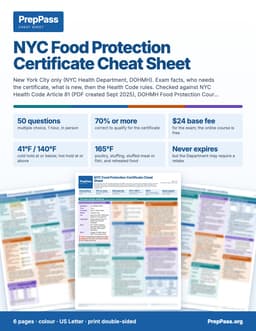
两周内就要考试?
这本指南是系统讲解,要花几周读。如果两周内就考,可打印的彩色速查表是另一款产品:考试涉及的关键数字,按章节排好。
6 页 · US Letter · 可打印 PDF · 永久保存
关于这场考试本身
| 主管机构 | New York City Department of Health and Mental Hygiene (DOHMH), Health Academy |
|---|---|
| 题目数量 | NYC DOHMH 未公布 我们查阅但未找到该数据的来源: NYC Health — Food Protection: Free Online Training |
| 考试时限 | NYC DOHMH 未公布 我们查阅但未找到该数据的来源: NYC Health — Food Protection: Classroom Course |
| 及格标准 | NYC DOHMH 未公布 我们查阅但未找到该数据的来源: NYC Health — Food Protection Course Online Frequently Asked Questions (PDF) |
| 费用 |
|
| 考试语言 | 英语 + 另有 36 种语言,主管机构未逐一列出 |
包含什么,不包含什么
包含
- NYC Health Code Article 81 — incl. the NYC-specific temps vs the FDA Food Code
- Time & temperature control, 2-stage cooling, cooking/reheat temps
- Contamination, personal hygiene, and pest control
- HACCP, active managerial control, letter grades & inspections
- 55 original practice questions with answer explanations
- PDF (print & tab it) + EPUB (phone / e-reader)
不包含
- 不寄送纸质书 —— 这是一份你下载后可自行打印的文件
- 购书不含视频课程、讲师或一对一辅导 —— 站上的免费视频是另一回事
- 不含考试报名费与考点费用,这些仍需向官方机构缴纳
免费读完整一章
完整的一章,与电子书正文一字不差。直接在此窗口滚动阅读;无需下载,无需邮箱。
在本页直接阅读第 2 章
我们没有拿轻松的绪论充数 —— 免费章节直接翻到书里最见功力的部分,让你在考试真正难的地方检验这本书讲得好不好。
Introduction
Controlling time and temperature is the heart of food protection in New York City, and this is the largest topic on the exam. Because bacteria grow fastest in the danger zone, the certified supervisor must know the exact temperatures for cooking, cooling, reheating, and holding food — and must check them with an accurate thermometer, not by eye. This chapter also carries the two most important NYC-vs-FDA divergences in the whole book, so read the flags carefully.
The temperature danger zone
The temperature danger zone in New York City is 41°F to 140°F — the range in which bacteria multiply most rapidly. Every hazardous food should spend as little time as possible in this zone.
- Cold hazardous food must be held at 41°F or below.
- Hot hazardous food must be held at 140°F or above.
NYC-vs-FDA flag: NYC uses 140°F as the top of the danger zone and the hot-holding minimum. The federal FDA Food Code uses 135°F. On the NYC exam, answer 140°F.
When food does pass through the zone during cooking or cooling, it should move through quickly. As a general limit, hazardous food left in the danger zone for more than four cumulative hours must be discarded, because bacteria may have multiplied to dangerous levels or formed heat-stable toxins. Treat temperature as your primary defense and use time only as a backup control, with written procedures.
Cooking temperatures
Cooking to the correct internal temperature destroys the bacteria that cause illness. Measure at the thickest part of the food with a clean, calibrated thermometer, and take at least two readings in different spots. The NYC minimums:
- Poultry, stuffed foods, and stuffing — 165°F. This is the highest required cooking temperature.
- Ground / chopped meat (hamburger, chopped meat, ground pork) — 158°F. Grinding spreads surface bacteria throughout the meat, so ground meat needs a higher temperature than a whole cut.
- Pork that is not ground and not a whole roast (e.g., pork chops) — 150°F.
- Whole cuts and roasts of beef and lamb, fish, and shell eggs cooked for immediate service — generally 140°F to 145°F (145°F for whole roasts and shell eggs; 140°F is the general minimum).
NYC-vs-FDA flag: NYC teaches 158°F for ground/chopped meat. The federal FDA Food Code uses 155°F. This is a well-known NYC divergence — on the NYC exam, answer 158°F.
Never judge doneness by color alone; a burger can look brown and still be unsafe, or look pink and be fully cooked. The thermometer is the only reliable test.
Cooling — the two-stage rule
Cooling is one of the most dangerous steps in the flow of food, because the food sits inside the danger zone as it cools. NYC uses a two-stage cooling rule:
- 140°F down to 70°F within 2 hours (the first stage is the riskiest, so it has the tightest limit).
- 70°F down to 41°F within 4 more hours.
- Total cooling time: no more than 6 hours from 140°F to 41°F.
If the food does not reach 70°F within the first two hours, you must reheat it and start cooling again, or discard it. Speed cooling by:
- Dividing food into shallow pans
- Using an ice-water bath
- Adding ice as an ingredient
- Stirring with an ice paddle
Cooling is about surface area and speed, not just putting a deep pot in the cold.
Reheating, holding, and thawing
Reheating. When reheating hazardous food for hot holding, bring it to 165°F within 2 hours, and reheat only once. Never use holding equipment (like a steam table) to reheat — it warms food too slowly and lets bacteria grow.
Holding. Once cooked, food must be held out of the danger zone until served: hot at 140°F or above, cold at 41°F or below. Check holding temperatures at least every two hours so problems are caught early.
Thawing. Thaw frozen food safely by one of four methods:
- In the refrigerator at 41°F or below
- Under cold running water at 70°F or below
- In a microwave, if the food is cooked immediately after
- As part of the cooking process
Thawing on the counter at room temperature is not allowed — it leaves the outer layer in the danger zone for hours.
Using a thermometer
A thermometer is only useful if it is accurate. Calibrate a bimetallic stem thermometer in ice water, where it should read 32°F; adjust the nut until it does. Clean and sanitize the stem before and between uses so it does not move bacteria from raw chicken to the next food you check. Measure at the thickest part, wait for the reading to steady, and take more than one reading.
Key numbers & facts — memorize these cold
| Item | NYC value / rule | FDA Food Code (for contrast) |
|---|---|---|
| Danger zone | 41°F – 140°F | 41°F – 135°F |
| Cold holding | 41°F or below | 41°F or below |
| Hot holding | 140°F or above | 135°F or above |
| Poultry / stuffed foods | 165°F | 165°F |
| Ground / chopped meat (incl. ground pork) | 158°F | 155°F |
| Pork (chops / non-roast, non-ground) | 150°F | 145°F |
| Whole cuts/roasts, fish, eggs to order | ~140°F – 145°F | 145°F (whole cuts) |
| Cooling — stage 1 | 140°F → 70°F in 2 hours | 135°F → 70°F in 2 hours |
| Cooling — stage 2 | 70°F → 41°F in 4 more hours (6 total) | same total |
| Reheating for hot holding | 165°F within 2 hours, once | 165°F within 2 hours |
| Time-only control | discard after 4 cumulative hours in the zone | 4 hours |
| Check holding temps | at least every 2 hours | — |
| Thermometer calibration | reads 32°F in ice water | 32°F |
| Safe thawing | fridge · cold running water (≤70°F) · microwave (cook now) · during cooking | same |
Source: NYC Health Code Article 81 and the DOHMH Food Protection Course for the NYC values; FDA Food Code shown only to flag where NYC differs. Teach and answer with the NYC column on this exam.
Worked scenario
The situation. At 3:00 p.m. a cook makes a large pot of chicken soup, cooks it to 165°F, and then puts the whole deep, covered pot straight into the walk-in to save for tomorrow. At 9:00 p.m. — six hours later — a manager checks the center of the pot: it is still 95°F.
What went wrong? A deep pot cools very slowly; the outside chills while the thick center stays warm for hours, sitting in the danger zone. To pass NYC's rule the soup needed to reach 70°F within 2 hours and 41°F within 6 hours total. At six hours it is still 95°F — it failed the cooling rule, and bacteria have had all evening to grow.
The right move. The soup must be thrown out — you cannot rescue it now. Next time, cool it correctly: divide it into shallow pans, set them in an ice-water bath, stir with an ice paddle, and check with a thermometer so it drops from 140°F to 70°F within 2 hours and to 41°F within 4 more.
Common exam traps
- Answering 135°F for hot holding or the danger-zone top. That is the FDA number. NYC = 140°F. This is the single most common NYC trap.
- Answering 155°F for ground meat. Again the FDA number. NYC = 158°F.
- Reheating on a steam table. A steam table holds hot food; it cannot reheat cold food fast enough. Reheat to 165°F on a stove, oven, or microwave first.
- Counter thawing. Never an approved method. Know the four safe ways.
- Judging doneness by color. Only the internal temperature, read on a calibrated thermometer, proves food is safe.
- Forgetting the two-hour checkpoint in cooling. If food is not at 70°F by 2 hours, it is already out of compliance.
购买前
- 怎么拿到?
- 付款后下载入口立即出现在本页,链接同时发到你的邮箱。无需注册账号。
- 不合适怎么办?
- 14 天内发邮件即可全额退款,无需理由。
- 免费练习会取消吗?
- 不会。站上的每一道练习题、计时模考和免费章节都继续免费。这本书是「学」的那一半,不是把免费部分围起来的门。
- 能在手机上看吗?
- 可以 —— EPUB 适合手机和电子书阅读器,PDF 适合打印和贴标签,两种都给你。
详细信息
The NYC DOHMH Food Protection Course exam every NYC food-service supervisor must pass — taught to the NYC Health Code (Article 81), including the NYC-specific temperatures the FDA Food Code doesn't use.
- Format: PDF + EPUB download · 47 pages
- 55 practice questions in the book, with a full answer key
- 240 free practice questions for this exam on PrepPass, included at no cost
- $14.99 one-time — no subscription
- 14-day money-back guarantee · refund policy
- Cross-referenced against: NYC Health Code Article 81 / NYC DOHMH Food Protection Course
- Last updated: September 2026
- 官方来源核验(NYC Health Code Article 81 / NYC DOHMH Food Protection Course)
- 240 道免费练习题
- 即时下载,永久拥有
练习免费,为什么还要买书?
我们的练习题和计时模考一直免费 —— 网站上的东西不会因为这本书而收起来。这本 $14.99 的书是「学」的那一半:知识本身,按顺序讲清楚,存成一份属于你的文件。
- 系统讲解 —— 每个考试部分按章节从头讲到尾,不只是题目
- 可打印可贴标签 —— 一份适合打印的 PDF,能划重点、做批注、带到书桌前
- 随处离线学 —— EPUB 放手机或电子书阅读器;不用 wifi,不用一堆浏览器标签
- 全在一处 —— 章节和练习题都在同一份文件里
- 永久归你 —— 一次 $14.99,即时下载,无订阅
而且零风险:14 天退款保证 —— 不满意?发邮件即可全额退款,无需理由。 详见退款政策。
14 天退款保证 · 全额退款,无需理由。
一次购买,永久下载访问。此电子书是完整的 NYC Food Protection Certificate 学习指南,含 PDF 与 EPUB。仅为教育性摘要,非专业或法律意见 —— 请始终以官方来源核实当前规定。最后更新:September 2026。