ServSafe Food Protection Manager · 2026 版
ServSafe Manager Exam — Complete Study Guide (2026)
Every tested temperature, time, and ppm — verified to the 2022 FDA Food Code.
- 考试 8 大内容领域合成一本,PDF + EPUB 永久保存
- 8 章每章都以一份测验收尾,答案页逐题给出解析
- 8 章中每章都有一页「关键数字」—— 考试真正会考的温度、时间与限值
PDF + EPUB · 英文 · 151 页 · $19.99 一次买断
本书为英文版,下载的 PDF 与 EPUB 均为英文。
付款后立即下载 —— 无需注册账号,无订阅。
14 天退款保证:任何原因不满意?购买后 14 天内发邮件至 support@preppass.org 即可全额退款。 这是电子下载,无需寄回任何东西。 退款政策
考试事实最近一次对照官方资料核对:2026年9月。
先做 10 题,看看讲解 —— 免费
先答完这 10 题,交卷后每题都有解析 —— 还会指出本指南里讲这一点的那一节。约 5 分钟,无需注册。
开始 10 道免费题翻开这本书看看
三页真实内页,直接从你将下载的 PDF 渲染而来 —— 依次是一页速查、一页讲解、一道带解析的例题。没有任何一页是为了好看而重画的。
- 速查页Chapter 1 — Foodborne Illness Basics · PDF 第 12 页
一页可以随时翻回来的内容:把数字、期限或术语集中在一处。
- 怎么讲Chapter 5 — Preparation and Cooking · PDF 第 63 页
讲解页:用文字把知识讲清楚,顺序与考试考查的顺序一致。
- 一道题的完整解析Chapter 1 — Foodborne Illness Basics · PDF 第 17 页
一道练习题,连同答案和背后的推理 —— 不只是一个答案键。
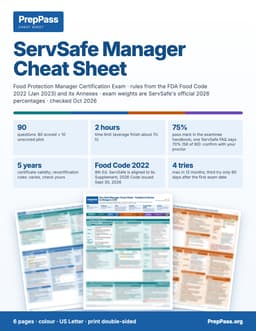
两周内就要考试?
这本指南是系统讲解,要花几周读。如果两周内就考,可打印的彩色速查表是另一款产品:考试涉及的关键数字,按章节排好。
6 页 · US Letter · 可打印 PDF · 永久保存
关于这场考试本身
| 主管机构 | National Restaurant Association Educational Foundation (NRAEF) —— 考试由 a registered ServSafe Instructor/Proctor, or ProctorU for online-proctored delivery 承办 来源: ServSafe — Food Protection Manager Certification Examinee Handbook (PDF, © 2020 NRAEF) |
|---|---|
| 题目数量 | 90 道题 (80 道计分,10 道不计分预试题) |
| 考试时限 | 120 分钟 来源: ServSafe — Manager Exam (Access Code), catalog product SSONLINEX |
| 及格标准 | 70% (80 道计分题中至少答对 56 道) 来源: ServSafe — FAQ: “What is the passing score for the ServSafe Food Protection Manager Examination?” |
| 费用 |
来源: ServSafe — Manager Exam (Access Code), catalog product SSONLINEX |
| 考试语言 | 英语 · 西班牙语 · 中文 · 韩语 · 法语 · 日语 来源: ServSafe — FAQ: “What languages is the ServSafe exam available in?” |
How this book compares
ServSafe sells the Manager exam itself, which only a registered ServSafe instructor or proctor may administer, and tells candidates to ask their instructor or proctor which materials to buy. This book is an independent review to read before that exam; it does not include an exam access code.
| Resource | Price | What you get | Choose it if |
|---|---|---|---|
| This bookServSafe Manager Exam — Complete Study Guide (2026)PrepPass | $19.99 | Independent downloadable review for the ServSafe Manager exam
| Choose this book if you want every tested time, temperature and concentration in one file to review before your proctored exam. It does not replace the exam, or a course your employer or local health department requires. |
| From the exam bodyServSafe Manager Exam (Access Code) (opens the publisher's page in a new tab)ServSafe (National Restaurant Association) | $38.99; requires an exam proctor, and additional fees apply | The certification exam itself
| You need the exam in any case. Ask your instructor or proctor which materials they supply before you buy a course or book. |
| AlternativeServSafe Exam Secrets (opens the publisher's page in a new tab)Mometrix Test Preparation | $24.99 ebook; $29.99 printed book | Study guide with practice questions | Choose Mometrix if you want a printed copy. |
This book
ServSafe Manager Exam — Complete Study Guide (2026)
PrepPass
- Price
- $19.99
- What you get
Independent downloadable review for the ServSafe Manager exam
- 240 practice questions with explanations
- 151 pages, PDF + EPUB
- Choose it if
- Choose this book if you want every tested time, temperature and concentration in one file to review before your proctored exam. It does not replace the exam, or a course your employer or local health department requires.
From the exam body
ServSafe Manager Exam (Access Code) (opens the publisher's page in a new tab)
ServSafe (National Restaurant Association)
- Price
- $38.99; requires an exam proctor, and additional fees apply
- What you get
The certification exam itself
- A one-time exam access code; only registered ServSafe instructors or proctors may administer the exam
- Choose it if
- You need the exam in any case. Ask your instructor or proctor which materials they supply before you buy a course or book.
Alternative
ServSafe Exam Secrets (opens the publisher's page in a new tab)
Mometrix Test Preparation
- Price
- $24.99 ebook; $29.99 printed book
- What you get
Study guide with practice questions
- Choose it if
- Choose Mometrix if you want a printed copy.
Other resources' prices and contents are as listed on each publisher's or seller's own page, checked September 24, 2026. Prices change; confirm on the linked page before you buy. This book's price and contents come from our own catalog.
Sources (3)
- https://www.servsafe.com/access/ss/catalog/productdetail/ssonlinex — read September 24, 2026
- https://www.servsafe.com/ServSafe-Manager/Get-Certified — read September 24, 2026
- https://www.mometrix.com/studyguides/servsafe/ — read September 24, 2026
包含什么,不包含什么
包含
- “Exam traps to avoid” in every chapter — the wording that catches people who know the material
- All 8 content areas of the ServSafe Manager exam (ServSafe publishes no per-area weights)
- Every cook / hold / cool / reheat temperature verified to the 2022 FDA Food Code
- The Big 6 pathogens, Big 9 allergens, and 7-day date-marking rules
- Sanitizer concentrations, HACCP’s 7 principles, and active managerial control
- 240 original practice questions with answer explanations
- PDF (print & tab it) + EPUB (phone / e-reader)
不包含
- 不寄送纸质书 —— 这是一份你下载后可自行打印的文件
- 购书不含视频课程、讲师或一对一辅导 —— 站上的免费视频是另一回事
- 不含考试报名费与考点费用,这些仍需向官方机构缴纳
目录
查看 10 个部分及各部分起始页
- Chapter 1 — Foodborne Illness Basics第 7 页
- Chapter 2 — Contamination, Cross-Contact, and Allergens第 21 页
- Chapter 3 — Personal Hygiene第 35 页
- Chapter 4 — Purchasing, Receiving, and Storage第 49 页
- Chapter 5 — Preparation and Cooking第 62 页
- Chapter 6 — Holding and Service第 76 页
- Chapter 7 — Food Safety Management and HACCP第 88 页
- Chapter 8 — Facilities, Cleaning, Sanitizing, and Pest Control第 103 页
- Appendix A — Master temperature & time reference第 149 页
- Appendix B — Sanitizer quick reference第 151 页
取自你将下载的那份 PDF,并标明各章起始页 —— 不是在此手工录入的。
免费读完整一章
完整的一章,与电子书正文一字不差。直接在此窗口滚动阅读;无需下载,无需邮箱。
在本页直接阅读第 1 章
Every rule in the rest of this book exists to answer one question: how do we keep pathogens from reaching a guest in a dose that makes them sick? Foodborne illness is the outcome we are all working to prevent, so this chapter defines the enemy — the pathogens, the foods they love, the conditions they need, and the guests who suffer most. Master the vocabulary here (Big Six, TCS, FAT TOM, the temperature danger zone) and the operational chapters that follow will feel like common sense rather than a list to memorize.
A foodborne illness is a sickness carried to people by the food they eat, and when two or more people get the same illness from the same meal it becomes a foodborne-illness outbreak. As a manager your job is to understand what makes food unsafe so you can stop problems before a guest ever gets sick.
The Big Six Pathogens
Most foodborne illness comes from biological contaminants, and the government has singled out six pathogens as so contagious and severe that a person carrying them must be kept out of your operation. These "Big Six" are Norovirus, Hepatitis A, Shigella, Shiga toxin-producing E. coli (STEC), Salmonella Typhi, and nontyphoidal Salmonella. Several of them are spread through the fecal-oral route, which is exactly why handwashing after using the restroom is non-negotiable. Norovirus and Hepatitis A come mainly from ready-to-eat food touched by infected workers; Salmonella Typhi and nontyphoidal Salmonella from poultry, eggs, and produce; Shigella from flies and unwashed hands; and E. coli from ground beef and contaminated produce. Knowing the source helps you target the right control, whether that is cooking, handwashing, or supplier selection.
TCS Foods
Time/Temperature Control for Safety (TCS) foods are the items that support rapid pathogen growth and therefore need strict time and temperature limits. Classic examples include milk and dairy, shell eggs, meat, poultry, fish, shellfish and crustaceans, baked potatoes, heat-treated plant foods like cooked rice, beans, and vegetables, tofu and other soy protein, sprouts and cut leafy greens, cut tomatoes, and cut melons. These foods share traits that microbes love: they are moist, protein-rich or high in carbohydrate, and have a neutral pH. Non-TCS foods such as dry pasta, uncut produce, and commercial mayonnaise are far more stable. When you can identify a TCS food on sight, you know instantly that it needs to stay out of the temperature danger zone.
FAT TOM: Conditions for Growth
Pathogens need the right conditions to multiply, summed up by the acronym FAT TOM: Food, Acidity, Temperature, Time, Oxygen, and Moisture. Microbes need nutrient-rich Food, a near-neutral Acidity (pH 7.5 down to 4.6), and warm Temperatures in the danger zone of 41°F to 135°F. Given enough Time — as little as four hours in that zone — a single bacterium can multiply into millions. Some bacteria need Oxygen while others thrive without it, and nearly all need Moisture, measured as water activity (aw) above 0.85. As a manager you cannot easily change food, oxygen, or acidity in most menu items, so your practical levers are temperature and time. Controlling those two factors is the foundation of nearly every food-safety rule you will enforce.
Toxins and Chemical Hazards
Not every hazard is a living microbe. Some fish carry natural toxins that cannot be cooked, frozen, or canned away. Scombroid poisoning comes from tuna, mahi-mahi, and bonito that were time-temperature abused, letting histamine build up. Ciguatera poisoning comes from large predatory reef fish like barracuda and grouper that ate smaller toxic fish. Certain wild mushrooms and shellfish from contaminated waters also carry toxins. Because these toxins are already formed and heat-stable, your only defense is buying from approved, reputable suppliers and keeping fish cold from the moment it arrives. Chemical hazards — cleaners, sanitizers, and pesticides — round out the picture and are prevented by proper labeling and storing chemicals away from food.
High-Risk Populations
Some guests get much sicker from foodborne illness than others, and a good manager keeps them in mind. The highest-risk groups are the very young (preschool-age children), older adults, pregnant women, and people with weakened immune systems, including those with cancer, HIV, or organ transplants. These populations have immune systems that are still developing, declining, or compromised, so even a small dose of a pathogen can cause severe illness. Facilities that serve these groups — hospitals, nursing homes, day cares — are called highly susceptible populations and often face stricter rules, such as bans on serving raw or undercooked animal foods and raw sprouts. Knowing your audience helps you decide how conservative your menu and handling need to be.
Rules & Food Code citations for this chapter
| Rule | What it means | Citation |
|---|---|---|
| Six pathogens are highly infectious and reportable | An employee diagnosed with any Big Six pathogen must be excluded from the operation and the illness reported to the regulatory authority. | FDA Food Code §2-201.11 |
| Norovirus and Hepatitis A spread from infected food handlers | Both are common in ready-to-eat food contaminated by an ill worker's hands, so barehand contact controls matter most here. | FDA Food Code §3-301.11 |
| Salmonella Typhi requires exclusion until cleared | A worker with Salmonella Typhi cannot return until a medical release is provided, because it is so easily transmitted. | — |
| TCS foods need time and temperature control | Because they support pathogen growth, TCS foods must be kept at 41°F or below or 135°F or above whenever possible. | FDA Food Code §3-501.16 |
| Cut melons, cut tomatoes, and cut leafy greens are TCS | Once these produce items are cut or processed, they lose their natural protection and must be temperature controlled. | — |
| Ready-to-eat TCS food has extra risk | Food that will not be cooked again, like deli salads or sliced fruit, must be protected from contamination at every step. | — |
| FAT TOM = Food, Acidity, Temperature, Time, Oxygen, Moisture | These six conditions must all be present for pathogens to grow, so removing even one slows or stops growth. | — |
| The temperature danger zone is 41°F to 135°F | Pathogens grow fastest between 70°F and 125°F, so food should pass through this range as quickly as possible. | FDA Food Code §3-501.16 |
| Temperature and time are your best controls | You usually cannot alter a food's pH, moisture, or oxygen, so managers focus on holding the right temperature for the right amount of time. | — |
| Fish toxins cannot be destroyed by cooking | Scombroid and ciguatera toxins are heat-stable, so prevention depends entirely on buying safe fish and keeping it cold. | FDA Food Code §3-201.11 |
| Buy from approved, reputable suppliers | Approved suppliers are inspected and meet applicable laws, which is your first line of defense against toxins. | FDA Food Code §3-201.11 |
| Store chemicals away from food and label them | Keep cleaners and pesticides in a separate area and in properly labeled containers to prevent chemical contamination. | — |
| The young, elderly, pregnant, and immunocompromised are highest risk | These groups can suffer severe illness from a small dose of a pathogen, so extra caution is warranted. | — |
| Highly susceptible populations get stricter rules | Facilities like nursing homes and hospitals may not serve raw or undercooked animal foods or raw seed sprouts. | FDA Food Code §3-801.11 |
| Match your controls to your guests | The more vulnerable your guests, the more conservative your sourcing, cooking, and handling should be. | — |
### Key numbers & deadlines | Item | Value | Source | |---|---|---| | Temperature danger zone | 41°F to 135°F | FDA Food Code §3-501.16 | | Fastest pathogen growth | 70°F to 125°F | §3-501.16 | | FAT TOM ideal pH range | 7.5 down to 4.6 (near-neutral) | source: Ch.1 | | Water activity pathogens need | above 0.85 aw | source: Ch.1 | | Time to millions in the zone | as little as 4 hours | source: Ch.1 | | Big Six → employee action | exclude + report to regulatory authority | §2-201.11 | Every value above appears in this chapter's verified source content. Verify against your local adopted food code before relying on it.
Worked example — is it TCS, and is it in the zone?
A cook pulls a pan of cooked rice from the walk-in and leaves it on the line at room temperature while the lunch rush builds. Ask two questions. (1) Is it TCS? Cooked rice is a heat-treated plant food — moist, starchy, neutral pH — so yes, it is a Time/Temperature Control for Safety food. (2) Is it in the danger zone? Room temperature sits inside 41°F–135°F, and squarely inside the 70°F–125°F fast-growth band. Both FAT TOM's Temperature and Time are now working for the bacteria. Under §3-501.16 that rice belongs at 41°F or below or 135°F or above — sitting out, it is on the clock toward discard, not safe holding.
Exam traps to avoid
- The danger zone is 41°F–135°F, not 40°F–140°F. Old U.S. materials taught 40/140; the current Food Code number tested by ServSafe is 41°F and 135°F.
- Fish toxins (scombroid, ciguatera) are heat-stable — cooking, freezing, and canning do not destroy them. The only control is an approved supplier plus keeping fish cold (§3-201.11).
- A cut melon, cut tomato, or cut leafy green is TCS; the same items whole and uncut are not. Processing is what makes them TCS.
- Highly susceptible populations (hospitals, nursing homes, day cares) may not be served raw or undercooked animal foods or raw seed sprouts (§3-801.11).
Chapter 1 quiz — 20 questions
Answer each question, then check the key that follows.
1. A manager finds mold on a block of cheddar cheese and on a loaf of bread. Which statement about fungi (molds and yeasts) is correct?
- A. Some molds produce toxins, so moldy soft/high-moisture foods should be discarded
- B. All mold is harmless and can simply be scraped off any food
- C. Mold only grows in the freezer
- D. Yeasts are always dangerous pathogens
2. What is the minimum internal cooking temperature and hold time for chicken, turkey, and other poultry?
- A. 155°F for 17 seconds
- B. 165°F for <1 second (instantaneous)
- C. 145°F for 15 seconds
- D. 175°F for 10 seconds
3. Norovirus outbreaks spread rapidly in restaurants. What is the most effective way for a manager to prevent Norovirus transmission from staff?
- A. Exclude ill staff and enforce proper handwashing with no bare-hand contact with ready-to-eat food
- B. Increase the freezer temperature to kill the virus
- C. Rely on hand sanitizer instead of soap and water
- D. Cook all food to 135°F
4. A cook holds a pot of chicken tortilla soup on the steam table. What is the minimum hot-holding temperature required?
- A. 135°F
- B. 125°F
- C. 145°F
- D. 155°F
5. Which of the following is a TCS (Time/Temperature Control for Safety) food that requires strict temperature control?
- A. Uncut whole lemons
- B. Cut cantaloupe melon
- C. Dry white rice (uncooked)
- D. Sealed jar of honey
6. A parasite of concern in raw or undercooked fish served as sushi or ceviche is:
- A. Salmonella
- B. Norovirus
- C. Anisakis (roundworm)
- D. Clostridium botulinum
7. A cook is grilling beef hamburger patties for lunch service. What is the minimum internal temperature and time for ground beef?
- A. 145°F for 15 seconds
- B. 165°F for 15 seconds
- C. 155°F for 17 seconds
- D. 135°F for 17 seconds
8. Shigella is most often transmitted in food establishments through:
- A. Undercooked poultry
- B. Cross-contact with allergens
- C. Flies and food handlers with poor personal hygiene
- D. Improper freezing of vegetables
9. A guest becomes ill after eating raw oysters and reports jaundice weeks later. Which of the Big 6 pathogens is a virus most associated with contaminated shellfish and infected food handlers?
- A. Nontyphoidal Salmonella
- B. Shigella
- C. Hepatitis A
- D. Shiga toxin-producing E. coli
10. Shiga toxin-producing E. coli (STEC), such as E. coli O157:H7, is most strongly associated with which food?
- A. Canned tomatoes
- B. Undercooked ground beef
- C. Boiled white rice
- D. Pasteurized milk
11. A manager reheats a pan of leftover rice and beans that was properly cooled. To what internal temperature must it be reheated, and within what time?
- A. 145°F within 4 hours
- B. 155°F within 2 hours
- C. 135°F within 2 hours
- D. 165°F within 2 hours
12. What is the maximum temperature at which cold TCS food may be held to keep it safe?
- A. 45°F
- B. 50°F
- C. 41°F
- D. 38°F
13. A customer becomes flushed, dizzy, and develops a rash within minutes of eating tuna that was stored improperly. This is most likely which type of toxin illness?
- A. Ciguatera poisoning
- B. Paralytic shellfish poisoning
- C. Botulism
- D. Scombroid (histamine) poisoning
14. The acronym FAT TOM describes the six conditions bacteria need to grow. What do the letters stand for?
- A. Fat, Acid, Temperature, Time, Oxygen, Moisture
- B. Food, Air, Time, Temperature, Oxygen, Minerals
- C. Fat, Acidity, Time, Texture, Oxygen, Moisture
- D. Food, Acidity, Temperature, Time, Oxygen, Moisture
15. Salmonella Typhi (which causes typhoid fever) differs from nontyphoidal Salmonella mainly because it:
- A. Is destroyed by refrigeration
- B. Only affects animals, never humans
- C. Is not one of the Big 6 pathogens
- D. Lives only in humans and is spread by infected food handlers
16. Ciguatera poisoning is caused by a toxin found in certain large predatory reef fish. Which fish is a common source?
- A. Farm-raised tilapia
- B. Barracuda and large grouper
- C. Atlantic cod
- D. Canned sardines
17. A customer orders a grilled salmon fillet and a medium steak. What is the minimum internal cooking temperature for whole seafood and steaks?
- A. 145°F for 15 seconds
- B. 155°F for 17 seconds
- C. 165°F for 15 seconds
- D. 135°F for 15 seconds
18. A line cook at a taquería leaves a pan of cooked carnitas on the counter at room temperature during a slow afternoon. Which range describes the Temperature Danger Zone where bacteria grow most rapidly?
- A. 70°F to 125°F
- B. 41°F to 135°F
- C. 32°F to 100°F
- D. 50°F to 150°F
19. A prep cook slices deli meat and then handles lettuce for salads without washing hands. Nontyphoidal Salmonella is most commonly associated with which foods?
- A. Fresh citrus and vinegar
- B. Poultry, eggs, and produce
- C. Bottled water and ice
- D. Dry pasta and flour
20. Which populations are considered highly susceptible (high-risk) to foodborne illness and should be given extra protection?
- A. Young children, the elderly, pregnant women, and immunocompromised people
- B. Healthy adults who eat out often
- C. Teenagers and athletes
- D. People who take daily vitamins
Answer key & explanations
1. A. Some molds produce dangerous mycotoxins, so moldy soft foods, breads, and high-moisture items should be thrown out; only certain hard cheeses can have mold trimmed at least an inch away. Not all mold is harmless, mold does not require the freezer to grow, and most yeasts spoil food rather than cause infection.
Next step: drill the full free question set for this topic at PrepPass.org, then move on.
2. B. Poultry must be cooked to 165°F for <1 second (instantaneous) because it commonly carries Salmonella and Campylobacter. 155°F is for ground meat, 145°F is for whole cuts and seafood, and 175°F is not a Food Code standard.
3. A. Norovirus is extremely contagious and spread by the fecal-oral route, so excluding sick employees and strict handwashing plus no bare-hand contact with ready-to-eat food are the key controls. Freezing does not kill Norovirus, sanitizer alone is not effective against it, and 135°F is a holding temperature, not a kill step.
4. A. Hot TCS food must be held at 135°F or above. 125°F is inside the danger zone and unsafe. 145°F and 155°F are cooking temperatures for certain foods, not the minimum hot-holding requirement.
5. B. Cut melons, including cantaloupe, are TCS foods because cutting exposes the moist, low-acid flesh where bacteria can grow. Whole citrus, uncooked dry rice, and shelf-stable honey are not TCS in their listed state. Once rice is cooked it becomes TCS.
6. C. Anisakis is a roundworm parasite found in raw or undercooked fish; freezing fish at required temperatures for the required time destroys it, which is why fish for raw service must be frozen unless exempt. Salmonella is bacteria, Norovirus a virus, and Clostridium botulinum a toxin-forming bacterium.
7. C. Ground meat such as hamburger must reach 155°F for 17 seconds because grinding spreads surface bacteria throughout the patty. Whole cuts only need 145°F since bacteria stay on the surface, and 165°F is for poultry.
8. C. Shigella is spread by the fecal-oral route, often through flies, contaminated water, and food handlers who do not wash hands after using the restroom. It commonly contaminates ready-to-eat foods and salads. Controlling handwashing and excluding ill staff are key, not freezing.
9. C. Hepatitis A is a virus linked to raw or undercooked shellfish and to infected food handlers with poor handwashing, and it can cause jaundice. Salmonella, Shigella, and STEC are bacteria, not viruses. Hepatitis A is one of the Big 6 highly infectious pathogens.
10. B. STEC is strongly linked to undercooked ground beef and to contaminated produce, and even a small dose can cause severe illness such as hemolytic uremic syndrome. Cooking ground beef to 155°F controls it. Canned tomatoes, boiled rice, and pasteurized milk are not typical STEC vehicles.
11. D. TCS food reheated for hot holding must reach 165°F for 15 seconds within 2 hours. Reaching only 135°F, 145°F, or 155°F would not destroy pathogens that may have grown, and taking longer than 2 hours keeps food in the danger zone too long.
12. C. Cold TCS (Time/Temperature Control for Safety) food must be held at 41°F or below. At 45°F or 50°F the food is inside the danger zone and pathogens can grow. 38°F is safe but is not the maximum allowed limit the question asks for.
13. D. Scombroid poisoning is caused by histamine that forms when fish like tuna, mahi-mahi, and mackerel are time-temperature abused; symptoms appear rapidly and include flushing and rash. The histamine is not destroyed by cooking, so cold storage is critical. Ciguatera comes from reef fish toxins and botulism causes neurological paralysis.
购买前
- 怎么拿到?
- 付款后下载入口立即出现在本页,链接同时发到你的邮箱。无需注册账号。
- 不合适怎么办?
- 14 天内发邮件即可全额退款,无需理由。
- 免费练习会取消吗?
- 不会。站上的每一道练习题、计时模考和免费章节都继续免费。这本书是「学」的那一半,不是把免费部分围起来的门。
- 能在手机上看吗?
- 可以 —— EPUB 适合手机和电子书阅读器,PDF 适合打印和贴标签,两种都给你。
详细信息
Every tested temperature, time, and ppm — verified to the 2022 FDA Food Code.
- Format: PDF + EPUB download · 151 pages
- 240 practice questions in the book, with a full answer key
- 500 free practice questions for this exam on PrepPass, included at no cost
- $19.99 one-time — no subscription
- 14-day money-back guarantee · refund policy
- Cross-referenced against: FDA Food Code 2022 / ServSafe Manager outline
- Last updated: September 2026
- 官方来源核验(FDA Food Code 2022 / ServSafe Manager outline)
- 500 道免费练习题
- 即时下载,永久拥有
“I kept doing them until I was getting around 85-90% and the actual exam felt easier after that.”
均为学员本人授权分享的个人经历,不代表通过率。
ServSafe Manager course + exam 要 $125–$350。这本书讲的是同一门考试 —— 同样的规则、核对到最新标准 —— 只需一次性 $19.99,永久归你。
练习免费,为什么还要买书?
我们的练习题和计时模考一直免费 —— 网站上的东西不会因为这本书而收起来。这本 $19.99 的书是「学」的那一半:知识本身,按顺序讲清楚,存成一份属于你的文件。
- 系统讲解 —— 每个考试部分按章节从头讲到尾,不只是题目
- 可打印可贴标签 —— 一份适合打印的 PDF,能划重点、做批注、带到书桌前
- 随处离线学 —— EPUB 放手机或电子书阅读器;不用 wifi,不用一堆浏览器标签
- 全在一处 —— 章节和练习题都在同一份文件里
- 永久归你 —— 一次 $19.99,即时下载,无订阅
而且零风险:14 天退款保证 —— 不满意?发邮件即可全额退款,无需理由。 详见退款政策。
14 天退款保证 · 全额退款,无需理由。
一次购买,永久下载访问。此电子书是完整的 ServSafe Food Protection Manager 学习指南,含 PDF 与 EPUB。仅为教育性摘要,非专业或法律意见 —— 请始终以官方来源核实当前规定。最后更新:September 2026。