EPA Section 608 Certification · 2026 版
EPA 608 Universal Study Guide (2026) — Core + Type I/II/III, with the 2027 A2L update
版本说明From January 1, 2027, certifiers accept only the revised 608 question bank (A2L/A3 refrigerants); this book covers it.
Updated September 2026 for the current 40 CFR §82.156 evacuation table and the revised question bank (A2L/A3: R-32, R-454B, R-1234yf)
- 全部 7 章 —— Core、法规、三个 Type 分项、回收,以及新一代可燃制冷剂与修订后的题库 —— 每章都以点名的考试陷阱和自测或专项练习收尾,合成一本,PDF + EPUB 永久保存
- 24 个例题详解,带着你走完真正要做的判断 —— 这台设备该抽到什么真空度、是回收还是再生、归在哪个 Type
- 九个附录,其中一页汇总了本考试最爱出题的每一个数字,另有一份最容易混淆的对照清单
$14.99一次买断 · 永久下载 · 无订阅
PDF + EPUB · 英文 · 165 页 · $14.99 一次买断
本书为英文版,下载的 PDF 与 EPUB 均为英文。
付款后立即下载 —— 无需注册账号,无订阅。
14 天退款保证:任何原因不满意?购买后 14 天内发邮件至 support@preppass.org 即可全额退款。 这是电子下载,无需寄回任何东西。 退款政策
购买前请阅读: Independent study guide; not affiliated with or endorsed by EPA or any certifying organization.
阅读本声明的其余部分
Regulatory figures checked against the eCFR (current September 22, 2026).
考试事实最近一次对照官方资料核对:2026年9月。
先做 10 题,看看讲解 —— 免费
先答完这 10 题,交卷后每题都有解析 —— 还会指出本指南里讲这一点的那一节。约 5 分钟,无需注册。
开始 10 道免费题翻开这本书看看
三页真实内页,直接从你将下载的 PDF 渲染而来 —— 依次是一页速查、一页讲解、一道带解析的例题。没有任何一页是为了好看而重画的。
- 速查页Part I — Cylinder and DOT detail · PDF 第 39 页
一页可以随时翻回来的内容:把数字、期限或术语集中在一处。
- 怎么讲Part III — Answer Key & Explanations · PDF 第 143 页
讲解页:用文字把知识讲清楚,顺序与考试考查的顺序一致。
- 一道题的完整解析Part II — Practice Questions · PDF 第 98 页
一道练习题,连同答案和背后的推理 —— 不只是一个答案键。
两门都要考?有套装价
- EPA 608 Universal Study Guide (2026) — Core + Type I/II/III, with the 2027 A2L update$14.99
- EPA Section 608 Certification — Cheat Sheet (2026)$9.99
两件一起买:$17.99 —— 比分开买省 $6.99
分开买 $24.98 · 立减 27% · 一次结账,两件都到手。
已经买过《EPA Section 608 Certification》了?那就别买套装——套装里含这本,你会重复付费。单独购买《EPA Section 608 Certification》只要 $14.99。 EPA Section 608 Certification · 套装内容 →
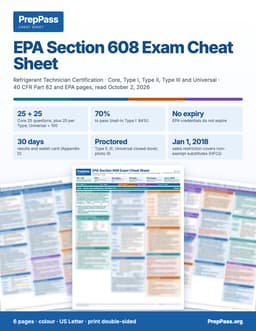
两周内就要考试?
这本指南是系统讲解,要花几周读。如果两周内就考,可打印的彩色速查表是另一款产品:考试涉及的关键数字,按章节排好。
6 页 · US Letter · 可打印 PDF · 永久保存
关于这场考试本身
| 主管机构 | United States Environmental Protection Agency (EPA) — rule-setting only —— 考试由 EPA-approved certifying organizations; there is no single national test vendor 承办 来源: US EPA — Section 608 Technician Certification Requirements |
|---|---|
| 题目数量 | 50–100 道题 来源: 40 CFR Part 82, Subpart F — Recycling and Emissions Reduction (incl. § 82.161 and Appendix D), eCFR |
| 考试时限 | US EPA 未公布 我们查阅但未找到该数据的来源: 40 CFR Part 82, Subpart F — Recycling and Emissions Reduction (incl. § 82.161 and Appendix D), eCFR |
| 及格标准 | 70% 来源: 40 CFR Part 82, Subpart F — Recycling and Emissions Reduction (incl. § 82.161 and Appendix D), eCFR |
| 费用 | US EPA 未公布 我们查阅但未找到该数据的来源: 40 CFR Part 82, Subpart F — Recycling and Emissions Reduction (incl. § 82.161 and Appendix D), eCFR |
| 考试语言 | US EPA 未公布 我们查阅但未找到该数据的来源: 40 CFR Part 82, Subpart F — Recycling and Emissions Reduction (incl. § 82.161 and Appendix D), eCFR |
How this book compares
EPA lists what each Section 608 test covers for free. This book teaches Core and Types I, II and III with a Universal practice exam; ESCO Institute sells a short preparatory manual.
| Resource | Price | What you get | Choose it if |
|---|---|---|---|
| This bookEPA 608 Universal Study Guide (2026) — Core + Type I/II/III, with the 2027 A2L updatePrepPass | $14.99 | Downloadable Universal study guide for Section 608
| Choose this book if you want each section taught with its regulations cited and a Universal practice exam scored by section. |
| From the exam bodySection 608 Technician Certification test topics (opens the publisher's page in a new tab)U.S. Environmental Protection Agency | Free (web page) | EPA's description of the Core, Type 1, Type 2 and Type 3 tests | Read it in any case to see what each test covers. |
| AlternativeEPA Section 608 Certification Exam Preparatory Manual, 9th Edition (opens the publisher's page in a new tab)ESCO Institute | $34.99 at HD Supply | Printed preparatory manual (retailer listing)
| Choose ESCO's manual if you want a short printed booklet. |
This book
EPA 608 Universal Study Guide (2026) — Core + Type I/II/III, with the 2027 A2L update
PrepPass
- Price
- $14.99
- What you get
Downloadable Universal study guide for Section 608
- 170 practice questions with explanations
- 165 pages, PDF + EPUB
- Choose it if
- Choose this book if you want each section taught with its regulations cited and a Universal practice exam scored by section.
From the exam body
Section 608 Technician Certification test topics (opens the publisher's page in a new tab)
U.S. Environmental Protection Agency
- Price
- Free (web page)
- What you get
EPA's description of the Core, Type 1, Type 2 and Type 3 tests
- Choose it if
- Read it in any case to see what each test covers.
Alternative
ESCO Institute
- Price
- $34.99 at HD Supply
- What you get
Printed preparatory manual (retailer listing)
- 28 pages
- Choose it if
- Choose ESCO's manual if you want a short printed booklet.
Other resources' prices and contents are as listed on each publisher's or seller's own page, checked September 24, 2026. Prices change; confirm on the linked page before you buy. This book's price and contents come from our own catalog.
Sources (2)
- https://www.epa.gov/section608/test-topics — read September 24, 2026
- https://hdsupplysolutions.com/p/esco-institute-epa-section-608-cert-exam-prep-p117508 — read September 24, 2026
包含什么,不包含什么
包含
- 7 chapters: Core, Regulations, Type I, Type II, Type III, Recovery, and A2L/A3 refrigerants with the 2027 question bank
- A 100-question Universal practice exam — 25 per section, scored per section
- 60 section practice questions plus a 10-question A2L drill
- Explanations with 40 CFR citations, and §82.156 Table 1 as it reads today (pressure classes by psia at 104°F)
- Appendix B "The numbers" cram page, plus nine appendices in all
- PDF (print & tab it) + EPUB (phone / e-reader)
不包含
- 不寄送纸质书 —— 这是一份你下载后可自行打印的文件
- 购书不含视频课程、讲师或一对一辅导 —— 站上的免费视频是另一回事
- 不含考试报名费与考点费用,这些仍需向官方机构缴纳
目录
查看 21 个部分及各部分起始页
- Part I — The pressure–temperature relationship第 16 页
- Part I — Cylinder and DOT detail第 33 页
- Part I — Small appliance vs. motor‑vehicle A/C (the Section 609 line)第 48 页
- Part I — Components you will meet on the exam第 60 页
- Part I — Standing tests, water boxes, and putting it together第 71 页
- Part I — Evacuation and dehydration (a different job from recovery)第 81 页
- Part II — Practice Questions第 98 页
- Part III — Universal Practice Exam (100 questions)第 117 页
- Section 1 — Core (Q1–Q25)第 117 页
- Section 2 — Type I (small appliances) (Q26–Q50)第 122 页
- Section 3 — Type II (medium-, high- and very‑high‑pressure) (Q51–Q75)第 127 页
- Section 4 — Type III (low‑pressure) (Q76–Q100)第 132 页
- Part III — Answer Key & Explanations第 137 页
- Appendix A — Common refrigerant reference第 148 页
- Appendix C — Glossary第 153 页
- Appendix D — Exam‑day strategy第 155 页
- Appendix E — Frequently confused pairs第 157 页
- Appendix F — A one‑week study plan第 159 页
- Appendix G — 40 must‑know facts (rapid fire)第 160 页
- Appendix H — Official sources and further reading第 162 页
- Appendix I — Frequently asked questions第 164 页
取自你将下载的那份 PDF,并标明各章起始页 —— 不是在此手工录入的。
免费读完整一章
完整的一章,与电子书正文一字不差。直接在此窗口滚动阅读;无需下载,无需邮箱。
在本页直接阅读第 4 章
我们没有拿轻松的绪论充数 —— 免费章节直接翻到书里最见功力的部分,让你在考试真正难的地方检验这本书讲得好不好。
EPA Section 608 Study Guide · Type II Section (25 questions)
Introduction
Type II certification covers medium-, high- and very‑high‑pressure appliances — from residential split systems and heat pumps to supermarket refrigeration racks and R‑134a chillers. This is the certification most field HVAC/R technicians rely on daily, because most everyday air‑conditioning and commercial refrigeration work is Type II.
The heart of this chapter is a table of evacuation vacuum levels that depend on the pressure class of the refrigerant, the appliance size (the 200‑pound split), and the age of your recovery equipment. Those numbers are among the most heavily tested figures on the entire certification. Learn them until they are automatic.
Learning objectives
After working through this chapter you should be able to:
- Define medium-, high- and very‑high‑pressure appliances the way 40 CFR §82.152 does (saturation pressure at 104°F) and place common refrigerants in each class.
- Recall the required evacuation levels (in inches of mercury vacuum) from §82.156 Table 1, by pressure class, by the 200‑pound size split, and by equipment age.
- Choose an appropriate leak‑detection method and pressurize a system safely.
- Apply efficient recovery techniques — liquid before vapor, managing non‑condensables, low‑loss fittings, and the 80% fill limit.
Part A — Pressure classes defined
40 CFR §82.152 sorts appliances by one measurement: the refrigerant's liquid‑phase saturation pressure at 104°F. Many study guides describe the classes by boiling point instead; the regulation does not, and the pressure class is what picks the row of the evacuation table.
| Class (§82.152) | Saturation pressure at 104°F | Examples the CFR names | Certification |
|---|---|---|---|
| Low‑pressure | below 45 psia | R‑11, R‑123, R‑113, R‑245fa | Type III |
| Medium‑pressure | 45 to 170 psia | R‑114, R‑124, R‑12, R‑134a, R‑500 | Type II |
| High‑pressure | 170 to 355 psia | R‑22, R‑407A, R‑407C, R‑410A, R‑502 | Type II |
| Very‑high‑pressure | above 355 psia, or critical temperature below 104°F | R‑13, R‑23, R‑503, R‑508A, R‑508B | Type II |
Two refrigerants you meet every week are placed by the numbers rather than by name:
- R‑404A is not on the CFR's example list, but a standard R‑404A pressure‑temperature chart reads about 250 psig (roughly 265 psia) at 104°F, inside the high‑pressure band. A supermarket rack on R‑404A is a high‑pressure appliance, in the same row as R‑22 and R‑410A.
- R‑134a is often called "high‑pressure" in older material, but it sits at about 147 psia at 104°F (NIST), which makes it medium‑pressure, alongside R‑12. For comparison, R‑22 is about 222 psia (NIST).
Type II is required to service, maintain, repair, or dispose of all three of the medium-, high-, and very‑high‑pressure classes — except for small appliances (Type I) and motor‑vehicle air conditioners (which fall under Section 609) (40 CFR §82.161). If a question describes a rooftop AC unit, a heat pump, a supermarket rack or an R‑134a chiller, think Type II.
Part B — Evacuation levels: 40 CFR §82.156, Table 1
Before opening an appliance for maintenance, service, repair or disposal, you must recover the refrigerant to the level in §82.156 Table 1 (small appliances, MVACs and MVAC‑like appliances have their own rules). The level turns on three things: the pressure class, the full charge (under 200 lb, or 200 lb and more), and the date your recovery equipment was made (before, or on/after, November 15, 1993). As read on the eCFR (current September 22, 2026):
| Appliance (or isolated component) | Equipment made before Nov 15, 1993 | Equipment made on/after Nov 15, 1993 |
|---|---|---|
| Very‑high‑pressure | 0 in Hg | 0 in Hg |
| High‑pressure, under 200 lb (R‑22, R‑410A, R‑404A, R‑407C) | 0 in Hg | 0 in Hg |
| High‑pressure, 200 lb or more | 4 in Hg | 10 in Hg |
| Medium‑pressure, under 200 lb (R‑12, R‑134a, R‑500) | 4 in Hg | 10 in Hg |
| Medium‑pressure, 200 lb or more | 4 in Hg | 15 in Hg |
| Low‑pressure (Type III, Chapter 5) | 25 mm Hg absolute | 25 mm Hg absolute |
(in Hg = inches of mercury vacuum, relative to standard atmospheric pressure of 29.9 in Hg.)
Almost every exam question assumes post‑1993 equipment, so the right‑hand column is the one to own. Two rules sit beside the table:
- Not a major repair? If the work does not remove a compressor, condenser, evaporator or auxiliary heat‑exchange coil, or leave an opening of more than 4 square inches of flow area uncovered for more than 15 minutes (§82.152, "major"), and the appliance will not be evacuated to atmosphere afterward, a medium-, high- or very‑high‑pressure appliance only has to reach 0 psig before it is opened (§82.156(a)(1)(i)).
- Leaks make the level unattainable? Isolate leaking from non‑leaking parts, take the non‑leaking parts to the Table 1 level, and take the leaking part as low as you can without substantially contaminating the refrigerant — never above 0 psig (§82.156(a)(2)).
Why other guides disagree. Many study guides still print a table organized by refrigerant name — "HCFC‑22" and "other high‑pressure" — that files R‑410A, R‑404A and R‑407C under "other" at 10/15 in Hg. That was the pre‑2017 table. Since EPA's November 2016 rule took effect on January 1, 2017, the CFR table is organized by pressure class. R‑410A, R‑404A and R‑407C sit in the high‑pressure row with R‑22 (0/10); the deeper 10/15 row belongs to medium‑pressure refrigerants such as R‑12 and R‑134a. If a practice test tells you a 300‑lb R‑404A rack needs 15 in Hg, it is teaching the wrong row.
Part C — Leak detection methods
Finding leaks quickly protects the charge, the equipment, and the atmosphere. Know the common methods and their strengths:
- Electronic leak detector — highly sensitive; pinpoints small leaks by sensing refrigerant near a joint. The go‑to for finding a small leak.
- Soap‑bubble solution — brushed on a suspect fitting, it reveals larger leaks as growing bubbles.
- Fluorescent dye — added to the system, it shows leak points under ultraviolet light after the unit runs.
- Ultrasonic detector — "hears" the hiss of escaping gas.
To pressurize a system for leak testing, use dry nitrogen — sometimes with a trace of refrigerant so an electronic detector can sense it — but never oxygen or compressed air (explosion hazard with refrigerant oil). And always leak‑test and repair before recharging: charging a leaking system simply vents refrigerant and wastes money.
Part D — Recovery techniques for high‑pressure systems
Recovering a high‑pressure system efficiently means managing both liquid and vapor:
- Recover liquid before vapor on large charges. Pull liquid first through the liquid‑line port to move the bulk quickly, then switch to vapor recovery to bring the remaining gas down to the required vacuum. This greatly shortens the job.
- Purge non‑condensables. Gases such as air raise head pressure and slow recovery, so purge them and avoid drawing air into the system.
- Minimize losses. Keep hoses short and use low‑loss fittings to cut the refrigerant released when you connect and disconnect.
- Respect the 80% fill limit. Watch the recovery cylinder weight and never exceed 80% fill.
- Manage temperature. If the appliance is very cold or the ambient is low, recovery slows; warming the appliance slightly or cooling the recovery cylinder can speed the transfer.
Part E — Memorizing the evacuation table
The Part B table is the single densest set of numbers on the certification, so here is a way to hold it in your head instead of memorizing cells cold. One sentence carries it: the lower the pressure class, the deeper the vacuum. Then three steps:
- High‑pressure (R‑22, R‑410A, R‑404A, R‑407C) is the shallow row. Under 200 lb: 0 in Hg. 200 lb and up: 10 in Hg.
- Medium‑pressure (R‑12, R‑134a, R‑500) is one step deeper. Under 200 lb: 10 in Hg. 200 lb and up: 15 in Hg.
- Very‑high‑pressure is 0 in Hg at any size, and low‑pressure is deepest of all (25 mm Hg absolute). With pre‑1993 equipment, nothing but a low‑pressure appliance ever needs more than 4 in Hg.
So the ladder from shallow to deep is: very‑high and small high‑pressure (0) → large high‑pressure and small medium‑pressure (10) → large medium‑pressure (15) → low‑pressure (25 mm Hg absolute). The 200‑lb line is the hinge; the pressure class picks the row.
Worked example — the large R‑404A rack. A supermarket condensing unit holds 300 lb of R‑404A and you are opening it for a compressor change with a 2019 recovery machine. To what vacuum must you evacuate? Reasoning: R‑404A reads about 250 psig (roughly 265 psia) at 104°F, inside the 170–355 psia band, so it is high‑pressure — the same row as R‑22 and R‑410A. 300 lb ≥ 200 lb and the machine is post‑1993, so Table 1 gives 10 in Hg. Guides that file R‑404A as "other high‑pressure" answer 15 in Hg; 15 is the medium‑pressure figure. Answer: 10 in Hg. (40 CFR §82.152; §82.156 Table 1.)
Part F — Leak detection and repair depth
You cannot fix what you cannot find, and Type II leans on leak‑detection judgment beyond the method list in Part C:
- Standing pressure/temperature. A system that has lost pressure since the last visit is leaking; comparing the saturation pressure to the ambient‑temperature saturation of the refrigerant tells you whether the charge is low or the system is under vacuum (drawing air).
- Match the method to the leak. The electronic detector pinpoints the small leak at a joint or flare; bubbles confirm a larger, accessible one; UV dye — circulated, run, then scanned with a UV lamp — catches the intermittent or hidden leak that only opens under running conditions; ultrasonic hears the hiss in a plant too noisy for anything else.
- Nitrogen pressure test. To confirm a repair or find a leak in an empty system, pressurize with dry nitrogen (optionally a trace of refrigerant so an electronic detector can sense it) and watch for pressure decay — never oxygen or compressed air.
Always repair before recharging. Charging a system that still leaks just meters expensive refrigerant into the atmosphere.
Part G — Retrofits and non‑condensables
- Retrofitting to a new refrigerant. As R‑22 supply tightens, systems get retrofitted to an approved substitute. The rules: the substitute must be SNAP‑approved for that end use, you usually must change the lubricant (mineral oil for CFC/HCFC vs. POE/polyol‑ester for many HFCs), you recover the old charge (never mix), and you relabel the system for the new refrigerant. Never just "top off" R‑22 with a different refrigerant — that creates an unreclaimable mixed charge.
- Non‑condensables. Air and other non‑condensable gases collect in the condenser, raise head pressure, and slow both cooling and recovery. Purge them and keep air out of the system in the first place (evacuate with a vacuum pump and hold a standing vacuum before charging a repaired system).
Worked example — retrofit compliance. A customer wants you to convert an old R‑22 rooftop unit to a lower‑cost refrigerant. List the compliance steps. Reasoning / Answer: (1) choose a refrigerant SNAP‑approved for that end use; (2) recover the R‑22 into a dedicated cylinder (do not vent, do not mix); (3) change the lubricant if the new refrigerant requires POE oil; (4) evacuate and leak‑check with nitrogen; (5) charge the new refrigerant — as a liquid if it is a zeotropic blend; (6) relabel the unit. (40 CFR Part 82, Subparts F & G.)
Part H — Charging a high‑pressure system correctly
After a repair you must put the right amount of refrigerant back — an undercharge or overcharge wrecks efficiency and can damage the compressor. Type II tests the concepts, not deep calculations:
- Weigh‑in (charge by weight). The most accurate method: recover/evacuate the system, then weigh in the exact factory charge listed on the nameplate using a scale. Best when the full charge is known and the system is empty.
- Superheat method. Superheat is how many degrees the vapor is above its saturation temperature at the suction line. On fixed‑orifice/capillary systems you charge to a target superheat — too little superheat risks liquid flooding back to the compressor; too much means the system is undercharged.
- Subcooling method. Subcooling is how many degrees the liquid is below its saturation temperature at the liquid line. On TXV (thermostatic expansion valve) systems you charge to a target subcooling; low subcooling usually means undercharge, high subcooling overcharge.
- Charge zeotropic blends as a liquid. Because R‑404A, R‑407C, and R‑410A glide and can fractionate, add them to the system as liquid (throttled so you don't slug the compressor) — never as vapor from the cylinder, which would shift the blend's composition.
Charging safety: never charge into a system you have not leak‑tested and evacuated; never use the cylinder pressure alone to judge the charge; and keep the recovery/charging cylinder on a scale.
购买前
- 怎么拿到?
- 付款后下载入口立即出现在本页,链接同时发到你的邮箱。无需注册账号。
- 不合适怎么办?
- 14 天内发邮件即可全额退款,无需理由。
- 免费练习会取消吗?
- 不会。站上的每一道练习题、计时模考和免费章节都继续免费。这本书是「学」的那一半,不是把免费部分围起来的门。
- 能在手机上看吗?
- 可以 —— EPUB 适合手机和电子书阅读器,PDF 适合打印和贴标签,两种都给你。
详细信息
Updated September 2026 for the current 40 CFR §82.156 evacuation table and the revised question bank (A2L/A3: R-32, R-454B, R-1234yf)
- Format: PDF + EPUB download · 165 pages
- 170 practice questions in the book, with a full answer key
- 240 free practice questions for this exam on PrepPass, included at no cost
- $14.99 one-time — no subscription
- 14-day money-back guarantee · refund policy
- Cross-referenced against: EPA Clean Air Act §608 / 40 CFR Part 82 Subpart F
- Last updated: September 2026
- 官方来源核验(EPA Clean Air Act §608 / 40 CFR Part 82 Subpart F)
- 240 道免费练习题
- 即时下载,永久拥有
EPA 608 certification course 要 $50–$200。这本书讲的是同一门考试 —— 同样的规则、核对到最新标准 —— 只需一次性 $14.99,永久归你。
练习免费,为什么还要买书?
我们的练习题和计时模考一直免费 —— 网站上的东西不会因为这本书而收起来。这本 $14.99 的书是「学」的那一半:知识本身,按顺序讲清楚,存成一份属于你的文件。
- 系统讲解 —— 每个考试部分按章节从头讲到尾,不只是题目
- 可打印可贴标签 —— 一份适合打印的 PDF,能划重点、做批注、带到书桌前
- 随处离线学 —— EPUB 放手机或电子书阅读器;不用 wifi,不用一堆浏览器标签
- 全在一处 —— 章节和练习题都在同一份文件里
- 永久归你 —— 一次 $14.99,即时下载,无订阅
而且零风险:14 天退款保证 —— 不满意?发邮件即可全额退款,无需理由。 详见退款政策。
14 天退款保证 · 全额退款,无需理由。
一次购买,永久下载访问。此电子书是完整的 EPA Section 608 Certification 学习指南,含 PDF 与 EPUB。仅为教育性摘要,非专业或法律意见 —— 请始终以官方来源核实当前规定。最后更新:September 2026。