Property & Casualty Insurance Producer · 2026 版
Property & Casualty Insurance Producer — Complete Study Guide (2026)
The general portion every state's P&C exam tests — property, homeowners, auto, commercial, liability and workers' comp — with a 100-question full-length practice exam. Pair it with your state's law.
- 全部 10 章 —— 财产险、住宅险、房主险、汽车险、商业险、责任险与工伤补偿 —— 合成一本,PDF + EPUB 永久保存
- 10 章每章都以一道例题详解和一页关键数字收尾
- 书内 100 道练习题,每道答案都写出推理而非只给字母 —— 站上的免费题库里一道都没有
$19.99一次买断 · 永久下载 · 无订阅
PDF + EPUB · 英文 · 121 页 · $19.99 一次买断
本书为英文版,下载的 PDF 与 EPUB 均为英文。
付款后立即下载 —— 无需注册账号,无订阅。
14 天退款保证:任何原因不满意?购买后 14 天内发邮件至 support@preppass.org 即可全额退款。 这是电子下载,无需寄回任何东西。 退款政策
翻开这本书看看
三页真实内页,直接从你将下载的 PDF 渲染而来 —— 依次是一页速查、一页讲解、一道带解析的例题。没有任何一页是为了好看而重画的。
- 速查页Appendix C — Glossary of Key P&C Terms · PDF 第 117 页
一页可以随时翻回来的内容:把数字、期限或术语集中在一处。
- 怎么讲Section II — insureds, insured location, exclusions · PDF 第 42 页
讲解页:用文字把知识讲清楚,顺序与考试考查的顺序一致。
- 一道题的完整解析Chapter 4 — The Dwelling Policy (DP) · PDF 第 39 页
一道练习题,连同答案和背后的推理 —— 不只是一个答案键。
两门都要考?有套装价
- Life & Health Insurance Producer — Complete Study Guide (2026)$19.99
- Property & Casualty Insurance Producer — Complete Study Guide (2026)$19.99
两件一起买:$29.99 —— 比分开买省 $9.99
分开买 $39.98 · 立减 24% · 一次结账,两件都到手。
已经买过《Life & Health Insurance Producer》了?那就别买套装——套装里含这本,你会重复付费。单独购买《Property & Casualty Insurance Producer》只要 $19.99。 Property & Casualty Insurance Producer · 套装内容 →
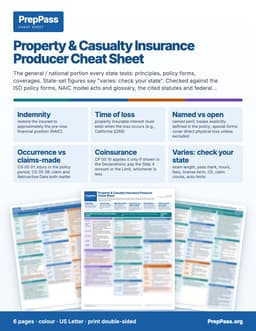
两周内就要考试?
这本指南是系统讲解,要花几周读。如果两周内就考,可打印的彩色速查表是另一款产品:考试涉及的关键数字,按章节排好。
6 页 · US Letter · 可打印 PDF · 永久保存
关于这场考试本身
| 主管机构 | 没有统一的主管机构:各州保险局分别颁发财产与意外险代理人执照并自行设定考试,通常由考试机构承办。加州由 PSI Services LLC 承办;得州由 Pearson VUE 承办。如 PrepPass 已有你所在州的考试事实页面,请查看该页面。 我们查阅但未找到该数据的来源: PSI / California Department of Insurance — Candidate Information Bulletin for California Insurance License Examinees (revised March 2026) |
|---|---|
| 题目数量 | 由各州自行规定。加州的考试为 150 题。如 PrepPass 已有你所在州的考试事实页面,请查看该页面。 我们查阅但未找到该数据的来源: PSI / California Department of Insurance — Candidate Information Bulletin for California Insurance License Examinees (revised March 2026) |
| 考试时限 | 由各州自行规定。加州给 195 分钟;得州的 General Lines - Property & Casualty 考试给 150 分钟。如 PrepPass 已有你所在州的考试事实页面,请查看该页面。 我们查阅但未找到该数据的来源: PSI / California Department of Insurance — Candidate Information Bulletin for California Insurance License Examinees (revised March 2026) |
| 及格标准 | 由各州自行规定。加州公布的是 60%;Pearson VUE 的得州手册公布的是 0–100 量表上的标准分 70,并说明该分数不是答对题目的百分比。如 PrepPass 已有你所在州的考试事实页面,请查看该页面。 我们查阅但未找到该数据的来源: CDI — Examination Times and Number of Questions (CDI website table; stale on languages and, for time limits, disagrees with the CIB) |
| 费用 | 由各州自行规定。Pearson VUE 的得州手册列出 General Lines - Property & Casualty 考试每次 $49。如 PrepPass 已有你所在州的考试事实页面,请查看该页面。 我们查阅但未找到该数据的来源: Pearson VUE — Texas Insurance Licensing Candidate Handbook, October 2024 (#124400) |
| 考试语言 | 由各州自行规定;Pearson VUE 的得州手册列有英语与西班牙语版本。如 PrepPass 已有你所在州的考试事实页面,请查看该页面。 我们查阅但未找到该数据的来源: Pearson VUE — Texas Insurance Licensing Candidate Handbook, October 2024 (#124400) |
包含什么,不包含什么
包含
- Property fundamentals, dwelling (DP) & homeowners (HO-2/3/4/5/6/8)
- Personal & commercial auto, CGL (occurrence vs claims-made)
- Workers' comp (exclusive remedy), casualty & liability doctrine
- Coinsurance, ISO forms, and the numbers the exam tests
- A 100-question full-length practice exam (general portion) with worked explanations
- PDF (print & tab it) + EPUB (phone / e-reader)
不包含
- 不寄送纸质书 —— 这是一份你下载后可自行打印的文件
- 购书不含视频课程、讲师或一对一辅导 —— 站上的免费视频是另一回事
- 不含考试报名费与考点费用,这些仍需向官方机构缴纳
目录
查看 20 个部分及各部分起始页
- Chapter 1 — General Insurance Principles第 8 页
- Chapter 2 — Insurance Regulation, the Producer’s Legal Duties & Federal Law第 18 页
- Chapter 3 — Property Insurance Fundamentals第 28 页
- Chapter 4 — The Dwelling Policy (DP)第 35 页
- Chapter 5 — Homeowners Insurance (HO Forms)第 40 页
- Section I — Coverages A and B第 41 页
- Section I — Coverages C and D第 41 页
- Section I — special internal limits and scheduling valuables第 41 页
- Section II — Coverages E and F第 42 页
- Section II — insureds, insured location, exclusions第 42 页
- Chapter 6 — Commercial Property Insurance第 47 页
- Chapter 7 — Auto Insurance — Personal and Commercial第 53 页
- Chapter 8 — Casualty & Liability Insurance第 60 页
- Chapter 9 — Workers’ Compensation Insurance第 67 页
- Chapter 10 — How to Study Your State’s Rules (the State Portion)第 73 页
- Practice Exam — 100 Questions (Full-Length General Portion)第 77 页
- Answer Key with Explanations第 99 页
- Appendix A — Exam-Day Strategy: How to Attack a P&C Question第 111 页
- Appendix B — Rapid-Review Cram Sheet (50 High-Yield Facts)第 113 页
- Appendix C — Glossary of Key P&C Terms第 117 页
取自你将下载的那份 PDF,并标明各章起始页 —— 不是在此手工录入的。
免费读完整一章
完整的一章,与电子书正文一字不差。直接在此窗口滚动阅读;无需下载,无需邮箱。
在本页直接阅读第 5 章
我们没有拿轻松的绪论充数 —— 免费章节直接翻到书里最见功力的部分,让你在考试真正难的地方检验这本书讲得好不好。
The Homeowners (HO) policy is the most widely sold personal-lines property contract in the country and typically the largest single block on the general portion — about 15%. The package combines real-property, personal-property, loss-of-use, personal-liability, and medical-payments coverage in one contract with shared declarations, exclusions, and conditions. This chapter covers the standard HO forms, the four Section I property coverages, the two Section II liability coverages, exclusions, loss settlement, special internal limits, and the key conditions. These are ISO-standard, national forms; the state overlays (mandatory earthquake offers, wildfire moratoria, residual-market "FAIR" plans) belong to the state portion and are summarized in Chapter 10.
The standard HO forms at a glance
Carriers use the ISO Homeowners program or close proprietary equivalents:
- HO-2, Broad Form — dwelling and personal property on a named-peril basis (a list of roughly 16 perils).
- HO-3, Special Form — the workhorse owner-occupied contract. Open-peril on the dwelling and other structures; named-peril on personal property.
- HO-4, Contents Broad Form — the renter's/tenant's form. No dwelling coverage; protects the tenant's personal property, loss of use, liability, and medical payments.
- HO-5, Comprehensive Form — the broadest standard contract: open-peril on BOTH the dwelling AND personal property.
- HO-6, Unit-Owners Form — for condominium owners: interior building items, personal property, loss of use, liability, medical payments, and built-in loss-assessment coverage.
- HO-8, Modified Coverage Form — for older/historic homes whose replacement cost far exceeds market value; settles dwelling losses on an ACV or functional repair-cost basis.
Section I — Coverages A and B
- Coverage A — Dwelling: the dwelling on the residence premises, including attached structures and on-site building materials. Coverage A is the keystone because most other coverages are expressed as a percentage of it. The agent's first task is to determine the replacement cost of the dwelling with a cost estimator.
- Coverage B — Other Structures: detached structures separated by clear space (detached garage, shed, fence, gazebo). Provides an additional amount equal to 10% of Coverage A (a separate additional amount, not a sublimit). Structures rented to others or used for business are restricted/excluded.
Section I — Coverages C and D
- Coverage C — Personal Property: covers personal property owned or used by an insured anywhere in the world, automatically written at 50% of Coverage A on an owner-occupied HO-3 (different percentages apply on HO-4/HO-6, where Coverage C is the keystone). Off-premises personal property is covered, commonly up to 10% of Coverage C (or a stated minimum such as $1,000, whichever is greater).
- Coverage D — Loss of Use: pays the necessary increase in living costs above the normal baseline when a Section I peril makes the residence uninhabitable — additional living expense (ALE) for temporary lodging/meals, and fair rental value if the insured rented part of the home. Usually about 30% of Coverage A on an HO-3, payable for the shortest time to repair/replace or permanently relocate.
Section I — special internal limits and scheduling valuables
Within Coverage C, the form imposes special internal limits (sublimits) on classes of property that are easily stolen, hard to value, or invite moral hazard. Typical figures (edition-dependent) include roughly $200 on money/bullion; $1,500 on securities and on watercraft/trailers; $1,500 on theft of jewelry, watches, and furs; $2,500 on theft of firearms; $2,500 on theft of silverware; $2,500 on business property on premises. These caps apply per loss within the Coverage C limit — they are sublimits, not additional amounts, so they do not increase Coverage C. (Contrast Coverage B, which genuinely is a separate additional amount equal to 10% of Coverage A.) To insure valuables fully and on broader perils, add a Scheduled Personal Property endorsement (or a Personal Articles Floater): each item is listed at an appraised value, the deductible is generally waived, coverage is open-peril including mysterious disappearance, and the special-limit cap does not apply.
Section II — Coverages E and F
- Coverage E — Personal Liability: pays sums the insured is legally obligated to pay as damages for bodily injury or property damage caused by a covered occurrence, and includes a duty to defend with defense costs paid in addition to the limit. A common baseline limit is $100,000 per occurrence, though insureds routinely buy $300,000–$500,000 and pair the policy with a personal umbrella for $1 million or more.
- Coverage F — Medical Payments to Others: a small no-fault coverage paying reasonable medical expenses (typically within three years) for someone other than an insured injured on the insured location with permission, or off-premises by an insured, a residence employee, or an owned animal. Typical limits $1,000–$5,000 per person. It heads off small claims before they become lawsuits.
Section II — insureds, insured location, exclusions
An insured under Section II includes the named insured, resident spouse/partner, resident relatives, and others under age 21 in their care. An insured location includes the residence premises, other premises the insured uses in connection with it, vacant land, cemetery plots, and premises used temporarily (a hotel room, a vacation rental). Important Section II exclusions: business activities (a home daycare or for-profit venture needs a separate policy/endorsement), professional services, ownership/operation of most motor vehicles, watercraft over stated size/horsepower, and aircraft; intentional injury; communicable disease; molestation; controlled-substance offenses; injury to an insured; and obligations under workers' compensation (employee injuries belong on a WC policy).
Standard exclusions and companion coverages
Every HO form lists Section I exclusions that reveal the gaps needing separate coverage: earth movement (earthquake — needs an earthquake program/DIC), flood (needs NFIP or private flood), war/nuclear/government action, intentional loss, ordinance or law (add-back endorsement available), and wear and tear/settling/mold/vermin/faulty workmanship (inevitable, non-fortuitous). Some forms still cover an ensuing named peril (e.g., a fire that follows an excluded cause).
Loss settlement on the dwelling: 80% coinsurance and RC
The standard HO-3 dwelling loss-settlement clause uses an 80% coinsurance trigger. Carry Coverage A ≥ 80% of the dwelling's full replacement cost at the time of loss, and partial losses are paid at full replacement cost up to the limit with no depreciation deduction. Carry less than 80%, and the insurer pays the greater of (a) the ACV of the damaged part, or (b) the proportion the limit bears to 80% of full RC, up to the limit. To stay above the line as costs rise, insureds add Inflation Guard (auto-increases Coverage A), Extended Replacement Cost (pays a stated 25%/50% above the limit if needed), or Guaranteed Replacement Cost (removes the cap, subject to underwriting).
Personal-property settlement: ACV vs. RC
Unless endorsed, Coverage C settles on ACV (replacement cost minus depreciation). Most insureds add the Personal Property Replacement Cost endorsement, paying full RC for items actually replaced within a stated time (commonly 180 days). The endorsement still respects the special internal limits — adding it does not lift the jewelry-theft cap.
Mortgage clause, liberalization, and other conditions
The standard (union) mortgage clause protects the lender even when the insured's own claim would be denied; the insurer typically gives the mortgagee at least 10 days' notice for non-payment cancellation and more (often 30 days) for other cancellations, and the mortgagee may pay premium to keep the policy in force. The liberalization clause extends any broader form the insurer adopts during the term (without extra premium) automatically. Other conditions include appraisal (either party may demand it to resolve amount disputes), a suit-against-insurer time limit, an assignment condition (no transfer without consent), and subrogation/salvage rules.
### Key numbers & facts — Chapter 5 National ISO Homeowners concepts. Percentages are standard HO-3 defaults (edition-dependent). - HO-3 = open dwelling/other structures, named-peril contents (workhorse). HO-5 = open on both. HO-4 = renter's, no dwelling. HO-6 = condo + loss assessment. HO-8 = older homes, ACV. - Coverage B ≈ 10% of A (additional). Coverage C ≈ 50% of A (owner-occupied HO-3). Coverage D ≈ 30% of A. - Coverage E commonly $100,000 per occurrence; defense is in addition to the limit. - Coverage F (Med Pay) no-fault, ~$1,000–$5,000 per person, expenses within 3 years. - Special internal limits (typical): ~$200 money, $1,500 jewelry theft, $2,500 firearms theft, $2,500 silverware theft. - Dwelling loss settlement: 80% coinsurance trigger for full RC; below 80% → greater of ACV or the pro-rata amount. - Personal Property RC endorsement — replace within ~180 days; special limits still apply. - Excluded → companion coverage: earthquake (separate program), flood (NFIP), ordinance/law (endorsement). - State overlays (mandatory earthquake offer, wildfire moratorium, FAIR-type plans) are (state-set) — see Ch. 10.
Worked example
A homeowner's dwelling has a $400,000 replacement cost but she insured Coverage A for only $280,000 (70% of RC). A kitchen fire causes $60,000 of damage. Because she carries less than 80% of RC ($320,000 required), the RC settlement does not apply in full. The insurer pays the greater of the ACV of the damaged portion or the pro-rata amount: (280,000 ÷ 320,000) × 60,000 = $52,500 (before any deductible), versus the depreciated ACV of the damaged kitchen. She loses the depreciation/coinsurance shortfall for being under-insured — the reason Inflation Guard and periodic RC re-estimates matter.
Named exam traps
- HO-4 and HO-6 have no Coverage A percentage engine. On a renter's/condo form, Coverage C is the keystone, not 50% of a dwelling limit.
- Defense costs. On Coverage E, defense is outside (in addition to) the limit — a common wrong answer says it erodes the limit.
- Med Pay is no-fault and only for others. It does not pay the insured's own household members' medical bills.
- Scheduling doesn't lift Coverage C's RC vs. sublimit automatically. The Personal Property RC endorsement still respects special limits; only a Scheduled endorsement removes the sublimit for listed items.
- Earthquake/flood "must be in the HO." They are excluded — separate coverage required. Any answer covering flood under the HO is wrong.
Sources: ISO Homeowners program forms (HO-2/3/4/5/6/8) and standard endorsements; NFIP for the flood exclusion. State-specific homeowners overlays are treated in Chapter 10.
购买前
- 怎么拿到?
- 付款后下载入口立即出现在本页,链接同时发到你的邮箱。无需注册账号。
- 不合适怎么办?
- 14 天内发邮件即可全额退款,无需理由。
- 免费练习会取消吗?
- 不会。站上的每一道练习题、计时模考和免费章节都继续免费。这本书是「学」的那一半,不是把免费部分围起来的门。
- 能在手机上看吗?
- 可以 —— EPUB 适合手机和电子书阅读器,PDF 适合打印和贴标签,两种都给你。
详细信息
The general portion every state's P&C exam tests — property, homeowners, auto, commercial, liability and workers' comp — with a 100-question full-length practice exam. Pair it with your state's law.
- Format: PDF + EPUB download · 121 pages
- 100 practice questions in the book, with a full answer key
- 324 free practice questions for this exam on PrepPass, included at no cost
- $19.99 one-time — no subscription
- 14-day money-back guarantee · refund policy
- Cross-referenced against: ISO forms / NAIC model acts / NFIP / TRIA
- Last updated: September 2026
- 官方来源核验(ISO forms / NAIC model acts / NFIP / TRIA)
- 324 道免费练习题
- 即时下载,永久拥有
insurance pre-license course 要 $100–$500。这本书讲的是同一门考试 —— 同样的规则、核对到最新标准 —— 只需一次性 $19.99,永久归你。
练习免费,为什么还要买书?
我们的练习题和计时模考一直免费 —— 网站上的东西不会因为这本书而收起来。这本 $19.99 的书是「学」的那一半:知识本身,按顺序讲清楚,存成一份属于你的文件。
- 系统讲解 —— 每个考试部分按章节从头讲到尾,不只是题目
- 可打印可贴标签 —— 一份适合打印的 PDF,能划重点、做批注、带到书桌前
- 随处离线学 —— EPUB 放手机或电子书阅读器;不用 wifi,不用一堆浏览器标签
- 全在一处 —— 章节和练习题都在同一份文件里
- 永久归你 —— 一次 $19.99,即时下载,无订阅
而且零风险:14 天退款保证 —— 不满意?发邮件即可全额退款,无需理由。 详见退款政策。
14 天退款保证 · 全额退款,无需理由。
一次购买,永久下载访问。此电子书是完整的 Property & Casualty Insurance Producer 学习指南,含 PDF 与 EPUB。仅为教育性摘要,非专业或法律意见 —— 请始终以官方来源核实当前规定。最后更新:September 2026。