学习指南 · 2026 版
California Life & Health Insurance Producer Exam — Complete Study Guide (2026)
The California Life, Accident and Health exam taught in full.
- 篇幅
- 141 页
- 书内练习题
- 200
- 考试事实核对与文件更新
- 2026年9月
- 交付
- PDF + EPUB · 英文 · 即时下载
购买前请阅读: Independent study aid, not affiliated with or endorsed by the California Department of Insurance or PSI.
阅读本声明的其余部分
California figures cite the Insurance Code section they come from, as read in September 2026. General educational information, not legal or financial advice.
关于本书
The California Life, Accident and Health exam taught in full — the general portion plus a California law chapter — with a 150-question practice exam built to the CDI's 2026 exam outlines. Updated for AB 943: the 20-hour course is gone.
考试事实、适合谁与变化
关于这场考试本身
| 主管机构 | California Department of Insurance (CDI), Producer Licensing Bureau —— 考试由 PSI Services LLC 承办 |
|---|---|
| 题目数量 | 150 道题 |
| 考试时限 | California Department of Insurance 未公布 我们查阅但未找到该数据的来源: PSI / California Department of Insurance — Candidate Information Bulletin for California Insurance License Examinees (revised March 2026) |
| 及格标准 | 60% |
| 费用 |
|
| 考试语言 | 英语 · 西班牙语 · 简体中文 · 越南语 · 韩语 · 他加禄语 |
翻开这本书看看
三页真实内页,直接从你将下载的 PDF 渲染而来 —— 依次是一页速查、一页讲解、一道带解析的例题。没有任何一页是为了好看而重画的。
- 速查页Chapter 9 — Group Insurance, Social Insurance & Senior Products · PDF 第 61 页
一页可以随时翻回来的内容:把数字、期限或术语集中在一处。
- 怎么讲Chapter 12 — California State Law for Life & Health Producers · PDF 第 91 页
讲解页:用文字把知识讲清楚,顺序与考试考查的顺序一致。
- 怎么讲Chapter 12 — California State Law for Life & Health Producers · PDF 第 92 页
讲解页:用文字把知识讲清楚,顺序与考试考查的顺序一致。
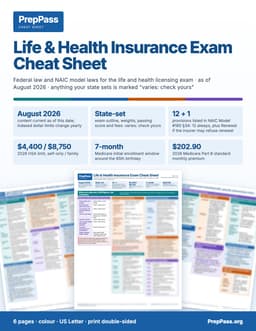
两周内就要考试?
这本指南是系统讲解,要花几周读。如果两周内就考,可打印的彩色速查表是另一款产品:考试涉及的关键数字,按章节排好。
6 页 · US Letter · 可打印 PDF · 永久保存
How this book compares
California requires CDI-approved pre-licensing education before a Life or Accident & Health license is issued. The free PSI bulletin explains the exam; this book is a review to use alongside that education, not instead of it.
| Resource | Price | What you get | Choose it if |
|---|---|---|---|
| This bookCalifornia Life & Health Insurance Producer Exam — Complete Study Guide (2026)PrepPass | $19.99 | Downloadable exam review for the California Life & Health exam
| Choose this book if you want a written review with a full California practice exam alongside your pre-licensing course. It does not count toward the required education. |
| From the exam bodyPSI Candidate Information Bulletin (California insurance examinations) (opens the publisher's page in a new tab)California Department of Insurance / PSI | Free (PDF) | The exam bulletin published on the Department's site
| Read it in any case: the educational objectives it points to are the basis of the exam. |
| AlternativeCareer Launcher Package (CA - Life, Health & Ethics) (opens the publisher's page in a new tab)Kaplan Financial Education | $389 list; shown at $330.65 on the day checked | Online study package with a code-and-ethics course
| Choose a package like this if you still need a course; check that it is CDI-approved for the license you want. |
This book
California Life & Health Insurance Producer Exam — Complete Study Guide (2026)
PrepPass
- Price
- $19.99
- What you get
Downloadable exam review for the California Life & Health exam
- 200 questions printed in the book, with explanations
- 141 pages, PDF + EPUB
- Choose it if
- Choose this book if you want a written review with a full California practice exam alongside your pre-licensing course. It does not count toward the required education.
From the exam body
California Department of Insurance / PSI
- Price
- Free (PDF)
- What you get
The exam bulletin published on the Department's site
- Exam procedures, sample question screens, the pre-licensing education requirements, and where to download the educational objectives the exams are based on
- Choose it if
- Read it in any case: the educational objectives it points to are the basis of the exam.
Alternative
Career Launcher Package (CA - Life, Health & Ethics) (opens the publisher's page in a new tab)
Kaplan Financial Education
- Price
- $389 list; shown at $330.65 on the day checked
- What you get
Online study package with a code-and-ethics course
- Self-study online course, QBank, License Exam Manual and State Law Supplement with cram sheets, and a 12-hour Code & Ethics online course
- Choose it if
- Choose a package like this if you still need a course; check that it is CDI-approved for the license you want.
Other resources' prices and contents are as listed on each publisher's or seller's own page, checked September 24, 2026. Prices change; confirm on the linked page before you buy. This book's price and contents come from our own catalog.
Sources (2)
包含什么,不包含什么
包含
- The full general L&H portion at real weight + a California state-law chapter
- Life provisions, riders, annuities and the taxation rules that get tested
不包含
- 不寄送纸质书 —— 这是一份你下载后可自行打印的文件
- 购书不含视频课程、讲师或一对一辅导 —— 站上的免费视频是另一回事
完整的包含项与不包含项
包含
- Medicare A-D, Medigap, Social Security and group coverage
- California licensing, replacement, free-look and guaranty-association rules
- 200 questions printed in the book with explanations — 45 chapter checks, 5 written California questions and a full 150-question California exam — plus 546 more free on the site
- A California quick-facts table, every figure with its source — PDF + EPUB
不包含
- 不含考试报名费与考点费用,这些仍需向官方机构缴纳
目录
查看 13 个部分及各部分起始页
- Chapter 1 — General Insurance Concepts第 7 页
- Chapter 2 — Life Insurance Basics & Policy Types第 14 页
- Chapter 3 — Life Policy Provisions, Riders & Options第 21 页
- Chapter 4 — Annuities第 28 页
- Chapter 5 — Life Insurance & Annuity Taxation and Uses第 33 页
- Chapter 6 — Health Insurance Basics & Policy Types第 39 页
- Chapter 7 — Health Policy Provisions, Clauses & Riders第 44 页
- Chapter 8 — Disability Income & Long-Term Care第 49 页
- Chapter 9 — Group Insurance, Social Insurance & Senior Products第 55 页
- Part II — California Insurance Law & Practice第 69 页
- Chapter 12 — California State Law for Life & Health Producers第 70 页
- Practice Exam — 150 Questions (California Combined Life, Accident and Health)第 95 页
- Answer Key and Explanations第 125 页
取自你将下载的那份 PDF,并标明各章起始页 —— 不是在此手工录入的。
免费读完整一章
完整的一章,与电子书正文一字不差。直接在此窗口滚动阅读;无需下载,无需邮箱。
在本页直接阅读第 10 章
我们没有拿轻松的绪论充数 —— 免费章节直接翻到书里最见功力的部分,让你在考试真正难的地方检验这本书讲得好不好。
Everything up to this point in the book is national: contract law, policy types, underwriting, riders, taxation, group benefits, health plan design. This chapter is the other half of your exam — the California-specific material tested on the Life-Only Agent and the Accident and Health (Accident and Health or Sickness) Agent examinations.
Two study rules before you start.
Rule one: learn the rule, then learn the number. California exam questions are overwhelmingly about whether a rule exists and what it requires, not about memorizing a fee schedule. The rules here are stable — California has a Department of Insurance, an elected Commissioner, an Unfair Practices Act, a replacement regulation, a guarantee association, a free-look mandate, senior-specific statutes, and an annuity best-interest standard. Those facts do not move. The numbers attached to them — hours, days, dollars, limits — do move, and California moves them more than most states. So every number in this chapter carries the Insurance Code section or regulation it comes from, as read on leginfo.legislature.ca.gov on 23 September 2026. Where the Code does not fix a number (the CDI sets it by form or regulation), the chapter says so rather than guess.
Rule two: California is not the NAIC model. California frequently writes its own, harsher version — a longer grace period, a longer free look for older buyers, a stand-alone senior insurance article, an elected rather than appointed Commissioner. When your national chapters and this chapter disagree, California controls on the California exam.
The primary authorities are the California Insurance Code (CIC) and Title 10 of the California Code of Regulations (10 CCR), administered by the CDI.
12.1 The California Department of Insurance and the Insurance Commissioner
The office
California regulates insurance through the California Department of Insurance (CDI), headed by the Insurance Commissioner. The single most-tested California fact about this office: the California Insurance Commissioner is elected by the voters of California, not appointed by the Governor. California is one of a minority of states that elect the office. The Commissioner is elected at the same time and in the same manner as the Governor and may serve no more than two four-year terms (CIC § 12900, added by Proposition 103 in 1988).
That matters conceptually, not just trivially. An elected Commissioner answers to the electorate, which is why California's consumer-protection posture — senior insurance rules, lapse-notice rules, claim-handling regulations — runs ahead of most states.
The CDI licenses producers, admits and monitors insurers, reviews policy forms and (in some lines) rates, investigates complaints and fraud, and enforces the Insurance Code.
Powers
The Commissioner's core powers, all affirmatively established in the Insurance Code:
- Rulemaking. Adopting regulations implementing the Insurance Code; they live in Title 10 CCR and carry the force of law.
- Examination. Examining the books, records, accounts, and business practices of admitted insurers and of licensees — financial examinations on a recurring cycle, market conduct examinations as needed. The examined company generally bears the cost.
- Investigation and hearings. Investigating suspected violations, subpoenaing witnesses and documents, holding administrative hearings. A licensee facing discipline is entitled to notice and a hearing.
- Licensing control — issue, deny, suspend, revoke, or refuse to renew — plus restitution and probationary or restricted licenses.
- Cease and desist orders against unfair methods of competition and unfair or deceptive acts.
- Civil penalties for Unfair Practices Act violations: up to $5,000 per act, or up to $10,000 per act if the act was willful (CIC § 790.035).
- Referral for criminal prosecution through the CDI Fraud Division; insurance fraud is a crime in California.
What the Commissioner does not do: adjudicate private contract disputes, act as the policyholder's attorney, or guarantee an insurer's solvency. Complaints go to the CDI's Consumer Services Division, which mediates and can trigger enforcement — but a policyholder's damages claim is a civil court matter.
12.2 Producer licensing in California
California uses license type names that differ from the generic "producer" language in your national chapters. For life and health work, the two resident individual licenses are:
- Life-Only Agent (sometimes shown as Life Agent) — life insurance and annuities.
- Accident and Health Agent (Accident and Health or Sickness Agent) — disability income, medical, dental, long-term care, Medicare supplement.
Most producers hold both. Variable products additionally require FINRA registration and a variable contracts qualification — a life license alone does not authorize the sale of variable life or variable annuities.
Resident license requirements
To obtain a resident Life-Only or Accident and Health license you must:
- Meet the minimum age and residency/business-presence requirements.
- Complete the 12-hour course on ethics and the California Insurance Code, which must include one hour on insurance fraud. One 12-hour course satisfies the requirement for every life, accident and health, property, casualty, and personal lines license you apply for. Since January 1, 2026 this is the only prelicensing education these licenses require: AB 943 repealed the former 20-hour line-specific courses (and with them the 32- and 52-hour combined courses). A certificate of completion expires three years after the course, whether or not a license is issued. (CIC § 1749, as amended by Stats. 2025, ch. 566 (AB 943), effective January 1, 2026; CDI Notice, November 10, 2025.)
- Pass the state licensing examination, administered by the CDI's vendor (currently PSI) at test centers and by remote proctoring: 75 questions for Life or for Accident and Health, 150 for the combined exam, 60 percent to pass (Candidate Information Bulletin, revised March 2026). A passing result is valid for one year (CIC § 1676(a)).
- Submit fingerprints for a Department of Justice and FBI background check.
- File the application and pay the fee, electronically (Sircon/NIPR) or on CDI forms. The CDI's fee table lists a $188 license filing fee and $55 per exam attempt.
Sequencing trap: the 12-hour course is not a condition for sitting the exam. The CDI's Candidate Information Bulletin states that ethics courses need not be completed before the exam but must be completed before the license can be issued, and recommends taking the course first because it covers exam material. The order after the exam: submit fingerprints, then apply; the license issues only after the exam is passed, the background check clears, the course is complete, and the application is approved. Passing the exam does not license you. (CIC § 1749; Candidate Information Bulletin, p. 3; CDI Notice, November 10, 2025.)
Term, renewal, and continuing education
A California life or accident and health license is issued for a fixed term and renewed on a cycle — the two-year license term is the structure to memorize (CIC § 1630). Continuing education must be completed before renewal, from CDI-approved providers and approved courses. The CE structure:
- 24 hours of CE per two-year term, including 3 hours of ethics; since March 1, 2023 the ethics hours must include one hour on insurance fraud (CIC § 1749.3(a)).
- Annuity training for anyone selling annuities: a one-time 8-hour course before soliciting, plus 4 hours before each renewal (CIC §§ 1749.8 and 10509.9205). Anyone who gets a life line of authority on or after January 1, 2025 may not sell annuities until the 8-hour course is done.
- Life insurance training (added by SB 263): a life agent licensed on or after January 1, 2024 must complete 4 hours before soliciting any life policy other than term with no cash value, and anyone selling variable life needs 2 hours before each renewal (CIC § 1749.81).
- Long-term care (LTC) training for anyone selling LTC: 8 hours in each of the first four 12-month periods after the license is first issued, then 8 hours before each renewal, with the initial training done before soliciting (CIC § 10234.93).
- Producers marketing to seniors and selling Medicare-related products face additional designated training.
Failure to complete CE means the license is not renewed — you cannot transact while it is lapsed, and reinstatement has its own rules and deadlines. A licensee in good standing for 30 continuous years in California who is 70 or older is exempt from the CE requirement — but the exemption does not apply to anyone first licensed on or after January 1, 2010 (CIC § 1749.3(c)).
Nonresident and temporary licenses
Nonresident licenses are issued on a reciprocity basis to producers licensed and in good standing in their home state, generally without the California prelicensing course or exam, provided the home state reciprocates. Nonresidents must designate the Commissioner for service of process, keep the home-state license in force, and comply with California conduct rules — including California's annuity training requirement, satisfied by the California course or by substantially similar training California accepts. A nonresident whose home-state license lapses loses the California license.
A certificate of convenience — California's temporary license — may be issued to administer the business of a licensee who has died or been declared incompetent by a court (an estate certificate), or to conserve the business of a licensee who enters military service (CIC § 1685). An estate certificate goes to the executor or administrator, or if none, the surviving spouse or heir, or to a conservator (CIC § 1686). It exists to keep in-force business serviced; it cannot be used to let an unlicensed person start selling while studying.
Grounds for denial, suspension, and revocation
The Insurance Code gives the Commissioner broad authority to deny, suspend, or revoke a license. The grounds you must be able to recognize:
- Providing materially false information on a license application.
- Violating any provision of the Insurance Code or a Commissioner's order or regulation.
- Misappropriating or converting money or property received in the course of business — premium theft is the classic case, since California treats premium funds as held in a fiduciary capacity.
- Fraudulent or dishonest acts, or conduct showing incompetence or untrustworthiness.
- Conviction of a felony, or a misdemeanor involving dishonesty or breach of trust.
- Having a license suspended, revoked, or denied in another state, or failing to report such an action or a criminal conviction to the CDI within the required window.
- Rebating, twisting, churning, misrepresentation, and the other unfair practices below.
- Acting as an agent for a non-admitted or unauthorized insurer where California does not permit it.
Reporting duties. A licensee must notify the CDI of administrative actions by another state or regulator and of criminal prosecutions/convictions, and must report changes of name, residence, mailing address, business address, and email. Address and email changes must be reported immediately through the CDI's online service (CIC § 1729); changes in background information — a conviction, felony charges, or an administrative action — must be reported in writing within 30 days of learning of them (CIC § 1729.2(d)). The duty is affirmative and self-executing — no one prompts you.
Federal overlay. Under 18 U.S.C. 1033, a person convicted of a felony involving dishonesty or breach of trust may not engage in the business of insurance affecting interstate commerce without written consent (a 1033 waiver), obtained in California through the CDI.
12.3 Appointments
A California life or accident and health agent transacts business on behalf of an insurer that has appointed the agent. The insurer, not the agent, files the notice of appointment with the Commissioner, and only with the agent's consent; the agent's authority runs from the date the notice is signed (CIC § 1704). When the relationship ends, the insurer files a notice of termination of appointment, and if the termination was for cause, the insurer must report the reasons.
Two exam points: appointment is per-insurer — holding a license does not authorize you to write for a company that has not appointed you; and termination reporting protects the public — an insurer terminating an agent for cause has a reporting duty, the report is confidential, and the insurer receives statutory immunity for good-faith reports. Holding yourself out as an independent broker while in fact acting as an insurer's appointed agent can itself be a misrepresentation.
12.4 Marketing and sales conduct: California's Unfair Practices Act
California's Unfair Practices Act (CIC 790 et seq.) is the state's unfair-trade-practices statute. It prohibits "unfair methods of competition and unfair and deceptive acts or practices in the business of insurance," and CIC 790.03 enumerates most of the violations below (a few, such as rebating and churning, are defined elsewhere in the Code and regulations). The Commissioner may issue cease-and-desist orders and impose civil penalties of up to $5,000 per act, or $10,000 per act if willful (CIC § 790.035). Memorize these by definition — California exam items are almost always fact patterns asking you to name the violation.
Misrepresentation. Any statement misrepresenting the terms, benefits, advantages, dividends, or share of surplus of a policy; misrepresenting an insurer's financial condition; or using a policy name or title that misrepresents its true nature. Includes presenting a life policy or annuity as a "retirement plan," "savings plan," or "investment" without disclosing that it is life insurance.
False advertising. Disseminating any advertisement, announcement, or statement containing untrue, deceptive, or misleading assertions about the business of insurance or any person conducting it. Advertising that names an insurer must not imply endorsement by a government agency.
Defamation. Making or circulating a false, maliciously critical statement calculated to injure any person engaged in the business of insurance.
Boycott, coercion, and intimidation. Agreements or acts resulting in unreasonable restraint of, or monopoly in, the business of insurance — including the tied-sale abuse of conditioning something the consumer needs on buying insurance from a particular source.
Rebating. Offering or giving, as an inducement to buy insurance, any rebate of premium or any valuable consideration or inducement not specified in the policy. Sharing commission with the insured is a rebate. The exam trap is the exception set: dividends, participating features, and benefits specified in the policy itself are not rebates. Both giving and receiving a rebate can violate the law.
Twisting. Misleading representations, or incomplete or fraudulent comparisons, to induce a policyholder to lapse, forfeit, change, surrender, or convert an existing policy — usually to write a replacement. Twisting is misrepresentation aimed at an existing policy.
Churning. Using the cash or other values of an existing policy issued by the same insurer to purchase or fund a new policy with that insurer, primarily to generate a new commission, without proper disclosure or policyholder benefit. Unlike twisting, churning stays inside one insurer's book.
Unfair discrimination. Discriminating between individuals of the same class and equal expectation of life in life/annuity rates, dividends, or benefits; and in health insurance between individuals of the same class and essentially the same hazard. California layers on further protections, including genetic characteristics and domestic violence status.
Failure to maintain a complaint record, and unfair claims settlement practices (below).
Commissions and sharing
Commission may be paid only to a properly licensed person, and only shared with another licensee holding a license of the appropriate type for the business written. No one may solicit, negotiate, or effect insurance without a license (CIC § 1631), so an unlicensed person may not be paid to do any of those things. Charging a fee in addition to commission requires a written, client-signed agreement disclosing the fee, executed before services are rendered.
Other California marketing rules
- Names and titles. Transact under the name on the license; a fictitious business name requires prior CDI approval. California restricts misleading senior-specialist designations — no certification or designation that falsely implies special expertise in advising seniors.
- Illustrations must comply with California's illustration rules; non-guaranteed elements must be labeled as such and never presented as guaranteed.
- Do-not-call, email, and telemarketing rules apply on top of insurance law.
购买者常问的问题
怎么拿到?
付款后下载入口立即出现在本页,链接同时发到你的邮箱。无需注册账号。
不合适怎么办?
14 天内发邮件即可全额退款,无需理由。
免费练习会取消吗?
不会。站上的每一道练习题、计时模考和免费章节都继续免费。这本书是「学」的那一半,不是把免费部分围起来的门。
更多问题 (1)
能在手机上看吗?
可以 —— EPUB 适合手机和电子书阅读器,PDF 适合打印和贴标签,两种都给你。
练习免费,为什么还要买书?
我们的练习题和计时模考一直免费 —— 网站上的东西不会因为这本书而收起来。这本 $19.99 的书是「学」的那一半:知识本身,按顺序讲清楚,存成一份属于你的文件。
- 系统讲解 —— 每个考试部分按章节从头讲到尾,不只是题目
- 可打印可贴标签 —— 一份适合打印的 PDF,能划重点、做批注、带到书桌前
- 随处离线学 —— EPUB 放手机或电子书阅读器;不用 wifi,不用一堆浏览器标签
- 全在一处 —— 章节和练习题都在同一份文件里
- 永久归你 —— 一次 $19.99,即时下载,无订阅
详细信息
- 官方来源核验(general L&H insurance principles + California insurance law)
- 546 道免费练习题
California insurance pre-license course 要 $100–$500。这本书讲的是同一门考试 —— 同样的规则、核对到最新标准 —— 只需一次性 $19.99,永久归你。
一次购买,永久下载访问。此电子书是完整的 California Life & Health Insurance Producer Exam 学习指南,含 PDF 与 EPUB。仅为教育性摘要,非专业或法律意见 —— 请始终以官方来源核实当前规定。最后更新:September 2026。