California Property & Casualty Broker-Agent · 2026 版
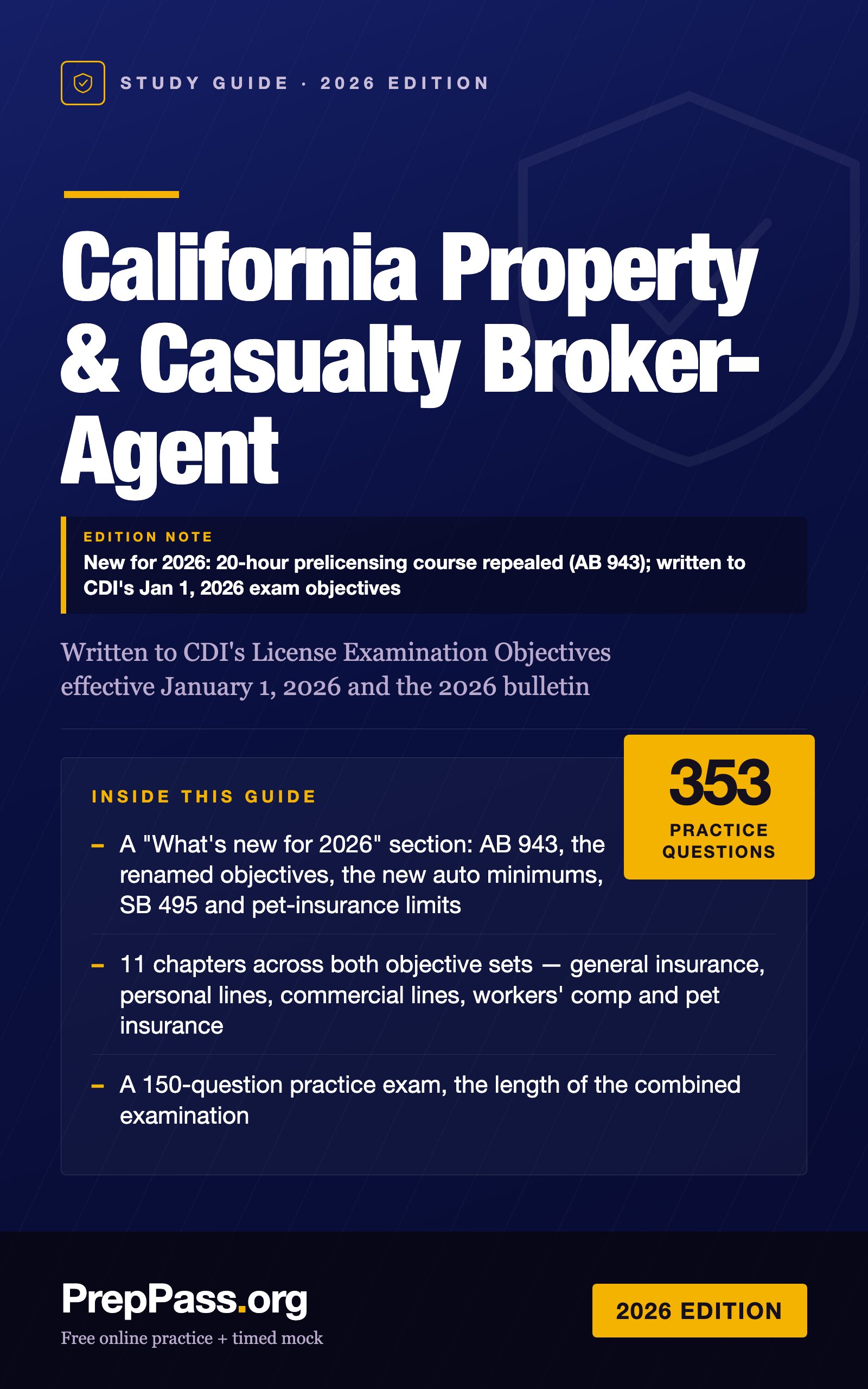
California Property & Casualty Broker-Agent Study Guide — 2026 Edition
版本说明New for 2026: 20-hour prelicensing course repealed (AB 943); written to CDI's Jan 1, 2026 exam objectives
Written to CDI's License Examination Objectives effective January 1, 2026 and the 2026 bulletin — no 20-hour prelicensing course since AB 943: 353 original questions and a 150-question practice exam.
- 353 道原创 California P&C 练习题,每题附解析,合成一本 PDF + EPUB 永久保存
PDF + EPUB · 英文 · 305 页 · $24.99 一次买断
本书为英文版,下载的 PDF 与 EPUB 均为英文。
付款后立即下载 —— 无需注册账号,无订阅。
14 天退款保证:任何原因不满意?购买后 14 天内发邮件至 support@preppass.org 即可全额退款。 退款政策
先做 10 题,看看讲解 —— 免费
先答完这 10 题,交卷后每题都有解析 —— 还会指出本指南里讲这一点的那一节。约 5 分钟,无需注册。
开始 10 道免费题翻开这本书看看
三页真实内页,直接从你将下载的 PDF 渲染而来 —— 依次是一页速查、一页讲解、一道带解析的例题。没有任何一页是为了好看而重画的。
- 速查页Chapter 10 — Commercial Casualty: CGL, Professional and Management Liability, Commercial Auto, Umbrella and Surety (Casualty Objectives IV.A–IV.C) · PDF 第 189 页
一页可以随时翻回来的内容:把数字、期限或术语集中在一处。
- 怎么讲Chapter 2 — The Insurance Marketplace: Producers, Licensing and Ethics (Objectives I.C.1–I.C.2) · PDF 第 49 页
讲解页:用文字把知识讲清楚,顺序与考试考查的顺序一致。
- 一道题的完整解析Chapter 4 — Legal Concept: Tort Law (Objective I.D) · PDF 第 80 页
一道练习题,连同答案和背后的推理 —— 不只是一个答案键。
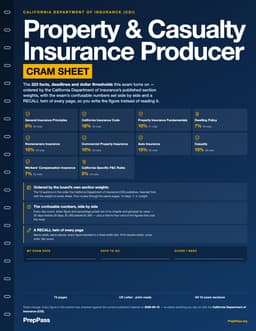
两周内就要考试?
这本指南是系统讲解,要花几周读。如果两周内就考,可打印的速记册才是另一款产品:所有数字按值归组、带默写页,并按 14 天、7 天、3 天或今晚分路线。
73 页 · US Letter · 可打印 PDF · 永久保存
关于这场考试本身
| 主管机构 | California Department of Insurance (CDI), Producer Licensing Bureau —— 考试由 PSI Services LLC 承办 |
|---|---|
| 题目数量 | 150 道题 |
| 考试时限 | 195 分钟 |
| 及格标准 | 60% |
| 费用 |
|
| 考试语言 | 英语 · 西班牙语 · 简体中文 · 越南语 · 韩语 · 他加禄语 |
包含什么,不包含什么
包含
- A "What's new for 2026" section: AB 943, the renamed objectives, the new auto minimums, SB 495 and pet-insurance limits
- 11 chapters across both objective sets — general insurance, personal lines, commercial lines, workers' comp and pet insurance
- A 150-question practice exam, the length of the combined examination
- A California numbers card: auto minimums, notice periods, claim deadlines and workers' comp figures
- 353 original questions, each with a worked explanation citing its source
- PDF + EPUB you keep
不包含
- 不寄送纸质书 —— 这是一份你下载后可自行打印的文件
- 购书不含视频课程、讲师或一对一辅导 —— 站上的免费视频是另一回事
- 不含考试报名费与考点费用,这些仍需向官方机构缴纳
目录
查看 16 个部分及各部分起始页
- Chapter 1 — General Insurance: Concepts, Principles and Contract Law (Objectives I.A–I.B)第 11 页
- Chapter 2 — The Insurance Marketplace: Producers, Licensing and Ethics (Objectives I.C.1–I.C.2)第 31 页
- Chapter 3 — The Insurance Marketplace: Insurers, Regulation, Claims and Surplus Lines (Objectives I.C.3–I.C.5)第 52 页
- Chapter 4 — Legal Concept: Tort Law (Objective I.D)第 71 页
- Chapter 5 — Property and Casualty Basics, Policies and Classes of Insurance (Objectives II.A–II.C)第 83 页
- Chapter 6 — Homeowners, Dwelling and Residential Valuation (Objectives III.A–III.C, property)第 105 页
- Chapter 7 — Catastrophe Programs, Wildfire Mitigation, Personal Inland Marine and Pet Insurance (Objectives III.D–III.F and V)第 125 页
- Chapter 8 — Personal Auto, Watercraft and Umbrella (Casualty Objectives III.A–III.D)第 143 页
- Chapter 9 — Commercial Property, the Commercial Package Policy and the BOP (Property Objectives IV.A–IV.C)第 163 页
- Chapter 10 — Commercial Casualty: CGL, Professional and Management Liability, Commercial Auto, Umbrella and Surety (Casualty Objectives IV.A–IV.C)第 180 页
- Answer key & explanations第 194 页
- Chapter 11 — Workers’ Compensation in California (Casualty Objective IV.B.8)第 197 页
- Practice Exam Section 2 — Property and Casualty Basics, Policy Provisions and California Rules第 221 页
- Practice Exam Section 7 — Pet Insurance (Questions 149–150)第 249 页
- Appendix A — The Exam at a Glance, in One Table第 265 页
- Appendix B — Terms the Exam Expects You to Use Precisely第 268 页
取自你将下载的那份 PDF,并标明各章起始页 —— 不是在此手工录入的。
免费读完整一章
完整的一章,与电子书正文一字不差。直接在此窗口滚动阅读;无需下载,无需邮箱。
在本页直接阅读第 8 章
我们没有拿轻松的绪论充数 —— 免费章节直接翻到书里最见功力的部分,让你在考试真正难的地方检验这本书讲得好不好。
The Casualty outline spends most of its Personal Lines weight here: the California financial responsibility law, the ISO Personal Auto Policy, California's auto statutes on good drivers, cancellation and uninsured motorists, ride-hailing and car sharing, the assigned risk and low-cost programs, and then watercraft and umbrella coverage. Section III.A of the Casualty outline — residential liability and liability endorsements — was taught with the homeowners form in Chapter 6; this chapter starts with the boat.
III.B Marine — Personal Watercraft
A homeowners policy is a poor fit for most boats. Property coverage for watercraft of all types, including trailers and motors, is capped at $1,500[1], and Section II liability applies only to small craft — sailboats under 26 feet and boats with outboard motors of 25 total horsepower or less, among a few other exceptions[1]. A watercraft endorsement to the homeowners policy broadens liability and medical payments for small sailboats and outboard boats[2]; larger boats need a boat owners or yacht policy. Those policies typically combine:
- Liability — operations liability, passenger liability and, for fleets, flotilla coverage.
- Medical payments for people aboard.
- Physical damage to the boat, motor, trailer and equipment.
- For yachts, hull coverage on the vessel itself and protection and indemnity (P&I) — the marine term for liability coverage.
III.C Personal Auto
1.a The California Financial Responsibility Law
"All drivers and all owners of a motor vehicle shall at all times be able to establish financial responsibility ... and shall at all times carry in the vehicle evidence of the form of financial responsibility in effect for the vehicle"[3]. Financial responsibility is established by being self-insured, being insured under a qualifying policy or bond, being a public entity, being a cash depositor under the Vehicle Code, or another method the DMV authorizes[4]. CDI's auto guide lists the three ways most drivers use: liability insurance from an authorized insurer, a $35,000 cash deposit with the DMV, or a $35,000 surety bond[5].
Minimum limits. For policies issued or renewed on or after January 1, 2025, the minimum liability limits are $30,000 for bodily injury to one person, $60,000 for bodily injury to two or more people in one accident, and $15,000 for property damage[6]. The prior minimums were $15,000/$30,000/$5,000[6], and the minimums rise again for policies issued or renewed on or after January 1, 2035[6]. An auto liability policy issued in California must carry at least these limits[7]. CDI states the minimums the same way for consumers[5].
Notice requirements. An insurer must notify the DMV when a policy is written or the insured stops paying; CDI's guide tells consumers that the insurer "tells the California Department of Motor Vehicles (DMV) if you buy auto insurance or if you stop paying your premium"[5].
1.b Company policies versus the ISO form
The exam uses ISO's Personal Auto Policy (PP 00 01) as the standard[8], but a company's own policy may differ in wording, limits and endorsements, and California amendatory endorsements change the ISO form to meet California statutes (cancellation notice periods, uninsured motorist rules and so on). Always read the actual policy.
1.c The Personal Auto Policy: who and what is covered
- "You" and "your" — the named insured and a resident spouse. If the spouse moves out, the spouse remains "you" only until the earliest of 90 days after the move, the effective date of another policy naming the spouse, or the end of the policy period[9].
- "Family member" — a person related to you by blood, marriage or adoption who is a resident of your household, including a ward or foster child[9].
- "Your covered auto" — any vehicle shown in the declarations, a newly acquired auto, any trailer you own, and a temporary substitute for a covered auto out of use because of breakdown, repair, servicing, loss or destruction[9].
- Who is insured under Part A — you or any family member for any auto or trailer, and "Any person using 'your covered auto'"[9]. California law requires the policy to cover the named insured and anyone using the vehicle with permission[7].
- Territory — the United States, its territories or possessions, Puerto Rico, and Canada, plus transport between their ports[9].
- Share-the-expense versus for-hire. Part A excludes a vehicle used as a public or livery conveyance, including any time the insured is logged into a transportation network platform as a driver, but the exclusion "does not apply to: a. A share-the-expense car pool"[9].
Newly acquired autos
A newly acquired private passenger auto, pickup or van gets the broadest coverage provided for any vehicle shown in the declarations, for everything except damage to your auto, if you ask the insurer to insure it within 14 days after you become the owner[9]. For physical damage:
- Collision begins on the date you become the owner. If at least one listed auto has collision coverage, you must ask within 14 days; if none does, you must ask within four days, and a $500 collision deductible applies to a loss that happens before you ask[9].
- Other than collision follows the same 14-day / four-day pattern[9].
CDI's objectives state the same rule: if the insured has collision coverage on at least one listed auto, all coverage on the newly acquired auto begins on the date of ownership[10].
Rental cars and non-owned autos
A non-owned private passenger auto rented for a vacation is covered under Part A because "You or any 'family member'" are insured "for the ownership, maintenance or use of any auto"[9]. Under Part D, a non-owned auto gets the broadest coverage applicable to any covered auto[9], and the policy pays up to $30 a day for loss-of-use charges you owe on a non-owned auto[9]. Liability insurance on a vehicle you do not own is excess over other collectible insurance[9].
1.d Primary and excess coverage
The PAP's liability coverage on a vehicle you do not own is excess over other collectible insurance, while coverage for your covered auto is shared pro rata with other applicable insurance[9]. Part D's "other sources of recovery" clause makes coverage on a non-owned auto "excess over any other collectible source of recovery," including the owner's coverage[9].
1.e The Good Driver Discount
Proposition 103 requires auto rates to be based, in decreasing order of importance, on the insured's driving safety record, annual miles driven, and years of driving experience, then other factors the Commissioner adopts[11]. A person who qualifies may buy a Good Driver Discount policy from the insurer of his or her choice, and its rate must be "at least 20 percent below the rate the insured would otherwise have been charged for the same coverage"[11]. To qualify, a driver must have been licensed for the previous three years and, in those three years, not had more than one violation point, and not been principally at fault in an accident causing injury or death[12]. The absence of prior insurance cannot, by itself, be used to set rates or eligibility[11].
Credit. CDI's objectives state that a consumer credit report cannot be used in California as the basis for declining to insure or as a premium factor for auto insurance[10]. The rating statute explains why: auto rates must follow the approved factors, and "the use of any criterion without approval shall constitute unfair discrimination"[11].
1.f Cancellation and nonrenewal
California limits the reasons an insurer may cancel or nonrenew an auto policy. Proposition 103 allows a notice of cancellation or nonrenewal "only if it is based on one or more of the following reasons: (A) nonpayment of premium; (B) fraud or material misrepresentation affecting the policy or insured; (C) a substantial increase in the hazard insured against"[13]. Section 661 lists the cancellation grounds in more detail, including suspension or revocation of the license of the named insured or a regular driver[14].
Notice periods:
- Cancellation: at least 20 days, or at least 10 days after nonpayment for a nonpayment cancellation; the cancellation takes effect only if the nonpayment is not cured within the 10 days[15].
- Renewal offer: at least 20 days before expiration; nonrenewal notice: at least 30 days before expiration[16]. If the insurer fails to give either, the policy continues for 30 days after the notice is given[16].
CDI's guide puts the grounds plainly — fraud or material misrepresentation, nonpayment, or substantial increase in the hazard — and notes the 10-day notice for nonpayment[5].
1.h Ride-hailing (TNC) and personal vehicle sharing
- Personal auto policies rarely cover TNC driving. The ISO form excludes use as a public or livery conveyance, including whenever the driver is logged into a transportation network platform[9]. Insurers offer products that fill the gap; CDI's guide notes you can buy coverage for business use, "including when driving for a Transportation Network Company"[5].
- What the TNC must carry. From the moment a driver accepts a ride request until the ride ends, TNC insurance must be primary and at least $1,000,000 for death, personal injury and property damage, and the TNC must provide uninsured and underinsured motorist coverage of $60,000 per person and $300,000 per incident while a passenger is in the vehicle[17].
- Personal vehicle sharing. A privately insured car is not reclassified as commercial or for-hire just because it is shared through a personal vehicle sharing program, as long as the owner's sharing revenue does not exceed the annual cost of owning and operating the vehicle and the owner does not knowingly allow commercial use[18]. The PAP excludes liability while the car is enrolled in and being used through such a program by someone other than you or a family member[9] — so the program's own insurance must respond.
2. Liability, medical payments and uninsured motorists
Part A — Liability. "We will pay damages for 'bodily injury' or 'property damage' for which any 'insured' becomes legally responsible because of an auto accident," and "In addition to our limit of liability, we will pay all defense costs we incur"[9].
- Supplementary payments (in addition to the limit): up to $250 for bail bonds, premiums on appeal bonds, post-judgment interest, up to $250 a day for lost earnings to attend hearings at the insurer's request, and other reasonable expenses; these payments do not reduce the limit[9].
- Split limits versus single limit. A split limit states a per-person bodily injury limit, a per-accident bodily injury limit and a property damage limit; CDI's example: with $50,000/$100,000, the policy will not pay more than $50,000 for one person or $100,000 for one accident[5]. A combined single limit is one sum for bodily injury and property damage per accident[19].
- Out-of-state coverage. If an accident happens in a state with higher financial responsibility limits, the policy provides the higher limits; if a state requires nonresidents to carry compulsory coverage, the policy provides at least the required minimum[9].
- Other insurance. For a non-owned vehicle, the PAP liability coverage is excess[9].
- Key exclusions. Intentional injury; property damage to property owned or transported by the insured, or rented to or in the insured's care (except a residence or private garage); vehicles with fewer than four wheels or designed mainly for off-road use; vehicles furnished for your regular use[9].
Part B — Medical Payments. Pays reasonable medical and funeral expenses "because of 'bodily injury'" caused by an accident and sustained by an insured, incurred within three years of the accident[9], for you and family members while occupying a motor vehicle or as pedestrians struck by one, and for anyone occupying your covered auto[9]. CDI notes the minimum medical payments limit you can buy is $1,000 per person[5], and it pays "no matter who is at fault"[5].
Part C — Uninsured Motorists. Pays compensatory damages an insured is legally entitled to recover from the owner or operator of an uninsured motor vehicle because of bodily injury[9]. An "uninsured motor vehicle" includes one with no bodily injury liability policy, one whose limits are below the financial responsibility minimum, a hit-and-run vehicle whose owner and operator cannot be identified, and one whose insurer denies coverage or becomes insolvent[9].
California's uninsured motorist law:
- Every auto bodily injury liability policy issued in California must include uninsured motorist coverage unless the named insured and insurer agree in writing to delete it or reduce it — but not below the financial responsibility limits[20]. CDI: "If you choose not to buy it, you must sign a form, called a waiver"[5].
- Underinsured motorist coverage pays when the at-fault driver's limits are too low[5].
- Uninsured motorist property damage (UMPD) pays damage to your car caused by an identified at-fault uninsured driver, up to $3,500, if you do not have collision coverage[5].
- Collision deductible waiver pays your collision deductible when an uninsured at-fault driver damages your car[5].
- Umbrella and excess policies are not required to include uninsured motorist coverage: "A policy shall be excluded from the application of this section if the automobile liability coverage is provided only on an excess or umbrella basis"[20].
Credit reports and MVRs. Insurers order a Motor Vehicle Report from the DMV — "the state's official record of your accidents, traffic violations, and suspended licenses"[5] — and the federal Fair Credit Reporting Act governs the use of consumer reports; in California, as noted above, credit may not be used to decline or price auto insurance[10, 11].
3. Physical damage and endorsements
Part D — Coverage for Damage to Your Auto pays "for direct and accidental loss to 'your covered auto' or any 'non-owned auto', including its equipment, minus any applicable deductible"[9].
- Collision means "the upset of 'your covered auto' or a 'non-owned auto' or its impact with another vehicle or object"[9].
- Other than collision (OTC) — what many insurers still call comprehensive — includes missiles or falling objects, fire, theft, explosion or earthquake, windstorm, hail, water or flood, vandalism, riot, contact with bird or animal, and breakage of glass; glass broken in a collision may be treated as collision at the insured's option[9]. CDI's guide: comprehensive covers damage "caused by something other than a collision"[5]. OTC is a property coverage — it pays for damage to the insured's own car.
- Valuation. The insurer pays the lesser of actual cash value or the cost to repair or replace with like kind and quality; depreciation and physical condition are considered for a total loss; betterment is not paid[9]. CDI notes collision and comprehensive "provide compensation based on the market value of your car"[5].
- The insurer's options. It may pay in money or repair or replace the property, and may return stolen property[9].
- Transportation expenses. Without a deductible, up to $30 a day and $900 total for temporary transportation after a covered loss to your auto; for total theft, beginning 48 hours after the theft[9].
- Personal effects and equipment. Part D covers the auto "including its equipment"; it excludes loss to non-permanently installed electronic equipment and limits custom equipment to $1,500 unless endorsed[9].
- Exclusions include wear and tear, freezing, mechanical or electrical breakdown, road damage to tires, and livery use[9].
- Duties after a loss. Promptly notify the insurer of how, when and where the accident happened; cooperate; submit to physical exams and examinations under oath as required[9]; for uninsured motorist claims, promptly notify police of a hit-and-run[9]; and for damage to your auto, protect it from further loss and notify police of a theft[9].
Common endorsements the objectives list: miscellaneous type vehicle (motor homes, motorcycles, golf carts), limited Mexico coverage, towing and labor, trust, joint ownership, auto loan/lease (GAP) coverage, named non-owner coverage, extended non-owned liability for a vehicle furnished for regular use, optional transportation expense limits, and customizing equipment coverage[10]. CDI's guide describes GAP as paying the difference between the car's fair market value and what is owed on the loan or lease[5].
4. CAARP and the Low-Cost Automobile program
California Automobile Assigned Risk Plan (CAARP). The Commissioner approves a plan for the equitable apportionment among admitted liability insurers of applicants "who are in good faith entitled to but are unable to procure that insurance through ordinary methods," and all such insurers must participate[21]. CDI's guide: CAARP assigns a driver to an insurer, all participating insurers charge the same premiums, installments are allowed, and "There is no broker's fee if you buy a CAARP policy"[5]. Eligibility standards may consider the applicant's driving record, license suspensions, accidents, and the condition or use of the car[22].
California Low-Cost Automobile Insurance (CLCA). A program within CAARP[23]:
- Limits: $10,000 per person and $20,000 per accident for bodily injury, $3,000 for property damage — lower than the standard minimums but satisfying financial responsibility for program participants[5, 24].
- Eligibility: household income at or below 250% of the federal poverty level; at least 16 and continuously licensed for three years (or pay a surcharge); no more than one at-fault property damage accident or one moving-violation point in three years; no at-fault injury accident; no Vehicle Code felony or misdemeanor on the record[25]. CDI adds that the car must be worth $25,000 or less[5].
- Terms: a one-year term, renewable annually[24]; an installment plan with no more than 20% down[26]; uninsured motorist and medical payments available as options[27].
Sources cited in this excerpt
- Homeowners 3 - Special Form, HO 00 03 05 11 (specimen filed with and published by the Nevada Division of Insurance). Insurance Services Office, Inc., 2010-05-01. https://doi.nv.gov/uploadedFiles/doinvgov/_public-documents/Consumers/Home/American_Family/Homesite_HO_00_03_05_11.pdf
- Home Insurance Forms (consumer information page). Alabama Department of Insurance, 2026-09-24. https://aldoi.gov/Consumers/HomeInsForms.aspx
- California Vehicle Code section 16020, text as retrieved 2026-09-24 (Amended by Stats. 2022, Ch. 295, Sec. 13. (AB 2956) Effective January 1, 2023.). California Legislature (California Legislative Information, leginfo.legislature.ca.gov), 2023-01-01. https://leginfo.legislature.ca.gov/faces/codes_displaySection.xhtml?lawCode=VEH§ionNum=16020
- California Vehicle Code section 16021, text as retrieved 2026-09-24 (Amended by Stats. 2003, Ch. 594, Sec. 41. Effective January 1, 2004.). California Legislature (California Legislative Information, leginfo.legislature.ca.gov), 2004-01-01. https://leginfo.legislature.ca.gov/faces/codes_displaySection.xhtml?lawCode=VEH§ionNum=16021
- Automobile Insurance information guide (Form 901, February 2025). California Department of Insurance, 2025-02-01. https://www.insurance.ca.gov/01-consumers/105-type/95-guides/01-auto/upload/IG-Auto-Insurance-Updated-020525.pdf
- California Vehicle Code section 16056, text as retrieved 2026-09-24 (Amended (as added by Stats. 2022, Ch. 717, Sec. 3) by Stats. 2023, Ch. 204, Sec. 19. (AB 1140) Effective January 1, 2024. Operative January 1, 2025, by its own provisions.). California Legislature (California Legislative Information, leginfo.legislature.ca.gov), 2025-01-01. https://leginfo.legislature.ca.gov/faces/codes_displaySection.xhtml?lawCode=VEH§ionNum=16056
- California Insurance Code section 11580.1, text as retrieved 2026-09-24 (Amended by Stats. 2016, Ch. 31, Sec. 176. (SB 836) Effective June 27, 2016.). California Legislature (California Legislative Information, leginfo.legislature.ca.gov), 2016-06-27. https://leginfo.legislature.ca.gov/faces/codes_displaySection.xhtml?lawCode=INS§ionNum=11580.1
- Property License Examination Objectives (effective January 1, 2026). California Department of Insurance, 2026-01-01. https://www.insurance.ca.gov/0200-industry/0030-seek-pre-lic/upload/2025-Property-License-Examination-Objectives.docx
- Personal Auto Policy, PP 00 01 09 18 (specimen published by the Virginia State Corporation Commission, Bureau of Insurance). Insurance Services Office, Inc., 2018-09-01. https://www.scc.virginia.gov/media/sccvirginiagov-home/regulated-industries/insurance/insurance-companies/property-casualty-companies/personal-commercial-auto-forms/PP-00-01-09-18.pdf
- Casualty License Examination Objectives (effective January 1, 2026). California Department of Insurance, 2026-01-01. https://www.insurance.ca.gov/0200-industry/0030-seek-pre-lic/upload/2025-Casualty-License-Examination-Objectives.docx
- California Insurance Code section 1861.02, text as retrieved 2026-09-24 (Amended by Stats. 2015, Ch. 348, Sec. 14. (AB 1515) Effective January 1, 2016. Note: This section was added on Nov. 8, 1988, by initiative Prop. 103.). California Legislature (California Legislative Information, leginfo.legislature.ca.gov), 2016-01-01. https://leginfo.legislature.ca.gov/faces/codes_displaySection.xhtml?lawCode=INS§ionNum=1861.02
- California Insurance Code section 1861.025, text as retrieved 2026-09-24 (Amended by Stats. 2015, Ch. 348, Sec. 15. (AB 1515) Effective January 1, 2016.). California Legislature (California Legislative Information, leginfo.legislature.ca.gov), 2016-01-01. https://leginfo.legislature.ca.gov/faces/codes_displaySection.xhtml?lawCode=INS§ionNum=1861.025
- California Insurance Code section 1861.03, text as retrieved 2026-09-24 (Amended by Stats. 2018, Ch. 776, Sec. 13. (AB 3250) Effective January 1, 2019. Note: This section was added on Nov. 8, 1988, by initiative Prop. 103.). California Legislature (California Legislative Information, leginfo.legislature.ca.gov), 2019-01-01. https://leginfo.legislature.ca.gov/faces/codes_displaySection.xhtml?lawCode=INS§ionNum=1861.03
- California Insurance Code section 661, text as retrieved 2026-09-24 (Amended by Stats. 2012, Ch. 786, Sec. 5. (AB 2303) Effective January 1, 2013.). California Legislature (California Legislative Information, leginfo.legislature.ca.gov), 2013-01-01. https://leginfo.legislature.ca.gov/faces/codes_displaySection.xhtml?lawCode=INS§ionNum=661
- California Insurance Code section 662, text as retrieved 2026-09-24 (Amended by Stats. 2024, Ch. 793, Sec. 1. (SB 1295) Effective January 1, 2025.). California Legislature (California Legislative Information, leginfo.legislature.ca.gov), 2025-01-01. https://leginfo.legislature.ca.gov/faces/codes_displaySection.xhtml?lawCode=INS§ionNum=662
- California Insurance Code section 663, text as retrieved 2026-09-24 (Repealed (in Sec. 6) and added by Stats. 2013, Ch. 369, Sec. 7. (SB 251) Effective January 1, 2014. Section operative January 1, 2019, by its own provisions.). California Legislature (California Legislative Information, leginfo.legislature.ca.gov), 2014-01-01. https://leginfo.legislature.ca.gov/faces/codes_displaySection.xhtml?lawCode=INS§ionNum=663
- California Public Utilities Code section 5433, text as retrieved 2026-09-24 (Amended by Stats. 2025, Ch. 314, Sec. 3. (SB 371) Effective January 1, 2026.). California Legislature (California Legislative Information, leginfo.legislature.ca.gov), 2026-01-01. https://leginfo.legislature.ca.gov/faces/codes_displaySection.xhtml?lawCode=PUC§ionNum=5433
- California Insurance Code section 11580.24, text as retrieved 2026-09-24 (Amended by Stats. 2024, Ch. 244, Sec. 1. (AB 2743) Effective January 1, 2025.). California Legislature (California Legislative Information, leginfo.legislature.ca.gov), 2025-01-01. https://leginfo.legislature.ca.gov/faces/codes_displaySection.xhtml?lawCode=INS§ionNum=11580.24
- Commercial Insurance information guide (Form 700, June 2024). California Department of Insurance, 2024-06-01. https://www.insurance.ca.gov/01-consumers/105-type/95-guides/09-comm/upload/IG-Commercial-Insurance-Updated-061524.pdf
- California Insurance Code section 11580.2, text as retrieved 2026-09-24 (Amended by Stats. 2005, Ch. 294, Sec. 23. Effective January 1, 2006.). California Legislature (California Legislative Information, leginfo.legislature.ca.gov), 2006-01-01. https://leginfo.legislature.ca.gov/faces/codes_displaySection.xhtml?lawCode=INS§ionNum=11580.2
- California Insurance Code section 11620, text as retrieved 2026-09-24 (Amended by Stats. 2017, Ch. 534, Sec. 69. (AB 1699) Effective January 1, 2018.). California Legislature (California Legislative Information, leginfo.legislature.ca.gov), 2018-01-01. https://leginfo.legislature.ca.gov/faces/codes_displaySection.xhtml?lawCode=INS§ionNum=11620
- California Insurance Code section 11624, text as retrieved 2026-09-24 (Amended by Stats. 1993, Ch. 1133, Sec. 1. Effective January 1, 1994.). California Legislature (California Legislative Information, leginfo.legislature.ca.gov), 1994-01-01. https://leginfo.legislature.ca.gov/faces/codes_displaySection.xhtml?lawCode=INS§ionNum=11624
- California Insurance Code section 11629.7, text as retrieved 2026-09-24 (Amended by Stats. 2014, Ch. 487, Sec. 1. (SB 1273) Effective January 1, 2015.). California Legislature (California Legislative Information, leginfo.legislature.ca.gov), 2015-01-01. https://leginfo.legislature.ca.gov/faces/codes_displaySection.xhtml?lawCode=INS§ionNum=11629.7
- California Insurance Code section 11629.71, text as retrieved 2026-09-24 (Amended by Stats. 2014, Ch. 487, Sec. 2. (SB 1273) Effective January 1, 2015.). California Legislature (California Legislative Information, leginfo.legislature.ca.gov), 2015-01-01. https://leginfo.legislature.ca.gov/faces/codes_displaySection.xhtml?lawCode=INS§ionNum=11629.71
- California Insurance Code section 11629.73, text as retrieved 2026-09-24 (Amended by Stats. 2019, Ch. 274, Sec. 2. (SB 570) Effective January 1, 2020.). California Legislature (California Legislative Information, leginfo.legislature.ca.gov), 2020-01-01. https://leginfo.legislature.ca.gov/faces/codes_displaySection.xhtml?lawCode=INS§ionNum=11629.73
- California Insurance Code section 11629.72, text as retrieved 2026-09-24 (Amended by Stats. 2019, Ch. 274, Sec. 1. (SB 570) Effective January 1, 2020.). California Legislature (California Legislative Information, leginfo.legislature.ca.gov), 2020-01-01. https://leginfo.legislature.ca.gov/faces/codes_displaySection.xhtml?lawCode=INS§ionNum=11629.72
- California Insurance Code section 11629.75, text as retrieved 2026-09-24 (Repealed and added by Stats. 2019, Ch. 274, Sec. 5. (SB 570) Effective January 1, 2020.). California Legislature (California Legislative Information, leginfo.legislature.ca.gov), 2020-01-01. https://leginfo.legislature.ca.gov/faces/codes_displaySection.xhtml?lawCode=INS§ionNum=11629.75
购买前
- 怎么拿到?
- 付款后下载入口立即出现在本页,链接同时发到你的邮箱。无需注册账号。
- 不合适怎么办?
- 14 天内发邮件即可全额退款,无需理由。
- 免费练习会取消吗?
- 不会。站上的每一道练习题、计时模考和免费章节都继续免费。这本书是「学」的那一半,不是把免费部分围起来的门。
- 能在手机上看吗?
- 可以 —— EPUB 适合手机和电子书阅读器,PDF 适合打印和贴标签,两种都给你。
详细信息
Written to CDI's License Examination Objectives effective January 1, 2026 and the 2026 bulletin — no 20-hour prelicensing course since AB 943: 353 original questions and a 150-question practice exam.
- Format: PDF + EPUB download · 305 pages
- 353 practice questions in the book, with a full answer key
- 531 free practice questions for this exam on PrepPass, included at no cost
- $24.99 one-time — no subscription
- 14-day money-back guarantee · refund policy
- Cross-referenced against: CDI Property and Casualty License Examination Objectives (effective January 1, 2026), PSI/CDI Candidate Information Bulletin (rev. Feb/Mar 2026) and the California Insurance Code (leginfo, September 2026)
- 官方来源核验(CDI Property and Casualty License Examination Objectives (effective January 1, 2026), PSI/CDI Candidate Information Bulletin (rev. Feb/Mar 2026) and the California Insurance Code (leginfo, September 2026))
- 531 道免费练习题
- 即时下载,永久拥有
练习免费,为什么还要买书?
我们的练习题和计时模考一直免费 —— 网站上的东西不会因为这本书而收起来。这本 $24.99 的书是「学」的那一半:知识本身,按顺序讲清楚,存成一份属于你的文件。
- 系统讲解 —— 每个考试部分按章节从头讲到尾,不只是题目
- 可打印可贴标签 —— 一份适合打印的 PDF,能划重点、做批注、带到书桌前
- 随处离线学 —— EPUB 放手机或电子书阅读器;不用 wifi,不用一堆浏览器标签
- 全在一处 —— 章节和练习题都在同一份文件里
- 永久归你 —— 一次 $24.99,即时下载,无订阅
而且零风险:14 天退款保证 —— 不满意?发邮件即可全额退款,无需理由。 详见退款政策。
14 天退款保证 · 全额退款,无需理由。
一次购买,永久下载访问。此电子书是完整的 California Property & Casualty Broker-Agent 学习指南,含 PDF 与 EPUB。仅为教育性摘要,非专业或法律意见 —— 请始终以官方来源核实当前规定。