NCLEX-RN Nursing Licensure · 2026 版
NCLEX-RN Exam — Complete Study Guide (2026)
All 8 client-needs categories, weighted like the NCSBN test plan — with the CAT scoring explained honestly (no fake pass %).
- 7 个考点类别章节合成一本,PDF + EPUB 永久保存
- 书内 120 道练习题,每题附完整解析
- 7 章每章都有关键数值与化验范围、一道例题详解、点名的陷阱与自测
$19.99一次买断 · 永久下载 · 无订阅
PDF + EPUB · 英文 · 105 页 · $19.99 一次买断
本书为英文版,下载的 PDF 与 EPUB 均为英文。
付款后立即下载 —— 无需注册账号,无订阅。
14 天退款保证:任何原因不满意?购买后 14 天内发邮件至 support@preppass.org 即可全额退款。 这是电子下载,无需寄回任何东西。 退款政策
考试事实最近一次对照官方资料核对:2026年9月。
先做 10 题,看看讲解 —— 免费
先答完这 10 题,交卷后每题都有解析 —— 还会指出本指南里讲这一点的那一节。约 5 分钟,无需注册。
开始 10 道免费题翻开这本书看看
三页真实内页,直接从你将下载的 PDF 渲染而来 —— 依次是一页速查、一页讲解、一道带解析的例题。没有任何一页是为了好看而重画的。
- 速查页Answer Key & Explanations · PDF 第 103 页
一页可以随时翻回来的内容:把数字、期限或术语集中在一处。
- 怎么讲Answer Key & Explanations · PDF 第 94 页
讲解页:用文字把知识讲清楚,顺序与考试考查的顺序一致。
- 怎么讲Answer Key & Explanations · PDF 第 97 页
讲解页:用文字把知识讲清楚,顺序与考试考查的顺序一致。
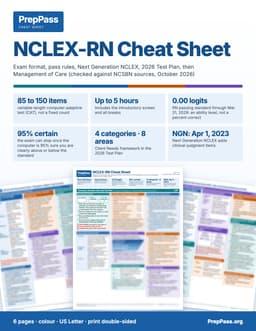
两周内就要考试?
这本指南是系统讲解,要花几周读。如果两周内就考,可打印的彩色速查表是另一款产品:考试涉及的关键数字,按章节排好。
6 页 · US Letter · 可打印 PDF · 永久保存
关于这场考试本身
| 主管机构 | National Council of State Boards of Nursing, Inc. (NCSBN) —— 考试由 Pearson VUE 承办 来源: NCSBN — 2026 NCLEX Examination Candidate Bulletin (PDF, April 2026) |
|---|---|
| 题目数量 | 85–150 道题 |
| 考试时限 | 300 分钟 来源: NCSBN — 2026 NCLEX Examination Candidate Bulletin (PDF, April 2026) |
| 及格标准 | 仅判定通过或未通过 —— 无固定及格分 来源: NCSBN — Passing Standard (NCLEX-RN 0.00 logits, effective through March 31, 2029) |
| 费用 |
来源: NCSBN — 2026 NCLEX Examination Candidate Bulletin (PDF, April 2026) |
| 考试语言 | 英语 · 法语 来源: NCSBN — NCLEX Frequently Asked Questions (“How is the NCLEX translated?”) |
包含什么,不包含什么
包含
- All 7 client-needs chapters, weighted like the NCSBN test plan
- Prioritization (ABC / Maslow), delegation, and safety frameworks
- Labs, fluid & electrolytes, acid-base, and high-alert medications
- How the variable-length CAT is scored — no fake “X% to pass”
- 120 original practice questions with answer explanations
- PDF (print & tab it) + EPUB (phone / e-reader)
不包含
- 不寄送纸质书 —— 这是一份你下载后可自行打印的文件
- 购书不含视频课程、讲师或一对一辅导 —— 站上的免费视频是另一回事
- 不含考试报名费与考点费用,这些仍需向官方机构缴纳
目录
查看 2 个部分及各部分起始页
- Practice Questions第 67 页
- Answer Key & Explanations第 93 页
取自你将下载的那份 PDF,并标明各章起始页 —— 不是在此手工录入的。
免费读完整一章
完整的一章,与电子书正文一字不差。直接在此窗口滚动阅读;无需下载,无需邮箱。
在本页直接阅读第 6 章
我们没有拿轻松的绪论充数 —— 免费章节直接翻到书里最见功力的部分,让你在考试真正难的地方检验这本书讲得好不好。
Introduction
Pharmacological and Parenteral Therapies is tied for the second-largest content area, and it tests safe medication administration end to end: applying the rights of medication administration, calculating doses accurately, monitoring the labs and vital signs specific to each drug class, recognizing adverse effects and toxicity, and handling high-alert parenteral therapies without a fatal error. It is a high-stakes category because a medication mistake reaches the client directly, which is exactly why the exam layers so many safety checks into it.
The category has a memorization core — which lab monitors which anticoagulant, which vital sign holds which cardiac drug, which electrolyte a loop diuretic depletes — but it rewards reasoning about mechanism. If you know why a loop diuretic wastes potassium, you don't have to memorize that furosemide causes hypokalemia; it follows. If you know why ACE inhibitors cause a dry cough (bradykinin accumulation), the teaching point is obvious. Throughout this chapter the numbers and rules are paired with their mechanism so the knowledge holds under pressure.
Above all, this category is about high-alert discipline. Certain drugs — insulin, heparin, IV potassium, blood products, digoxin, lithium — cause disproportionate harm when given wrong, so they carry extra rules: independent double-checks, holding parameters, dilution and slow infusion, and level monitoring for narrow-therapeutic-range drugs. The recurring correct answer is the cautious one: verify, double-check, hold and notify, and never take a shortcut with a high-alert drug.
Key concepts
| Item | Rule | Why it matters |
|---|---|---|
| Rights of administration | Right client, drug, dose, route, time, documentation | The core safety checklist |
| Documented allergy | Hold the drug and notify the prescriber | A hard contraindication |
| Dose calculation | Desired ÷ available × quantity | Prevents under/overdose |
| High-alert double-check | Second nurse verifies insulin, heparin, pediatric doses, blood | Catches lethal errors |
| Warfarin monitoring | PT / INR; reversed by vitamin K | Wrong lab = wrong drug |
| Heparin monitoring | aPTT; reversed by protamine sulfate | Distinguish from warfarin |
| Digoxin | Hold for apical pulse < 60; watch for toxicity | Further slows the heart |
| Loop diuretic (furosemide) | Causes hypokalemia — monitor potassium | Dysrhythmia risk |
| Aminoglycosides | Monitor renal function + peak/trough | Nephrotoxic/ototoxic |
| Lithium | Narrow range — vomiting, coarse tremor, confusion = toxicity | Level monitoring + hydration |
| IV potassium | Never IV push; dilute, infuse slowly via pump | Rapid push can be fatal |
| Rapid-acting insulin (lispro) | Food within ~15 minutes | Prevents hypoglycemia |
| Blood products | Infuse with normal saline only, verify with second nurse | Prevents reaction |
Safe medication administration
Every administration runs through the rights of medication administration — verify the right client, drug, dose, route, time, and documentation (many programs add right reason and right response). Client identity is confirmed with two identifiers before any drug. These checks feel routine precisely so that they catch the non-routine error — the look-alike drug name, the transposed dose, the wrong client.
Allergies are a hard stop. When the client has a documented allergy to a drug, the nurse holds the medication and notifies the prescriber to clarify or change the order — you do not give a smaller "test" dose, do not pre-medicate with an antihistamine and give it anyway, and do not give it and "monitor closely." A documented allergy is a contraindication, and overriding it risks a life-threatening reaction. This is one of the most reliable right answers in the category: allergy → hold and notify.
Documentation is immediate and truthful: record administration promptly after giving the drug, and never chart a medication before it is given. Charting ahead of administration is both a veracity violation (Chapter 1) and a setup for a real error if the dose is then missed or changed. Right checks, allergy discipline, honest and timely documentation — this is the safety spine the rest of the category hangs on.
Dosage calculation
Accurate calculation prevents both underdosing and overdosing, and the workhorse method is desired over available: divide the ordered (desired) dose by the dose on hand and multiply by the quantity the dose comes in. If 250 mg is ordered and the pharmacy supplies 125 mg tablets, then 250 ÷ 125 = 2 tablets. Set the problem up the same way every time and the arithmetic becomes routine.
Two safety habits protect the calculation. Convert units before you calculate — make sure everything is in the same units (mg to mg, not mg to g) — because a unit mismatch is how a tenfold error sneaks in. And double-check high-alert drugs: have a second nurse independently verify insulin, heparin, and pediatric doses, where a small error does large harm. Independent verification means the second nurse calculates without being told your answer.
Finally, question any dose that seems off. A calculation that requires an unusual number of tablets or vials, or a dose that seems far too high, is a signal to stop and re-verify rather than proceed. The professional instinct the exam is cultivating is that a strange-looking answer is probably a wrong answer — recheck the math and the order before the drug reaches the client.
Drug classes and monitoring
Each drug class has signature parameters, and the anticoagulants are the most tested pair. Warfarin is monitored with the PT and INR and reversed by vitamin K; heparin is monitored with the aPTT and reversed by protamine sulfate. Keep the pairs straight — using aPTT for warfarin, or giving vitamin K for a heparin overdose, are classic wrong answers. So for a client bleeding on IV heparin with a very high aPTT, the antidote is protamine sulfate, not vitamin K (that's for warfarin) and not naloxone (that's for opioids).
Cardiac drugs have holding parameters tied to vital signs. Hold digoxin for an apical heart rate below 60 beats/minute in an adult, because digoxin further slows the heart and bradycardia may signal toxicity — so an apical rate of 52 means hold and notify, while a normal blood pressure, respiratory rate, or temperature would not. Before a beta-blocker such as metoprolol, check the apical heart rate and blood pressure, since beta-blockers lower both and the dose is held for significant bradycardia or hypotension per parameters.
Two more classes round out the section. Loop diuretics such as furosemide promote potassium excretion and cause hypokalemia — monitor potassium and watch for muscle weakness and dysrhythmias (not hyperkalemia, hypernatremia, or hypercalcemia). And aminoglycoside antibiotics are nephrotoxic and ototoxic, so monitor renal function and peak-and-trough drug levels to keep the drug in its safe window. Each rule is really a mechanism: the diuretic dumps potassium, the aminoglycoside stresses the kidney, so those are what you watch.
Adverse effects and toxicity
Recognizing trouble early prevents harm, and several drugs have hallmark warnings. Opioids (such as morphine) can cause respiratory depression and sedation, so assess respiratory rate and level of sedation before and after administration, and start a bowel regimen (stool softener, fluids, fiber) to prevent the constipation opioids reliably cause — withholding fluids or fiber is the wrong direction. Lithium has a narrow therapeutic range, and vomiting, coarse tremors, and confusion signal toxicity, requiring level monitoring and adequate hydration; these are not "normal side effects to ignore."
ACE inhibitors commonly cause a persistent dry cough (from bradykinin accumulation) that clients should be taught to report, while angioedema, though rare, is an emergency. Corticosteroids taken long term must be tapered, never stopped abruptly, to prevent adrenal insufficiency — they are taken with food, and blood glucose is monitored because steroids raise it. So "stop when symptoms improve" and "take on an empty stomach" are wrong for long-term steroids.
A few other teaching points recur. Phenytoin causes gingival hyperplasia, so meticulous oral hygiene is taught; doses are never skipped, and a rash is reported because it may signal a serious reaction. The pattern across the section is that each drug carries a specific, mechanism-based warning — respiratory rate for opioids, tremor and confusion for lithium, cough for ACE inhibitors, taper for steroids, gum care for phenytoin — and the exam tests whether you can attach the right warning to the right drug.
Parenteral and high-alert therapies
Parenteral therapy is where the highest-alert rules live, and IV potassium is the headline: never give potassium by IV push. It must be diluted and infused slowly with an infusion pump, because rapid IV administration can cause fatal cardiac arrest; cardiac monitoring is maintained during the infusion. "Undiluted for faster effect" and "rapid IV push" are dangerous, always-wrong answers. This is the single most important safety rule in the chapter.
Insulin and blood products carry their own timing and verification rules. Rapid-acting insulin such as lispro begins working within about 15 minutes, so ensure the client has food available within roughly 15 minutes of the injection to prevent hypoglycemia — two hours later is far too long. Blood products are infused with normal saline only (never dextrose or another solution) and are verified by a second qualified nurse for client and product before hanging, with baseline vital signs taken first.
Finally, food-and-drug interactions get specific teaching. Clients on MAOIs must avoid tyramine-rich foods — aged cheese and cured meats — which can trigger a hypertensive crisis; fresh fruit, rice, and steamed vegetables are safe. Clients on tetracycline must separate the dose from dairy and antacids, because the calcium in them binds the drug and blocks absorption (and doses are never doubled when missed). Across parenteral and high-alert therapy, the through-line is the same as the whole category: dilute, verify, time correctly, teach the interaction, and never shortcut a high-alert drug.
Key numbers & clinical values
- Hold digoxin for an apical pulse < 60 beats/minute.
- Rapid-acting insulin (lispro) — ensure food within ~15 minutes.
- Dose calculation — desired ÷ available × quantity (e.g., 250 mg ÷ 125 mg/tab = 2 tablets).
- Warfarin → PT/INR (reverse with vitamin K); heparin → aPTT (reverse with protamine sulfate).
- Loop diuretic (furosemide) → hypokalemia (monitor potassium; normal potassium ~3.5–5.0 mEq/L, see Chapter 7).
- Aminoglycosides — monitor renal function + peak/trough.
- IV potassium — never IV push; dilute and infuse slowly via pump.
- Blood products — normal saline only, second-nurse verification.
- Lithium — narrow range; vomiting, coarse tremor, confusion = toxicity.
Worked example
Scenario. You are about to give digoxin and find an apical heart rate of 52 beats/minute. What do you do? Reasoning. Hold digoxin for an apical rate below 60 — it further slows the heart and bradycardia may signal toxicity — and notify the provider. A normal BP, respiratory rate, or temperature would not stop the dose. Hold and notify.
Scenario. A client on IV heparin has an aPTT far above range and is bleeding. Which antidote? Reasoning. Heparin is reversed by protamine sulfate. Vitamin K reverses warfarin; naloxone reverses opioids. Give protamine sulfate.
Common exam traps
- Swapping the anticoagulant labs/antidotes. Warfarin = PT/INR + vitamin K; heparin = aPTT + protamine. Don't cross them.
- Giving a drug despite a documented allergy. Always hold and notify — no test dose, no "give and monitor."
- IV push potassium. Never — dilute and infuse slowly via pump.
- Expecting hyperkalemia from a loop diuretic. Furosemide causes hypokalemia.
- Stopping long-term steroids abruptly. Taper to avoid adrenal insufficiency; take with food.
- Charting a med before giving it. Document promptly after administration, never before.
Self-check
- What is the antidote for heparin, and how is heparin monitored? (Protamine sulfate; monitored by aPTT.)
- Below what apical heart rate do you hold digoxin? (Below 60 beats per minute.)
- Order: 250 mg; supply: 125 mg tablets. How many tablets? (Two tablets — desired ÷ available.)
- Which electrolyte imbalance does furosemide cause? (Hypokalemia.)
- Can IV potassium be given by IV push? (No — never; it must be diluted and infused slowly via pump.)
购买前
- 怎么拿到?
- 付款后下载入口立即出现在本页,链接同时发到你的邮箱。无需注册账号。
- 不合适怎么办?
- 14 天内发邮件即可全额退款,无需理由。
- 免费练习会取消吗?
- 不会。站上的每一道练习题、计时模考和免费章节都继续免费。这本书是「学」的那一半,不是把免费部分围起来的门。
- 能在手机上看吗?
- 可以 —— EPUB 适合手机和电子书阅读器,PDF 适合打印和贴标签,两种都给你。
详细信息
All 8 client-needs categories, weighted like the NCSBN test plan — with the CAT scoring explained honestly (no fake pass %).
- Format: PDF + EPUB download · 105 pages
- 120 practice questions in the book, with a full answer key
- 400 free practice questions for this exam on PrepPass, included at no cost
- $19.99 one-time — no subscription
- 14-day money-back guarantee · refund policy
- Cross-referenced against: NCSBN NCLEX-RN Test Plan
- Last updated: August 2026
- 官方来源核验(NCSBN NCLEX-RN Test Plan)
- 400 道免费练习题
- 即时下载,永久拥有
NCLEX review course 要 $200–$800。这本书讲的是同一门考试 —— 同样的规则、核对到最新标准 —— 只需一次性 $19.99,永久归你。
练习免费,为什么还要买书?
我们的练习题和计时模考一直免费 —— 网站上的东西不会因为这本书而收起来。这本 $19.99 的书是「学」的那一半:知识本身,按顺序讲清楚,存成一份属于你的文件。
- 系统讲解 —— 每个考试部分按章节从头讲到尾,不只是题目
- 可打印可贴标签 —— 一份适合打印的 PDF,能划重点、做批注、带到书桌前
- 随处离线学 —— EPUB 放手机或电子书阅读器;不用 wifi,不用一堆浏览器标签
- 全在一处 —— 章节和练习题都在同一份文件里
- 永久归你 —— 一次 $19.99,即时下载,无订阅
而且零风险:14 天退款保证 —— 不满意?发邮件即可全额退款,无需理由。 详见退款政策。
14 天退款保证 · 全额退款,无需理由。
一次购买,永久下载访问。此电子书是完整的 NCLEX-RN Nursing Licensure 学习指南,含 PDF 与 EPUB。仅为教育性摘要,非专业或法律意见 —— 请始终以官方来源核实当前规定。最后更新:August 2026。