ASWB Masters Social Work Licensing Exam Practice Test
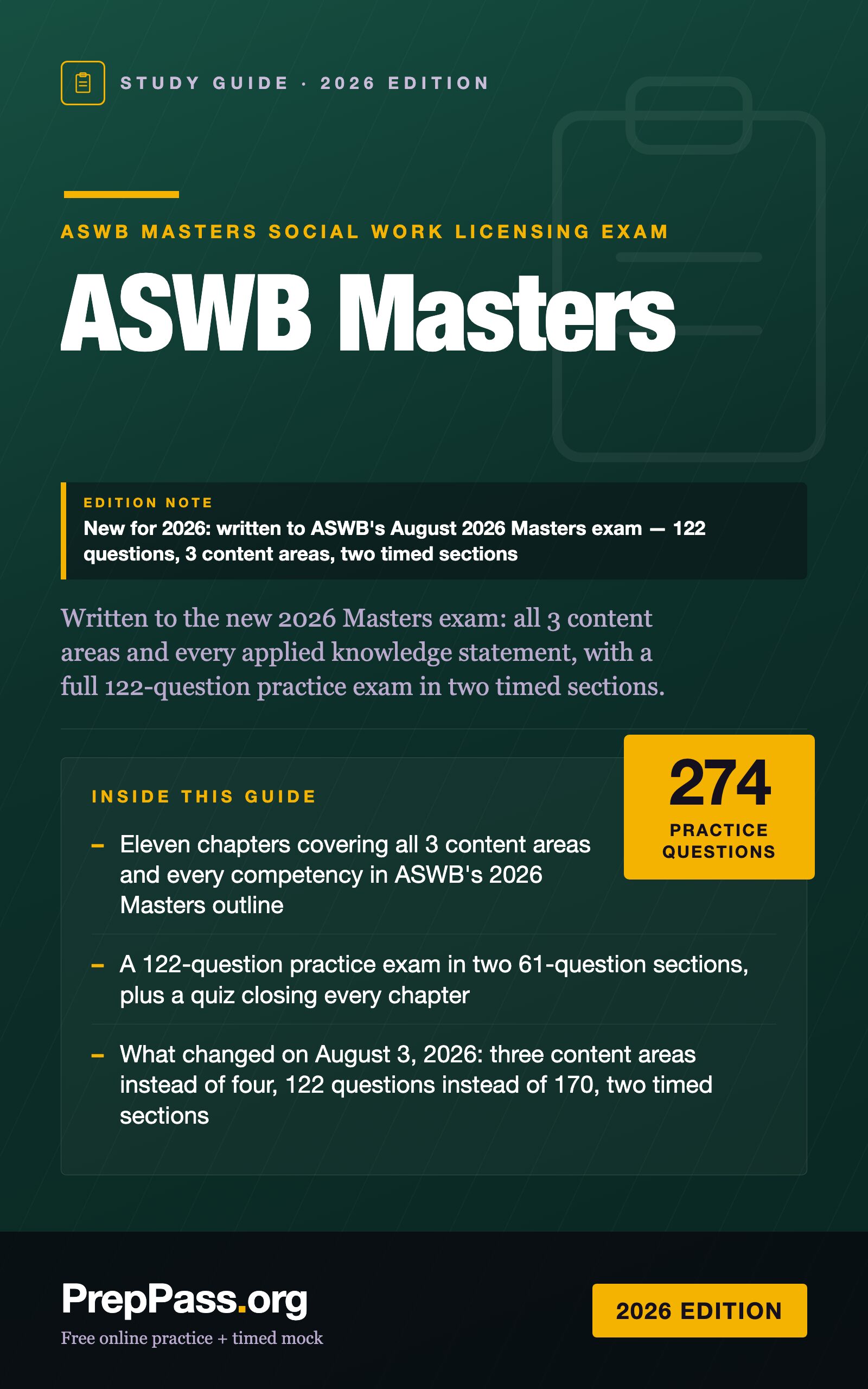
Practice stays free. The full ASWB Masters Social Work Licensing Exam study guide is the material itself, taught start to finish — a downloadable PDF + EPUB you keep.
| Administering body | Association of Social Work Boards (ASWB) — exam delivered by Pearson Source: ASWB — Examination Guidebook, Social Work Licensing Exams (08/2026 edition, PDF) |
|---|---|
| Questions | 122 questions (110 scored, 12 unscored pretest) Source: ASWB — Examination Guidebook, Social Work Licensing Exams (08/2026 edition, PDF) |
| Time limit | 240 minutes Source: ASWB — Examination Guidebook, Social Work Licensing Exams (08/2026 edition, PDF) |
| Passing score | Not published by ASWB What we read and found nothing in: ASWB — Examination Guidebook, Social Work Licensing Exams (08/2026 edition, PDF) |
| Fees |
Source: ASWB — Examination Guidebook, Social Work Licensing Exams (08/2026 edition, PDF) |
| Languages offered | Not published by ASWB What we read and found nothing in: ASWB — Examination Guidebook, Social Work Licensing Exams (08/2026 edition, PDF) |
Frequently asked questions
How many ASWB Masters Social Work Licensing Exam practice questions are here?+
A full bank of original ASWB Masters Social Work Licensing Exam practice questions across the official content areas, weighted like the real exam, with explanations. Free, no signup.
What is the ASWB Masters Social Work Licensing Exam exam like?+
About 122 questions, 240 minutes. Practice by topic here, then take the full timed mock exam to gauge readiness.
Are these the real exam questions?+
No. Every question is 100% original, written from public primary sources with explanations. We never copy real exam questions or paid prep material.
Can I study in Chinese or Spanish?+
PrepPass practice is in English, 中文 and Español. The official exam is in English — switch the question language to English any time to rehearse the exact terminology you'll see on test day.
Is there a study guide for the ASWB Masters Social Work Licensing Exam?+
Yes. PrepPass sells ASWB Masters Study Guide — 2026 Edition, a PDF + EPUB download, $24.99 one-time; the practice on this page stays free without it. See the study guide →
Sample practice questions
A few real questions from this free bank, with full explanations. Use the practice tool above for the whole set.
- 1. Values and Ethics
Which list names the six core values in the NASW Code of Ethics?
- a.Advocacy, confidentiality, informed consent, competence, diversity and respect
- b.Autonomy, beneficence, nonmaleficence, justice, fidelity, veracity and privacy
- c.Empathy, genuineness, warmth, honesty, fairness, loyalty
- d.Service, social justice, dignity and worth, relationships, integrity, competence
Answer: d
Explanation: The NASW Code's core values are service, social justice, dignity and worth of the person, importance of human relationships, integrity and competence. The list beginning with autonomy and beneficence is the set of biomedical ethics principles, a common confusion.
- 2. Values and Ethics
A client with a moderate intellectual disability has a legal guardian. How should the social worker obtain consent for a new service?
- a.From the guardian, without involving the client
- b.From the agency director
- c.From the client alone, since it is his treatment
- d.From the guardian, while informing the client
Answer: d
Explanation: When clients lack capacity to consent, social workers seek permission from an appropriate third party and inform the client consistent with his level of understanding.
- 3. Values and Ethics
A Deaf client's family offers to have her hearing sister interpret at medical appointments. What should the social worker recommend?
- a.Lip-reading with slow speech
- b.Written notes for all appointments
- c.The sister, since the client trusts her
- d.A qualified American Sign Language interpreter
Answer: d
Explanation: NASW's cultural competence standards require effective communication for people who are deaf or hard of hearing, and the Code calls for a qualified interpreter whenever possible.
- 4. Values and Ethics
A social worker who uses a clinical title she does not hold on her website is violating which principle?
- a.Social justice
- b.Integrity
- c.Service
- d.Importance of relationships
Answer: b
Explanation: Misrepresenting credentials violates integrity; the Code says social workers should claim only credentials they actually possess.
- 5. Assessment and Planning
A man insists nothing is wrong despite losing his license after three drunk-driving arrests. He is MOST likely using:
- a.Rationalization
- b.Denial
- c.Suppression
- d.Undoing
Answer: b
Explanation: Denial is dismissing external reality to avoid an uncomfortable situation. Suppression is a conscious choice to set thoughts aside, not a refusal to see the problem.
- 6. Assessment and Planning
A client has both major depression and an alcohol use disorder. This is BEST described as:
- a.A dual relationship
- b.Co-occurring disorders
- c.A primary medical condition
- d.A personality disorder
Answer: b
Explanation: SAMHSA defines co-occurring disorders as the coexistence of a mental health disorder and a substance use disorder.
- 7. Assessment and Planning
Which medication requires regular blood monitoring of drug levels and kidney and thyroid function?
- a.Sertraline
- b.Methylphenidate
- c.Lithium
- d.Buspirone
Answer: c
Explanation: NIMH notes that people taking lithium generally participate in regular monitoring of lithium levels and kidney and thyroid function.
- 8. Intervention and Practice
Who must be included on a child's IEP team under IDEA?
- a.The school board president
- b.The child's pediatrician
- c.The school social worker
- d.The child's parents
Answer: d
Explanation: IDEA requires that the IEP team include the parents of the child, along with teachers and an agency representative.
- 9. Intervention and Practice
Several months into a group, members share openly, feel close and value working together toward the group's goals. Which stage is this?
- a.Norming
- b.Adjourning
- c.Storming
- d.Forming
Answer: a
Explanation: In the norming stage the group has established connections and recognizes the benefit of collaborative work toward its goals.
- 10. Intervention and Practice
An agency is choosing between two anxiety scales. Scale X reports a reliability estimate of 0.45 and Scale Y reports 0.85. What does this suggest?
- a.Both scales are equally reliable
- b.Scale Y gives more consistent results
- c.Scale X measures more concepts
- d.Scale X is more valid than Scale Y
Answer: b
Explanation: StatPearls explains that reliability estimates as close to 1 as possible, higher than 0.7, indicate high reliability, while weak correlations suggest the tool may not be reliable. Reading a lower number as greater validity is the trap: reliability is consistency, and a tool that is not reliable cannot be trusted to be valid.