California RBS (Responsible Beverage Service) · 2026 Edition
California RBS — Responsible Beverage Service Study Guide (2026)
ABC laws, signs of intoxication, refusing service, checking ID and detecting fakes, and civil/criminal liability — California-specific, with worked BAC math.
- 90 practice questions inside the book, with a full answer key
- 107 pages of teaching, chapter by chapter — not a question dump
- Cross-referenced against California ABC Act (B&P §25680+) / Title 4 CCR / leginfo
$9.99one-time · lifetime download · no subscription
PDF + EPUB · English · 107 pages · $9.99 one-time
This book is written in English.
Instant download after payment — no account needed, no subscription.
14-day money-back guarantee: not satisfied for any reason? Email support@preppass.org within 14 days of purchase for a full refund. It's a download, so there is nothing to ship back. Refund policy
Exam facts last checked against official sources: September 2026.
Try 10 questions first — free
Answer all 10, then see every answer explained — with the section of this guide that teaches it. About 5 minutes, no sign-up.
Start 10 free questionsLook inside the book
Three real pages, rendered straight from the PDF you download — a reference page, a teaching page, and a worked question, always in that order. Nothing here was redrawn to look better.
- Quick referenceChapter 1 — ABC Laws & Regulations · PDF page 16
A page you can turn back to: the numbers, deadlines or terms gathered in one place.
- How it's taughtChapter 5 — Checking ID & Detecting Fakes · PDF page 46
An explanation page: the material taught in prose, in the order the exam tests it.
- A question, workedPart II — Practice Exam · PDF page 68
A practice question with its answer and the reasoning behind it — not just a key.
Exam inside two weeks?
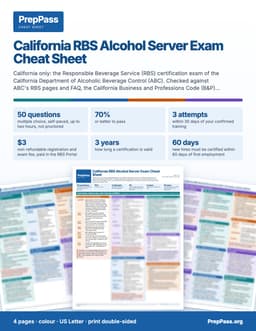
This guide is the teaching, read over weeks. If your exam is inside two weeks, the printable colour cheat sheet is the other product: the figures the exam turns on, laid out by section.
See the California RBS cheat sheet PDF — $9.99 →
4 pages · US Letter · printable PDF · yours to keep
About the exam itself
| Administering body | California Department of Alcoholic Beverage Control (ABC) — exam delivered by ABC itself, through the RBS Portal; the training beforehand is bought from a private ABC-approved RBS training provider Source: California ABC — Responsible Beverage Service (RBS) Training Program |
|---|---|
| Questions | 50 questions |
| Time limit | The exam is self-paced and ABC enforces no time limit. ABC estimates it “can take up to two hours to complete” — a duration estimate, not a cutoff. The deadlines ABC does enforce are calendar ones: the exam must be passed within 30 days of confirmed training, and the server certified within 60 days of hire. What we read and found nothing in: California ABC — RBS Frequently Asked Questions |
| Passing score | 70% |
| Fees |
|
| Languages offered | English · Chinese · Hindi · Korean · Punjabi · Spanish · Tagalog · Vietnamese Source: California ABC — Responsible Beverage Service (RBS) Training Program |
Questions buyers ask
- Is a study guide enough for the California RBS (Responsible Beverage Service) exam, or do I need a course?
- A book is exam review: it does not replace any education, training or experience California Department of Alcoholic Beverage Control (ABC) requires before you may sit the exam, so check those requirements first. For the exam content itself, this 107-page guide teaches the material chapter by chapter with 90 practice questions and explanations inside, and 100 more practice questions are free on PrepPass. A prep course adds live instruction and a set schedule; whether you need one beyond any required education is your call.
- What is the cheapest way to prepare for the California RBS (Responsible Beverage Service) exam?
- Start with what costs nothing: 100 practice questions on PrepPass, with explanations and no signup. If you want it taught in one file you keep, the full study guide is $9.99 once; the printable cheat sheet for the last days is $9.99. No subscription on any of them.
- Who administers the California ABC Alcohol Server Certification Examination (Responsible Beverage Service)?
- California Department of Alcoholic Beverage Control (ABC) — exam delivered by ABC itself, through the RBS Portal; the training beforehand is bought from a private ABC-approved RBS training provider. Training and examination are separate purchases from separate parties. ABC also requires servers to be certified within 60 days of their first date of employment, and certification lasts three years.
- How many questions are on the California ABC Alcohol Server Certification Examination (Responsible Beverage Service)?
- 50 questions. ABC does not split the 50 into scored and unscored items and mentions no pretest questions, so no scored/unscored claim is made here.
- How long is the California ABC Alcohol Server Certification Examination (Responsible Beverage Service)?
- The exam is self-paced and ABC enforces no time limit. ABC estimates it “can take up to two hours to complete” — a duration estimate, not a cutoff. The deadlines ABC does enforce are calendar ones: the exam must be passed within 30 days of confirmed training, and the server certified within 60 days of hire.
- What is the passing score for the California ABC Alcohol Server Certification Examination (Responsible Beverage Service)?
- 70%. Open book — ABC allows the training provider's study guide during the exam. Three attempts are permitted, all within 30 days of confirmed training.
- How much does the California ABC Alcohol Server Certification Examination (Responsible Beverage Service) cost?
- $3 — RBS Portal registration, which includes the examination (California ABC, one-time). $3 is non-refundable and is the only fee paid to the state — the exam fee is not separate from registration. The training beforehand is a separate, variable charge: ABC states that providers set their own price and that ABC cannot negotiate group pricing, so no total cost figure is published here.
- What languages is the California ABC Alcohol Server Certification Examination (Responsible Beverage Service) offered in?
- English · Chinese · Hindi · Korean · Punjabi · Spanish · Tagalog · Vietnamese. The exam is offered in eight languages; the TRAINING is offered in only five — English, Chinese, Korean, Spanish and Vietnamese. The two lists are different lengths and must not be collapsed into one number.
- Does the California RBS (Responsible Beverage Service) study guide come as a PDF?
- Yes — California RBS — Responsible Beverage Service Study Guide (2026) downloads as PDF and EPUB, 107 pages. The download link is emailed the moment payment clears and does not expire.
- How much does the California RBS (Responsible Beverage Service) study guide cost?
- $9.99, once. There is no subscription and no account to create; the PDF and EPUB files are yours to keep.
- Are there free California RBS (Responsible Beverage Service) practice questions?
- Yes — 100 of them, free to use with no signup and an explanation on every one. They are separate from this study guide, which is what you are buying here. The same free, no-account system also has practice modes (adaptive, new questions, spaced review of misses, weak-topic focus, saved, my mistakes); a timed mock exam (50 questions, 50 minutes) with a score report by topic; a 10-question readiness check (about 5 minutes); 7 study chapters. None of it needs this study guide.
- Can I read part of the California RBS (Responsible Beverage Service) study guide before buying?
- Yes. A full chapter is free to read on this page — not a summary of one, the chapter itself.
- What is the difference between the California RBS (Responsible Beverage Service) study guide and the cheat sheet?
- The study guide ($9.99) teaches the material chapter by chapter and is meant to be read over weeks. The cheat sheet ($9.99, 4 pages) drops the teaching and keeps the figures: every number on the exam grouped by value so the confusable ones sit together, each reference page paired with a recall page that blanks the answers, and four routes by days left — 14, 7, 3, or tonight. They are separate purchases; neither replaces the other.
- Is this the official California RBS (Responsible Beverage Service) study guide?
- No. This is an independent study guide and is not affiliated with or endorsed by the exam's awarding body. It is written from California ABC Act (B&P §25680+) / Title 4 CCR / leginfo. Always confirm current requirements with the body that issues your licence.
Free California RBS (Responsible Beverage Service) practice questions and study chapters →
What's included — and what isn't
Included
- California ABC laws (B&P §§25680–25684) and the RBS mandate
- Alcohol effects + worked BAC math the exam actually tests
- Refusing service, de-escalation, and obvious-intoxication cues
- Checking ID, detecting fakes, and the decoy (ABC Rule 141) rules
- 90 original practice questions with answer explanations
- PDF (print & tab it) + EPUB (phone / e-reader)
Not included
- No printed copy is shipped — this is a file you download and can print yourself
- No video course, instructor or tutoring comes with the book — the free videos on the site are separate
- Not your exam registration or the testing centre's fee, which you still pay to the official body
Contents
See 13 sections and the page each one starts on
- Part I — The Study Guidep. 7
- Chapter 1 — ABC Laws & Regulationsp. 8
- Chapter 2 — Alcohol Effects on the Bodyp. 20
- Chapter 3 — Identifying Signs of Intoxicationp. 29
- Chapter 4 — Refusing Service & De-escalationp. 36
- Chapter 5 — Checking ID & Detecting Fakesp. 44
- Chapter 6 — Civil & Criminal Liabilityp. 53
- Chapter 7 — Special Situationsp. 60
- Part II — Practice Examp. 68
- Part III — Answer Key & Explanationsp. 80
- Part IV — Practice Exam B (Rapid Review)p. 89
- Appendix A — Statute & Number Quick-Referencep. 103
- Appendix B — Glossary of Key Termsp. 106
Taken from the PDF you download, with the page each one starts on — not typed here.
Read a chapter free, in full
One complete chapter, exactly as it ships in the eBook. Scroll the window to read it right here; no download, no email.
Read chapter 3 here, without leaving the page
We didn't give you the easy intro — the free chapter opens on one of the hardest-working parts of the book, so you can judge the teaching where the exam gets difficult.
Introduction
Chapter 1 gave you the legal command — do not serve an obviously intoxicated person (B&P §25602). Chapter 2 explained the chemistry. This chapter is the eyes-and-ears skill that connects them: how a trained server actually recognizes intoxication in real time, without a breathalyzer, on a busy floor, in bad lighting. The word "obviously" is doing a lot of work in the statute — it means the standard is what a reasonable person, observing the customer, would conclude. No chemical test, no confession, no medical diagnosis. Just trained observation.
The exam tests two things here: a framework for spotting the signs, and the discipline of tracking and pacing so you catch impairment as it builds rather than after it explodes.
Learning objectives
After this chapter you should be able to:
- Apply the SCAN observation framework — Speech, Coordination, Appearance, Notable behavior — and recognize that a pattern across two or more categories meets the "obviously intoxicated" standard.
- Explain that §25602 uses an objective, observational ("reasonable person") standard, not a BAC test.
- Distinguish early-stage signs (the intervention window) from late-stage signs (mandatory, immediate cut-off).
- Use tracking, pacing, and cumulative observation — counting drinks, watching change over time, and handing off information at shift change.
- Handle difficult cases where a sign may not mean intoxication (disability, medication, accent, language) without either over-refusing or under-refusing.
- Recognize that a customer who arrives already intoxicated may not be served — there is no "first drink" exception.
Part A — The SCAN framework
RBS training organizes the visible signs of impairment into four categories, commonly taught with the mnemonic SCAN:
- S — Speech. Slurring, mumbling, thick or slow speech, loss of the conversational thread, repeating oneself, or a sudden change in volume (loud if previously quiet, or the reverse).
- C — Coordination. Swaying or stumbling, leaning on the bar for support, spilling drinks, missing the glass or the mouth, fumbling with money or a credit card, dropping a wallet or phone, difficulty with familiar fine-motor tasks.
- A — Appearance. Glassy or bloodshot eyes, droopy eyelids, flushed face, disheveled or sweaty look, unfocused gaze.
- N — Notable behavior. Aggression, belligerence, crying or sudden mood swings, overly friendly or sexual conduct toward strangers, inappropriate risk-taking, falling asleep at the bar, arguing over the tab.
(These map onto the same idea as the older "speech, behavior, appearance, judgment" domains — the labels differ, the observation is the same.)
The single most important rule: look for a pattern, not one cue. No single sign proves intoxication. A person can have glassy eyes from allergies, slur from a speech condition, or stumble on a bad knee. What establishes "obviously intoxicated" is multiple signs across multiple SCAN categories, especially when they worsen over the visit and accelerate after each drink. Glassy eyes plus leaning on the bar plus slowed speech is three categories at once — that is obviously intoxicated, and service must stop.
California example. A bartender watches a patron order "one more vodka soda." His eyes are red and glassy (Appearance), he is leaning heavily on the bar (Coordination), and his speech has slowed and thickened (Speech). That is three SCAN categories — the "obviously intoxicated" standard is met. Continued service is a §25602 misdemeanor. The bartender politely refuses, offers water and food, and helps arrange a ride. A diluted or "weaker" version of the drink would still be a sale of alcohol and still a violation.
Part B — Tracking, pacing, and cumulative observation
Because impairment lags behind intake, the customer who looks fine as you pour the fourth shot may be a problem fifteen minutes later when it fully hits. The defense is not a better guess in the moment — it is a system.
- Count drinks per customer. Use the POS, a written tab, or a deliberate mental count for each individual (not "the table"). Recall from Chapter 2 that a "double" is two standard drinks and a craft beer may be 1.5.
- Pace against the ~one-drink-per-hour elimination rate. A customer drinking faster than the body clears is building BAC, even if they still look fine right now. Slow the rounds, bring water with every drink, offer food, and steer toward lower-ABV options.
- Cumulative observation means watching change over time — a single ambiguous slurred word means little; the same word plus a stumble ten minutes later confirms the trend. A brief SCAN glance each time you approach the customer catches the slide early.
- Communicate at shift change. A classic patron move is to wait for a fresh bartender who has no baseline. Verbal handoffs and a note near the well ("table 6 is heavy tonight") close that gap.
- Watch the red flags that don't prove intoxication but predict a fast BAC climb: ordering rapid rounds (three shots in ten minutes), ordering the next before finishing the last, "two-fisting," or one person ordering rounds for a heavy-drinking friend. The response is heightened observation and slower service — not necessarily refusal yet.
Note what is not a red flag: ordering water, paying with a card, or tipping generously. Do not let normal behavior drive service decisions.
California example. A customer downs four shots in twenty minutes and still seems okay as the fourth is poured — the alcohol has not fully absorbed. The server who counted and paced knows the BAC is about to spike, stops further rounds, and brings water and food now, before the SCAN signs bloom. The server who only reacts to visible drunkenness will serve a fifth and own the incident.
Part C — Difficult cases, and the customer who arrives drunk
Not everyone who shows a "sign" is intoxicated, and treating every cue as proof leads to unlawful, discriminatory refusals. Use the pattern test and a brief conversation.
- Disability and medical conditions. A customer with a stroke history, Parkinson's, or a speech impediment may slur or move unsteadily sober. A prosthetic or an injury can cause an uneven gait. Refuse for intoxication, never for disability — refusing someone because of a disability can violate the ADA and California's Unruh Civil Rights Act (Civil Code §51). The question is always: are there multiple signs, are they worsening, do they track the drinking?
- Medication. Drowsiness may come from a prescription, not the drink — but recall that medications amplify alcohol, so pace slowly and refuse early if impairment appears.
- Accent and language. An unfamiliar accent or limited English is not impairment. "I can't easily understand this person" is different from "this person is slurring." Refusing on accent risks national-origin discrimination.
- The coherence check. When you genuinely cannot tell, talk to the customer. Ask their order back, ask an easy question, watch whether their answers make sense. A customer whose responses are coherent and whose pace is slow is not §25602 intoxicated; one whose coherence deteriorates after each round is.
- Tolerance (from Chapter 2): a heavy regular may not look drunk at a BAC well over 0.08. High tolerance is not a defense — the ABC has held so — and you can still be cited for serving them.
The customer who arrives already intoxicated. A patron who walks in already obviously intoxicated is a §25602 problem the moment you pour the first drink. Your liability does not require that you served the drinks that got them there. Bar-hoppers, wedding guests who pre-gamed, travelers who drank on the plane, the person who finished a flask in the parking lot — the framework does not change. Observe at the door, at the order, and at delivery. If they arrive drunk, the answer is no service, plus water/food if they will stay calm, and a safe ride out.
California example. A patron arrives slurring, with a stumbling gait, and orders a beer "— I haven't even had anything here yet." There is no first-drink exception under §25602: he is already obviously intoxicated, so he cannot lawfully be served at all. Serving "just one" is a misdemeanor. The right response is a polite refusal, water and a seat, and help arranging transportation.
Key numbers & deadlines
Legal standard: §25602 — do not serve an obviously intoxicated person. This is an objective, observational ("reasonable person") test — no breathalyzer, no confession, no diagnosis required. SCAN: Speech · Coordination · Appearance · Notable behavior. A pattern across two or more categories = obviously intoxicated → stop service. Pattern, not a single sign. One cue (glassy eyes, a slur, a stumble) can have innocent causes; multiple signs, worsening over time, tracking the drinking = intoxicated. Impairment lags intake — count drinks, pace to ~1 standard drink/hour, observe cumulatively, and hand off at shift change. Early window (relaxed, loud, disinhibited) = slow down, water/food. Late signs (slurring, stumbling, vomiting, falling asleep, blackout) = mandatory immediate cut-off; consider 911. No "first drink" exception: a customer who arrives obviously intoxicated may not be served at all (§25602). Never refuse for a protected trait — disability, accent, or national origin (Civil Code §51). Refuse for behavior/intoxication.
Named exam traps
- "One sign is enough to refuse." No — look for a pattern across ≥2 SCAN categories. (But equally, do not wait for someone to be unconscious — that is far too late.)
- "A weaker/diluted drink is okay for an intoxicated patron." It is still a sale of alcohol and still a §25602 violation.
- "He hasn't had anything here yet, so I can serve one." No first-drink exception — already-intoxicated means no service.
- "Slurring/stumbling always means drunk." Not if it is disability or a medical condition; use the pattern test and a coherence check.
- "An accent or poor English is a sign of intoxication." Never — refusing on that basis is discrimination.
- "Wait and see what happens after this drink." Reactive observation means the harm has already occurred; intervene early.
- "Rapid rounds prove intoxication." They are a red flag warranting closer watch, not proof by themselves — but they demand action.
Key takeaways
- §25602 intoxication is judged by trained observation, not a chemical test.
- Use SCAN (Speech, Coordination, Appearance, Notable behavior); a pattern across categories that worsens over time is the trigger.
- Track and pace: count each person's drinks, watch cumulatively, hand off at shift change, and treat rapid ordering as a red flag.
- Intervene in the early window; do not wait for late, dangerous signs.
- Distinguish innocent causes (disability, medication, accent, language) from intoxication, and never refuse for a protected trait.
- A customer who arrives intoxicated gets no service — there is no first-drink exception.
Sources
Cited to the California ABC RBS curriculum framework and the Business & Professions Code (leginfo.legislature.ca.gov). The SCAN mnemonic reflects standard RBS training practice.
- Cal. Bus. & Prof. Code § 25602 — prohibition on service to an obviously intoxicated person; objective "obviously intoxicated" standard (tolerance is not a defense per ABC disciplinary practice).
- California ABC RBS Training Program / Title 4 Cal. Code Regs. § 165 — observation framework (SCAN: Speech, Coordination, Appearance, Notable behavior) and cumulative-observation / pacing practice.
- Cal. Civ. Code § 51 (Unruh Civil Rights Act) — prohibition on refusing service based on a protected characteristic (disability, national origin, etc.); Americans with Disabilities Act — disability protection.
- NIAAA — impairment progression and the ~one-standard-drink-per-hour elimination rate (see Chapter 2 sources).
Before you buy
- How do I get it?
- Pay, and the download appears on this page straight away. The links are also emailed to you. No account is required.
- What if it isn't for me?
- Email us within 14 days for a full refund, no questions asked.
- Is the free practice going away?
- No. Every practice question, the timed mock and the free chapters on this site stay free. This book is the studying half, not a gate around the free half.
- Can I read it on my phone?
- Yes — the EPUB is for phones and e-readers, the PDF is for printing and tabbing. You get both.
The details
ABC laws, signs of intoxication, refusing service, checking ID and detecting fakes, and civil/criminal liability — California-specific, with worked BAC math.
- Format: PDF + EPUB download · 107 pages
- 90 practice questions in the book, with a full answer key
- 100 free practice questions for this exam on PrepPass, included at no cost
- $9.99 one-time — no subscription
- 14-day money-back guarantee · refund policy
- Cross-referenced against: California ABC Act (B&P §25680+) / Title 4 CCR / leginfo
- Last updated: August 2026
- Verified from the official source(California ABC Act (B&P §25680+) / Title 4 CCR / leginfo)
- 100 free practice questions
- Instant download, yours for life
Why buy the book when the practice is free?
Our practice questions and timed mock stay free — nothing on the site moves behind this book. The $9.99 book is the studying half: the material itself, taught in order, in a file you own.
- Systematic teaching — every exam section explained chapter by chapter, start to finish, not just questions
- Print it & tab it — a paper-ready PDF you can highlight, mark up, and bring to your study table
- Study anywhere, offline — EPUB on your phone or e-reader; no wifi, no browser tabs
- Everything in one place — the chapters and the practice questions in one file
- Yours for life — one-time $9.99, instant download, no subscription
And it's risk-free: 14-day money-back guarantee — not satisfied? Email us for a full refund, no questions asked. See the refund policy.
Also free on PrepPass for California RBS (Responsible Beverage Service)
Beside this guide, PrepPass has a free study system for the same exam. It needs no account, and buying the guide does not unlock or change it: 100 practice questions with explanations; practice modes (adaptive, new questions, spaced review of misses, weak-topic focus, saved, my mistakes); a timed mock exam (50 questions, 50 minutes) with a score report by topic; a 10-question readiness check (about 5 minutes); 7 study chapters.
Progress is saved in your browser; a free account keeps it across devices. The readiness gauge reflects your own practice, not a prediction of the real exam result. How the practice works
14-day money-back guarantee · full refund, no questions asked.
One-time purchase, lifetime access to the download. The eBook is the full California RBS (Responsible Beverage Service) study guide in PDF and EPUB. Educational summary, not professional or legal advice — always confirm the current rules with the official source. Last updated: August 2026.