ServSafe Food Protection Manager · 2026 Edition
ServSafe Manager Exam — Complete Study Guide (2026)
This independent PrepPass study guide gives you 151 pages of teaching plus 240 practice questions with a full answer key — PDF + EPUB, $19.99 one-time. Inside: a quiz closing each of the 8 chapters, with an answer key that explains every one; a key numbers sheet in each of the 8 chapters — the temperatures, times and limits the exam turns on.
- All 8 exam content areas as one PDF + EPUB you keep
- A quiz closing each of the 8 chapters, with an answer key that explains every one
- A key numbers sheet in each of the 8 chapters — the temperatures, times and limits the exam turns on
PDF + EPUB · English · 151 pages · $19.99 one-time
This book is written in English.
Instant download after payment — no account needed, no subscription.
14-day money-back guarantee: not satisfied for any reason? Email support@preppass.org within 14 days of purchase for a full refund. It's a download, so there is nothing to ship back. Refund policy
Not sure yet? Try 10 free questions first
Exam facts last checked against official sources: September 2026.
To prepare for the ServSafe Food Protection Manager exam, start with what the exam body publishes: ServSafe Manager Exam (Access Code) from ServSafe (National Restaurant Association) — the certification exam itself, $38.99; requires an exam proctor, and additional fees apply. The exam itself (ServSafe Food Protection Manager Certification Examination): 90 questions (80 scored, 10 unscored pretest), 120 minutes, 70% (at least 56 of the 80 scored questions) to pass. Choose this book if you want every tested time, temperature and concentration in one file to review before your proctored exam. It does not replace the exam, or a course your employer or local health department requires.
Try 10 questions first — free
Answer all 10, then see every answer explained — with the section of this guide that teaches it. About 5 minutes, no sign-up.
You do not need the book to practise: 500 practice questions for this exam are free on PrepPass.
Start 10 free questionsLook inside the book
Three real pages, rendered straight from the PDF you download — a reference page, a teaching page, and a worked question, always in that order. Nothing here was redrawn to look better.
- Quick referenceChapter 1 — Foodborne Illness Basics · PDF page 12
A page you can turn back to: the numbers, deadlines or terms gathered in one place.
- How it's taughtChapter 5 — Preparation and Cooking · PDF page 63
An explanation page: the material taught in prose, in the order the exam tests it.
- A question, workedChapter 1 — Foodborne Illness Basics · PDF page 17
A practice question with its answer and the reasoning behind it — not just a key.
Exam inside two weeks?
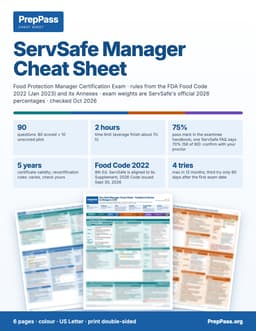
This guide is the teaching, read over weeks. If your exam is inside two weeks, the printable colour cheat sheet is the other product: the figures the exam turns on, laid out by section.
See the ServSafe Food Protection Manager cheat sheet PDF — $9.99 →
6 pages · US Letter · printable PDF · yours to keep
About the exam itself
| Administering body | National Restaurant Association Educational Foundation (NRAEF) — exam delivered by a registered ServSafe Instructor/Proctor, or ProctorU for online-proctored delivery Source: ServSafe — Food Protection Manager Certification Examinee Handbook (PDF, © 2020 NRAEF) |
|---|---|
| Questions | 90 questions (80 scored, 10 unscored pretest) |
| Time limit | 120 minutes Source: ServSafe — Manager Exam (Access Code), catalog product SSONLINEX |
| Passing score | 70% (at least 56 of the 80 scored questions) Source: ServSafe — FAQ: “What is the passing score for the ServSafe Food Protection Manager Examination?” |
| Fees |
Source: ServSafe — Manager Exam (Access Code), catalog product SSONLINEX |
| Languages offered | English · Spanish · Chinese · Korean · French · Japanese Source: ServSafe — FAQ: “What languages is the ServSafe exam available in?” |
Questions buyers ask
- Which ServSafe Food Protection Manager study guide should I use?
- It depends on what you already have. ServSafe (National Restaurant Association): ServSafe Manager Exam (Access Code), $38.99; requires an exam proctor, and additional fees apply — you need the exam in any case. Ask your instructor or proctor which materials they supply before you buy a course or book. Mometrix Test Preparation: ServSafe Exam Secrets, $24.99 ebook; $29.99 printed book — choose Mometrix if you want a printed copy. This PrepPass guide: 151 pages, 240 practice questions with explanations, PDF + EPUB, $19.99 one-time — choose this book if you want every tested time, temperature and concentration in one file to review before your proctored exam. It does not replace the exam, or a course your employer or local health department requires. Prices were checked on 2026-09-24; confirm them with each seller.
- Is a study guide enough for the ServSafe Food Protection Manager exam, or do I need a course?
- A book is exam review: it does not replace any education, training or experience National Restaurant Association Educational Foundation (NRAEF) requires before you may sit the exam, so check those requirements first. For the exam content itself, this 151-page guide teaches the material chapter by chapter with 240 practice questions and explanations inside, and 500 more practice questions are free on PrepPass. A prep course adds live instruction and a set schedule; whether you need one beyond any required education is your call.
- What is the cheapest way to prepare for the ServSafe Food Protection Manager exam?
- Start with what costs nothing: 500 practice questions on PrepPass, with explanations and no signup. If you want it taught in one file you keep, the full study guide is $19.99 once; the printable cheat sheet for the last days is $9.99. No subscription on any of them.
- Who administers the ServSafe Food Protection Manager Certification Examination?
- National Restaurant Association Educational Foundation (NRAEF) — exam delivered by a registered ServSafe Instructor/Proctor, or ProctorU for online-proctored delivery. The programme is operated under license by National Restaurant Association Solutions, LLC. ServSafe states that online proctors are supplied by ProctorU and not by ServSafe.
- How many questions are on the ServSafe Food Protection Manager Certification Examination?
- 90 questions (80 scored, 10 unscored pretest). ServSafe calls the unscored items “pilot questions … for research purposes only”. They are indistinguishable from scored items during the exam.
- How long is the ServSafe Food Protection Manager Certification Examination?
- 120 minutes. The Examinee Handbook states the same limit from the proctor's side: all examination materials must be returned to the proctor two hours after the start.
- What is the passing score for the ServSafe Food Protection Manager Certification Examination?
- 70% (at least 56 of the 80 scored questions). Two official ServSafe sources disagree and the older one is wrong: the © 2020 Examinee Handbook PDF still prints “A passing score is 75 percent or better”, while the current live FAQ and the Online Proctoring FAQ both say 70%. The percentage is of the scored questions only.
- How much does the ServSafe Food Protection Manager Certification Examination cost?
- $99 — Manager exam with online proctoring (ServSafe catalog price) (ServSafe, per attempt); $38.99 — Manager exam access code, proctor fee not included (ServSafe catalog price) (ServSafe, per attempt). ServSafe declines to publish one exam fee: the Examinee Handbook tells candidates to check with their instructor, proctor or organization about fees. The prices above are ServSafe's own catalog prices for the exam product; what an examinee actually pays depends on who administers it, and the access-code product notes that additional proctor fees apply.
- What languages is the ServSafe Food Protection Manager Certification Examination offered in?
- English · Spanish · Chinese · Korean · French · Japanese. Not all forms are available every way. Online-proctored delivery is English, Spanish and Chinese only; Korean, French Canadian and Japanese exist as bilingual printed forms paired with English. Three official ServSafe pages disagree about the online list, so only the FAQ's list is treated as the online set here.
- Does the ServSafe Food Protection Manager study guide come as a PDF?
- Yes — ServSafe Manager Exam — Complete Study Guide (2026) downloads as PDF and EPUB, 151 pages. The download link is emailed the moment payment clears and does not expire.
- How much does the ServSafe Food Protection Manager study guide cost?
- $19.99, once. There is no subscription and no account to create; the PDF and EPUB files are yours to keep.
- Are there free ServSafe Food Protection Manager practice questions?
- Yes — 500 of them, free to use with no signup and an explanation on every one. They are separate from this study guide, which is what you are buying here. The same free, no-account system also has practice modes (adaptive, new questions, spaced review of misses, weak-topic focus, saved, my mistakes); a timed mock exam (90 questions, 120 minutes) with a score report by topic; a 10-question readiness check (about 5 minutes); 8 study chapters; a day-by-day study plan. None of it needs this study guide.
- Can I read part of the ServSafe Food Protection Manager study guide before buying?
- Yes. A full chapter is free to read on this page — not a summary of one, the chapter itself.
- What is the difference between the ServSafe Food Protection Manager study guide and the cheat sheet?
- The study guide ($19.99) teaches the material chapter by chapter and is meant to be read over weeks. The cheat sheet ($9.99, 6 pages) drops the teaching and keeps the figures: every number on the exam grouped by value so the confusable ones sit together, each reference page paired with a recall page that blanks the answers, and four routes by days left — 14, 7, 3, or tonight. They are separate purchases; neither replaces the other.
- Is this the official ServSafe Food Protection Manager study guide?
- No. This is an independent study guide and is not affiliated with or endorsed by the exam's awarding body. It is written from FDA Food Code 2022 / ServSafe Manager outline. Always confirm current requirements with the body that issues your licence.
Free ServSafe Food Protection Manager practice questions and study chapters →
How this book compares
ServSafe sells the Manager exam itself, which only a registered ServSafe instructor or proctor may administer, and tells candidates to ask their instructor or proctor which materials to buy. This book is an independent review to read before that exam; it does not include an exam access code.
| Resource | Price | What you get | Choose it if |
|---|---|---|---|
| This bookServSafe Manager Exam — Complete Study Guide (2026)PrepPass | $19.99 | Independent downloadable review for the ServSafe Manager exam
| Choose this book if you want every tested time, temperature and concentration in one file to review before your proctored exam. It does not replace the exam, or a course your employer or local health department requires. |
| From the exam bodyServSafe Manager Exam (Access Code) (opens the publisher's page in a new tab)ServSafe (National Restaurant Association) | $38.99; requires an exam proctor, and additional fees apply | The certification exam itself
| You need the exam in any case. Ask your instructor or proctor which materials they supply before you buy a course or book. |
| AlternativeServSafe Exam Secrets (opens the publisher's page in a new tab)Mometrix Test Preparation | $24.99 ebook; $29.99 printed book | Study guide with practice questions | Choose Mometrix if you want a printed copy. |
This book
ServSafe Manager Exam — Complete Study Guide (2026)
PrepPass
- Price
- $19.99
- What you get
Independent downloadable review for the ServSafe Manager exam
- 240 practice questions with explanations
- 151 pages, PDF + EPUB
- Choose it if
- Choose this book if you want every tested time, temperature and concentration in one file to review before your proctored exam. It does not replace the exam, or a course your employer or local health department requires.
From the exam body
ServSafe Manager Exam (Access Code) (opens the publisher's page in a new tab)
ServSafe (National Restaurant Association)
- Price
- $38.99; requires an exam proctor, and additional fees apply
- What you get
The certification exam itself
- A one-time exam access code; only registered ServSafe instructors or proctors may administer the exam
- Choose it if
- You need the exam in any case. Ask your instructor or proctor which materials they supply before you buy a course or book.
Alternative
ServSafe Exam Secrets (opens the publisher's page in a new tab)
Mometrix Test Preparation
- Price
- $24.99 ebook; $29.99 printed book
- What you get
Study guide with practice questions
- Choose it if
- Choose Mometrix if you want a printed copy.
Other resources' prices and contents are as listed on each publisher's or seller's own page, checked September 24, 2026. Prices change; confirm on the linked page before you buy. This book's price and contents come from our own catalog.
Sources (3)
- https://www.servsafe.com/access/ss/catalog/productdetail/ssonlinex — read September 24, 2026
- https://www.servsafe.com/ServSafe-Manager/Get-Certified — read September 24, 2026
- https://www.mometrix.com/studyguides/servsafe/ — read September 24, 2026
What's included — and what isn't
Included
- “Exam traps to avoid” in every chapter — the wording that catches people who know the material
- All 8 content areas of the ServSafe Manager exam (ServSafe publishes no per-area weights)
- Every cook / hold / cool / reheat temperature verified to the 2022 FDA Food Code
- The Big 6 pathogens, Big 9 allergens, and 7-day date-marking rules
- Sanitizer concentrations, HACCP’s 7 principles, and active managerial control
- 240 original practice questions with answer explanations
- PDF (print & tab it) + EPUB (phone / e-reader)
Not included
- No printed copy is shipped — this is a file you download and can print yourself
- No video course, instructor or tutoring comes with the book — the free videos on the site are separate
- Not your exam registration or the testing centre's fee, which you still pay to the official body
Contents
See 10 sections and the page each one starts on
- Chapter 1 — Foodborne Illness Basicsp. 7
- Chapter 2 — Contamination, Cross-Contact, and Allergensp. 21
- Chapter 3 — Personal Hygienep. 35
- Chapter 4 — Purchasing, Receiving, and Storagep. 49
- Chapter 5 — Preparation and Cookingp. 62
- Chapter 6 — Holding and Servicep. 76
- Chapter 7 — Food Safety Management and HACCPp. 88
- Chapter 8 — Facilities, Cleaning, Sanitizing, and Pest Controlp. 103
- Appendix A — Master temperature & time referencep. 149
- Appendix B — Sanitizer quick referencep. 151
Taken from the PDF you download, with the page each one starts on — not typed here.
Read a chapter free, in full
One complete chapter, exactly as it ships in the eBook. Scroll the window to read it right here; no download, no email.
Read chapter 1 here, without leaving the page
Every rule in the rest of this book exists to answer one question: how do we keep pathogens from reaching a guest in a dose that makes them sick? Foodborne illness is the outcome we are all working to prevent, so this chapter defines the enemy — the pathogens, the foods they love, the conditions they need, and the guests who suffer most. Master the vocabulary here (Big Six, TCS, FAT TOM, the temperature danger zone) and the operational chapters that follow will feel like common sense rather than a list to memorize.
A foodborne illness is a sickness carried to people by the food they eat, and when two or more people get the same illness from the same meal it becomes a foodborne-illness outbreak. As a manager your job is to understand what makes food unsafe so you can stop problems before a guest ever gets sick.
The Big Six Pathogens
Most foodborne illness comes from biological contaminants, and the government has singled out six pathogens as so contagious and severe that a person carrying them must be kept out of your operation. These "Big Six" are Norovirus, Hepatitis A, Shigella, Shiga toxin-producing E. coli (STEC), Salmonella Typhi, and nontyphoidal Salmonella. Several of them are spread through the fecal-oral route, which is exactly why handwashing after using the restroom is non-negotiable. Norovirus and Hepatitis A come mainly from ready-to-eat food touched by infected workers; Salmonella Typhi and nontyphoidal Salmonella from poultry, eggs, and produce; Shigella from flies and unwashed hands; and E. coli from ground beef and contaminated produce. Knowing the source helps you target the right control, whether that is cooking, handwashing, or supplier selection.
TCS Foods
Time/Temperature Control for Safety (TCS) foods are the items that support rapid pathogen growth and therefore need strict time and temperature limits. Classic examples include milk and dairy, shell eggs, meat, poultry, fish, shellfish and crustaceans, baked potatoes, heat-treated plant foods like cooked rice, beans, and vegetables, tofu and other soy protein, sprouts and cut leafy greens, cut tomatoes, and cut melons. These foods share traits that microbes love: they are moist, protein-rich or high in carbohydrate, and have a neutral pH. Non-TCS foods such as dry pasta, uncut produce, and commercial mayonnaise are far more stable. When you can identify a TCS food on sight, you know instantly that it needs to stay out of the temperature danger zone.
FAT TOM: Conditions for Growth
Pathogens need the right conditions to multiply, summed up by the acronym FAT TOM: Food, Acidity, Temperature, Time, Oxygen, and Moisture. Microbes need nutrient-rich Food, a near-neutral Acidity (pH 7.5 down to 4.6), and warm Temperatures in the danger zone of 41°F to 135°F. Given enough Time — as little as four hours in that zone — a single bacterium can multiply into millions. Some bacteria need Oxygen while others thrive without it, and nearly all need Moisture, measured as water activity (aw) above 0.85. As a manager you cannot easily change food, oxygen, or acidity in most menu items, so your practical levers are temperature and time. Controlling those two factors is the foundation of nearly every food-safety rule you will enforce.
Toxins and Chemical Hazards
Not every hazard is a living microbe. Some fish carry natural toxins that cannot be cooked, frozen, or canned away. Scombroid poisoning comes from tuna, mahi-mahi, and bonito that were time-temperature abused, letting histamine build up. Ciguatera poisoning comes from large predatory reef fish like barracuda and grouper that ate smaller toxic fish. Certain wild mushrooms and shellfish from contaminated waters also carry toxins. Because these toxins are already formed and heat-stable, your only defense is buying from approved, reputable suppliers and keeping fish cold from the moment it arrives. Chemical hazards — cleaners, sanitizers, and pesticides — round out the picture and are prevented by proper labeling and storing chemicals away from food.
High-Risk Populations
Some guests get much sicker from foodborne illness than others, and a good manager keeps them in mind. The highest-risk groups are the very young (preschool-age children), older adults, pregnant women, and people with weakened immune systems, including those with cancer, HIV, or organ transplants. These populations have immune systems that are still developing, declining, or compromised, so even a small dose of a pathogen can cause severe illness. Facilities that serve these groups — hospitals, nursing homes, day cares — are called highly susceptible populations and often face stricter rules, such as bans on serving raw or undercooked animal foods and raw sprouts. Knowing your audience helps you decide how conservative your menu and handling need to be.
Rules & Food Code citations for this chapter
| Rule | What it means | Citation |
|---|---|---|
| Six pathogens are highly infectious and reportable | An employee diagnosed with any Big Six pathogen must be excluded from the operation and the illness reported to the regulatory authority. | FDA Food Code §2-201.11 |
| Norovirus and Hepatitis A spread from infected food handlers | Both are common in ready-to-eat food contaminated by an ill worker's hands, so barehand contact controls matter most here. | FDA Food Code §3-301.11 |
| Salmonella Typhi requires exclusion until cleared | A worker with Salmonella Typhi cannot return until a medical release is provided, because it is so easily transmitted. | — |
| TCS foods need time and temperature control | Because they support pathogen growth, TCS foods must be kept at 41°F or below or 135°F or above whenever possible. | FDA Food Code §3-501.16 |
| Cut melons, cut tomatoes, and cut leafy greens are TCS | Once these produce items are cut or processed, they lose their natural protection and must be temperature controlled. | — |
| Ready-to-eat TCS food has extra risk | Food that will not be cooked again, like deli salads or sliced fruit, must be protected from contamination at every step. | — |
| FAT TOM = Food, Acidity, Temperature, Time, Oxygen, Moisture | These six conditions must all be present for pathogens to grow, so removing even one slows or stops growth. | — |
| The temperature danger zone is 41°F to 135°F | Pathogens grow fastest between 70°F and 125°F, so food should pass through this range as quickly as possible. | FDA Food Code §3-501.16 |
| Temperature and time are your best controls | You usually cannot alter a food's pH, moisture, or oxygen, so managers focus on holding the right temperature for the right amount of time. | — |
| Fish toxins cannot be destroyed by cooking | Scombroid and ciguatera toxins are heat-stable, so prevention depends entirely on buying safe fish and keeping it cold. | FDA Food Code §3-201.11 |
| Buy from approved, reputable suppliers | Approved suppliers are inspected and meet applicable laws, which is your first line of defense against toxins. | FDA Food Code §3-201.11 |
| Store chemicals away from food and label them | Keep cleaners and pesticides in a separate area and in properly labeled containers to prevent chemical contamination. | — |
| The young, elderly, pregnant, and immunocompromised are highest risk | These groups can suffer severe illness from a small dose of a pathogen, so extra caution is warranted. | — |
| Highly susceptible populations get stricter rules | Facilities like nursing homes and hospitals may not serve raw or undercooked animal foods or raw seed sprouts. | FDA Food Code §3-801.11 |
| Match your controls to your guests | The more vulnerable your guests, the more conservative your sourcing, cooking, and handling should be. | — |
### Key numbers & deadlines | Item | Value | Source | |---|---|---| | Temperature danger zone | 41°F to 135°F | FDA Food Code §3-501.16 | | Fastest pathogen growth | 70°F to 125°F | §3-501.16 | | FAT TOM ideal pH range | 7.5 down to 4.6 (near-neutral) | source: Ch.1 | | Water activity pathogens need | above 0.85 aw | source: Ch.1 | | Time to millions in the zone | as little as 4 hours | source: Ch.1 | | Big Six → employee action | exclude + report to regulatory authority | §2-201.11 | Every value above appears in this chapter's verified source content. Verify against your local adopted food code before relying on it.
Worked example — is it TCS, and is it in the zone?
A cook pulls a pan of cooked rice from the walk-in and leaves it on the line at room temperature while the lunch rush builds. Ask two questions. (1) Is it TCS? Cooked rice is a heat-treated plant food — moist, starchy, neutral pH — so yes, it is a Time/Temperature Control for Safety food. (2) Is it in the danger zone? Room temperature sits inside 41°F–135°F, and squarely inside the 70°F–125°F fast-growth band. Both FAT TOM's Temperature and Time are now working for the bacteria. Under §3-501.16 that rice belongs at 41°F or below or 135°F or above — sitting out, it is on the clock toward discard, not safe holding.
Exam traps to avoid
- The danger zone is 41°F–135°F, not 40°F–140°F. Old U.S. materials taught 40/140; the current Food Code number tested by ServSafe is 41°F and 135°F.
- Fish toxins (scombroid, ciguatera) are heat-stable — cooking, freezing, and canning do not destroy them. The only control is an approved supplier plus keeping fish cold (§3-201.11).
- A cut melon, cut tomato, or cut leafy green is TCS; the same items whole and uncut are not. Processing is what makes them TCS.
- Highly susceptible populations (hospitals, nursing homes, day cares) may not be served raw or undercooked animal foods or raw seed sprouts (§3-801.11).
Chapter 1 quiz — 20 questions
Answer each question, then check the key that follows.
1. A manager finds mold on a block of cheddar cheese and on a loaf of bread. Which statement about fungi (molds and yeasts) is correct?
- A. Some molds produce toxins, so moldy soft/high-moisture foods should be discarded
- B. All mold is harmless and can simply be scraped off any food
- C. Mold only grows in the freezer
- D. Yeasts are always dangerous pathogens
2. What is the minimum internal cooking temperature and hold time for chicken, turkey, and other poultry?
- A. 155°F for 17 seconds
- B. 165°F for <1 second (instantaneous)
- C. 145°F for 15 seconds
- D. 175°F for 10 seconds
3. Norovirus outbreaks spread rapidly in restaurants. What is the most effective way for a manager to prevent Norovirus transmission from staff?
- A. Exclude ill staff and enforce proper handwashing with no bare-hand contact with ready-to-eat food
- B. Increase the freezer temperature to kill the virus
- C. Rely on hand sanitizer instead of soap and water
- D. Cook all food to 135°F
4. A cook holds a pot of chicken tortilla soup on the steam table. What is the minimum hot-holding temperature required?
- A. 135°F
- B. 125°F
- C. 145°F
- D. 155°F
5. Which of the following is a TCS (Time/Temperature Control for Safety) food that requires strict temperature control?
- A. Uncut whole lemons
- B. Cut cantaloupe melon
- C. Dry white rice (uncooked)
- D. Sealed jar of honey
6. A parasite of concern in raw or undercooked fish served as sushi or ceviche is:
- A. Salmonella
- B. Norovirus
- C. Anisakis (roundworm)
- D. Clostridium botulinum
7. A cook is grilling beef hamburger patties for lunch service. What is the minimum internal temperature and time for ground beef?
- A. 145°F for 15 seconds
- B. 165°F for 15 seconds
- C. 155°F for 17 seconds
- D. 135°F for 17 seconds
8. Shigella is most often transmitted in food establishments through:
- A. Undercooked poultry
- B. Cross-contact with allergens
- C. Flies and food handlers with poor personal hygiene
- D. Improper freezing of vegetables
9. A guest becomes ill after eating raw oysters and reports jaundice weeks later. Which of the Big 6 pathogens is a virus most associated with contaminated shellfish and infected food handlers?
- A. Nontyphoidal Salmonella
- B. Shigella
- C. Hepatitis A
- D. Shiga toxin-producing E. coli
10. Shiga toxin-producing E. coli (STEC), such as E. coli O157:H7, is most strongly associated with which food?
- A. Canned tomatoes
- B. Undercooked ground beef
- C. Boiled white rice
- D. Pasteurized milk
11. A manager reheats a pan of leftover rice and beans that was properly cooled. To what internal temperature must it be reheated, and within what time?
- A. 145°F within 4 hours
- B. 155°F within 2 hours
- C. 135°F within 2 hours
- D. 165°F within 2 hours
12. What is the maximum temperature at which cold TCS food may be held to keep it safe?
- A. 45°F
- B. 50°F
- C. 41°F
- D. 38°F
13. A customer becomes flushed, dizzy, and develops a rash within minutes of eating tuna that was stored improperly. This is most likely which type of toxin illness?
- A. Ciguatera poisoning
- B. Paralytic shellfish poisoning
- C. Botulism
- D. Scombroid (histamine) poisoning
14. The acronym FAT TOM describes the six conditions bacteria need to grow. What do the letters stand for?
- A. Fat, Acid, Temperature, Time, Oxygen, Moisture
- B. Food, Air, Time, Temperature, Oxygen, Minerals
- C. Fat, Acidity, Time, Texture, Oxygen, Moisture
- D. Food, Acidity, Temperature, Time, Oxygen, Moisture
15. Salmonella Typhi (which causes typhoid fever) differs from nontyphoidal Salmonella mainly because it:
- A. Is destroyed by refrigeration
- B. Only affects animals, never humans
- C. Is not one of the Big 6 pathogens
- D. Lives only in humans and is spread by infected food handlers
16. Ciguatera poisoning is caused by a toxin found in certain large predatory reef fish. Which fish is a common source?
- A. Farm-raised tilapia
- B. Barracuda and large grouper
- C. Atlantic cod
- D. Canned sardines
17. A customer orders a grilled salmon fillet and a medium steak. What is the minimum internal cooking temperature for whole seafood and steaks?
- A. 145°F for 15 seconds
- B. 155°F for 17 seconds
- C. 165°F for 15 seconds
- D. 135°F for 15 seconds
18. A line cook at a taquería leaves a pan of cooked carnitas on the counter at room temperature during a slow afternoon. Which range describes the Temperature Danger Zone where bacteria grow most rapidly?
- A. 70°F to 125°F
- B. 41°F to 135°F
- C. 32°F to 100°F
- D. 50°F to 150°F
19. A prep cook slices deli meat and then handles lettuce for salads without washing hands. Nontyphoidal Salmonella is most commonly associated with which foods?
- A. Fresh citrus and vinegar
- B. Poultry, eggs, and produce
- C. Bottled water and ice
- D. Dry pasta and flour
20. Which populations are considered highly susceptible (high-risk) to foodborne illness and should be given extra protection?
- A. Young children, the elderly, pregnant women, and immunocompromised people
- B. Healthy adults who eat out often
- C. Teenagers and athletes
- D. People who take daily vitamins
Answer key & explanations
1. A. Some molds produce dangerous mycotoxins, so moldy soft foods, breads, and high-moisture items should be thrown out; only certain hard cheeses can have mold trimmed at least an inch away. Not all mold is harmless, mold does not require the freezer to grow, and most yeasts spoil food rather than cause infection.
Next step: drill the full free question set for this topic at PrepPass.org, then move on.
2. B. Poultry must be cooked to 165°F for <1 second (instantaneous) because it commonly carries Salmonella and Campylobacter. 155°F is for ground meat, 145°F is for whole cuts and seafood, and 175°F is not a Food Code standard.
3. A. Norovirus is extremely contagious and spread by the fecal-oral route, so excluding sick employees and strict handwashing plus no bare-hand contact with ready-to-eat food are the key controls. Freezing does not kill Norovirus, sanitizer alone is not effective against it, and 135°F is a holding temperature, not a kill step.
4. A. Hot TCS food must be held at 135°F or above. 125°F is inside the danger zone and unsafe. 145°F and 155°F are cooking temperatures for certain foods, not the minimum hot-holding requirement.
5. B. Cut melons, including cantaloupe, are TCS foods because cutting exposes the moist, low-acid flesh where bacteria can grow. Whole citrus, uncooked dry rice, and shelf-stable honey are not TCS in their listed state. Once rice is cooked it becomes TCS.
6. C. Anisakis is a roundworm parasite found in raw or undercooked fish; freezing fish at required temperatures for the required time destroys it, which is why fish for raw service must be frozen unless exempt. Salmonella is bacteria, Norovirus a virus, and Clostridium botulinum a toxin-forming bacterium.
7. C. Ground meat such as hamburger must reach 155°F for 17 seconds because grinding spreads surface bacteria throughout the patty. Whole cuts only need 145°F since bacteria stay on the surface, and 165°F is for poultry.
8. C. Shigella is spread by the fecal-oral route, often through flies, contaminated water, and food handlers who do not wash hands after using the restroom. It commonly contaminates ready-to-eat foods and salads. Controlling handwashing and excluding ill staff are key, not freezing.
9. C. Hepatitis A is a virus linked to raw or undercooked shellfish and to infected food handlers with poor handwashing, and it can cause jaundice. Salmonella, Shigella, and STEC are bacteria, not viruses. Hepatitis A is one of the Big 6 highly infectious pathogens.
10. B. STEC is strongly linked to undercooked ground beef and to contaminated produce, and even a small dose can cause severe illness such as hemolytic uremic syndrome. Cooking ground beef to 155°F controls it. Canned tomatoes, boiled rice, and pasteurized milk are not typical STEC vehicles.
11. D. TCS food reheated for hot holding must reach 165°F for 15 seconds within 2 hours. Reaching only 135°F, 145°F, or 155°F would not destroy pathogens that may have grown, and taking longer than 2 hours keeps food in the danger zone too long.
12. C. Cold TCS (Time/Temperature Control for Safety) food must be held at 41°F or below. At 45°F or 50°F the food is inside the danger zone and pathogens can grow. 38°F is safe but is not the maximum allowed limit the question asks for.
13. D. Scombroid poisoning is caused by histamine that forms when fish like tuna, mahi-mahi, and mackerel are time-temperature abused; symptoms appear rapidly and include flushing and rash. The histamine is not destroyed by cooking, so cold storage is critical. Ciguatera comes from reef fish toxins and botulism causes neurological paralysis.
Before you buy
- How do I get it?
- Pay, and the download appears on this page straight away. The links are also emailed to you. No account is required.
- What if it isn't for me?
- Email us within 14 days for a full refund, no questions asked.
- Is the free practice going away?
- No. Every practice question, the timed mock and the free chapters on this site stay free. This book is the studying half, not a gate around the free half.
- Can I read it on my phone?
- Yes — the EPUB is for phones and e-readers, the PDF is for printing and tabbing. You get both.
The details
Every tested temperature, time, and ppm — verified to the 2022 FDA Food Code.
- Format: PDF + EPUB download · 151 pages
- 240 practice questions in the book, with a full answer key
- 500 free practice questions for this exam on PrepPass, included at no cost
- $19.99 one-time — no subscription
- 14-day money-back guarantee · refund policy
- Cross-referenced against: FDA Food Code 2022 / ServSafe Manager outline
- Last updated: September 2026
- Verified from the official source(FDA Food Code 2022 / ServSafe Manager outline)
- 500 free practice questions
- Instant download, yours for life
“I kept doing them until I was getting around 85-90% and the actual exam felt easier after that.”
Individual results, shared with permission. Not a pass-rate claim.
A ServSafe Manager course + exam runs $125–$350. This book teaches the same exam — same rules, verified to current standards — for a one-time $19.99 you keep for life.
Why buy the book when the practice is free?
Our practice questions and timed mock stay free — nothing on the site moves behind this book. The $19.99 book is the studying half: the material itself, taught in order, in a file you own.
- Systematic teaching — every exam section explained chapter by chapter, start to finish, not just questions
- Print it & tab it — a paper-ready PDF you can highlight, mark up, and bring to your study table
- Study anywhere, offline — EPUB on your phone or e-reader; no wifi, no browser tabs
- Everything in one place — the chapters and the practice questions in one file
- Yours for life — one-time $19.99, instant download, no subscription
And it's risk-free: 14-day money-back guarantee — not satisfied? Email us for a full refund, no questions asked. See the refund policy.
Also free on PrepPass for ServSafe Food Protection Manager
Beside this guide, PrepPass has a free study system for the same exam. It needs no account, and buying the guide does not unlock or change it: 500 practice questions with explanations; practice modes (adaptive, new questions, spaced review of misses, weak-topic focus, saved, my mistakes); a timed mock exam (90 questions, 120 minutes) with a score report by topic; a 10-question readiness check (about 5 minutes); 8 study chapters; a day-by-day study plan.
Progress is saved in your browser; a free account keeps it across devices. The readiness gauge reflects your own practice, not a prediction of the real exam result. How the practice works
14-day money-back guarantee · full refund, no questions asked.
One-time purchase, lifetime access to the download. The eBook is the full ServSafe Food Protection Manager study guide in PDF and EPUB. Educational summary, not professional or legal advice — always confirm the current rules with the official source. Last updated: September 2026.