California Guard Card (BSIS Security Guard) · 2026 Edition
California Guard Card — Complete Study Guide (2026)
Powers to arrest, appropriate use of force, liability, observation & report writing, and terrorism awareness — California statute, cited to BSIS + Penal Code.
- 50 practice questions inside the book, with a full answer key
- 89 pages of teaching, chapter by chapter — not a question dump
- Cross-referenced against CA BSIS / B&P §7580+ / Penal Code / 16 CCR
$9.99one-time · lifetime download · no subscription
PDF + EPUB · English · 89 pages · $9.99 one-time
This book is written in English.
Instant download after payment — no account needed, no subscription.
14-day money-back guarantee: not satisfied for any reason? Email support@preppass.org within 14 days of purchase for a full refund. It's a download, so there is nothing to ship back. Refund policy
Exam facts last checked against official sources: September 2026.
Try 10 questions first — free
Answer all 10, then see every answer explained — with the section of this guide that teaches it. About 5 minutes, no sign-up.
Start 10 free questionsLook inside the book
Three real pages, rendered straight from the PDF you download — a reference page, a teaching page, and a worked question, always in that order. Nothing here was redrawn to look better.
- Quick referenceChapter 2 — Appropriate Use of Force · PDF page 28
A page you can turn back to: the numbers, deadlines or terms gathered in one place.
- How it's taughtChapter 1 — Powers to Arrest · PDF page 12
An explanation page: the material taught in prose, in the order the exam tests it.
- A question, workedPart II — Practice Exam · PDF page 66
A practice question with its answer and the reasoning behind it — not just a key.
Exam inside two weeks?
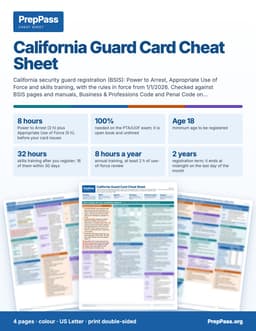
This guide is the teaching, read over weeks. If your exam is inside two weeks, the printable colour cheat sheet is the other product: the figures the exam turns on, laid out by section.
See the California Guard Card cheat sheet PDF — $9.99 →
4 pages · US Letter · printable PDF · yours to keep
About the exam itself
| Administering body | Bureau of Security and Investigative Services (BSIS), California Department of Consumer Affairs — exam delivered by a BSIS-approved training school, or the employer where it has a Bureau-qualified instructor Source: 16 CCR § 628(b) — BSIS Regulations (BSIS-published compilation, PDF) |
|---|---|
| Questions | Not published by BSIS What we read and found nothing in: BSIS — Power to Arrest Answer Key (released to instructors on request) |
| Time limit | The examination is untimed: BSIS instructs administrators to allow unlimited time. What BSIS does schedule is the course — Power to Arrest 3 hours, Appropriate Use of Force 5 hours — which is course length, not exam length. What we read and found nothing in: BSIS — Power to Arrest and Appropriate Use of Force Training Manual (revised July 2023, PDF) |
| Passing score | 100% Source: 16 CCR § 628(b) — BSIS Regulations (BSIS-published compilation, PDF) |
| Fees |
Source: BSIS — Licensing Fees (fee schedule dated September 2025, PDF) |
| Languages offered | Not published by BSIS What we read and found nothing in: BSIS — Resources and Training Materials |
Questions buyers ask
- Is a study guide enough for the California Guard Card (BSIS Security Guard) exam, or do I need a course?
- A book is exam review: it does not replace any education, training or experience Bureau of Security and Investigative Services (BSIS), California Department of Consumer Affairs requires before you may sit the exam, so check those requirements first. For the exam content itself, this 89-page guide teaches the material chapter by chapter with 50 practice questions and explanations inside, and 200 more practice questions are free on PrepPass. A prep course adds live instruction and a set schedule; whether you need one beyond any required education is your call.
- What is the cheapest way to prepare for the California Guard Card (BSIS Security Guard) exam?
- Start with what costs nothing: 200 practice questions on PrepPass, with explanations and no signup. If you want it taught in one file you keep, the full study guide is $9.99 once; the printable cheat sheet for the last days is $9.99. No subscription on any of them.
- Who administers the California Power to Arrest and Appropriate Use of Force Examination (security guard registration)?
- Bureau of Security and Investigative Services (BSIS), California Department of Consumer Affairs — exam delivered by a BSIS-approved training school, or the employer where it has a Bureau-qualified instructor. There is no statewide test vendor. 16 CCR § 628(b) allows the training and the examination to be given by an approved training school or by the employer, provided the employer has a designated instructor knowledgeable in the Power to Arrest manual.
- How many questions are on the California Power to Arrest and Appropriate Use of Force Examination (security guard registration)?
- Not published by BSIS. BSIS releases the examination and its answer key only to licensed training facilities and instructors on request, and publishes no question count. The 42 numbered items inside the training manual are headed “Review Questions” and are not the final examination.
- How long is the California Power to Arrest and Appropriate Use of Force Examination (security guard registration)?
- The examination is untimed: BSIS instructs administrators to allow unlimited time. What BSIS does schedule is the course — Power to Arrest 3 hours, Appropriate Use of Force 5 hours — which is course length, not exam length.
- What is the passing score for the California Power to Arrest and Appropriate Use of Force Examination (security guard registration)?
- 100%. 16 CCR § 628(b): “An employee must receive a score of 100% on said examination.” The examination is open-book and may be retaken after review, so a first-attempt failure is not a barrier — but nothing below 100% completes the training.
- How much does the California Power to Arrest and Appropriate Use of Force Examination (security guard registration) cost?
- $60 — Security guard registration — initial application (BSIS, one-time, from 2025-10-01); $44 — Security guard registration — renewal (BSIS, every two years, from 2025-10-01). BSIS prints two columns, “Prior to 10/1/2025” and “On or After 10/1/2025”, and notes that the date an application is submitted decides which applies; the later column is the one in force. Unreconciled conflict between official sources: 16 CCR § 640(f) still states $50 and $35 — the regulation was never conformed to the fee change. There is no separate examination fee: the exam is given inside the training course, whose tuition is set by each training facility and is not published by BSIS.
- What languages is the California Power to Arrest and Appropriate Use of Force Examination (security guard registration) offered in?
- Not published by BSIS. BSIS publishes one Power to Arrest training manual, in English, with no translated editions and no list of examination languages. What it does publish is an accommodation instruction: administrators are to assist employees who cannot read or write, including by reading the examination aloud.
- Does the California Guard Card (BSIS Security Guard) study guide come as a PDF?
- Yes — California Guard Card — Complete Study Guide (2026) downloads as PDF and EPUB, 89 pages. The download link is emailed the moment payment clears and does not expire.
- How much does the California Guard Card (BSIS Security Guard) study guide cost?
- $9.99, once. There is no subscription and no account to create; the PDF and EPUB files are yours to keep.
- Are there free California Guard Card (BSIS Security Guard) practice questions?
- Yes — 200 of them, free to use with no signup and an explanation on every one. They are separate from this study guide, which is what you are buying here. The same free, no-account system also has practice modes (adaptive, new questions, spaced review of misses, weak-topic focus, saved, my mistakes); a timed mock exam (40 questions, 60 minutes) with a score report by topic; a 10-question readiness check (about 5 minutes); 7 study chapters. None of it needs this study guide.
- Can I read part of the California Guard Card (BSIS Security Guard) study guide before buying?
- Yes. A full chapter is free to read on this page — not a summary of one, the chapter itself.
- What is the difference between the California Guard Card (BSIS Security Guard) study guide and the cheat sheet?
- The study guide ($9.99) teaches the material chapter by chapter and is meant to be read over weeks. The cheat sheet ($9.99, 4 pages) drops the teaching and keeps the figures: every number on the exam grouped by value so the confusable ones sit together, each reference page paired with a recall page that blanks the answers, and four routes by days left — 14, 7, 3, or tonight. They are separate purchases; neither replaces the other.
- Is this the official California Guard Card (BSIS Security Guard) study guide?
- No. This is an independent study guide and is not affiliated with or endorsed by the exam's awarding body. It is written from CA BSIS / B&P §7580+ / Penal Code / 16 CCR. Always confirm current requirements with the body that issues your licence.
Free California Guard Card (BSIS Security Guard) practice questions and study chapters →
What's included — and what isn't
Included
- Every chapter ends the same way: key numbers & deadlines, the exam traps named one by one, and the takeaways — so the night before is a re-read, not a re-study
- A worked California example in each chapter: the rule applied to a real guard scenario
- Powers to arrest vs peace-officer arrest; citizen's arrest (PC §837)
- Appropriate use of force (PC §835a) and the observe-and-report rule
- Liability, detention limits, and merchant's privilege (PC §490.5(f))
- Observation, documentation, and courtroom-ready report writing
- 50 original practice questions with answer explanations
- PDF (print & tab it) + EPUB (phone / e-reader)
Not included
- No printed copy is shipped — this is a file you download and can print yourself
- No video course, instructor or tutoring comes with the book — the free videos on the site are separate
- Not your exam registration or the testing centre's fee, which you still pay to the official body
Contents
See 11 sections and the page each one starts on
- Part I — The Study Guidep. 8
- Chapter 1 — Powers to Arrestp. 9
- Chapter 2 — Appropriate Use of Forcep. 22
- Chapter 3 — Liability & Legal Aspectsp. 31
- Chapter 4 — Observation, Documentation & Report Writingp. 39
- Chapter 5 — Communication, Public Relations & Ethicsp. 46
- Chapter 6 — Emergency Procedures & Officer Safetyp. 53
- Chapter 7 — Terrorism Awareness & Weapons of Mass Destructionp. 59
- Part II — Practice Examp. 66
- Part III — Answer Key & Explanationsp. 79
- Appendix — Quick statute & standard referencep. 88
Taken from the PDF you download, with the page each one starts on — not typed here.
Read a chapter free, in full
One complete chapter, exactly as it ships in the eBook. Scroll the window to read it right here; no download, no email.
Read chapter 4 here, without leaving the page
We didn't give you the easy intro — the free chapter opens on one of the hardest-working parts of the book, so you can judge the teaching where the exam gets difficult.
Introduction
A security guard's real product is information — accurate observation, clearly documented, delivered to the people who need it. The camera does not testify; you do. A theft, an assault, a slip-and-fall, a use of force: months later, the only reliable record of what happened is the report you wrote and the notes behind it. A vague, editorial, or contradictory report loses cases; a specific, factual, chronological one wins them. This chapter teaches you to see deliberately, note contemporaneously, and write in a way that would satisfy a judge reading it five years from now.
It covers patrol technique and situational awareness, the discipline of note-taking and the 5W + H report structure, systematic suspect and vehicle descriptions, and the legal limits on photography and audio recording in a two-party-consent state.
Learning objectives
After working through this chapter you should be able to:
- Patrol with varied patterns and situational awareness (Cooper's color codes; the OODA loop), using all your senses.
- Take contemporaneous notes and write a report answering Who, What, When, Where, Why, How with facts, not conclusions.
- Give a systematic head-to-toe suspect description and a CYMBALS vehicle description.
- Apply the two-party consent rule for audio (Penal Code §632) and the privacy limits on recording (Penal Code §647(j)), and treat images as evidence.
- Explain how contemporaneous notes refresh recollection for later testimony (Evidence Code §771).
Part A — Patrol patterns and situational awareness
Good patrols are neither random wandering nor predictable loops. A predictable patrol teaches a hostile actor exactly when you will be at the back dock; a varied patrol — changing direction, timing, and route, with deliberate pauses to listen — denies them that. Practical habits: walk against vehicle traffic so you can see drivers; use your nose (smoke, fuel, marijuana often register before anything is visible) and your ears (breaking glass, raised voices, alarms) as much as your eyes.
Two mental models anchor awareness:
- Cooper's color codes. White = oblivious (never acceptable on duty); Yellow = relaxed alert (your normal on-duty baseline); Orange = a specific possible threat identified, plan forming; Red = acting on the threat. Live in Yellow.
- The OODA loop. Observe, Orient, Decide, Act — cycle continuously so you keep updating on fresh information instead of locking onto your first guess.
Your post orders define the patrol path; your awareness determines whether the patrol accomplishes anything.
Part B — Notes and reports: the 5W + H, written contemporaneously
Every incident report answers six questions:
- Who — everyone involved, with full names where available, detailed descriptions where not, witness contact information, and your own name and post.
- What — what happened, in plain chronological order, with concrete facts ("the man swung his right fist at the cashier"), not conclusions ("he became aggressive").
- When — specific times from your watch or radio log, for each step.
- Where — the exact location on the property, detailed enough that a stranger could find it.
- Why — the hardest box: stick to facts and reported statements; do not guess at motive unless the subject told you.
- How — how the events unfolded and how they were resolved.
Take notes during the incident if it is safe, or immediately after while it is fresh. The bridge from raw notes to clean report to courtroom testimony months later is California Evidence Code §771, which allows a witness to refresh recollection from a writing made when the events were fresh. Two rules make a report defensible: write facts over conclusions ("the subject said he had three beers," not "the subject was drunk"), and apply the stranger test — could someone who was not there reconstruct what happened from your report alone? If not, rewrite it.
Part C — Suspect and vehicle descriptions that hold up
Build a suspect description head to toe so a responding officer can broadcast it without gaps: gender and approximate age; race/ethnicity if discernible; height and build; hair (color, length, style); eyes; facial hair, glasses, scars, tattoos; hat; shirt and outerwear with colors; pants; shoes; anything in the hands; and direction of travel. Practice the sequence out loud on slow shifts — the time to learn the script is not while someone is running away.
For vehicles, a common California mnemonic is CYMBALS: Color, Year, Make, Body style, All other (damage, decals, distinguishing marks), License, State. The license plate beats every other identifier — get it first if you can; if you cannot, get a partial plate and the state. For weapons, describe what you actually saw ("a black semi-automatic pistol with a stainless slide"), rather than guessing make and model. Use compass directions for travel, not "that way."
Part D — Photography, recording, and privacy
Phones make documentation easy and legally complicated at once.
- Video without sound, in a public space or your employer's premises where there is no reasonable expectation of privacy, is generally allowed.
- Audio is the harder line. California is a two-party (all-party) consent state under Penal Code §632: it is a crime to record a confidential communication without the consent of all parties. Body cameras that capture audio in private areas implicate §632 — know whether your company policy or a posted written notice supplies the needed consent.
- Privacy crimes. Penal Code §647(j) makes it a crime to photograph or record a person in a place where they have a reasonable expectation of privacy — restrooms, dressing rooms, hotel rooms — even with no audio.
- Treat images as evidence. Do not edit them, do not post them to social media, and turn them over to your supervisor with a clear chain of custody.
Write and photograph as if a judge will read and view it tomorrow — because one might.
California worked example
At 9:42 p.m. a guard hears glass break near the loading dock, moves to Yellow-to-Orange, and sees a man throw a laptop bag over a fence and run west toward Elm Street in a gray hooded sweatshirt.
The report writes itself if the observation was disciplined. When: 9:42 p.m. (from the radio log). Where: northeast loading dock, exterior. Who/What (facts): "I heard glass breaking; I observed a male adult, approximately 20–30, ~5'10", medium build, gray hooded sweatshirt, dark pants, throw a dark laptop bag over the north fence and run west on Elm Street." Suspect description head-to-toe, finishing with direction of travel (west). Vehicle, if one was used, in CYMBALS order with the plate captured first. The guard does not write "the burglar" (a conclusion) but "a male adult who threw a bag and fled." If the guard used a phone to photograph the broken window, those images are evidence — unedited, handed to the supervisor, not posted anywhere. Notes taken now let the guard refresh recollection (Evidence Code §771) if called to testify next year.
Key numbers & deadlines
Awareness models: Cooper's color codes (White / Yellow / Orange / Red — operate in Yellow); OODA loop (Observe, Orient, Decide, Act). Vary patrol patterns; use all senses. Report structure: 5W + H (Who, What, When, Where, Why, How); chronological, specific times/names/locations, facts over conclusions. Descriptions: suspect head-to-toe, ending with direction of travel; vehicle CYMBALS (Color, Year, Make, Body, All-other, License, State). Plate beats all other IDs. Recording law: audio = two-party consent, Penal Code §632 (crime to record a confidential communication without all-party consent). Penal Code §647(j) — criminal invasion of privacy (restrooms, dressing rooms, etc.). Treat images as evidence (no edits, chain of custody). Testimony: contemporaneous notes refresh recollection — Evidence Code §771.
Named exam traps
- "A good patrol follows the same reliable route every time." No — predictable patrols are exploitable. Vary route and timing.
- "Write your conclusion so it's clear ('he was drunk / he was the thief')." No — write facts ("said he had three beers"; "threw a bag and fled"). Conclusions belong to others.
- "Guess the make and model of the gun so the report looks complete." No — describe what you saw. Guessing invents evidence.
- "You can record any conversation on duty." No — audio needs all-party consent (§632); recording a confidential conversation without it is a crime.
- "A photo is just a photo — edit or share it freely." No — images are evidence; no edits, no social media, keep a chain of custody. Recording in restrooms/dressing rooms violates §647(j).
- "Notes don't matter once you file the report." No — contemporaneous notes are what let you refresh recollection (Evidence Code §771) in court months later.
Key takeaways
- Patrol with varied patterns and stay in Cooper's Yellow; run the OODA loop and use every sense.
- Write 5W + H, chronological, specific, and factual — pass the stranger test.
- Describe suspects head-to-toe (end with direction of travel) and vehicles by CYMBALS, capturing the plate first.
- Audio recording needs all-party consent (§632); respect privacy (§647(j)); treat images as evidence.
- Contemporaneous notes refresh recollection at trial (Evidence Code §771).
Sources
Cited to leginfo.legislature.ca.gov (Penal Code, Evidence Code). Awareness models (Cooper's color codes, OODA, CYMBALS) are standard security-training frameworks, not statutes.
- Cal. Penal Code §632 — recording of confidential communications (two-party consent).
- Cal. Penal Code §647(j) — invasion of privacy by recording/photography.
- Cal. Evidence Code §771 — refreshing recollection from a writing.
- Security-training frameworks: Cooper's color codes; the OODA loop (J. Boyd); CYMBALS vehicle- description mnemonic; the 5W + H report standard.
Before you buy
- How do I get it?
- Pay, and the download appears on this page straight away. The links are also emailed to you. No account is required.
- What if it isn't for me?
- Email us within 14 days for a full refund, no questions asked.
- Is the free practice going away?
- No. Every practice question, the timed mock and the free chapters on this site stay free. This book is the studying half, not a gate around the free half.
- Can I read it on my phone?
- Yes — the EPUB is for phones and e-readers, the PDF is for printing and tabbing. You get both.
The details
Powers to arrest, appropriate use of force, liability, observation & report writing, and terrorism awareness — California statute, cited to BSIS + Penal Code.
- Format: PDF + EPUB download · 89 pages
- 50 practice questions in the book, with a full answer key
- 200 free practice questions for this exam on PrepPass, included at no cost
- $9.99 one-time — no subscription
- 14-day money-back guarantee · refund policy
- Cross-referenced against: CA BSIS / B&P §7580+ / Penal Code / 16 CCR
- Last updated: September 2026
- Verified from the official source(CA BSIS / B&P §7580+ / Penal Code / 16 CCR)
- 200 free practice questions
- Instant download, yours for life
A BSIS guard card training course runs $50–$150. This book teaches the same exam — same rules, verified to current standards — for a one-time $9.99 you keep for life.
Why buy the book when the practice is free?
Our practice questions and timed mock stay free — nothing on the site moves behind this book. The $9.99 book is the studying half: the material itself, taught in order, in a file you own.
- Systematic teaching — every exam section explained chapter by chapter, start to finish, not just questions
- Print it & tab it — a paper-ready PDF you can highlight, mark up, and bring to your study table
- Study anywhere, offline — EPUB on your phone or e-reader; no wifi, no browser tabs
- Everything in one place — the chapters and the practice questions in one file
- Yours for life — one-time $9.99, instant download, no subscription
And it's risk-free: 14-day money-back guarantee — not satisfied? Email us for a full refund, no questions asked. See the refund policy.
Also free on PrepPass for California Guard Card (BSIS Security Guard)
Beside this guide, PrepPass has a free study system for the same exam. It needs no account, and buying the guide does not unlock or change it: 200 practice questions with explanations; practice modes (adaptive, new questions, spaced review of misses, weak-topic focus, saved, my mistakes); a timed mock exam (40 questions, 60 minutes) with a score report by topic; a 10-question readiness check (about 5 minutes); 7 study chapters.
Progress is saved in your browser; a free account keeps it across devices. The readiness gauge reflects your own practice, not a prediction of the real exam result. How the practice works
14-day money-back guarantee · full refund, no questions asked.
One-time purchase, lifetime access to the download. The eBook is the full California Guard Card (BSIS Security Guard) study guide in PDF and EPUB. Educational summary, not professional or legal advice — always confirm the current rules with the official source. Last updated: September 2026.