Personal Lines Insurance Producer · 2026 Edition
Personal Lines Insurance Producer — Complete Study Guide (2026)
This independent PrepPass study guide gives you 70 pages of teaching plus 55 practice questions with a full answer key — PDF + EPUB, $19.99 one-time. Inside: a 55-question practice exam whose key explains every item — the reasoning, not just the letter; every figure your own state sets — 51 of them — flagged [state-set] in the text, so you know exactly what to confirm with your DOI.
- All 8 chapters of the national Personal Lines portion — homeowners, dwelling, personal auto, renters and condo, umbrella and NFIP flood — PDF + EPUB you keep
- A 55-question practice exam whose key explains every item — the reasoning, not just the letter
- Every figure your own state sets — 51 of them — flagged [state-set] in the text, so you know exactly what to confirm with your DOI
$19.99one-time · lifetime download · no subscription
PDF + EPUB · English · 70 pages · $19.99 one-time
This book is written in English.
Instant download after payment — no account needed, no subscription.
14-day money-back guarantee: not satisfied for any reason? Email support@preppass.org within 14 days of purchase for a full refund. It's a download, so there is nothing to ship back. Refund policy
To prepare for the Personal Lines Insurance Producer exam, cover every topic on the exam body's current content outline and practise with timed questions.
Try 10 questions first — free
Answer all 10, then see every answer explained — with the section of this guide that teaches it. About 5 minutes, no sign-up.
You do not need the book to practise: 324 practice questions for this exam are free on PrepPass.
Start 10 free questionsLook inside the book
Three real pages, rendered straight from the PDF you download — a reference page, a teaching page, and a worked question, always in that order. Nothing here was redrawn to look better.
- Quick referenceChapter 2 — Insurance Regulation, Licensing & Producer Ethics · PDF page 19
A page you can turn back to: the numbers, deadlines or terms gathered in one place.
- How it's taughtPractice Exam — 55 Questions · PDF page 63
An explanation page: the material taught in prose, in the order the exam tests it.
- A question, workedChapter 1 — General Insurance Principles · PDF page 13
A practice question with its answer and the reasoning behind it — not just a key.
Studying for both? There's a pair price
- Personal Lines Insurance Producer — Complete Study Guide (2026)$19.99
- California Personal Lines Insurance Producer — Cheat Sheet (2026)$9.99
Buy both: $22.99 — save $6.99 vs buying separately
Separately $29.98 · 23% off · One checkout, both items.
Already bought California Personal Lines Insurance Producer? Don't buy the bundle — it includes that book and you'd pay for it twice. Get Personal Lines Insurance Producer on its own for $19.99. Personal Lines Insurance Producer · What's in the bundle →
Exam inside two weeks?
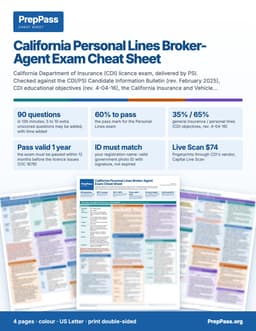
This guide is the teaching, read over weeks. If your exam is inside two weeks, the printable colour cheat sheet is the other product: the figures the exam turns on, laid out by section.
See the California Personal Lines Insurance Producer cheat sheet PDF — $9.99 →
4 pages · US Letter · printable PDF · yours to keep
About the exam itself
| Administering body | No single body: each state's insurance department licenses personal lines producers and sets its own exam, usually delivered by a testing vendor. California's is delivered by PSI Services LLC; Texas's by Pearson VUE. See the facts page for your state where PrepPass has one. What we read and found nothing in: PSI / California Department of Insurance — Candidate Information Bulletin for California Insurance License Examinees (revised March 2026) |
|---|---|
| Questions | Set by each state. California's exam is 90 questions. See the facts page for your state where PrepPass has one. What we read and found nothing in: PSI / California Department of Insurance — Candidate Information Bulletin for California Insurance License Examinees (revised March 2026) |
| Time limit | Set by each state. California allows 135 minutes; Texas's Personal Lines Property & Casualty exam allows 120 minutes. See the facts page for your state where PrepPass has one. What we read and found nothing in: PSI / California Department of Insurance — Candidate Information Bulletin for California Insurance License Examinees (revised March 2026) |
| Passing score | Set by each state. California publishes 60%; Pearson VUE's Texas handbook publishes a scaled score of 70 on a 0–100 scale, which it says is not the percentage of questions answered correctly. See the facts page for your state where PrepPass has one. What we read and found nothing in: CDI — Examination Times and Number of Questions (CDI website table; stale on languages and, for time limits, disagrees with the CIB) |
| Fees | Set by each state. Pearson VUE's Texas handbook lists $39 per attempt for the Personal Lines Property & Casualty exam. See the facts page for your state where PrepPass has one. What we read and found nothing in: Pearson VUE — Texas Insurance Licensing Candidate Handbook, October 2024 (#124400) |
| Languages offered | Set by each state; Pearson VUE's Texas handbook lists English and Spanish forms. See the facts page for your state where PrepPass has one. What we read and found nothing in: Pearson VUE — Texas Insurance Licensing Candidate Handbook, October 2024 (#124400) |
Questions buyers ask
- Is a study guide enough for the Personal Lines Insurance Producer exam, or do I need a course?
- A book is exam review: it does not replace any education, training or experience your licensing body requires before you may sit the exam, so check those requirements first. For the exam content itself, this 70-page guide teaches the material chapter by chapter with 55 practice questions and explanations inside, and 324 more practice questions are free on PrepPass. A prep course adds live instruction and a set schedule; whether you need one beyond any required education is your call.
- What is the cheapest way to prepare for the Personal Lines Insurance Producer exam?
- Start with what costs nothing: 324 practice questions on PrepPass, with explanations and no signup. If you want it taught in one file you keep, the full study guide is $19.99 once; the printable cheat sheet for the last days is $9.99. No subscription on any of them.
- Who administers the State Personal Lines Insurance Producer Licensing Exams?
- No single body: each state's insurance department licenses personal lines producers and sets its own exam, usually delivered by a testing vendor. California's is delivered by PSI Services LLC; Texas's by Pearson VUE. See the facts page for your state where PrepPass has one.
- How many questions are on the State Personal Lines Insurance Producer Licensing Exams?
- Set by each state. California's exam is 90 questions. See the facts page for your state where PrepPass has one.
- How long is the State Personal Lines Insurance Producer Licensing Exams?
- Set by each state. California allows 135 minutes; Texas's Personal Lines Property & Casualty exam allows 120 minutes. See the facts page for your state where PrepPass has one.
- What is the passing score for the State Personal Lines Insurance Producer Licensing Exams?
- Set by each state. California publishes 60%; Pearson VUE's Texas handbook publishes a scaled score of 70 on a 0–100 scale, which it says is not the percentage of questions answered correctly. See the facts page for your state where PrepPass has one.
- How much does the State Personal Lines Insurance Producer Licensing Exams cost?
- Set by each state. Pearson VUE's Texas handbook lists $39 per attempt for the Personal Lines Property & Casualty exam. See the facts page for your state where PrepPass has one.
- What languages is the State Personal Lines Insurance Producer Licensing Exams offered in?
- Set by each state; Pearson VUE's Texas handbook lists English and Spanish forms. See the facts page for your state where PrepPass has one.
- Does the Personal Lines Insurance Producer study guide come as a PDF?
- Yes — Personal Lines Insurance Producer — Complete Study Guide (2026) downloads as PDF and EPUB, 70 pages. The download link is emailed the moment payment clears and does not expire.
- How much does the Personal Lines Insurance Producer study guide cost?
- $19.99, once. There is no subscription and no account to create; the PDF and EPUB files are yours to keep.
- Are there free Personal Lines Insurance Producer practice questions?
- Yes — 324 of them, free to use with no signup and an explanation on every one. They are separate from this study guide, which is what you are buying here. The same free, no-account system also has practice modes (adaptive, new questions, spaced review of misses, weak-topic focus, saved, my mistakes); a timed mock exam (100 questions, 150 minutes) with a score report by topic; a 10-question readiness check (about 5 minutes); 8 study chapters. None of it needs this study guide.
- Can I read part of the Personal Lines Insurance Producer study guide before buying?
- Yes. A full chapter is free to read on this page — not a summary of one, the chapter itself.
- What is the difference between the Personal Lines Insurance Producer study guide and the cheat sheet?
- The study guide ($19.99) teaches the material chapter by chapter and is meant to be read over weeks. The cheat sheet ($9.99, 4 pages) drops the teaching and keeps the figures: every number on the exam grouped by value so the confusable ones sit together, each reference page paired with a recall page that blanks the answers, and four routes by days left — 14, 7, 3, or tonight. They are separate purchases; neither replaces the other.
- Is there a cheaper way to buy the Personal Lines Insurance Producer study guide with anything else?
- Yes. Personal Lines Insurance Producer + Cheat Sheet is $22.99 for 2 files in one checkout — 23% less than the $29.98 those items cost bought separately today. It adds California Personal Lines Insurance Producer — Cheat Sheet (2026). The saving is measured against the items' real current prices; there is no struck-through "original" price on this site.
- Is this the official Personal Lines Insurance Producer study guide?
- No. This is an independent study guide and is not affiliated with or endorsed by the exam's awarding body. It is written from ISO personal-lines forms / NFIP / NAIC model acts. Always confirm current requirements with the body that issues your licence.
Free Personal Lines Insurance Producer practice questions and study chapters →
What's included — and what isn't
Included
- Homeowners: HO-2/3/4/5/6/8, Coverage A–F, and special limits
- Dwelling (DP-1/2/3) and the 'no liability in the base DP' trap
- Personal auto (PAP) Parts A–F, UM/UIM, and newly-acquired-auto rules
- Property fundamentals: coinsurance, ACV vs RC, NFIP flood
- 55 original practice questions with answer explanations
- PDF (print & tab it) + EPUB (phone / e-reader)
Not included
- No printed copy is shipped — this is a file you download and can print yourself
- No video course, instructor or tutoring comes with the book — the free videos on the site are separate
- Not your exam registration or the testing centre's fee, which you still pay to the official body
Contents
See 12 sections and the page each one starts on
- Chapter 1 — General Insurance Principlesp. 7
- Chapter 2 — Insurance Regulation, Licensing & Producer Ethicsp. 14
- Chapter 3 — Property Insurance Fundamentalsp. 20
- Chapter 4 — The Dwelling Policy (DP)p. 27
- Chapter 5 — Homeowners Insurance (HO Forms)p. 33
- Section I — The Property Coveragesp. 34
- Section II — Liability and Medical Paymentsp. 35
- Section I Exclusions (Homeowners)p. 36
- Chapter 6 — Personal Auto Insurance (PAP)p. 39
- Chapter 7 — State Overlays, Residual Markets & Catastrophe Perilsp. 46
- Chapter 8 — Endorsements, Personal Liability & Umbrellap. 52
- Practice Exam — 55 Questionsp. 58
Taken from the PDF you download, with the page each one starts on — not typed here.
Read a chapter free, in full
One complete chapter, exactly as it ships in the eBook. Scroll the window to read it right here; no download, no email.
Read chapter 1 here, without leaving the page
Before you ever quote a homeowners or personal auto policy, you need a vocabulary. This chapter covers the bedrock ideas every personal lines producer must master: which risks are insurable, how hazards differ from perils, the legal nature of an insurance contract, the duty of utmost good faith, and the doctrines — insurable interest, indemnity, subrogation, contribution — that keep insurance from turning into a wager. These concepts are truly national: they come from insurance law and industry practice, not from any one state's code, so nothing in this chapter is state-set. Expect roughly seven percent of the exam here, and expect it to test definitions and applications, not memorized statute language.
Risk, and What Makes a Risk Insurable
Risk is simply uncertainty about a future outcome. Insurance addresses only pure risk — a situation that can end in a loss or in no loss, but never in a gain. A house burning, a car being rear-ended, jewelry being stolen: each is a pure risk. Speculative risk carries three possibilities — loss, no change, or gain — like buying a stock or betting on a game. Speculative risk is not insurable, because insuring a chance to profit would create a wagering contract, which the law will not enforce.
To be insurable, a pure risk should also meet several practical conditions. A common memory aid is that an insurable loss should be definite (measurable in time, place, and amount), accidental (fortuitous, outside the insured's control — not intentional), part of a large group of similar exposure units (so the insurer can predict aggregate losses by the law of large numbers), not catastrophic to the insurer (one event should not bankrupt the pool the way an uninsured war or a single mega-hurricane could), calculable (frequency and severity can be estimated well enough to price), and economically feasible (the premium is small relative to the potential loss). This is why insurers reinsure or exclude flood, quake, and war — those perils threaten too many insureds at once.
Peril vs. Hazard
A peril is the actual cause of a loss — fire, theft, windstorm, a falling tree. A hazard is a condition that increases the chance a peril will occur or makes a resulting loss worse. The exam tests three kinds of hazard, and confusing them is a classic wrong answer.
- A physical hazard is a tangible condition: worn knob-and-tube wiring, an unfenced pool, a roof at the end of its life.
- A moral hazard is a dishonest tendency in the insured — a history of suspicious claims, or a desire to over-insure in order to profit from a loss. Moral hazards involve intent to cause or exaggerate loss.
- A morale hazard (sometimes "attitudinal hazard") is carelessness or indifference that arises because the person has insurance — leaving the front door unlocked because "the policy will pay." No dishonesty, just apathy.
Underwriters price physical hazards, decline or surcharge moral hazards, and try to educate against morale hazards.
The Insurance Contract and Its Special Nature
An insurance policy is a contract, so it needs the four elements of any contract: agreement (offer and acceptance), consideration (the premium in exchange for the insurer's promise to pay), legal capacity of both parties, and a legal purpose. Beyond those basics, insurance contracts carry four special characteristics that appear on nearly every exam:
- Aleatory — the dollars exchanged are unequal and depend on chance. An insured might pay one premium and collect a $400,000 loss, or pay for thirty years and never file a claim.
- Conditional — the insurer pays only if conditions are met: premium paid, prompt notice of loss, cooperation, proof of loss.
- Unilateral — only one party (the insurer) makes a legally enforceable promise. The insured can simply stop paying without being sued for breach; the insurer, once premium is paid, is bound.
- Adhesion — the insurer drafts the contract and offers it on a take-it-or-leave-it basis. Because the insured cannot negotiate the wording, courts construe any genuine ambiguity against the insurer (the drafter). This rule of construction is heavily tested.
A related idea: insurance contracts are contracts of utmost good faith (see below), and they rely on representations and warranties. A representation is a statement believed true when made; a warranty is a promise guaranteed to be true. In modern personal lines, most applicant statements are treated as representations.
The Anatomy of a Policy — and the Binder
Every personal-lines policy is assembled from the same four building blocks, remembered by the acronym DICE:
- Declarations — the who/what/where/how much page: named insured, address, policy period, limits, deductibles, premium.
- Insuring agreement — the insurer's core promise: what perils or claims it will pay for.
- Conditions — the rules both parties must follow for the promise to operate: duties after loss, appraisal, subrogation, cancellation.
- Exclusions — what the policy will not pay for, no matter how the loss occurred.
Endorsements are attached forms that modify the base contract — adding, removing, or reshaping coverage — and an endorsement controls over the base form wherever they conflict.
Before the policy itself is issued, an agent with binding authority may issue a binder: temporary evidence that coverage is in force, effective immediately, oral or written. A binder is not the policy and does not guarantee one will be issued; it simply holds coverage in place until the insurer issues the policy or declines the risk, at which point the binder ends. Exam questions like to test that a binder is temporary and that it is real coverage while it lasts.
Utmost Good Faith, Representations, and Concealment
An insurance contract is one of utmost good faith (Latin: uberrimae fidei). Both sides must deal honestly, and the applicant in particular must disclose information the insurer cannot easily verify. Three terms recur:
- A representation is a statement of fact made by the applicant before the policy takes effect. A misrepresentation is a false one. If it is material, the insurer may rescind (void) the policy.
- Concealment is silence — the failure to disclose a fact the applicant knows and ought to communicate. A material concealment also gives the insurer grounds to rescind.
- Materiality is the test that governs both: a fact is material if it would influence a prudent insurer's decision to accept the risk or set the premium. For property-casualty policies, materiality generally does not require proof of intent — even an innocent material misstatement can support rescission (whereas fraud requires intent).
Two doctrines cut the other way — they stop the insurer from going back on its own conduct. Waiver is the intentional relinquishment of a known right: an insurer that issues a policy knowing of a breach may be held to have waived the right to rely on it. Estoppel bars the insurer from asserting a defense after its words or conduct led the insured to reasonably rely to their detriment — an adjuster who tells the insured "you're covered, go ahead and repair" may estop the company from later denying on a technicality. Good faith runs in both directions.
(The specific statutory citations and the exact standard for rescission are [state-set]; the concepts are national.)
Insurable Interest — When It Must Exist
Insurable interest is the legal or financial stake an insured must have in the covered property or life. Without it, the contract is a wager and unenforceable. The rule that matters most in property insurance:
In property insurance, insurable interest must exist at the time of loss (it need not exist when the policy is bought). In life insurance, insurable interest must exist at policy inception (it need not exist at the time of the insured's death).
Sources of insurable interest in personal lines include direct ownership of a home or car, a mortgagee's lien on a dwelling, a lessee's interest in property, and a bailee's interest in property held for another. Classic trap: a homeowner sells the house, and the buyer's payment clears before a fire; the seller has no insurable interest at the moment of loss and cannot collect — even though premium was paid through the policy period.
Indemnity, Subrogation, and Contribution
Indemnity is the principle that insurance should restore the insured to the same financial position as before the loss — no better, no worse. It is what keeps property insurance from becoming a profit center. Most personal lines property policies are contracts of indemnity, paying actual cash value or replacement cost up to the limit and never more than the actual loss. (Valued policies and some replacement-cost settlements are limited exceptions.)
Subrogation is indemnity's enforcement arm. Once the insurer pays the insured for a covered loss, it steps into the insured's shoes and may pursue any responsible third party to recover what it paid. If a neighbor's contractor negligently starts a fire that damages the insured's home, the insurer pays the homeowner, then sues the contractor. Two rules follow: the insured may not collect twice (once from the insurer, once from the wrongdoer) because that would violate indemnity, and the insured may not sign away the insurer's subrogation rights after a loss.
Contribution (and the Other Insurance clause) governs when more than one policy covers the same loss. The most common personal-lines method is pro rata: each insurer pays the share of the loss that its limit bears to the total of all applicable limits. If two policies cover the same dwelling for $400,000 and $200,000 and the loss is $300,000, the first pays two-thirds ($200,000) and the second one-third ($100,000). Contribution prevents the insured from profiting by stacking overlapping policies.
How Insurers Are Classified
Insurers are grouped by ownership and by regulatory status:
- A stock insurer is owned by shareholders; profits go to shareholders as dividends, and policyholders are simply customers.
- A mutual insurer is owned by its policyholders; surplus may be returned to insureds as policyholder dividends, which are not guaranteed.
- A reciprocal exchange is an unincorporated group whose subscribers insure each other through an attorney-in-fact.
- An admitted (authorized) insurer holds a certificate of authority from the state, is regulated for rates and forms, and participates in the state guaranty association that pays covered claims if the insurer becomes insolvent.
- A non-admitted (surplus lines) insurer is not licensed in the state; its policies are placed through a surplus lines broker only for risks the admitted market will not write, and its insureds generally get no guaranty-association protection.
(Guaranty-association names, coverage caps, and surplus-lines rules are [state-set]; the categories are national.)
Key Numbers & Facts — Chapter 1 - Insurance covers pure risk only (loss or no loss), never speculative risk (loss/no change/gain). - Peril = cause of loss; hazard = something that raises the chance/severity. Physical / moral (dishonesty) / morale (carelessness). - Four special contract traits: aleatory, conditional, unilateral, adhesion. Ambiguity is read against the insurer. - Policy anatomy = DICE: Declarations, Insuring agreement, Conditions, Exclusions (+ endorsements modify). A binder = temporary, immediate evidence of coverage until the policy issues or is declined. - Utmost good faith; a material misrepresentation or concealment can let the insurer rescind. Property-casualty materiality generally needs no proof of intent. - Waiver = insurer intentionally gives up a known right; estoppel = insurer barred from a defense after the insured relied on its conduct. - Insurable interest: property = at time of loss; life = at inception. - Indemnity = made whole, no more. Subrogation = insurer pursues the at-fault third party. Contribution/pro rata = insurers share by limits. - Stock (shareholders) vs. mutual (policyholders); admitted (guaranty-fund protected) vs. non-admitted/surplus (not).
Worked Example. A homeowner tells her agent she has "never had a claim," when in fact she had two water-damage claims two years ago that she genuinely forgot. A pipe bursts; the insurer's investigation surfaces the prior claims. Can the insurer rescind? Likely yes: prior claims are material (they influence acceptance and pricing), and for a property policy the misrepresentation need not be intentional to be grounds for rescission. Her honest forgetfulness does not save the policy. The lesson for a producer: help clients answer application questions completely, because an innocent material error can void coverage after a loss.
Exam Traps.
- Moral vs. morale. Moral = dishonesty (padding a claim). Morale = carelessness born of having insurance (leaving keys in the car). Test-writers swap these constantly.
- Peril vs. hazard. Fire is a peril; the frayed wiring that started it is a hazard.
- Insurable-interest timing. Property = time of loss; life = inception. A choice that says "property insurance requires insurable interest when the policy is issued" is wrong.
- Unilateral. Only the insurer makes an enforceable promise. Do not pick "bilateral."
- Ambiguity is construed against the drafter (insurer) — a consequence of adhesion, not of good faith.
- A binder is coverage, but temporary. "No coverage exists until the policy is delivered" is wrong when a binder was issued; "a binder guarantees the policy will be issued" is wrong too.
Before you buy
- How do I get it?
- Pay, and the download appears on this page straight away. The links are also emailed to you. No account is required.
- What if it isn't for me?
- Email us within 14 days for a full refund, no questions asked.
- Is the free practice going away?
- No. Every practice question, the timed mock and the free chapters on this site stay free. This book is the studying half, not a gate around the free half.
- Can I read it on my phone?
- Yes — the EPUB is for phones and e-readers, the PDF is for printing and tabbing. You get both.
The details
The personal subset of P&C — homeowners, dwelling, personal auto, renters/condo, and umbrella — with HO forms, PAP parts, and coinsurance worked examples.
- Format: PDF + EPUB download · 70 pages
- 55 practice questions in the book, with a full answer key
- 324 free practice questions for this exam on PrepPass, included at no cost
- $19.99 one-time — no subscription
- 14-day money-back guarantee · refund policy
- Cross-referenced against: ISO personal-lines forms / NFIP / NAIC model acts
- Last updated: September 2026
- Verified from the official source(ISO personal-lines forms / NFIP / NAIC model acts)
- 324 free practice questions
- Instant download, yours for life
An insurance pre-license course runs $100–$500. This book teaches the same exam — same rules, verified to current standards — for a one-time $19.99 you keep for life.
Why buy the book when the practice is free?
Our practice questions and timed mock stay free — nothing on the site moves behind this book. The $19.99 book is the studying half: the material itself, taught in order, in a file you own.
- Systematic teaching — every exam section explained chapter by chapter, start to finish, not just questions
- Print it & tab it — a paper-ready PDF you can highlight, mark up, and bring to your study table
- Study anywhere, offline — EPUB on your phone or e-reader; no wifi, no browser tabs
- Everything in one place — the chapters and the practice questions in one file
- Yours for life — one-time $19.99, instant download, no subscription
And it's risk-free: 14-day money-back guarantee — not satisfied? Email us for a full refund, no questions asked. See the refund policy.
Also free on PrepPass for Personal Lines Insurance Producer
Beside this guide, PrepPass has a free study system for the same exam. It needs no account, and buying the guide does not unlock or change it: 324 practice questions with explanations; practice modes (adaptive, new questions, spaced review of misses, weak-topic focus, saved, my mistakes); a timed mock exam (100 questions, 150 minutes) with a score report by topic; a 10-question readiness check (about 5 minutes); 8 study chapters.
Progress is saved in your browser; a free account keeps it across devices. The readiness gauge reflects your own practice, not a prediction of the real exam result. How the practice works
14-day money-back guarantee · full refund, no questions asked.
One-time purchase, lifetime access to the download. The eBook is the full Personal Lines Insurance Producer study guide in PDF and EPUB. Educational summary, not professional or legal advice — always confirm the current rules with the official source. Last updated: September 2026.