EPA Section 608 Certification · 2026 Edition
EPA 608 Universal Study Guide (2026) — Core + Type I/II/III, with the 2027 A2L update
Edition noteFrom January 1, 2027, certifiers accept only the revised 608 question bank (A2L/A3 refrigerants); this book covers it.
This independent PrepPass study guide gives you 165 pages of teaching plus 170 practice questions with a full answer key — PDF + EPUB, $14.99 one-time. Inside: 24 worked examples that walk the decision itself — which vacuum level this appliance needs, recover or reclaim, which Type it falls under; nine appendices, including a one-page sheet of every number this exam turns into a question and a list of the look-alike pairs it trips people on.
- All 7 chapters — Core, the regulations, the three Type sections, recovery, and the newer flammable refrigerants with the revised question bank — each closing with named exam traps and a self-check or drill, as one PDF + EPUB you keep
- 24 worked examples that walk the decision itself — which vacuum level this appliance needs, recover or reclaim, which Type it falls under
- Nine appendices, including a one-page sheet of every number this exam turns into a question and a list of the look-alike pairs it trips people on
$14.99one-time · lifetime download · no subscription
PDF + EPUB · English · 165 pages · $14.99 one-time
This book is written in English.
Instant download after payment — no account needed, no subscription.
14-day money-back guarantee: not satisfied for any reason? Email support@preppass.org within 14 days of purchase for a full refund. It's a download, so there is nothing to ship back. Refund policy
Please read before you buy: Independent study guide; not affiliated with or endorsed by EPA or any certifying organization.
Read the rest of this notice
Regulatory figures checked against the eCFR (current September 22, 2026).
Exam facts last checked against official sources: September 2026.
To prepare for the EPA Section 608 Certification exam, start with what the exam body publishes: Section 608 Technician Certification test topics from U.S. Environmental Protection Agency — EPA's description of the Core, Type 1, Type 2 and Type 3 tests, free (web page). That is enough if you only need to see what the exam covers; this book is for learning it and practising it. The exam itself (EPA Section 608 Technician Certification Test (40 CFR Part 82, Subpart F)): 50–100 questions, time limit not published by US EPA, passing score 70%. Choose this book if you want each section taught with its regulations cited and a Universal practice exam scored by section.
Try 10 questions first — free
Answer all 10, then see every answer explained — with the section of this guide that teaches it. About 5 minutes, no sign-up.
You do not need the book to practise: 240 practice questions for this exam are free on PrepPass.
Start 10 free questionsLook inside the book
Three real pages, rendered straight from the PDF you download — a reference page, a teaching page, and a worked question, always in that order. Nothing here was redrawn to look better.
- Quick referencePart I — Cylinder and DOT detail · PDF page 39
A page you can turn back to: the numbers, deadlines or terms gathered in one place.
- How it's taughtPart III — Answer Key & Explanations · PDF page 143
An explanation page: the material taught in prose, in the order the exam tests it.
- A question, workedPart II — Practice Questions · PDF page 98
A practice question with its answer and the reasoning behind it — not just a key.
Studying for both? There's a pair price
- EPA 608 Universal Study Guide (2026) — Core + Type I/II/III, with the 2027 A2L update$14.99
- EPA Section 608 Certification — Cheat Sheet (2026)$9.99
Buy both: $17.99 — save $6.99 vs buying separately
Separately $24.98 · 27% off · One checkout, both items.
Already bought EPA Section 608 Certification? Don't buy the bundle — it includes that book and you'd pay for it twice. Get EPA Section 608 Certification on its own for $14.99. EPA Section 608 Certification · What's in the bundle →
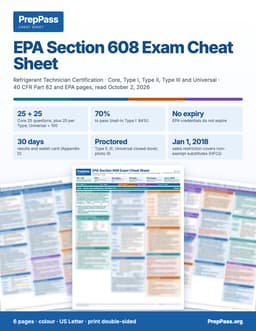
Exam inside two weeks?
This guide is the teaching, read over weeks. If your exam is inside two weeks, the printable colour cheat sheet is the other product: the figures the exam turns on, laid out by section.
See the EPA Section 608 Certification cheat sheet PDF — $9.99 →
6 pages · US Letter · printable PDF · yours to keep
About the exam itself
Questions buyers ask
- What has changed on the EPA Section 608 Certification exam?
- From January 1, 2027, certifiers accept only the revised 608 question bank (A2L/A3 refrigerants); this book covers it.
- Which EPA Section 608 Certification study guide should I use?
- It depends on what you already have. U.S. Environmental Protection Agency: Section 608 Technician Certification test topics, free (web page) — read it in any case to see what each test covers. ESCO Institute: EPA Section 608 Certification Exam Preparatory Manual, 9th Edition, $34.99 at HD Supply — choose ESCO's manual if you want a short printed booklet. This PrepPass guide: 165 pages, 170 practice questions with explanations, PDF + EPUB, $14.99 one-time — choose this book if you want each section taught with its regulations cited and a Universal practice exam scored by section. Prices were checked on 2026-09-24; confirm them with each seller.
- Is a study guide enough for the EPA Section 608 Certification exam, or do I need a course?
- A book is exam review: it does not replace any education, training or experience United States Environmental Protection Agency (EPA) — rule-setting only requires before you may sit the exam, so check those requirements first. For the exam content itself, this 165-page guide teaches the material chapter by chapter with 170 practice questions and explanations inside, and 240 more practice questions are free on PrepPass. A prep course adds live instruction and a set schedule; whether you need one beyond any required education is your call.
- What is the cheapest way to prepare for the EPA Section 608 Certification exam?
- Start with what costs nothing: Section 608 Technician Certification test topics from U.S. Environmental Protection Agency — free (web page) and 240 practice questions on PrepPass, with explanations and no signup. If you want it taught in one file you keep, the full study guide is $14.99 once; the printable cheat sheet for the last days is $9.99. No subscription on any of them.
- Who administers the EPA Section 608 Technician Certification Test (40 CFR Part 82, Subpart F)?
- United States Environmental Protection Agency (EPA) — rule-setting only — exam delivered by EPA-approved certifying organizations; there is no single national test vendor. EPA states that tests must be administered by an EPA-approved certifying organization, that EPA does not issue certification cards, and that it does not review or approve preparatory training. EPA also states that Section 608 technician credentials do not expire.
- How many questions are on the EPA Section 608 Technician Certification Test (40 CFR Part 82, Subpart F)?
- 50–100 questions. The count is fixed by Appendix D to Subpart F and does not vary by certifying organization — but it depends on which certification you sit. Each section is 25 questions. Type I, Type II and Type III are each the Core section plus one technical section; Universal is the Core section plus all three technical sections.
- How long is the EPA Section 608 Technician Certification Test (40 CFR Part 82, Subpart F)?
- Not published by US EPA. No time limit exists in § 82.161 or in Appendix D to Subpart F, and EPA publishes none. Any time allowance is set by the certifying organization giving the test.
- What is the passing score for the EPA Section 608 Technician Certification Test (40 CFR Part 82, Subpart F)?
- 70%. This is the one figure the regulation itself fixes, so it does not vary by certifying organization. It applies to the closed-book, proctored test for every type. A Type I certification taken in the mail-in, open-book format requires 84 percent instead.
- How much does the EPA Section 608 Technician Certification Test (40 CFR Part 82, Subpart F) cost?
- Not published by US EPA. EPA sets no fee and publishes none; the regulation allows certifying programmes to charge “reasonable fees”, and EPA's directory of approved programmes lists no prices. There is no EPA application fee and no renewal fee, because EPA states the credential does not expire.
- What languages is the EPA Section 608 Technician Certification Test (40 CFR Part 82, Subpart F) offered in?
- Not published by US EPA. Neither § 82.161 nor Appendix D mandates any language, and EPA publishes no list. Language depends on the approved certifying organization; EPA's directory annotates some individual programmes as offering Spanish.
- Does the EPA Section 608 Certification study guide come as a PDF?
- Yes — EPA 608 Universal Study Guide (2026) — Core + Type I/II/III, with the 2027 A2L update downloads as PDF and EPUB, 165 pages. The download link is emailed the moment payment clears and does not expire.
- How much does the EPA Section 608 Certification study guide cost?
- $14.99, once. There is no subscription and no account to create; the PDF and EPUB files are yours to keep.
- Are there free EPA Section 608 Certification practice questions?
- Yes — 240 of them, free to use with no signup and an explanation on every one. They are separate from this study guide, which is what you are buying here. The same free, no-account system also has practice modes (adaptive, new questions, spaced review of misses, weak-topic focus, saved, my mistakes); a timed mock exam (100 questions, 60 minutes) with a score report by topic; a 10-question readiness check (about 5 minutes); 6 study chapters. None of it needs this study guide.
- Can I read part of the EPA Section 608 Certification study guide before buying?
- Yes. A full chapter is free to read on this page — not a summary of one, the chapter itself.
- What is the difference between the EPA Section 608 Certification study guide and the cheat sheet?
- The study guide ($14.99) teaches the material chapter by chapter and is meant to be read over weeks. The cheat sheet ($9.99, 6 pages) drops the teaching and keeps the figures: every number on the exam grouped by value so the confusable ones sit together, each reference page paired with a recall page that blanks the answers, and four routes by days left — 14, 7, 3, or tonight. They are separate purchases; neither replaces the other.
- Is there a cheaper way to buy the EPA Section 608 Certification study guide with anything else?
- Yes. EPA Section 608 Certification + Cheat Sheet is $17.99 for 2 files in one checkout — 27% less than the $24.98 those items cost bought separately today. It adds EPA Section 608 Certification — Cheat Sheet (2026). The saving is measured against the items' real current prices; there is no struck-through "original" price on this site.
- Is this the official EPA Section 608 Certification study guide?
- No. This is an independent study guide and is not affiliated with or endorsed by the exam's awarding body. It is written from EPA Clean Air Act §608 / 40 CFR Part 82 Subpart F. Always confirm current requirements with the body that issues your licence.
Free EPA Section 608 Certification practice questions and study chapters →
How this book compares
EPA lists what each Section 608 test covers for free. This book teaches Core and Types I, II and III with a Universal practice exam; ESCO Institute sells a short preparatory manual.
| Resource | Price | What you get | Choose it if |
|---|---|---|---|
| This bookEPA 608 Universal Study Guide (2026) — Core + Type I/II/III, with the 2027 A2L updatePrepPass | $14.99 | Downloadable Universal study guide for Section 608
| Choose this book if you want each section taught with its regulations cited and a Universal practice exam scored by section. |
| From the exam bodySection 608 Technician Certification test topics (opens the publisher's page in a new tab)U.S. Environmental Protection Agency | Free (web page) | EPA's description of the Core, Type 1, Type 2 and Type 3 tests | Read it in any case to see what each test covers. |
| AlternativeEPA Section 608 Certification Exam Preparatory Manual, 9th Edition (opens the publisher's page in a new tab)ESCO Institute | $34.99 at HD Supply | Printed preparatory manual (retailer listing)
| Choose ESCO's manual if you want a short printed booklet. |
This book
EPA 608 Universal Study Guide (2026) — Core + Type I/II/III, with the 2027 A2L update
PrepPass
- Price
- $14.99
- What you get
Downloadable Universal study guide for Section 608
- 170 practice questions with explanations
- 165 pages, PDF + EPUB
- Choose it if
- Choose this book if you want each section taught with its regulations cited and a Universal practice exam scored by section.
From the exam body
Section 608 Technician Certification test topics (opens the publisher's page in a new tab)
U.S. Environmental Protection Agency
- Price
- Free (web page)
- What you get
EPA's description of the Core, Type 1, Type 2 and Type 3 tests
- Choose it if
- Read it in any case to see what each test covers.
Alternative
ESCO Institute
- Price
- $34.99 at HD Supply
- What you get
Printed preparatory manual (retailer listing)
- 28 pages
- Choose it if
- Choose ESCO's manual if you want a short printed booklet.
Other resources' prices and contents are as listed on each publisher's or seller's own page, checked September 24, 2026. Prices change; confirm on the linked page before you buy. This book's price and contents come from our own catalog.
Sources (2)
- https://www.epa.gov/section608/test-topics — read September 24, 2026
- https://hdsupplysolutions.com/p/esco-institute-epa-section-608-cert-exam-prep-p117508 — read September 24, 2026
What's included — and what isn't
Included
- 7 chapters: Core, Regulations, Type I, Type II, Type III, Recovery, and A2L/A3 refrigerants with the 2027 question bank
- A 100-question Universal practice exam — 25 per section, scored per section
- 60 section practice questions plus a 10-question A2L drill
- Explanations with 40 CFR citations, and §82.156 Table 1 as it reads today (pressure classes by psia at 104°F)
- Appendix B "The numbers" cram page, plus nine appendices in all
- PDF (print & tab it) + EPUB (phone / e-reader)
Not included
- No printed copy is shipped — this is a file you download and can print yourself
- No video course, instructor or tutoring comes with the book — the free videos on the site are separate
- Not your exam registration or the testing centre's fee, which you still pay to the official body
Contents
See 21 sections and the page each one starts on
- Part I — The pressure–temperature relationshipp. 16
- Part I — Cylinder and DOT detailp. 33
- Part I — Small appliance vs. motor‑vehicle A/C (the Section 609 line)p. 48
- Part I — Components you will meet on the examp. 60
- Part I — Standing tests, water boxes, and putting it togetherp. 71
- Part I — Evacuation and dehydration (a different job from recovery)p. 81
- Part II — Practice Questionsp. 98
- Part III — Universal Practice Exam (100 questions)p. 117
- Section 1 — Core (Q1–Q25)p. 117
- Section 2 — Type I (small appliances) (Q26–Q50)p. 122
- Section 3 — Type II (medium-, high- and very‑high‑pressure) (Q51–Q75)p. 127
- Section 4 — Type III (low‑pressure) (Q76–Q100)p. 132
- Part III — Answer Key & Explanationsp. 137
- Appendix A — Common refrigerant referencep. 148
- Appendix C — Glossaryp. 153
- Appendix D — Exam‑day strategyp. 155
- Appendix E — Frequently confused pairsp. 157
- Appendix F — A one‑week study planp. 159
- Appendix G — 40 must‑know facts (rapid fire)p. 160
- Appendix H — Official sources and further readingp. 162
- Appendix I — Frequently asked questionsp. 164
Taken from the PDF you download, with the page each one starts on — not typed here.
Read a chapter free, in full
One complete chapter, exactly as it ships in the eBook. Scroll the window to read it right here; no download, no email.
Read chapter 4 here, without leaving the page
We didn't give you the easy intro — the free chapter opens on one of the hardest-working parts of the book, so you can judge the teaching where the exam gets difficult.
EPA Section 608 Study Guide · Type II Section (25 questions)
Introduction
Type II certification covers medium-, high- and very‑high‑pressure appliances — from residential split systems and heat pumps to supermarket refrigeration racks and R‑134a chillers. This is the certification most field HVAC/R technicians rely on daily, because most everyday air‑conditioning and commercial refrigeration work is Type II.
The heart of this chapter is a table of evacuation vacuum levels that depend on the pressure class of the refrigerant, the appliance size (the 200‑pound split), and the age of your recovery equipment. Those numbers are among the most heavily tested figures on the entire certification. Learn them until they are automatic.
Learning objectives
After working through this chapter you should be able to:
- Define medium-, high- and very‑high‑pressure appliances the way 40 CFR §82.152 does (saturation pressure at 104°F) and place common refrigerants in each class.
- Recall the required evacuation levels (in inches of mercury vacuum) from §82.156 Table 1, by pressure class, by the 200‑pound size split, and by equipment age.
- Choose an appropriate leak‑detection method and pressurize a system safely.
- Apply efficient recovery techniques — liquid before vapor, managing non‑condensables, low‑loss fittings, and the 80% fill limit.
Part A — Pressure classes defined
40 CFR §82.152 sorts appliances by one measurement: the refrigerant's liquid‑phase saturation pressure at 104°F. Many study guides describe the classes by boiling point instead; the regulation does not, and the pressure class is what picks the row of the evacuation table.
| Class (§82.152) | Saturation pressure at 104°F | Examples the CFR names | Certification |
|---|---|---|---|
| Low‑pressure | below 45 psia | R‑11, R‑123, R‑113, R‑245fa | Type III |
| Medium‑pressure | 45 to 170 psia | R‑114, R‑124, R‑12, R‑134a, R‑500 | Type II |
| High‑pressure | 170 to 355 psia | R‑22, R‑407A, R‑407C, R‑410A, R‑502 | Type II |
| Very‑high‑pressure | above 355 psia, or critical temperature below 104°F | R‑13, R‑23, R‑503, R‑508A, R‑508B | Type II |
Two refrigerants you meet every week are placed by the numbers rather than by name:
- R‑404A is not on the CFR's example list, but a standard R‑404A pressure‑temperature chart reads about 250 psig (roughly 265 psia) at 104°F, inside the high‑pressure band. A supermarket rack on R‑404A is a high‑pressure appliance, in the same row as R‑22 and R‑410A.
- R‑134a is often called "high‑pressure" in older material, but it sits at about 147 psia at 104°F (NIST), which makes it medium‑pressure, alongside R‑12. For comparison, R‑22 is about 222 psia (NIST).
Type II is required to service, maintain, repair, or dispose of all three of the medium-, high-, and very‑high‑pressure classes — except for small appliances (Type I) and motor‑vehicle air conditioners (which fall under Section 609) (40 CFR §82.161). If a question describes a rooftop AC unit, a heat pump, a supermarket rack or an R‑134a chiller, think Type II.
Part B — Evacuation levels: 40 CFR §82.156, Table 1
Before opening an appliance for maintenance, service, repair or disposal, you must recover the refrigerant to the level in §82.156 Table 1 (small appliances, MVACs and MVAC‑like appliances have their own rules). The level turns on three things: the pressure class, the full charge (under 200 lb, or 200 lb and more), and the date your recovery equipment was made (before, or on/after, November 15, 1993). As read on the eCFR (current September 22, 2026):
| Appliance (or isolated component) | Equipment made before Nov 15, 1993 | Equipment made on/after Nov 15, 1993 |
|---|---|---|
| Very‑high‑pressure | 0 in Hg | 0 in Hg |
| High‑pressure, under 200 lb (R‑22, R‑410A, R‑404A, R‑407C) | 0 in Hg | 0 in Hg |
| High‑pressure, 200 lb or more | 4 in Hg | 10 in Hg |
| Medium‑pressure, under 200 lb (R‑12, R‑134a, R‑500) | 4 in Hg | 10 in Hg |
| Medium‑pressure, 200 lb or more | 4 in Hg | 15 in Hg |
| Low‑pressure (Type III, Chapter 5) | 25 mm Hg absolute | 25 mm Hg absolute |
(in Hg = inches of mercury vacuum, relative to standard atmospheric pressure of 29.9 in Hg.)
Almost every exam question assumes post‑1993 equipment, so the right‑hand column is the one to own. Two rules sit beside the table:
- Not a major repair? If the work does not remove a compressor, condenser, evaporator or auxiliary heat‑exchange coil, or leave an opening of more than 4 square inches of flow area uncovered for more than 15 minutes (§82.152, "major"), and the appliance will not be evacuated to atmosphere afterward, a medium-, high- or very‑high‑pressure appliance only has to reach 0 psig before it is opened (§82.156(a)(1)(i)).
- Leaks make the level unattainable? Isolate leaking from non‑leaking parts, take the non‑leaking parts to the Table 1 level, and take the leaking part as low as you can without substantially contaminating the refrigerant — never above 0 psig (§82.156(a)(2)).
Why other guides disagree. Many study guides still print a table organized by refrigerant name — "HCFC‑22" and "other high‑pressure" — that files R‑410A, R‑404A and R‑407C under "other" at 10/15 in Hg. That was the pre‑2017 table. Since EPA's November 2016 rule took effect on January 1, 2017, the CFR table is organized by pressure class. R‑410A, R‑404A and R‑407C sit in the high‑pressure row with R‑22 (0/10); the deeper 10/15 row belongs to medium‑pressure refrigerants such as R‑12 and R‑134a. If a practice test tells you a 300‑lb R‑404A rack needs 15 in Hg, it is teaching the wrong row.
Part C — Leak detection methods
Finding leaks quickly protects the charge, the equipment, and the atmosphere. Know the common methods and their strengths:
- Electronic leak detector — highly sensitive; pinpoints small leaks by sensing refrigerant near a joint. The go‑to for finding a small leak.
- Soap‑bubble solution — brushed on a suspect fitting, it reveals larger leaks as growing bubbles.
- Fluorescent dye — added to the system, it shows leak points under ultraviolet light after the unit runs.
- Ultrasonic detector — "hears" the hiss of escaping gas.
To pressurize a system for leak testing, use dry nitrogen — sometimes with a trace of refrigerant so an electronic detector can sense it — but never oxygen or compressed air (explosion hazard with refrigerant oil). And always leak‑test and repair before recharging: charging a leaking system simply vents refrigerant and wastes money.
Part D — Recovery techniques for high‑pressure systems
Recovering a high‑pressure system efficiently means managing both liquid and vapor:
- Recover liquid before vapor on large charges. Pull liquid first through the liquid‑line port to move the bulk quickly, then switch to vapor recovery to bring the remaining gas down to the required vacuum. This greatly shortens the job.
- Purge non‑condensables. Gases such as air raise head pressure and slow recovery, so purge them and avoid drawing air into the system.
- Minimize losses. Keep hoses short and use low‑loss fittings to cut the refrigerant released when you connect and disconnect.
- Respect the 80% fill limit. Watch the recovery cylinder weight and never exceed 80% fill.
- Manage temperature. If the appliance is very cold or the ambient is low, recovery slows; warming the appliance slightly or cooling the recovery cylinder can speed the transfer.
Part E — Memorizing the evacuation table
The Part B table is the single densest set of numbers on the certification, so here is a way to hold it in your head instead of memorizing cells cold. One sentence carries it: the lower the pressure class, the deeper the vacuum. Then three steps:
- High‑pressure (R‑22, R‑410A, R‑404A, R‑407C) is the shallow row. Under 200 lb: 0 in Hg. 200 lb and up: 10 in Hg.
- Medium‑pressure (R‑12, R‑134a, R‑500) is one step deeper. Under 200 lb: 10 in Hg. 200 lb and up: 15 in Hg.
- Very‑high‑pressure is 0 in Hg at any size, and low‑pressure is deepest of all (25 mm Hg absolute). With pre‑1993 equipment, nothing but a low‑pressure appliance ever needs more than 4 in Hg.
So the ladder from shallow to deep is: very‑high and small high‑pressure (0) → large high‑pressure and small medium‑pressure (10) → large medium‑pressure (15) → low‑pressure (25 mm Hg absolute). The 200‑lb line is the hinge; the pressure class picks the row.
Worked example — the large R‑404A rack. A supermarket condensing unit holds 300 lb of R‑404A and you are opening it for a compressor change with a 2019 recovery machine. To what vacuum must you evacuate? Reasoning: R‑404A reads about 250 psig (roughly 265 psia) at 104°F, inside the 170–355 psia band, so it is high‑pressure — the same row as R‑22 and R‑410A. 300 lb ≥ 200 lb and the machine is post‑1993, so Table 1 gives 10 in Hg. Guides that file R‑404A as "other high‑pressure" answer 15 in Hg; 15 is the medium‑pressure figure. Answer: 10 in Hg. (40 CFR §82.152; §82.156 Table 1.)
Part F — Leak detection and repair depth
You cannot fix what you cannot find, and Type II leans on leak‑detection judgment beyond the method list in Part C:
- Standing pressure/temperature. A system that has lost pressure since the last visit is leaking; comparing the saturation pressure to the ambient‑temperature saturation of the refrigerant tells you whether the charge is low or the system is under vacuum (drawing air).
- Match the method to the leak. The electronic detector pinpoints the small leak at a joint or flare; bubbles confirm a larger, accessible one; UV dye — circulated, run, then scanned with a UV lamp — catches the intermittent or hidden leak that only opens under running conditions; ultrasonic hears the hiss in a plant too noisy for anything else.
- Nitrogen pressure test. To confirm a repair or find a leak in an empty system, pressurize with dry nitrogen (optionally a trace of refrigerant so an electronic detector can sense it) and watch for pressure decay — never oxygen or compressed air.
Always repair before recharging. Charging a system that still leaks just meters expensive refrigerant into the atmosphere.
Part G — Retrofits and non‑condensables
- Retrofitting to a new refrigerant. As R‑22 supply tightens, systems get retrofitted to an approved substitute. The rules: the substitute must be SNAP‑approved for that end use, you usually must change the lubricant (mineral oil for CFC/HCFC vs. POE/polyol‑ester for many HFCs), you recover the old charge (never mix), and you relabel the system for the new refrigerant. Never just "top off" R‑22 with a different refrigerant — that creates an unreclaimable mixed charge.
- Non‑condensables. Air and other non‑condensable gases collect in the condenser, raise head pressure, and slow both cooling and recovery. Purge them and keep air out of the system in the first place (evacuate with a vacuum pump and hold a standing vacuum before charging a repaired system).
Worked example — retrofit compliance. A customer wants you to convert an old R‑22 rooftop unit to a lower‑cost refrigerant. List the compliance steps. Reasoning / Answer: (1) choose a refrigerant SNAP‑approved for that end use; (2) recover the R‑22 into a dedicated cylinder (do not vent, do not mix); (3) change the lubricant if the new refrigerant requires POE oil; (4) evacuate and leak‑check with nitrogen; (5) charge the new refrigerant — as a liquid if it is a zeotropic blend; (6) relabel the unit. (40 CFR Part 82, Subparts F & G.)
Part H — Charging a high‑pressure system correctly
After a repair you must put the right amount of refrigerant back — an undercharge or overcharge wrecks efficiency and can damage the compressor. Type II tests the concepts, not deep calculations:
- Weigh‑in (charge by weight). The most accurate method: recover/evacuate the system, then weigh in the exact factory charge listed on the nameplate using a scale. Best when the full charge is known and the system is empty.
- Superheat method. Superheat is how many degrees the vapor is above its saturation temperature at the suction line. On fixed‑orifice/capillary systems you charge to a target superheat — too little superheat risks liquid flooding back to the compressor; too much means the system is undercharged.
- Subcooling method. Subcooling is how many degrees the liquid is below its saturation temperature at the liquid line. On TXV (thermostatic expansion valve) systems you charge to a target subcooling; low subcooling usually means undercharge, high subcooling overcharge.
- Charge zeotropic blends as a liquid. Because R‑404A, R‑407C, and R‑410A glide and can fractionate, add them to the system as liquid (throttled so you don't slug the compressor) — never as vapor from the cylinder, which would shift the blend's composition.
Charging safety: never charge into a system you have not leak‑tested and evacuated; never use the cylinder pressure alone to judge the charge; and keep the recovery/charging cylinder on a scale.
Before you buy
- How do I get it?
- Pay, and the download appears on this page straight away. The links are also emailed to you. No account is required.
- What if it isn't for me?
- Email us within 14 days for a full refund, no questions asked.
- Is the free practice going away?
- No. Every practice question, the timed mock and the free chapters on this site stay free. This book is the studying half, not a gate around the free half.
- Can I read it on my phone?
- Yes — the EPUB is for phones and e-readers, the PDF is for printing and tabbing. You get both.
The details
Updated September 2026 for the current 40 CFR §82.156 evacuation table and the revised question bank (A2L/A3: R-32, R-454B, R-1234yf)
- Format: PDF + EPUB download · 165 pages
- 170 practice questions in the book, with a full answer key
- 240 free practice questions for this exam on PrepPass, included at no cost
- $14.99 one-time — no subscription
- 14-day money-back guarantee · refund policy
- Cross-referenced against: EPA Clean Air Act §608 / 40 CFR Part 82 Subpart F
- Last updated: September 2026
- Verified from the official source(EPA Clean Air Act §608 / 40 CFR Part 82 Subpart F)
- 240 free practice questions
- Instant download, yours for life
An EPA 608 certification course runs $50–$200. This book teaches the same exam — same rules, verified to current standards — for a one-time $14.99 you keep for life.
Why buy the book when the practice is free?
Our practice questions and timed mock stay free — nothing on the site moves behind this book. The $14.99 book is the studying half: the material itself, taught in order, in a file you own.
- Systematic teaching — every exam section explained chapter by chapter, start to finish, not just questions
- Print it & tab it — a paper-ready PDF you can highlight, mark up, and bring to your study table
- Study anywhere, offline — EPUB on your phone or e-reader; no wifi, no browser tabs
- Everything in one place — the chapters and the practice questions in one file
- Yours for life — one-time $14.99, instant download, no subscription
And it's risk-free: 14-day money-back guarantee — not satisfied? Email us for a full refund, no questions asked. See the refund policy.
Also free on PrepPass for EPA Section 608 Certification
Beside this guide, PrepPass has a free study system for the same exam. It needs no account, and buying the guide does not unlock or change it: 240 practice questions with explanations; practice modes (adaptive, new questions, spaced review of misses, weak-topic focus, saved, my mistakes); a timed mock exam (100 questions, 60 minutes) with a score report by topic; a 10-question readiness check (about 5 minutes); 6 study chapters.
Progress is saved in your browser; a free account keeps it across devices. The readiness gauge reflects your own practice, not a prediction of the real exam result. How the practice works
14-day money-back guarantee · full refund, no questions asked.
One-time purchase, lifetime access to the download. The eBook is the full EPA Section 608 Certification study guide in PDF and EPUB. Educational summary, not professional or legal advice — always confirm the current rules with the official source. Last updated: September 2026.